Buffer Solutions: How They Work and Why They Matter
A concise revision guide to buffer solutions: what a buffer is, how an acidic buffer is made, how it removes added acid or alkali using equilibrium equations, and how the carbonic acid–hydrogencarbonate buffer controls blood pH.
- 5.1.3(i)
- 5.1.3(j)(i)
- 5.1.3(j)(ii)
- 5.1.3(k)
- 5.1.3(m)
What these spec points say
- 5.1.3(i) a buffer solution as a system that minimises pH changes on addition of small amounts of an acid or a base
- 5.1.3(j)(i) formation of a buffer solution from a weak acid and a salt of the weak acid, e.g. CH3COOH/CH3COONa
- 5.1.3(j)(ii) formation of a buffer solution from excess of a weak acid and a strong alkali, e.g. excess CH3COOH/NaOH
- 5.1.3(k) explanation of the role of the conjugate acid–base pair in an acid buffer solution, e.g. CH3COOH/CH3COO–, in the control of pH
- 5.1.3(m) explanation of the control of blood pH by the carbonic acid–hydrogencarbonate buffer system
How a buffer resists pH change
Watch ethanoic acid and ethanoate ions mop up added H⁺ and OH⁻, so the pH barely moves.
© Dr. Mohammed Al-Fatah – onlinelearningsystem.net
Before You Start
This page builds on Weak Acids: Ka and pKa: weak acids, the Ka expression and conjugate acid-base pairs. The flat buffer region of a weak acid with strong base curve, on pH Titration Curves and Indicators, is a buffer at work.
GCSE Recap: Weak Acids, pH and Salts
Three quick questions on the GCSE ideas this page builds on.
What a Buffer Is
Definition: Buffer solution: a system that minimises pH changes on the addition of small amounts of an acid or a base.
A buffer does not hold the pH perfectly constant. It keeps the change very small compared with what the same addition does to water.
- Add 0.00100 mol of H⁺ to 1.00 dm³ of pure water and the pH falls from 7.00 to 3.00.
- Add the same amount to 1.00 dm³ of a typical ethanoic acid buffer and the pH falls only from 4.76 to 4.74.
What a buffer contains
Every buffer contains a conjugate acid-base pair, both present in large amounts.
| Type | Contains | Example | pH |
|---|---|---|---|
| Acidic buffer | a weak acid and a salt of that weak acid | CH₃COOH and CH₃COONa | below 7 |
- The weak acid, HA, removes added OH⁻. Its conjugate base, A⁻, removes added H⁺.
- A strong acid cannot make a buffer: it is fully dissociated, so there is no reservoir of HA, and Cl⁻ does not accept protons.
Making an Acidic Buffer
There are two ways to put large amounts of HA and A⁻ into the same solution.
Method 1: a weak acid and its salt
Dissolve sodium ethanoate in ethanoic acid solution. The two substances behave very differently in water.
CH₃COONa(aq) → CH₃COO⁻(aq) + Na⁺(aq) (fully dissociated)
CH₃COOH(aq) ⇌ CH₃COO⁻(aq) + H⁺(aq) (only slightly dissociated)
- The salt supplies a large concentration of CH₃COO⁻.
- That extra CH₃COO⁻ pushes the acid equilibrium even further to the left, so almost all of the acid stays as CH₃COOH.
- Na⁺ is a spectator ion and plays no part.
Method 2: partial neutralisation
Add a strong base (alkali), such as NaOH, to an excess of the weak acid. Some of the acid is converted into its salt and the rest is left unreacted.
CH₃COOH + NaOH → CH₃COONa + H₂O
| Mixed | After reaction | Result |
|---|---|---|
| 2 mol CH₃COOH + 1 mol NaOH | 1 mol CH₃COOH left, 1 mol CH₃COO⁻ formed | a buffer with equal amounts of HA and A⁻ |
| 1 mol CH₃COOH + 1 mol NaOH | 0 mol CH₃COOH, 1 mol CH₃COO⁻ | not a buffer: no weak acid left |
Key idea: An acidic buffer needs a large reservoir of a weak acid and a large reservoir of its conjugate base. It can be made from the acid and its salt, or by partly neutralising an excess of the weak acid.
How an Acidic Buffer Works
The ethanoic acid buffer depends on one equilibrium, with large amounts of the species on both sides of it.
CH₃COOH(aq) ⇌ CH₃COO⁻(aq) + H⁺(aq)
Adding a small amount of acid
- The added H⁺ ions react with the large reservoir of CH₃COO⁻: CH₃COO⁻ + H⁺ → CH₃COOH.
- The equilibrium shifts to the left, removing almost all of the added H⁺.
- The amounts of CH₃COOH and CH₃COO⁻ change only slightly compared with their large starting amounts, so the pH hardly changes.
Adding a small amount of alkali
- The added OH⁻ ions react with the large reservoir of CH₃COOH: CH₃COOH + OH⁻ → CH₃COO⁻ + H₂O.
- Some OH⁻ also removes H⁺ to form water. The equilibrium shifts to the right as more CH₃COOH dissociates to replace that H⁺.
- Again the ratio of CH₃COOH to CH₃COO⁻ barely changes, so the pH hardly changes.
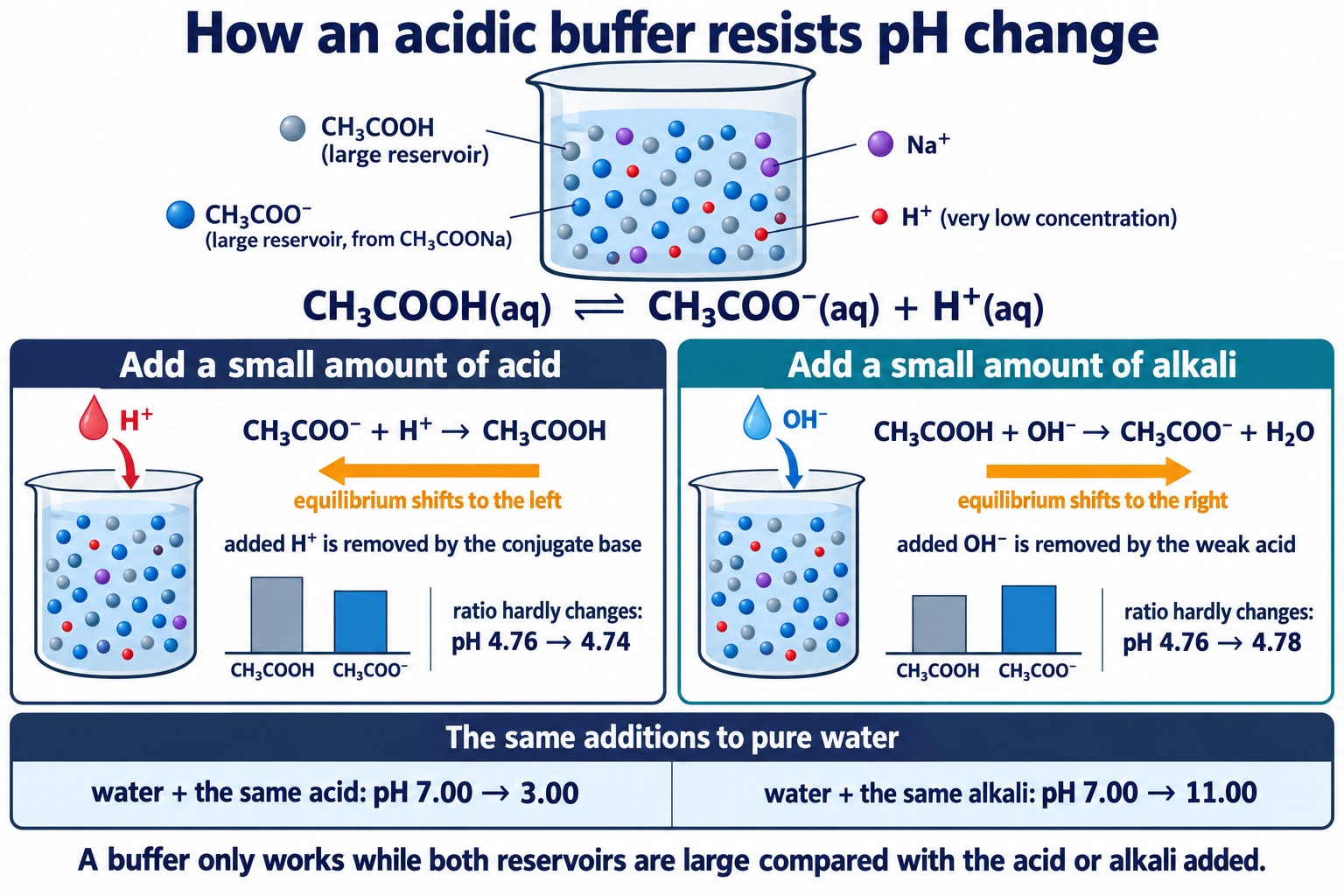
How an acidic buffer resists pH change: added H⁺ is removed by the ethanoate ions and added OH⁻ by the ethanoic acid, so the pH moves only from 4.76 to 4.74 or 4.78 while water swings to 3.00 or 11.00.
The pH of a buffer is set by the ratio ([HA]) / ([A⁻]), as Calculating the pH of a Buffer Solution shows. A small addition changes that ratio very little.
Exam wording: “Added H⁺ reacts with CH₃COO⁻, so the equilibrium shifts to the left. Added OH⁻ reacts with CH₃COOH, so the equilibrium shifts to the right. The ratio ([CH₃COOH]) / ([CH₃COO⁻]) stays almost constant.”
Check: How a Buffer Works
Identify the species in a buffer that removes added acid or added alkali, and write the equation for each, for buffers not used on this page.
Dilution and Buffer Capacity
Diluting a buffer
Adding water lowers [HA] and [A⁻] by the same factor. Their ratio does not change, so the pH of a buffer stays almost constant on dilution, provided it is not diluted very greatly.
Buffer capacity
- A buffer only copes with small additions. Each mole of H⁺ added uses up a mole of A⁻; each mole of OH⁻ uses up a mole of HA.
- Once one reservoir is nearly used up, the ratio changes rapidly and the pH changes sharply.
- More concentrated buffers can absorb more acid or alkali before this happens.
- A buffer works best when [HA] and [A⁻] are similar, at a pH close to pKa of the weak acid.
On a weak acid with strong base pH titration curve the buffer region ends in a steep rise: that is the moment the reservoir of weak acid runs out.
Remember: Choose a weak acid whose pKa is close to the pH needed, and use large, similar concentrations of the acid and its salt.
Check: Making Buffers and Their Limits
Decide whether given mixtures form a buffer, and explain what happens to the pH on dilution or when too much acid or alkali is added, using mixtures not used on this page.
Quick Check: Which Buffer Absorbs the Most Acid?
Decide which reservoir added acid uses up, then rank the buffers.
Buffers in Blood and Everyday Life
Blood: the carbonic acid–hydrogencarbonate buffer
Blood must stay between pH 7.35 and 7.45. Outside that range enzymes and other proteins stop working properly. The main buffer is carbonic acid with hydrogencarbonate ions.
CO₂(aq) + H₂O(l) ⇌ H₂CO₃(aq) ⇌ H⁺(aq) + HCO₃⁻(aq)
| Change in the blood | What removes it | Then |
|---|---|---|
| Acid enters (for example lactic acid from exercise) | HCO₃⁻ + H⁺ → H₂CO₃ | H₂CO₃ → CO₂ + H₂O; the extra CO₂ is breathed out |
| Alkali enters | H₂CO₃ + OH⁻ → HCO₃⁻ + H₂O | more CO₂ dissolves and replaces the H₂CO₃ used |
- Blood holds about 20 times as much HCO₃⁻ as H₂CO₃, so it is especially good at removing added acid.
- The lungs adjust breathing to remove CO₂, and the kidneys adjust HCO₃⁻, keeping the ratio and the pH steady.
Uses of buffers
- Calibrating pH meters with buffer solutions of known pH.
- Keeping a fixed pH in enzyme experiments and in fermentation.
- Foods and drinks, where buffers help stop pH changes that spoil flavour or allow microbes to grow.
- Shampoos, cosmetics and medicines, which are buffered to a pH that suits skin, hair or the body.
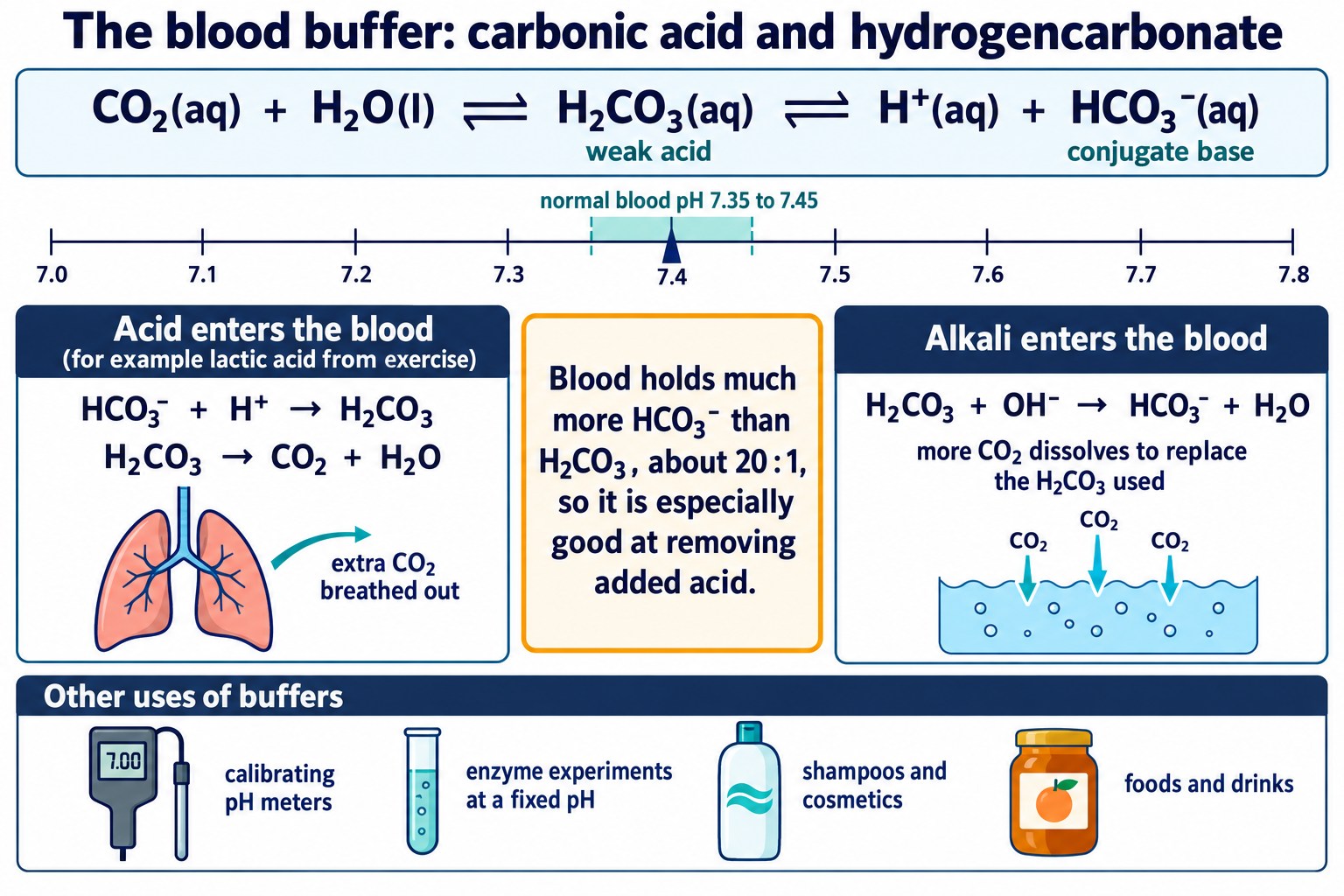
The blood buffer: carbon dioxide, carbonic acid and hydrogencarbonate in equilibrium, how added acid and alkali are removed, blood pH held between 7.35 and 7.45, and other uses of buffers.
Exam wording: “Added H⁺ reacts with HCO₃⁻ to form H₂CO₃, which breaks down to CO₂ and H₂O; the CO₂ is exhaled. Added OH⁻ reacts with H₂CO₃ to form HCO₃⁻ and water.”
Common Exam Points
Say
- “A buffer is a system that minimises pH changes on the addition of small amounts of an acid or a base.”
- “There are large reservoirs of the weak acid and its conjugate base, so the ratio ([HA]) / ([A⁻]) hardly changes.”
- “Added H⁺ reacts with A⁻, so the equilibrium shifts to the left.”
Do not say
- “A buffer keeps the pH exactly constant” (it keeps the change small).
- “The salt reacts with the added acid” without naming the ion: say the conjugate base, A⁻.
- “Hydrochloric acid and sodium chloride make a buffer” (a strong acid has no reservoir of undissociated acid).
Watch for
- Questions asking for equations: one for added acid, one for added alkali, each with the right species.
- Partial neutralisation: the weak acid must be in excess, or no buffer forms.
- Blood questions: name both H₂CO₃ and HCO₃⁻ and say what happens to the CO₂.
Check: Buffers in Blood and in Use
Explain how a buffer system controls pH in a biological or everyday context, with equations, for systems and situations not used on this page.
FAQs
Use these quick answers to check how buffer solutions are made and how they work.
What is a buffer solution?
A buffer is a system that minimises pH changes on the addition of small amounts of an acid or a base. It does not keep the pH perfectly constant, but the change is very small compared with the same addition to pure water.
Why can a strong acid not be used to make a buffer?
A strong acid is fully dissociated, so there is no reservoir of undissociated HA to remove added OH⁻. Its anion, such as Cl⁻, does not accept protons, so nothing removes added H⁺ either.
How does an ethanoic acid buffer remove added acid?
Added H⁺ reacts with the large reservoir of ethanoate ions: CH₃COO⁻ + H⁺ → CH₃COOH. The equilibrium shifts to the left. The ratio of CH₃COOH to CH₃COO⁻ hardly changes, so the pH hardly changes.
Can I make a buffer by adding sodium hydroxide to a weak acid?
Yes, provided the weak acid is in excess. Some acid is converted into its salt and the rest remains, giving large amounts of both HA and A⁻. Equal moles of acid and NaOH leave no weak acid, so no buffer forms.
How is the pH of blood kept between 7.35 and 7.45?
Mainly by the carbonic acid and hydrogencarbonate buffer. Added H⁺ reacts with HCO₃⁻ to form H₂CO₃, which breaks down to CO₂ and water, and the lungs breathe out the CO₂. Added OH⁻ reacts with H₂CO₃ to form HCO₃⁻.

Copyright notice: This OLS revision content, including the explanations, layout, diagrams, tables and embedded learning structure, is authored for Online Learning System by Dr. Mohammed Al-Fatah. It may not be copied, reproduced, redistributed or adapted without written permission.
Keep this note — free
Save your progress across every OCR topic. A free account remembers which topics you have covered, saves your question scores, and syncs across your phone and laptop.
- Track every topic you have finished
- Keep your practice-question scores
- No payment, no card, free forever
Already registered? Log in