Reactions of the Group 1 and 2 Elements
A concise revision guide to the reactions of the s-block metals with oxygen, chlorine, water (and steam for magnesium) and dilute acids, with equations, observations and the trend in vigour down each group.
Where This Sits in Your Specification
Cambridge Topic 10 examines Group 2 only. The Group 1 metals are kept in the tables for comparison, because the same reasoning explains both groups, but questions will be set on magnesium to barium.
Reactions with Oxygen
All the s-block metals burn in oxygen to form ionic oxides. The metal is oxidised and oxygen is reduced from 0 to −2. Group 1 forms M₂O and Group 2 forms MO, with the flame colours that are also seen in flame tests.
4Li + O₂ → 2Li₂O (red flame) 4Na + O₂ → 2Na₂O (yellow flame) 4K + O₂ → 2K₂O (lilac flame)
2Mg + O₂ → 2MgO (bright white flame) 2Ca + O₂ → 2CaO (brick red) 2Sr + O₂ → 2SrO (red) 2Ba + O₂ → 2BaO (apple green)
The vigour increases down each group. Sodium and potassium in excess oxygen also form higher oxides (sodium peroxide, Na₂O₂, and potassium superoxide, KO₂), which is why they are stored under oil, but the simple oxides are the equations expected in an exam.
Exam focus: Write the equation with the correct formula of the oxide: Group 1 oxides are M₂O, Group 2 oxides are MO. Balancing follows from the formula.
Reactions with Chlorine
The metals react with chlorine on heating to give ionic chlorides, with a bright flame and white smoke of the solid chloride. Chlorine is reduced from 0 to −1 as the metal is oxidised.
2Na + Cl₂ → 2NaCl 2K + Cl₂ → 2KCl Mg + Cl₂ → MgCl₂ Ca + Cl₂ → CaCl₂
The chlorides are white solids that dissolve in water to give neutral solutions, because the metal ions do not react with water and chloride is the ion of a strong acid.
Key idea: Group 1 gives MCl and Group 2 gives MCl₂. The charge on the metal ion fixes the formula, and the formula fixes the balancing.
Check: Equations with Oxygen and Chlorine
Write balanced equations, with the correct formula of the product, for s-block metals not shown above.
Reactions with Water
The Group 1 metals react with cold water to give the metal hydroxide and hydrogen. The reaction gets faster down the group: lithium fizzes steadily, sodium melts into a ball that skates on the surface, potassium ignites the hydrogen with a lilac flame.
2Na + 2H₂O → 2NaOH + H₂
The Group 2 metals follow the same pattern but more slowly. Magnesium reacts very slowly with cold water, giving a few bubbles over several days, but reacts quickly with steam to give the oxide, not the hydroxide, because magnesium hydroxide decomposes at the temperature of the reaction:
Mg + 2H₂O(l) → Mg(OH)₂ + H₂ (very slow) Mg + H₂O(g) → MgO + H₂ (fast, bright white glow)
Calcium reacts steadily with cold water and the solution turns cloudy, because calcium hydroxide is only slightly soluble: Ca + 2H₂O → Ca(OH)₂ + H₂. Strontium and barium react more vigorously and give clear solutions, because their hydroxides are more soluble.
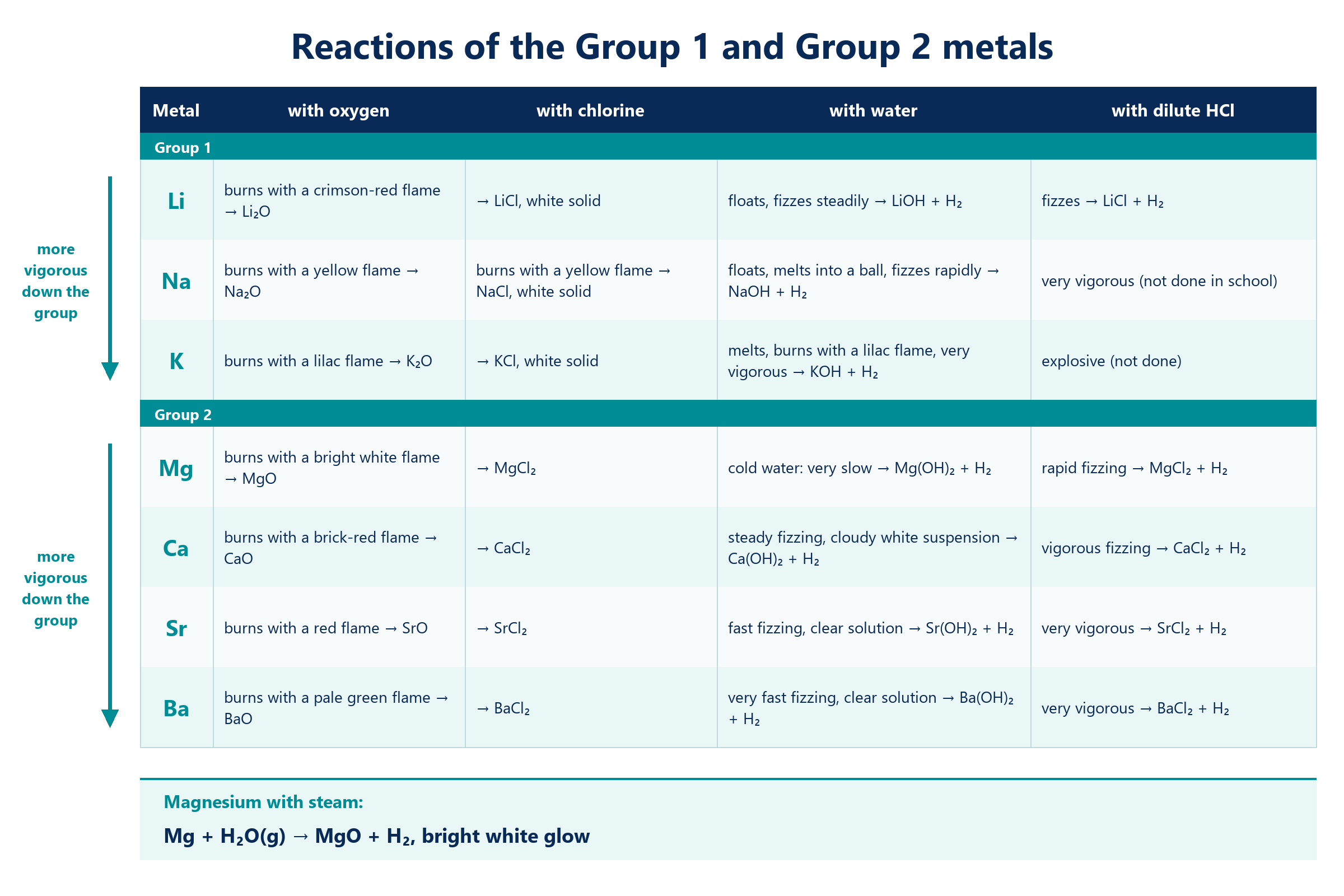
The vigour of each reaction increases down both groups, and the products are the hydroxide with water, the oxide with steam, and the oxide and chloride with oxygen and chlorine.
Common mistake: Writing MgO for magnesium in cold water. Liquid water gives the hydroxide; only steam gives the oxide.
Check: Observations with Water
Match metals to their observations with water and steam, and explain the cloudiness seen with one of them.
Reactions with Dilute Acids
The metals react with dilute acids to give a salt and hydrogen. The reaction is a redox reaction in which the metal is oxidised and hydrogen ions are reduced. Magnesium with hydrochloric acid fizzes vigorously and the test tube gets hot:
Mg + 2HCl → MgCl₂ + H₂ ionic: Mg + 2H⁺ → Mg²⁺ + H₂
Mg + H₂SO₄ → MgSO₄ + H₂ Ca + 2HCl → CaCl₂ + H₂
With sulfuric acid the reaction of calcium, strontium and barium quickly slows down, because their sulfates are insoluble and coat the metal. This is the same solubility trend as the sulfate test, seen from the other side.
Exam focus: The ionic equation is the same for every metal and every strong acid: metal + H⁺ ions. Use it to show that the acid is the oxidising agent.
Check: Redox in the Metal Reactions
For reactions not printed above, name the species oxidised and reduced and give the oxidation number changes.
Common Exam Points
Write the equation for a Group 2 metal reacting with water
M + 2H₂O → M(OH)₂ + H₂, unless the water is steam, when magnesium gives MgO + H₂.
Explain the observation with calcium and water
The solution turns cloudy because calcium hydroxide is only sparingly soluble, so some forms as a white solid.
Identify the reducing agent when a metal reacts with an acid
The metal, because it loses electrons and its oxidation number increases.
Do not say
“Magnesium reacts vigorously with cold water”; “the metal is reduced”; “MgO forms with liquid water”.
FAQs
Use these quick answers to check the reactions of the s-block metals.
What is the difference between magnesium in water and in steam?
With cold water magnesium reacts very slowly to give magnesium hydroxide; with steam it reacts quickly to give magnesium oxide and hydrogen.
Why does the solution go cloudy when calcium reacts with water?
Calcium hydroxide is only slightly soluble, so some of it forms as a white solid.
Which is the reducing agent when a metal reacts with an acid?
The metal, because it loses electrons and its oxidation number rises; the hydrogen ions are the oxidising agent.
Why does the reaction of calcium with sulfuric acid slow down?
Calcium sulfate is only slightly soluble, so it coats the metal and stops the acid reaching it.
Why are the alkali metals stored under oil?
They react with oxygen and water vapour in the air; the oil keeps both away.
Copyright and author footprint: This OLS revision page was written for Online Learning System by Dr. Mohammed Al-Fatah. It is designed for A Level Chemistry revision and should not be copied or redistributed without permission.
Keep this note — free
Save your progress across every Cambridge topic. A free account remembers which topics you have covered, saves your question scores, and syncs across your phone and laptop.
- Track every topic you have finished
- Keep your practice-question scores
- No payment, no card, free forever
Already registered? Log in