Thermal Stability and Flame Colours
A concise revision guide to the thermal decomposition of the Group 1 and 2 nitrates and carbonates, the trend in stability explained by cation size, charge and polarisation, how to show the patterns experimentally, and the flame colours and their cause.
Thermal Decomposition of the Carbonates
On strong heating a metal carbonate breaks down to the metal oxide and carbon dioxide. The Group 2 carbonates all decompose in a Bunsen flame, and the temperature needed rises down the group: magnesium carbonate at about 350 °C, calcium carbonate at about 840 °C, strontium carbonate at about 1100 °C and barium carbonate at about 1300 °C.
MgCO₃ → MgO + CO₂ CaCO₃ → CaO + CO₂
The Group 1 carbonates are more stable. Sodium and potassium carbonate do not decompose at Bunsen temperatures at all; only lithium carbonate, whose ion is the smallest, breaks down: Li₂CO₃ → Li₂O + CO₂.
Key idea: Thermal stability increases down each group, and Group 1 carbonates are more stable than the Group 2 carbonates beside them.
Thermal Decomposition of the Nitrates
The nitrates show the same pattern, but the products differ between the groups. Most Group 1 nitrates decompose only to the nitrite and oxygen:
2NaNO₃ → 2NaNO₂ + O₂ 2KNO₃ → 2KNO₂ + O₂
The Group 2 nitrates, and again lithium nitrate, decompose further to the oxide, nitrogen dioxide and oxygen. The brown fumes of nitrogen dioxide are the sign of this reaction:
2Mg(NO₃)₂ → 2MgO + 4NO₂ + O₂ 4LiNO₃ → 2Li₂O + 4NO₂ + O₂
The temperature needed rises down Group 2, as with the carbonates.
Exam focus: Learn both nitrate equations. A Group 2 nitrate gives three products; a Group 1 nitrate (other than lithium) gives two.
Check: Decomposition Products
Write the decomposition equation and name the gases for carbonates and nitrates not shown above.
Why the Trend Exists: Polarisation
The carbonate and nitrate ions are large anions with electron density spread over several oxygen atoms. A small, highly charged cation has a high charge density and pulls that electron cloud towards itself, polarising the anion. The distortion weakens the C–O or N–O bonds, so less energy is needed to break the ion apart, and the compound decomposes at a lower temperature.
Down each group the cation gets larger, its charge density falls, it polarises the anion less, and the compound is more stable. Across from Group 1 to Group 2 the charge doubles, so a 2+ ion polarises far more than a 1+ ion of similar size, which is why Group 2 carbonates and nitrates are the less stable set.
Polarisation and the Thermal Stability of Group 2 Carbonates
Compare how strongly Mg2+, Ca2+, Sr2+ and Ba2+ distort a carbonate ion, and see why a less polarised anion needs a higher temperature to break up.
© Dr. Mohammed Al-Fatah – onlinelearningsystem.net
Exam sentence: Magnesium carbonate decomposes at a lower temperature than barium carbonate because the Mg²⁺ ion is smaller, so it has a higher charge density and polarises the carbonate ion more, weakening the C–O bonds.
Check: Explaining Stability
Choose the correct polarisation argument and rank compounds by stability using ionic radius and charge.
Showing the Trend Experimentally
To compare the thermal stability of carbonates, heat the same amount in moles of each carbonate with the same Bunsen flame and pass the gas through limewater. The time taken for the limewater to turn cloudy is a measure of how easily the carbonate decomposes: the longer the time, the more stable the carbonate. For the nitrates, time how long the brown fumes take to appear, or test for oxygen with a glowing splint.
The comparison is only fair if the amount of solid, the flame and the apparatus are the same each time, and the test is repeated to check the ranking.
Technique point: Use the same number of moles, not the same mass, because the compounds have different molar masses and the amount of gas that can form depends on the moles of anion.
Flame Colours
Compounds of the s-block metals give characteristic colours in a Bunsen flame. A nichrome wire is cleaned in concentrated hydrochloric acid, dipped in the solid or solution, and held in a hot blue flame.
| Metal | Flame colour | Metal | Flame colour |
|---|---|---|---|
| Lithium | red | Magnesium | no colour (burns with a bright white light) |
| Sodium | yellow | Calcium | brick red |
| Potassium | lilac | Strontium | red |
| Rubidium | red | Barium | apple green |
| Caesium | blue |
The colour comes from electron transitions. The heat of the flame promotes electrons in the metal ions to higher energy levels. When they fall back to lower levels they release the energy difference as light. The energy gaps are fixed for each element and correspond to particular frequencies in the visible region, so each element gives its own colour. Magnesium ions have no transition in the visible region, so magnesium compounds give no flame colour.
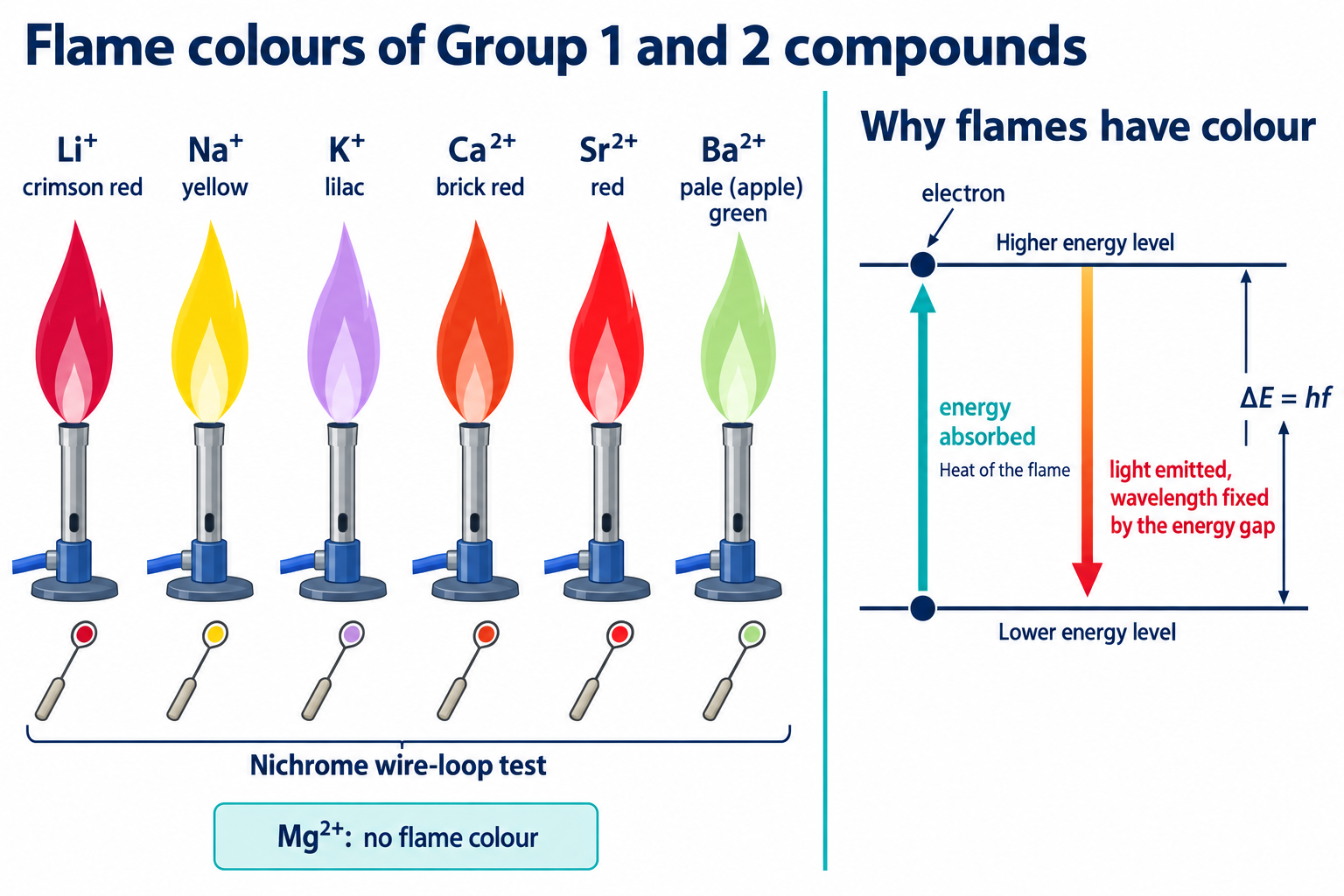
Each flame colour is a fingerprint of the energy gaps in that element: the electron is promoted by the heat and emits light of a fixed frequency as it falls back.
Exam wording: “Electrons are excited to higher energy levels by the heat; as they fall back to lower levels they emit light of a specific frequency, which corresponds to a colour in the visible region.”
Check: Flame Colours and Their Cause
Identify metals from flame colours and choose the correct explanation of why the light is emitted.
Common Exam Points
Explain why the thermal stability of carbonates increases down Group 2
The cation gets larger, its charge density falls, it polarises the carbonate ion less, so the C–O bonds are less weakened and more energy is needed to break them.
Write the equation for the decomposition of a Group 2 nitrate
2M(NO₃)₂ → 2MO + 4NO₂ + O₂.
Explain the origin of a flame colour
Electrons promoted by heat fall back to lower energy levels and emit light of a frequency fixed by the energy gap.
Do not say
“Barium carbonate has stronger ionic bonds so it is more stable”; “sodium nitrate gives brown fumes”; “the flame colour comes from the anion”.
FAQs
Use these quick answers to check thermal stability and flame colours.
Why does thermal stability increase down the group?
The cation gets larger, so its charge density falls and it polarises the carbonate or nitrate ion less, leaving the C–O or N–O bonds stronger.
Why are Group 1 carbonates more stable than Group 2 carbonates?
A 1+ ion has a lower charge density than a 2+ ion of similar size, so it polarises the anion less.
What are the products when a Group 2 nitrate decomposes?
The metal oxide, nitrogen dioxide (brown gas) and oxygen: 2M(NO₃)₂ → 2MO + 4NO₂ + O₂.
How is a flame colour produced?
Heat promotes electrons to higher energy levels; as they fall back they emit light of a fixed frequency, which is a colour in the visible region.
Why does magnesium give no flame colour?
The energy gaps in magnesium ions do not correspond to visible light, so no colour is seen, although burning magnesium gives a bright white light.
Copyright and author footprint: This OLS revision page was written for Online Learning System by Dr. Mohammed Al-Fatah. It is designed for A Level Chemistry revision and should not be copied or redistributed without permission.
Keep this note — free
Save your progress across every Cambridge topic. A free account remembers which topics you have covered, saves your question scores, and syncs across your phone and laptop.
- Track every topic you have finished
- Keep your practice-question scores
- No payment, no card, free forever
Already registered? Log in