Solubility Trends and the Sulfate Test
A concise revision guide to the solubility of the Group 2 hydroxides rising and the sulfates falling down the group, sparingly soluble magnesium hydroxide and insoluble barium sulfate, the acidified barium chloride test for sulfate ions and barium sulfate in medicine.
Solubility of the Group 2 Hydroxides
The solubility of the hydroxides increases down Group 2. Magnesium hydroxide is sparingly soluble, calcium hydroxide is slightly soluble (which is why limewater is a dilute solution and calcium reacting with water goes cloudy), and barium hydroxide is soluble enough to give a strongly alkaline solution.
| Hydroxide | Solubility at 25 °C / g per 100 g water | Description |
|---|---|---|
| Mg(OH)₂ | 0.0012 | sparingly soluble; forms a white suspension |
| Ca(OH)₂ | 0.15 | slightly soluble; limewater |
| Sr(OH)₂ | 0.8 | soluble |
| Ba(OH)₂ | 3.9 | soluble |
The practical consequence is seen when sodium hydroxide solution is added to solutions of the metal ions: Mg²⁺(aq) gives a thick white precipitate of magnesium hydroxide, Ca²⁺(aq) a faint one, and Ba²⁺(aq) none.
Exam focus: The observation is the mark. “A white precipitate forms with magnesium ions but not with barium ions, because magnesium hydroxide is much less soluble.”
Solubility of the Group 2 Sulfates
The solubility of the sulfates decreases down Group 2, the opposite direction to the hydroxides. Magnesium sulfate is very soluble (it is Epsom salts), calcium sulfate is slightly soluble, and barium sulfate is so insoluble that it is used as the test for sulfate ions and as a barium meal.
| Sulfate | Solubility at 25 °C / g per 100 g water | Description |
|---|---|---|
| MgSO₄ | 35 | very soluble |
| CaSO₄ | 0.2 | slightly soluble |
| SrSO₄ | 0.013 | almost insoluble |
| BaSO₄ | 0.0002 | insoluble |
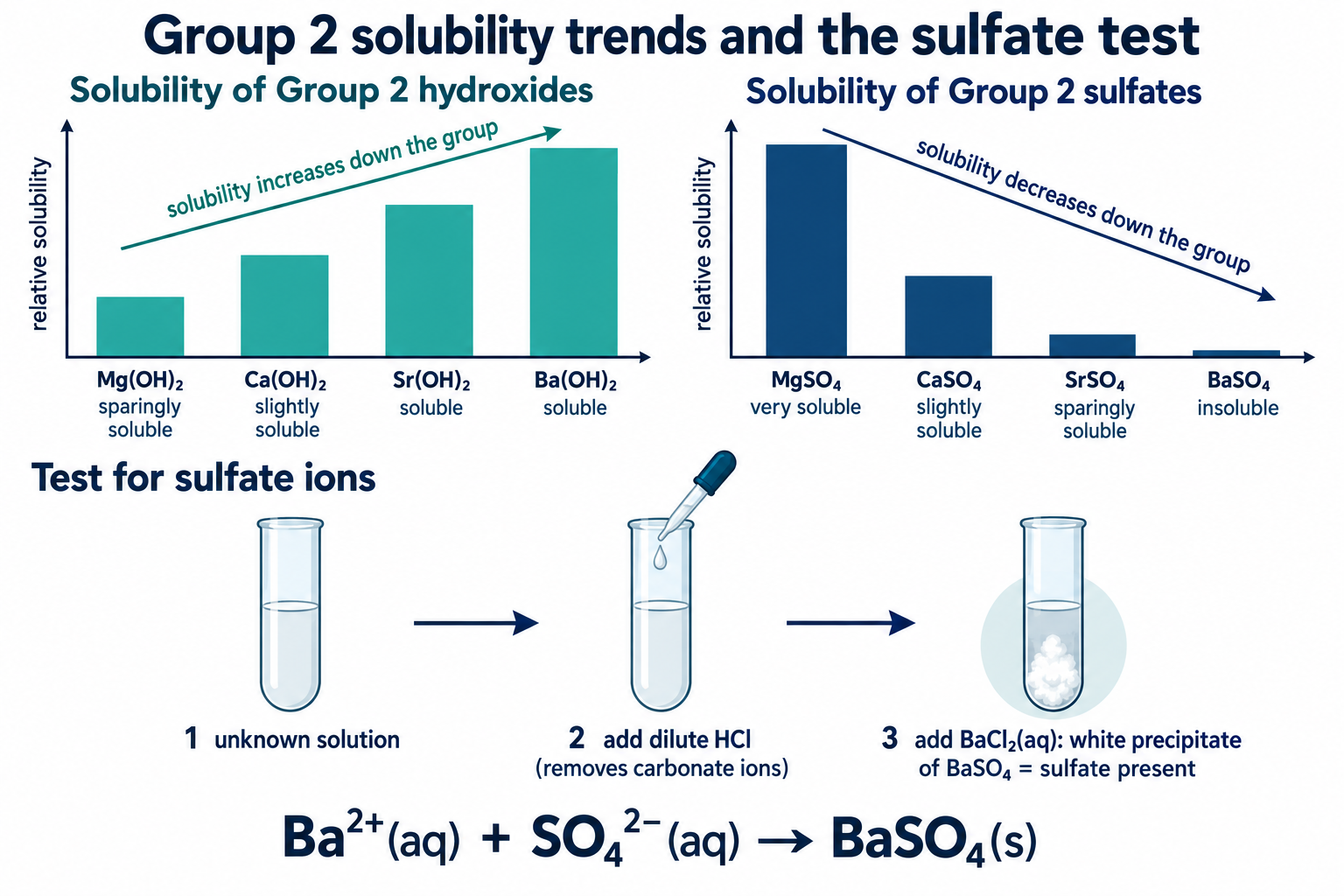
The two trends run in opposite directions: hydroxides become more soluble down the group and sulfates become less soluble.
Remember: Hydroxides up, sulfates down. Barium sits at the soluble end of one list and the insoluble end of the other, which is why it appears in both the alkalinity trend and the sulfate test.
Check: Predicting Precipitates
Predict what is seen when solutions are mixed, using the two solubility trends with ions not used in the examples above.
The Test for Sulfate Ions
The sulfate test uses the insolubility of barium sulfate. Add dilute hydrochloric acid to the solution being tested, then add barium chloride solution. A white precipitate of barium sulfate shows that sulfate ions were present:
Ba²⁺(aq) + SO₄²⁻(aq) → BaSO₄(s)
The acid is added first to remove carbonate ions (and sulfite ions), which would otherwise also give a white precipitate with barium ions, barium carbonate, and give a false positive. Carbonate ions react with the acid and leave as carbon dioxide. Hydrochloric acid or nitric acid is used; sulfuric acid is never used, because it would add the very ion being tested for.
| Step | What to add | Why |
|---|---|---|
| 1 | a few drops of dilute hydrochloric acid | removes carbonate ions, which would give a white precipitate of BaCO₃ |
| 2 | barium chloride solution (or barium nitrate) | Ba²⁺ ions precipitate any sulfate as BaSO₄ |
| Result | white precipitate | sulfate ions present; the precipitate does not dissolve in excess acid |
Exam wording: Name the acid and say why: “acidify with dilute hydrochloric acid to remove carbonate ions, then add barium chloride solution; a white precipitate of barium sulfate confirms sulfate ions”.
Check: Designing the Sulfate Test
Decide which reagents give a valid test, which give a false result and why, for a set of unknown solutions.
Barium Sulfate in Medicine
Barium ions are toxic, yet patients drink a suspension of barium sulfate, a barium meal, before an X-ray of the digestive system. It is safe because barium sulfate is so insoluble that almost no barium ions dissolve and enter the bloodstream. Barium is a heavy element that absorbs X-rays, so the outline of the stomach and intestines shows up clearly on the image.
Key idea: Insolubility is what makes the barium meal safe and the sulfate test reliable. Both depend on the same fact: barium sulfate does not dissolve.
Common Exam Points
State the trend in solubility of the Group 2 sulfates
Solubility decreases down the group; barium sulfate is insoluble.
Describe the test for sulfate ions
Acidify with dilute hydrochloric acid, add barium chloride solution, a white precipitate of barium sulfate forms.
Explain why the solution is acidified first
To remove carbonate ions, which would also form a white precipitate with barium ions.
Do not say
“Add sulfuric acid”; “barium hydroxide is insoluble”; “the precipitate is barium chloride”.
FAQs
Use these quick answers to check the solubility trends and the sulfate test.
Which way do the two trends go?
Hydroxide solubility increases down Group 2 and sulfate solubility decreases, so barium hydroxide is soluble but barium sulfate is insoluble.
Why acidify before adding barium chloride?
To remove carbonate ions, which would also give a white precipitate with barium ions and give a false positive.
Why not use sulfuric acid to acidify?
It contains sulfate ions, so a precipitate would form whatever the sample contained.
What is the ionic equation for the sulfate test?
Ba²⁺(aq) + SO₄²⁻(aq) → BaSO₄(s).
Why is a barium meal safe if barium ions are toxic?
Barium sulfate is so insoluble that almost no barium ions dissolve, so they cannot be absorbed into the body.
Copyright and author footprint: This OLS revision page was written for Online Learning System by Dr. Mohammed Al-Fatah. It is designed for A Level Chemistry revision and should not be copied or redistributed without permission.
Keep this note — free
Save your progress across every Cambridge topic. A free account remembers which topics you have covered, saves your question scores, and syncs across your phone and laptop.
- Track every topic you have finished
- Keep your practice-question scores
- No payment, no card, free forever
Already registered? Log in