Kp and Partial Pressures
A concise revision guide to mole fraction and partial pressure, writing Kp expressions for gas equilibria, working out their units and calculating Kp from partial pressures.
- 7.1.5-a
- 7.1.5-b
- 7.1.6
- 7.1.7-b
- 7.1.9-c
What these spec points say
- 7.1.5-a use the term mole fraction
- 7.1.5-b use the term partial pressure
- 7.1.6 deduce expressions for equilibrium constants in terms of partial pressures, Kp (use of the relationship between Kp and Kc is not required)
- 7.1.7-b use the Kp expression to carry out calculations (such calculations will not require the solving of quadratic equations)
- 7.1.9-c state whether changes in pressure affect the value of the equilibrium constant for a reaction
Mole Fraction and Partial Pressure
For equilibria between gases it is more convenient to use pressures than concentrations.
In a mixture of gases each gas contributes a share of the total pressure called its partial pressure, p, which is the pressure that gas would exert if it alone filled the container.
The partial pressures add up to the total pressure.
The share each gas contributes is its mole fraction, x: the number of moles of that gas divided by the total number of moles of gas in the mixture. Mole fractions add up to 1, and partial pressure = mole fraction × total pressure.
In a mixture of 2.0 mol of nitrogen, 6.0 mol of hydrogen and 2.0 mol of ammonia at a total pressure of 100 atm, the total is 10.0 mol, so x(N₂) = 0.20, x(H₂) = 0.60, x(NH₃) = 0.20, and the partial pressures are 20 atm, 60 atm and 20 atm.
Definitions: Mole fraction = moles of the gas ÷ total moles of gas. Partial pressure = mole fraction × total pressure.
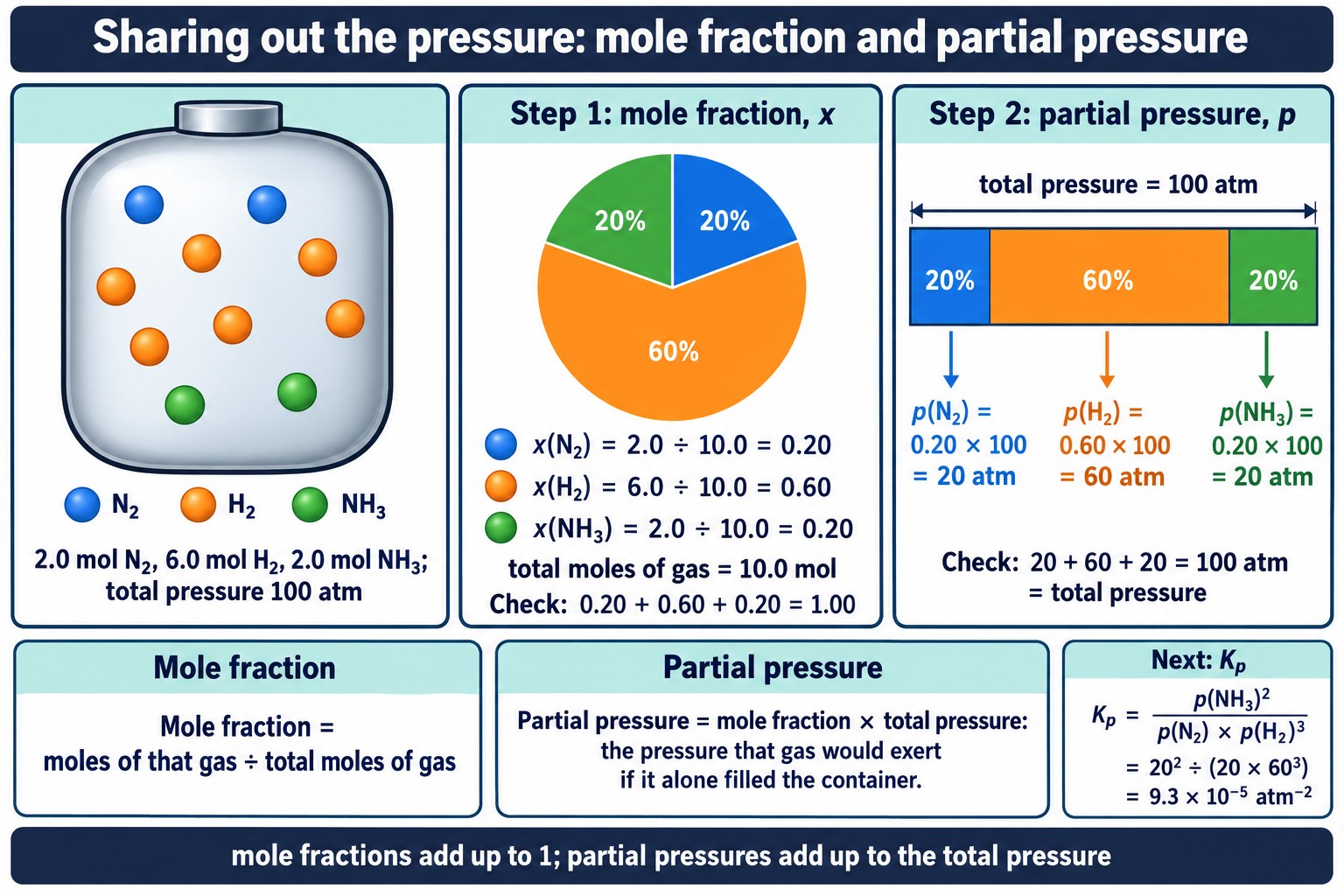
Each gas takes a share of the total pressure equal to its mole fraction, so a mixture with mole fractions 0.20, 0.60 and 0.20 at 100 atm has partial pressures of 20, 60 and 20 atm.
Check: Mole Fractions and Partial Pressures
Calculate mole fractions and partial pressures for a different gas mixture.
Writing and Using Kp
The equilibrium constant in terms of partial pressures, Kp, is written like Kc but with partial pressures in place of concentrations, each raised to the power of its balancing number.
For N₂(g) + 3H₂(g) ⇌ 2NH₃(g), Kp = p(NH₃)² ÷ (p(N₂) p(H₂)³). Only gases appear in the expression; solids and liquids are left out.
The units come from the pressure units: for the ammonia equilibrium, atm² ÷ (atm × atm³) = atm⁻². For H₂(g) + I₂(g) ⇌ 2HI(g), Kp has no units. Using the partial pressures above, Kp = 20² ÷ (20 × 60³) = 9.3 × 10⁻⁵ atm⁻².
Like Kc, Kp depends only on temperature. Changing the total pressure moves the position of equilibrium, but the partial pressures adjust so that Kp is unchanged.
Calculations at this level give the equilibrium amounts or partial pressures directly, or need one step from the equation, and never require solving a quadratic.
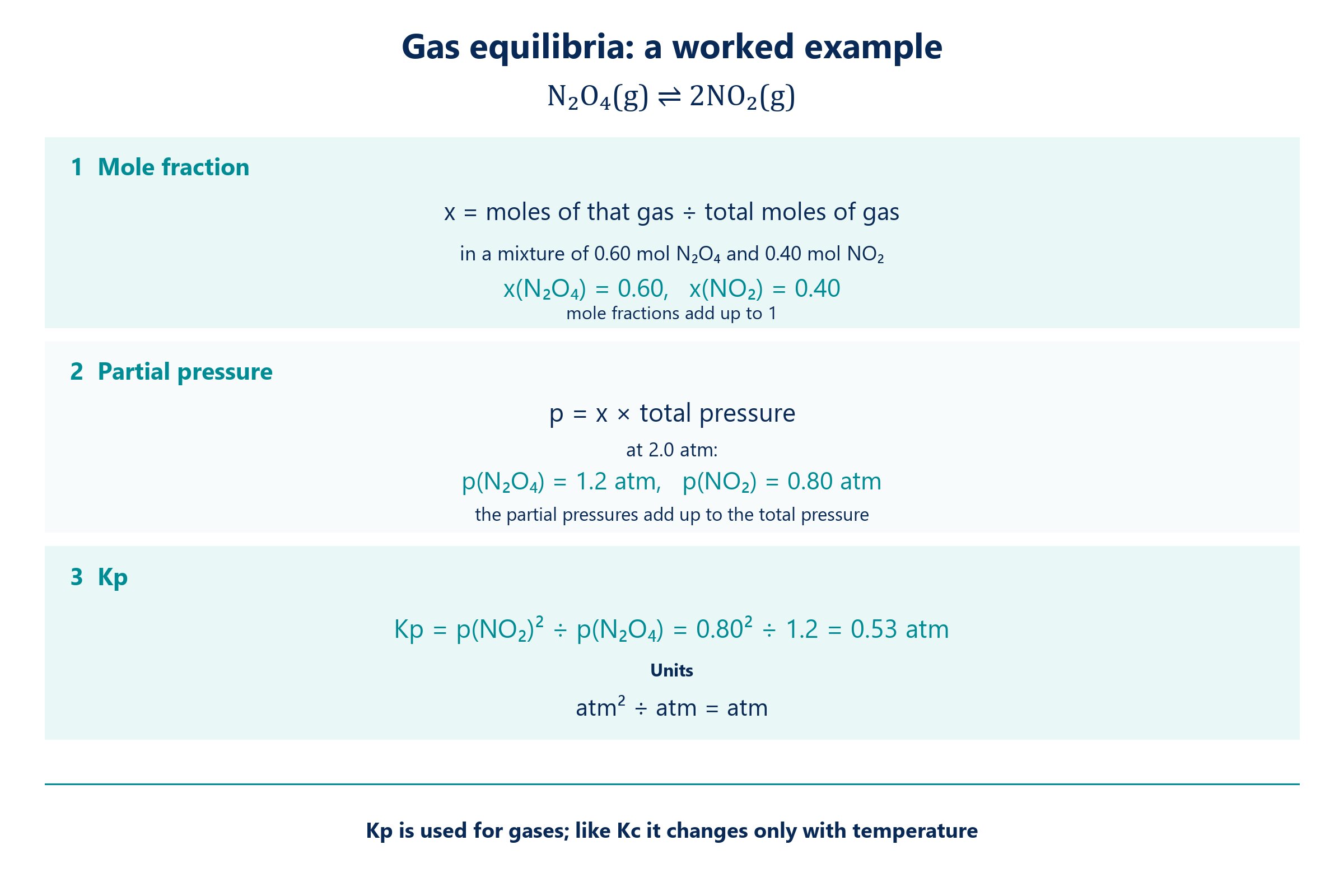
A worked Kp card: mole fraction, partial pressure and the Kp expression with its units for a gas equilibrium.
Exam focus: Convert moles to mole fractions, then to partial pressures, then substitute. Keep the pressure unit consistent throughout and give it in the answer.
Check: Kp Calculations
Write Kp expressions with units and calculate values for equilibria not used above.
FAQs
Use these quick answers to check Kp.
What is a mole fraction?
The number of moles of one gas divided by the total number of moles of gas in the mixture. The mole fractions of all the gases add up to 1.
How do I get a partial pressure?
Multiply the mole fraction of the gas by the total pressure. The partial pressures add up to the total pressure.
Do solids appear in a Kp expression?
No. Only gases have partial pressures, so only gases appear.
Does Kp change if the total pressure changes?
No. The partial pressures adjust as the position of equilibrium moves, but Kp is constant at a given temperature.
What are the units of Kp?
They come from the pressure unit raised to the difference in gas moles between products and reactants, for example atm⁻² for the ammonia equilibrium, or no units when the moles are equal.
Copyright and author footprint: This OLS revision page was written for Online Learning System by Dr. Mohammed Al-Fatah. It is designed for A Level Chemistry revision and should not be copied or redistributed without permission.
Keep this note — free
Save your progress across every Cambridge topic. A free account remembers which topics you have covered, saves your question scores, and syncs across your phone and laptop.
- Track every topic you have finished
- Keep your practice-question scores
- No payment, no card, free forever
Already registered? Log in