Acids, Bases and pH Curves
A concise revision guide to Brønsted–Lowry acids and bases, strong and weak acids and bases, pH, neutralisation and salts, the four pH titration curves and choosing an indicator.
- 7.2.3
- 7.2.4-a
- 7.2.4-b
- 7.2.5
- 7.2.6-a
- 7.2.6-b
- 7.2.7
- 7.2.8
- 7.2.9-a
- 7.2.9-b
- 7.2.9-c
- 7.2.9-d
- 7.2.10
What these spec points say
- 7.2.3 describe the Brønsted–Lowry theory of acids and bases
- 7.2.4-a describe strong acids and strong bases as fully dissociated in aqueous solution
- 7.2.4-b describe weak acids and weak bases as partially dissociated in aqueous solution
- 7.2.5 appreciate that water has pH of 7, acid solutions pH of below 7 and alkaline solutions pH of above 7
- 7.2.6-a explain qualitatively the differences in behaviour between strong and weak acids including the reaction with a reactive metal
- 7.2.6-b explain qualitatively the differences in behaviour between strong and weak acids including the difference in pH values by use of a pH meter, universal indicator or conductivity
- 7.2.7 understand that neutralisation reactions occur when H+(aq) and OH–(aq) form H2O(l)
- 7.2.8 understand that salts are formed in neutralisation reactions
- 7.2.9-a sketch the pH titration curve of a titration using a strong acid with a strong alkali
- 7.2.9-b sketch the pH titration curve of a titration using a strong acid with a weak alkali
- 7.2.9-c sketch the pH titration curve of a titration using a weak acid with a strong alkali
- 7.2.9-d sketch the pH titration curve of a titration using a weak acid with a weak alkali
- 7.2.10 select suitable indicators for acid-alkali titrations, given appropriate data (pKa values will not be used)
GCSE Recap: Acids and Alkalis
Three quick questions on pH, neutralisation and the common acids and alkalis from GCSE.
Brønsted–Lowry Acids and Bases
In the Brønsted–Lowry theory an acid is a proton donor and a base is a proton acceptor.
Hydrogen chloride dissolving in water donates a proton to a water molecule: HCl + H₂O → H₃O⁺ + Cl⁻; here HCl is the acid and water the base.
Ammonia dissolving in water accepts a proton: NH₃ + H₂O ⇌ NH₄⁺ + OH⁻; here ammonia is the base and water the acid.
Water can act as either, and every acid–base reaction is a transfer of a proton from the acid to the base.
The common acids are hydrochloric acid HCl, sulfuric acid H₂SO₄, nitric acid HNO₃ and ethanoic acid CH₃COOH; the common alkalis are sodium hydroxide NaOH, potassium hydroxide KOH and ammonia NH₃.
Definition: Acid: proton (H⁺) donor. Base: proton acceptor. An alkali is a base that dissolves in water to give OH⁻ ions.
Strong and Weak Acids and Bases
A strong acid is fully dissociated (ionised) in aqueous solution: every HCl molecule gives an H⁺ ion, so the reaction is written with a full arrow.
A weak acid is only partially dissociated. In a solution of ethanoic acid only a small fraction of the molecules have given up a proton at any moment: CH₃COOH ⇌ CH₃COO⁻ + H⁺, an equilibrium lying well to the left.
The same words apply to bases. Sodium hydroxide is a strong base, fully dissociated into Na⁺ and OH⁻; ammonia is a weak base, only partially reacting with water to give OH⁻.
Strength is about the degree of dissociation, not concentration. A dilute solution of a strong acid and a concentrated solution of a weak acid are both possible.
Because a weak acid gives far fewer H⁺ ions than a strong acid of the same concentration, it has a higher pH, a lower electrical conductivity, and it reacts more slowly with a reactive metal or a carbonate.
It eventually gives the same volume of gas, though, because all the acid is used up in the end.
Key idea: Strong = fully dissociated; weak = partially dissociated. Compare equal concentrations: the weak acid has the higher pH, the lower conductivity and the slower reaction with magnesium.
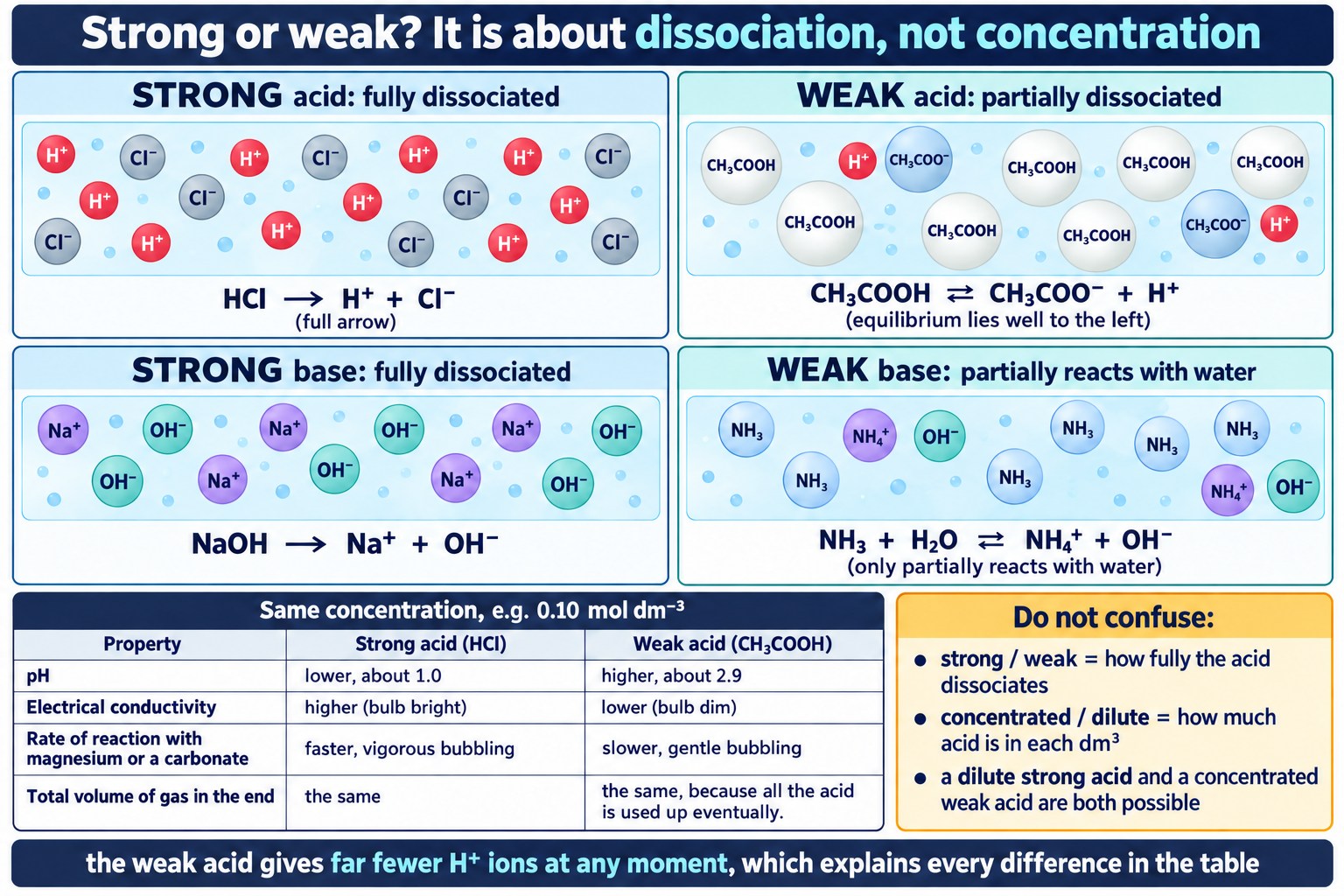
A strong acid is fully dissociated and a weak acid only partially, so at equal concentration the weak acid has a higher pH, lower conductivity and slower reactions but gives the same total volume of gas.
Check: Strong or Weak
Distinguish strong and weak acids and bases from observations not given above.
pH, Neutralisation and Salts
The pH scale runs from 0 to 14 at room temperature: pure water is pH 7, acidic solutions are below 7 and alkaline solutions above 7.
A lower pH means a higher concentration of H⁺ ions; each unit of pH is a tenfold change. pH is measured with a pH meter, or estimated with universal indicator.
Neutralisation is the reaction of H⁺(aq) ions from an acid with OH⁻(aq) ions from an alkali to form water: H⁺(aq) + OH⁻(aq) → H₂O(l).
The other product is a salt, in which the hydrogen of the acid has been replaced by a metal or ammonium ion.
Hydrochloric acid gives chlorides, sulfuric acid gives sulfates, nitric acid gives nitrates and ethanoic acid gives ethanoates.
Exam wording: The ionic equation for any strong acid–strong alkali neutralisation is H⁺ + OH⁻ → H₂O. Name the salt from the acid: “sodium sulfate” from sulfuric acid and sodium hydroxide.
Check: pH and Neutralisation
Questions on pH values, ionic equations and naming salts for examples not used above.
pH Titration Curves and Indicators
A pH titration curve plots the pH of the mixture as alkali is added to a measured volume of acid.
Every curve has a nearly vertical section at the equivalence point where a single drop changes the pH by several units. The range of that vertical section depends on which acid and base are used.
| Titration | Start pH | Vertical section | End pH | Suitable indicator |
|---|---|---|---|---|
| Strong acid + strong base | about 1 | about 3 to 11 | about 13 | Either methyl orange or phenolphthalein |
| Strong acid + weak base | about 1 | about 3 to 7 | about 11 | Methyl orange |
| Weak acid + strong base | about 3 | about 7 to 11 | about 13 | Phenolphthalein |
| Weak acid + weak base | about 3 | no clear vertical section | about 11 | No indicator suitable: use a pH meter |
An indicator changes colour over a narrow pH range: methyl orange over about 3.1 to 4.4 (red to yellow) and phenolphthalein over about 8.3 to 10.0 (colourless to pink).
An indicator is suitable if its colour-change range lies within the vertical section of the curve, so that the colour changes sharply at the equivalence point.
That is why phenolphthalein is chosen for a weak acid against a strong base and methyl orange for a strong acid against a weak base.
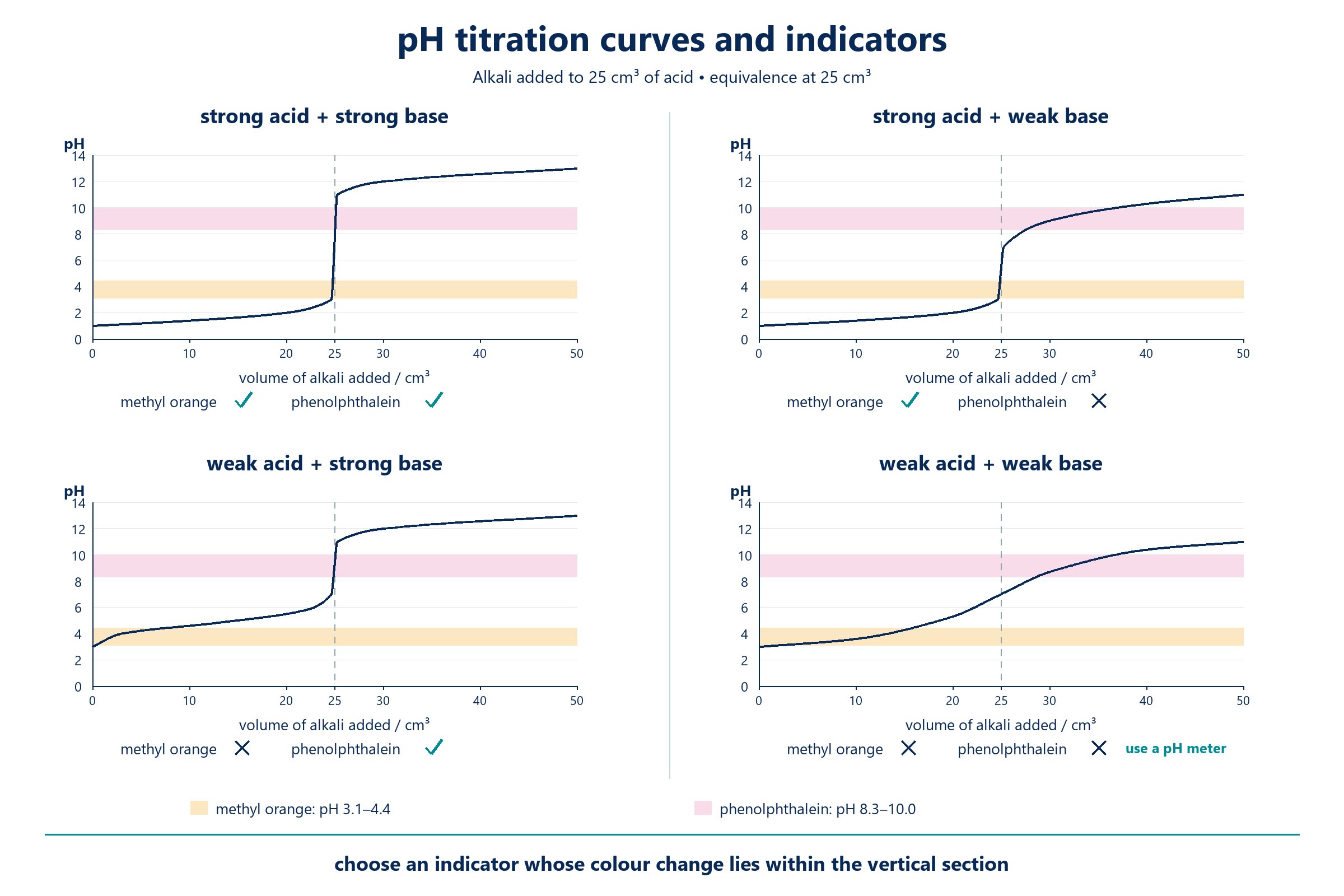
The four pH titration curves with the working ranges of methyl orange and phenolphthalein marked against the vertical section of each.
Exam focus: Sketch the curve with the correct start pH, the vertical section in the correct range at the equivalence volume, and the final pH; then justify the indicator by comparing its range with the vertical section.
Check: Titration Curves
Sketch-reading and indicator choices for titrations not shown above.
FAQs
Use these quick answers to check acids, bases and pH curves.
What is the Brønsted–Lowry definition of an acid?
A proton donor. A base is a proton acceptor. Every acid–base reaction is a transfer of a proton.
Is a concentrated acid the same as a strong acid?
No. Strength is the degree of dissociation; concentration is the amount dissolved per dm³. Ethanoic acid is weak however concentrated it is.
Why does a weak acid give the same volume of gas with magnesium as a strong acid?
As the H⁺ ions are used up, more of the weak acid dissociates to replace them, so eventually all the acid reacts. It just happens more slowly.
Why is there no suitable indicator for a weak acid against a weak base?
The curve has no vertical section, so no indicator changes colour sharply at the equivalence point. A pH meter is used instead.
Why is phenolphthalein used for a weak acid and a strong base?
Its colour change (pH 8.3 to 10.0) lies inside the vertical section of that curve (about pH 7 to 11), so it changes colour exactly at the equivalence point.
Copyright and author footprint: This OLS revision page was written for Online Learning System by Dr. Mohammed Al-Fatah. It is designed for A Level Chemistry revision and should not be copied or redistributed without permission.
Keep this note — free
Save your progress across every Cambridge topic. A free account remembers which topics you have covered, saves your question scores, and syncs across your phone and laptop.
- Track every topic you have finished
- Keep your practice-question scores
- No payment, no card, free forever
Already registered? Log in