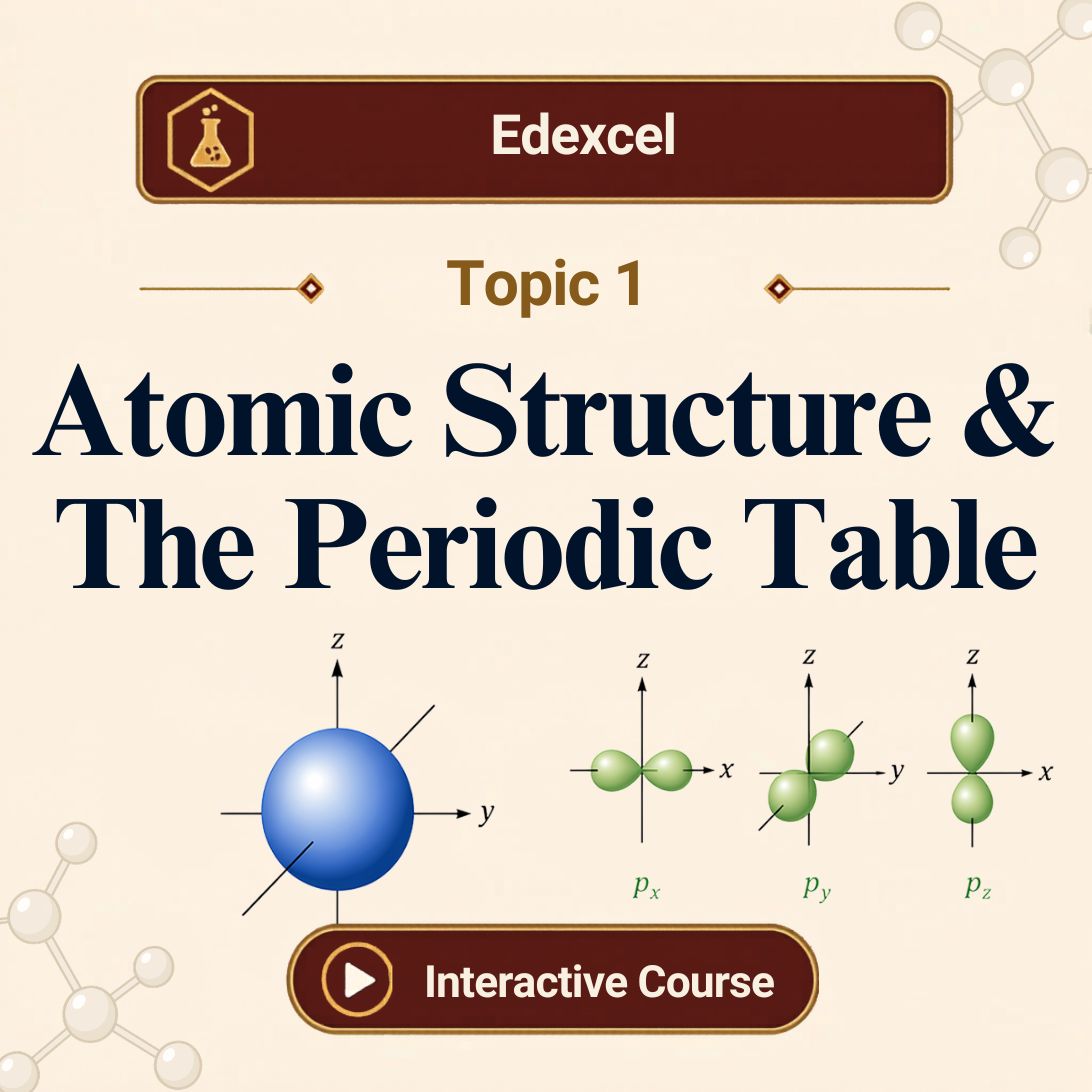
Atomic Structure and The Periodic Table – Topic 1

£34.99

Atomic Structure and The Periodic Table Topic 1

The Topic 1 course on Edexcel A Level Chemistry provides approximately 21 hours of guided learning. Students work through five recorded video lessons, 155 marks of auto-marked MCQ practice, 270 marks of teacher-marked written questions, and a personalised spec-point progress report.

Guided Learning
21 Hours
total study time
Video Lessons
388 mins
5 recorded lessons
MCQ Assessments
155 Marks
8 quizzes
SAQ Assessments
270 Marks
9 quizzes

How the 21 guided learning hours are worked out

Guided learning hours are calculated from the actual contents of the course, not estimated. Video time is counted at its true running length, MCQs at 1.5 minutes per question, written answers at 1.5 minutes per mark, and time is allowed for reading the feedback returned on every quiz.

ComponentTime
Virtual lesson video388 min
MCQ practice (155 questions × 1.5 min)232 min
MCQ feedback review (8 quizzes × 10 min)80 min
SAQ practice (270 marks × 1.5 min)405 min
SAQ feedback review (9 quizzes × 15 min)135 min
Total1240 min ≈ 21 hours

The five recorded lessons

The virtual lesson is delivered as five recorded lessons totalling 388 minutes. Students pause during exam-practice sections, attempt questions independently, then review the worked explanations and the mark-scheme approach.

LessonRunning time
1. Atom & Mass Spectrometry137 min
2. Atomic Orbitals and Electronic Configuration69 min
3. Ionisation Energy Part 164 min
4. Ionisation Energy Part 240 min
5. Exam Practice78 min
Total video388 min

Course preview

A short walkthrough of how the course is taught and how the assessment fits together.

At a glance

What you get in this course

388 minutes of guided video

Five recorded lessons covering Topic 1 in full, with worked exam questions and mark-scheme strategy built into the teaching.

155 marks of MCQ practice

8 auto-marked quizzes of 19–20 questions each, with diagnostic feedback on every option. One attempt per quiz, so your scores track real progress.

270 marks of written practice

9 written-answer quizzes (133 questions) marked by a chemistry specialist, with per-mark feedback returned the following Monday.

Complete spec-point coverage

All 55 assessable Edexcel A level spec points in Topic 1 carry questions in the bank.

Exam-technique baked in

The lessons teach the chemistry and the exam wording. You learn what Edexcel actually rewards, not just the content.

Personalised progress report

A one-click PDF report shows your level on every spec point in colour-coded form.
What is KASP Analytics?

KASP (Knowledge Analytics & Spec-point Platform) tracks your progress at the level of individual specification points, not just whole quizzes. Every question on this course is mapped to the Edexcel A level spec point it assesses, so you always know exactly which parts of the specification you have mastered and which need another look.

Spec points tracked
55
Specification area
Topic 1: Atomic Structure and the Periodic Table
Questions tagged
288
55 spec points assessed in this course

55 Topic 1 spec points carry questions in this course. The remainder of the framework's Topic 1 covers relative masses and periodicity content that is assessed in the Formulae, Equations and Amounts of Substance course instead. Across the 155 MCQ and 133 SAQ questions here, most of those spec points are assessed several times over, in both question styles.

Your topic dashboard

Every topic you have worked through is summarised here. At a glance you see how many questions you have attempted, what is still waiting to be marked, your total marks scored, and an overall score percentage. The dashboard below is an example, filled with the real topic structure of this course.

Hello, Sara – here is how you are doing

Edexcel A level Chemistry
TopicQuestions attemptedPendingMarks (scored / available)Score
Topic 1: Atomic Structure and The Periodic Table38 / 46658.00 / 80.0073%

Spec-point breakdown for a topic

Click into any topic and you see the full spec-point breakdown. Each row is a single Edexcel A level spec point with its official wording, how many questions the bank holds against it, your score, and a colour that tells you immediately where to focus. The spec points and question counts below are the real ones from this course; the scores are an example.

Spec tagDescriptionAttemptedIn bankMarksScore
1.4-dbe able to determine the number of electrons in an ion from atomic number, mass number and charge5 / 51310.00 / 10.00100.0%
1.8-abe able to analyse mass spectrometry data to calculate relative atomic mass from relative abundance of isotopes6 / 62711.00 / 13.0084.6%
1.11-bbe able to define the term 'successive ionisation energies'4 / 4137.00 / 9.0077.8%
1.15iiunderstand how ideas about electronic configuration developed from: the fact that successive ionisation energies provide evidence for the existence of quantum shells and the group to which the element belongs5 / 5308.00 / 12.0066.7%
1.21ibe able to predict the electronic configurations, using 1s notation and electrons-in-boxes notation, of: atoms, given the atomic number, Z, up to Z = 364 / 4255.00 / 9.0055.6%
1.21iibe able to predict the electronic configurations, using 1s notation and electrons-in-boxes notation, of: ions, given the atomic number, Z, and the ionic charge, for s and p block ions only, up to Z = 363 / 4124.00 / 8.0050.0%
1.25i-aunderstand reasons for trends in melting temperatures of elements from periods 2 and 3 based on given data in terms of structure and bonding2 / 3142.00 / 7.0028.6%
1.25ii-aunderstand reasons for trends in ionisation energy of elements from periods 2 and 3 based on given data0 / 311Not yet attempted
■ Green 70–100%: secure mastery■ Orange 40–69%: some gaps■ Red 0–39%: needs attention■ Grey: not yet assessed

Printable progress report

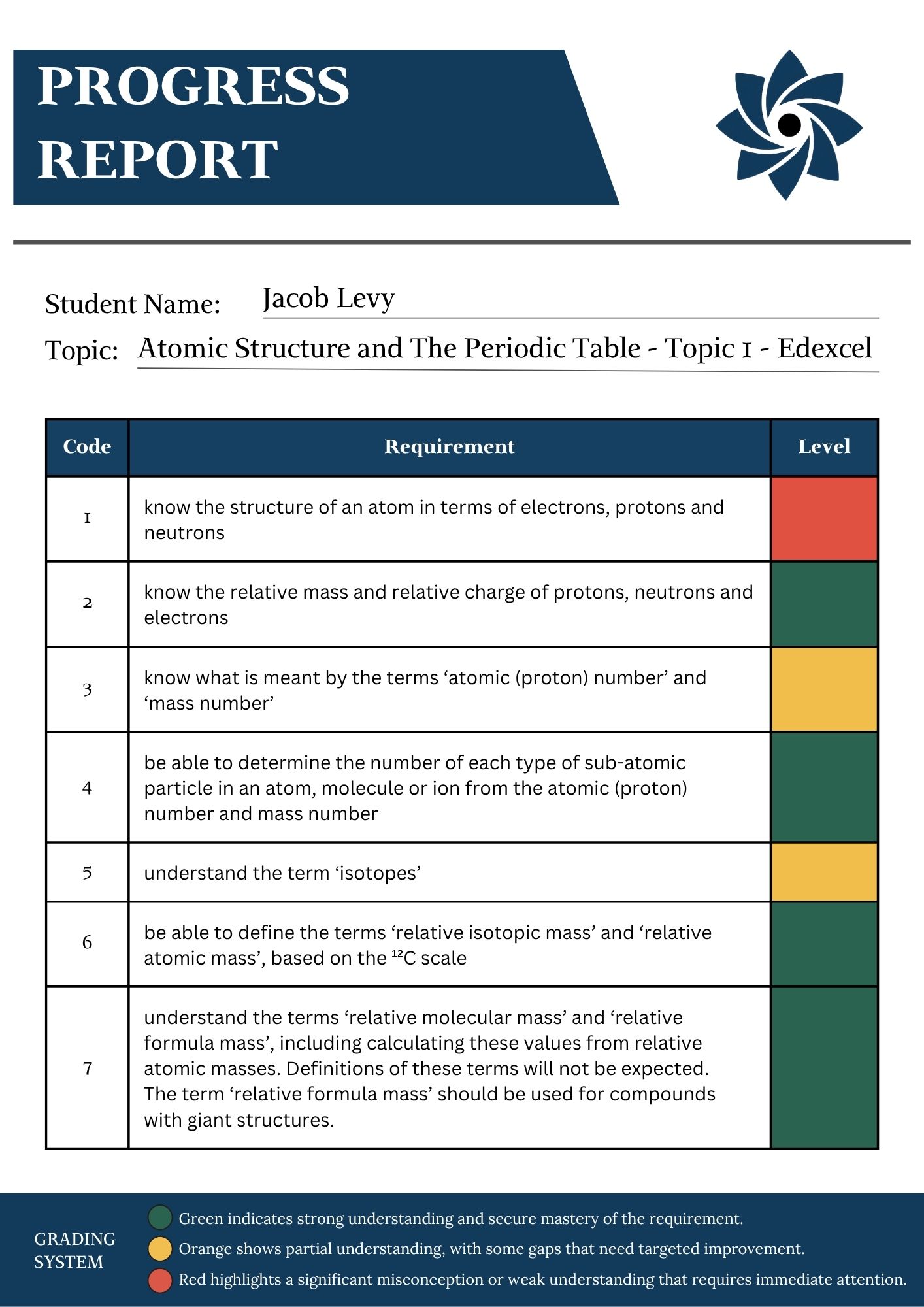
One click and you can download a clean, branded Progress Report PDF for the topic. Useful for your own revision folder, for parents to see at a glance, or for tutors to plan focused sessions. Every spec point in the topic appears with its code and full requirement text, and the level column is colour-coded green through red.

A Level Chemistry progress report for Atomic Structure and The Periodic Table Topic 1 showing student performance across specification points with colour coded levels for understanding
At a glance

What you get with KASP Analytics

Spec-point level tracking

Every question is tagged to the exact Edexcel A level spec point it assesses, so your scores roll up cleanly to the specification.

Updates automatically

Submit a quiz and your dashboard updates right away. Short-answer questions appear as pending until they have been marked.

Built for Edexcel A level

Wording, codes and topic structure follow the Edexcel A Level Chemistry specification exactly, so your scores line up with the document you will be examined on.

Printable report

One-click PDF Progress Report per topic, in the same colour system, ready for your folder or for a tutor session.

Both question styles counted

MCQ and written answers feed the same spec point. With 155 MCQ and 133 SAQ questions tagged, a weak area shows up whether you miss it under multiple choice or in writing.

Progress over time

A simple line chart shows how your overall score has trended across the days you have been studying.

What is the MCQ Bank?

The MCQ Bank for Topic 1 is an auto-marked, instant-feedback practice engine built from past Edexcel A level paper questions. It runs to 8 quizzes, 155 questions and 155 marks. Every question is tagged to a specific Edexcel A level spec point, every option carries diagnostic feedback explaining the chemistry, and every quiz attempt feeds directly into your KASP Analytics dashboard.

Quizzes
8
Questions
155
Marks
155
Attempts
1 per quiz

Try a real Topic 1 MCQ

This is a genuine question from the bank, reproduced exactly as it appears in the course. Click any option to reveal the diagnostic feedback for that choice, then expand the panel at the bottom for the full walkthrough.

What all isotopes of an element share

1.5 (Edexcel A level)1 mark

Two atoms are isotopes of the same element. They must have the same

Click an option to see feedback

Anumber of protons
Correct

Correct. Isotopes of the same element must contain the same number of protons. The proton number defines the element. They differ from one another in the number of neutrons, giving different mass numbers.

Bnumber of neutrons
Incorrect

Isotopes have different numbers of neutrons from one another. This is precisely what makes two atoms isotopes rather than identical atoms. What they share is the number of protons.

Cmass number
Incorrect

Isotopes have different mass numbers because they have different numbers of neutrons. The shared property that defines them as the same element is the proton number, not the mass number.

Dnumber of nucleons
Incorrect

Nucleons are protons and neutrons combined, so the number of nucleons equals the mass number. Isotopes differ in mass number because they differ in neutron count. They share the number of protons only.

Show correct answer & full explanation →
General feedback

Isotopes are atoms of the same element with the same number of protons but different numbers of neutrons.

  • Same number of protons (atomic number) – this is what makes them the same element.
  • Different numbers of neutrons, which is what makes them isotopes of one another.
  • Different mass numbers as a consequence of different neutron counts.
  • The number of electrons can differ if one atom is an ion; what is always identical is the proton count.

The correct answer is number of protons.

8 quizzes, 155 marks of MCQ practice

The MCQ Bank runs as a single set of quizzes across the topic. Quizzes hold 19–20 questions worth one mark each, and each quiz is a single auto-marked attempt. Because every spec point is tested across several quizzes, your KASP scores reveal real improvement as you work through them.

Topic 1: Atomic Structure and The Periodic Table

8 quizzes · 155 marks
MCQ A
20
questions & marks
MCQ B
20
questions & marks
MCQ C
20
questions & marks
MCQ D
19
questions & marks
MCQ E
19
questions & marks
MCQ F
19
questions & marks
MCQ G
19
questions & marks
MCQ H
19
questions & marks
155 total marks155 questions in totalOne attempt per quizAuto-marked on submit
At a glance

What you get with the MCQ Bank

155 marks across 8 quizzes

Eight quizzes of 19–20 questions each, giving balanced coverage of every spec point in Topic 1.

Instant auto-marking

Submit and the result is back in your hands inside a second. No waiting, no manual checking.

Diagnostic feedback per option

Every wrong option carries a tailored explanation of the misconception, not just a generic ‘incorrect’, plus a full walkthrough on every question.

Spec-point tagged

Each question is mapped to the Edexcel A level spec point it assesses, so your score flows straight into KASP Analytics.

Track improvement across quizzes

One attempt per quiz, but the same spec points appear across the set. Your scores from quiz to quiz show genuine progress, not repeat-attempt inflation.

Built from past papers

Every MCQ is sourced from genuine Edexcel A level past papers, with the wording polished for clarity and the chemistry verified.

What is the SAQ Bank?

The SAQ Bank for Topic 1 is a written-answer practice engine marked by a real chemistry specialist. It runs to 9 quizzes, 133 questions and 270 marks. You attempt one quiz per week, submit your full written response, and your teacher returns mark-by-mark feedback the following Monday. Every comment is targeted at the exam wording you need to use.

Quizzes
9
Questions
133
Marks
270
Marks per quiz
30

A submitted SAQ and the feedback it gets

This is a genuine question from the bank with its real mark scheme. The submitted answer below is an example of a typical response at this standard. Expand the panel to see how it was marked.

Trend in first ionisation energies down Group 2

1.14 (Edexcel A level)4 marks

Explain the trend in first ionisation energies down Group 2.

Submitted answer

The first ionisation energy decreases as you go down Group 2. This is because the atomic radius gets bigger each time, so the outer electron is in a shell further from the nucleus, and there are more inner shells shielding it. Both of these make the outer electron easier to remove.

View returned feedback →
Returned by your chemistry specialist3 / 4 · 75%
Mark scheme
Criterion
The trend: first ionisation energy decreases down Group 2.
Awarded – the direction of the trend is stated clearly at the start.
Atomic radius increases (outer electron in a shell further from the nucleus).
Awarded – and you linked it to where the outer electron sits, which is what the mark wants.
Shielding by inner electron shells increases.
Awarded – more inner shells, correctly identified as shielding.
So the nuclear attraction on the outer electron is weaker, despite the increasing nuclear charge.
Not awarded. ‘Easier to remove’ restates the trend rather than explaining it, and you never mention nuclear charge. The mark needs the conclusion and the concession: the attraction between the nucleus and the outer electron is weaker, and this outweighs the increasing nuclear charge down the group.
Teacher comment

Three of four, Sara, and the three you have are the ones most students fumble – radius and shielding are both correctly stated and correctly directed. The missing mark is the one that ties it together. Examiners want the net effect named (weaker nuclear attraction on the outer electron) and they want you to acknowledge that nuclear charge is rising and is outweighed. Any trend question where two factors pull in opposite directions needs that concession sentence – write it every time and you will pick this mark up.

A predictable weekly rhythm over 9 weeks

One quiz per week across the 9 quizzes, so the SAQ Bank runs as a 9-week programme. Submit anywhere from Monday to Friday, marking happens over the weekend, and you receive your feedback by the following Monday. The rhythm is the same every week so you always know when to expect a return.

Mon
Submit
Tue
Submit
Wed
Submit
Thu
Submit
Fri
Submit
Sat
Marking
Sun
Marking
Mon
Returned

One attempt per quiz, one quiz submitted per week. Because the same spec points reappear across the 9 quizzes, your scores over the programme show genuine improvement – not repeat-attempt inflation. The weekly cap also keeps the marking load manageable so your feedback stays genuinely thorough.

9 quizzes, 270 marks of written practice

The SAQ Bank holds 133 questions and 270 marks between its 9 quizzes. Every quiz is worth 30 marks, and runs to between 12 and 18 questions depending on how the marks fall, with the parts of any one original exam question kept together in the same quiz. They draw from past Edexcel A level written-paper questions across Topic 1.

Topic 1: Atomic Structure and The Periodic Table

9 quizzes · 270 marks
SAQ A
30
marks · 14 questions
SAQ B
30
marks · 12 questions
SAQ C
30
marks · 14 questions
SAQ D
30
marks · 14 questions
SAQ E
30
marks · 17 questions
SAQ F
30
marks · 16 questions
SAQ G
30
marks · 14 questions
SAQ H
30
marks · 14 questions
SAQ I
30
marks · 18 questions
270 total marks133 questions1 quiz per week, over 9 weeksReturned the following Monday

What the written questions ask you to do

The bank is not all prose. Alongside written explanations you are asked to draw structures and mechanisms and to work through calculations, all marked by hand against the same mark scheme.

Question styleQuestionsWhat it asks for
Written answer104Explanations, descriptions, equations and definitions, marked against the exam mark scheme point by point.
Drawing15Structural and displayed formulae, skeletal structures and mechanism steps, drawn on screen and marked by the specialist.
Calculation14Quantitative work shown in full, so method marks can be awarded even when the final answer is wrong.
Total133
At a glance

What you get with the SAQ Bank

270 marks across 9 quizzes

Nine quizzes, SAQ A through SAQ I, holding 133 questions between them at 30 marks per quiz.

Marked by a chemistry specialist

Not auto-graded, not AI-scored. A subject specialist reads your answer end-to-end and writes the comments by hand.

Per-mark feedback

Every mark in the scheme is checked off explicitly. You see exactly which marks you earned and what wording the missed ones needed.

Predictable weekly turnaround

Submit by Friday, marked over the weekend, feedback returned by Monday. One quiz per week; one attempt per quiz; 9 weeks end to end.

Exam-board wording focus

Feedback teaches the precise language the Edexcel mark scheme rewards, so the next time the topic appears you write to score.

Feeds your KASP dashboard

Every SAQ is spec-point tagged. Once marked, your scores flow into KASP Analytics alongside your MCQ results.

Exam Board Alignment

Atomic Structure and The Periodic Table Topic 1 Edexcel A Level Chemistry

This course covers the following Edexcel A Level Chemistry specification points for Topic 1 Atomic Structure and The Periodic Table.

1
know the structure of an atom in terms of electrons, protons and neutrons
2
know the relative mass and relative charge of protons, neutrons and electrons
3
know what is meant by the terms ‘atomic (proton) number’ and ‘mass number’
4
be able to determine the number of each type of sub-atomic particle in an atom, molecule or ion from the atomic (proton) number and mass number
5
understand the term ‘isotopes’
6
be able to define the terms ‘relative isotopic mass’ and ‘relative atomic mass’, based on the 12C scale
7
understand the terms ‘relative molecular mass’ and ‘relative formula mass’, including calculating these values from relative atomic masses
Definitions of these terms will not be expected.
The term ‘relative formula mass’ should be used for compounds with giant structures.
8
be able to analyse and interpret data from mass spectrometry to calculate relative atomic mass from relative abundance of isotopes and vice versa
9
be able to predict the mass spectra, including relative peak heights, for diatomic molecules, including chlorine
10
understand how mass spectrometry can be used to determine the relative molecular mass of a molecule
Limited to the m/z value for the molecular ion, M+, giving the relative molecular mass of the molecule.
11
be able to define the terms ‘first ionisation energy’ and ‘successive ionisation energies’
12
understand how ionisation energies are influenced by the number of protons, the electron shielding and the electron sub-shell from which the electron is removed
13
understand reasons for the general increase in first ionisation energy across a period
14
understand reasons for the decrease in first ionisation energy down a group
15
understand how ideas about electronic configuration developed from:
i
the fact that atomic emission spectra provide evidence for the existence of quantum shells
ii
the fact that successive ionisation energies provide evidence for the existence of quantum shells and the group to which the element belongs
iii
the fact that the first ionisation energy of successive elements provides evidence for electron sub-shells
16
know the number of electrons that can fill the first four quantum shells
17
know that an orbital is a region within an atom that can hold up to two electrons with opposite spins
18
know the shape of an s-orbital and a p-orbital
19
know the number of electrons that occupy s, p and d-subshells
20
know that electrons fill subshells singly, before pairing up, and that two electrons in the same orbital must have opposite spins
21
be able to predict the electronic configurations, using 1s notation and electrons-in-boxes notation, of:
i
atoms, given the atomic number, Z, up to Z = 36
ii
ions, given the atomic number, Z, and the ionic charge, for s and p block ions only, up to Z = 36
22
know that elements can be classified as s, p and d-block elements
23
understand that electronic configuration determines the chemical properties of an element
24
understand periodicity in terms of a repeating pattern across different periods
25
understand reasons for the trends in the following properties of the elements from periods 2 and 3 of the Periodic Table:
i
the melting and boiling temperatures of the elements, based on given data, in terms of structure and bonding
ii
ionisation energy based on given data or recall of the plots of ionisation energy versus atomic number
26
be able to illustrate periodicity using data, including electronic configurations, atomic radii, melting and boiling temperatures and first ionisation energies
Specification Coverage

Students will be assessed on their ability to:

The following specification points outline the knowledge and skills students are expected to demonstrate.

1
know the structure of an atom in terms of electrons, protons and neutrons
2
know the relative mass and relative charge of protons, neutrons and electrons
3
know what is meant by the terms ‘atomic (proton) number’ and ‘mass number’
4
be able to determine the number of each type of sub-atomic particle in an atom, molecule or ion from the atomic (proton) number and mass number
5
understand the term ‘isotopes’
6
be able to define the terms ‘relative isotopic mass’ and ‘relative atomic mass’, based on the 12C scale
7
understand the terms ‘relative molecular mass’ and ‘relative formula mass’, including calculating these values from relative atomic masses
Definitions of these terms will not be expected.
The term ‘relative formula mass’ should be used for compounds with giant structures.
8
be able to analyse and interpret data from mass spectrometry to calculate relative atomic mass from relative abundance of isotopes and vice versa
9
be able to predict the mass spectra, including relative peak heights, for diatomic molecules, including chlorine
10
understand how mass spectrometry can be used to determine the relative molecular mass of a molecule
Limited to the m/z value for the molecular ion, M+, giving the relative molecular mass of the molecule.
11
be able to define the terms ‘first ionisation energy’ and ‘successive ionisation energies’
12
understand how ionisation energies are influenced by the number of protons, the electron shielding and the electron sub-shell from which the electron is removed
13
understand reasons for the general increase in first ionisation energy across a period
14
understand reasons for the decrease in first ionisation energy down a group
15
understand how ideas about electronic configuration developed from:
i
the fact that atomic emission spectra provide evidence for the existence of quantum shells
ii
the fact that successive ionisation energies provide evidence for the existence of quantum shells and the group to which the element belongs
iii
the fact that the first ionisation energy of successive elements provides evidence for electron sub-shells
16
know the number of electrons that can fill the first four quantum shells
17
know that an orbital is a region within an atom that can hold up to two electrons with opposite spins
18
know the shape of an s-orbital and a p-orbital
19
know the number of electrons that occupy s, p and d-subshells
20
know that electrons fill subshells singly, before pairing up, and that two electrons in the same orbital must have opposite spins
21
be able to predict the electronic configurations, using 1s notation and electrons-in-boxes notation, of:
i
atoms, given the atomic number, Z, up to Z = 36
ii
ions, given the atomic number, Z, and the ionic charge, for s and p block ions only, up to Z = 36
22
know that elements can be classified as s, p and d-block elements
23
understand that electronic configuration determines the chemical properties of an element
24
understand periodicity in terms of a repeating pattern across different periods
25
understand reasons for the trends in the following properties of the elements from periods 2 and 3 of the Periodic Table:
i
the melting and boiling temperatures of the elements, based on given data, in terms of structure and bonding
ii
ionisation energy based on given data or recall of the plots of ionisation energy versus atomic number
26
be able to illustrate periodicity using data, including electronic configurations, atomic radii, melting and boiling temperatures and first ionisation energies
Complete Topic Package

Learn the content, practise exam questions, and identify exactly where marks are being lost.

This course combines guided video teaching, diagnostic MCQs, teacher-marked written assessment, and detailed specification reporting for Edexcel A Level Chemistry.

Exam-focused learning with clear performance feedback