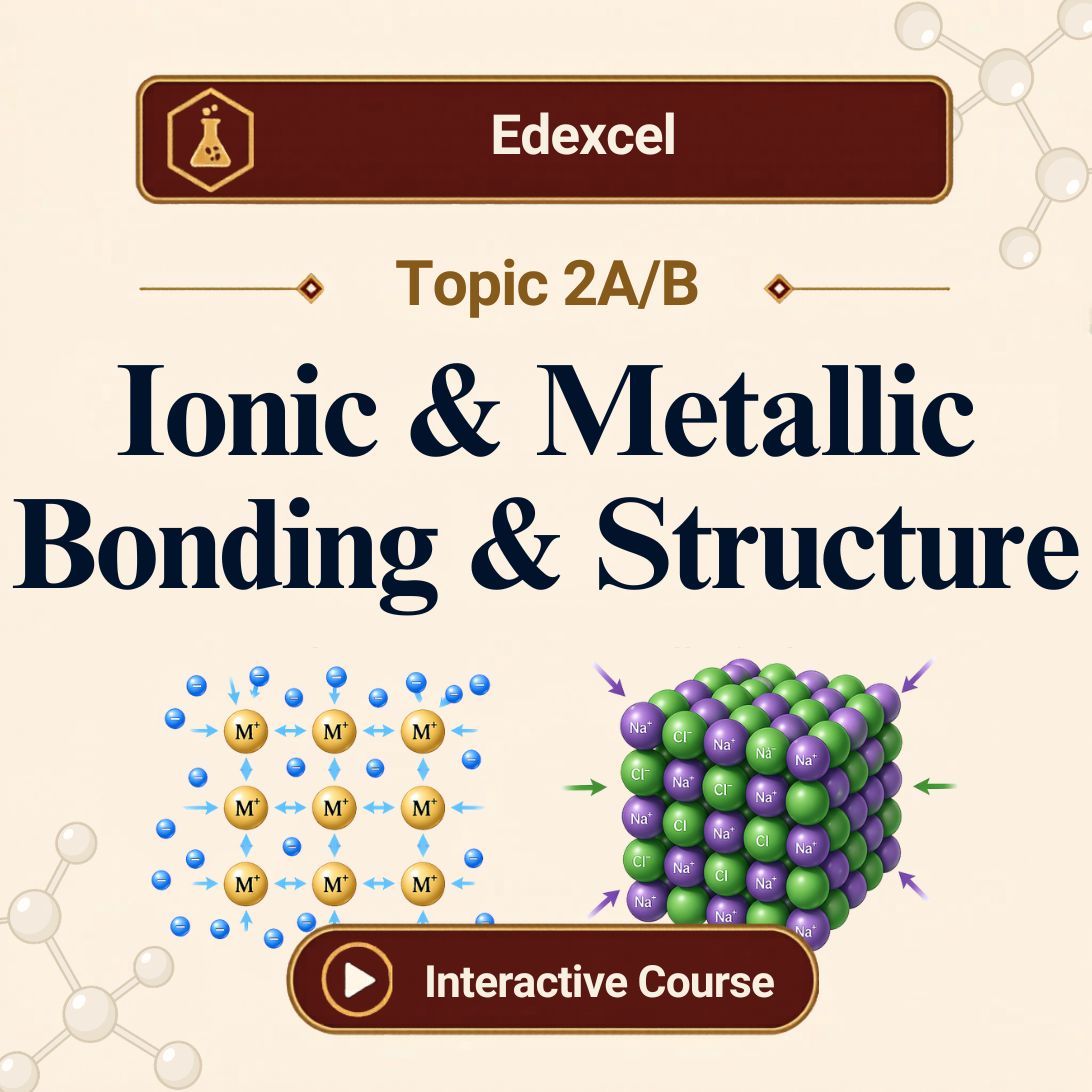
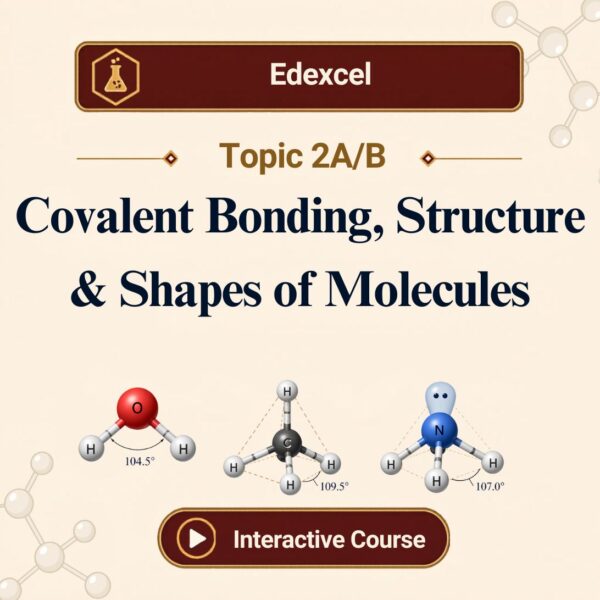
Ionic and Metallic Bonding and Structure Topic 2A/2B
The Topic 2A/2B course on Edexcel A Level Chemistry provides approximately 13 hours of guided learning. Students work through three recorded video lessons, 92 marks of auto-marked MCQ practice, 150 marks of teacher-marked written questions, and a personalised spec-point progress report.
Guided Learning
13 Hours
total study time
Video Lessons
288 mins
3 recorded lessons
MCQ Assessments
92 Marks
5 quizzes
SAQ Assessments
150 Marks
5 quizzes
How the 13 guided learning hours are worked out
Guided learning hours are calculated from the actual contents of the course, not estimated. Video time is counted at its true running length, MCQs at 1.5 minutes per question, written answers at 1.5 minutes per mark, and time is allowed for reading the feedback returned on every quiz.
Component
Time
Virtual lesson video
288 min
MCQ practice (92 questions × 1.5 min)
138 min
MCQ feedback review (5 quizzes × 10 min)
50 min
SAQ practice (150 marks × 1.5 min)
225 min
SAQ feedback review (5 quizzes × 15 min)
75 min
Total
776 min ≈ 13 hours
The three recorded lessons
The virtual lesson is delivered as three recorded lessons totalling 288 minutes. Students pause during exam-practice sections, attempt questions independently, then review the worked explanations and the mark-scheme approach.
Lesson
Running time
1. Ionic Bonding
150 min
2. Metallic Bonding
66 min
3. Solid Lattices
72 min
Total video
288 min
Course preview
A short walkthrough of how the course is taught and how the assessment fits together.
At a glance
What you get in this course
288 minutes of guided video
Three recorded lessons covering Topic 2A and Topic 2A/2B in full, with worked exam questions and mark-scheme strategy built into the teaching.
92 marks of MCQ practice
5 auto-marked quizzes of 15–20 questions each, with diagnostic feedback on every option. One attempt per quiz, so your scores track real progress.
150 marks of written practice
5 written-answer quizzes (64 questions) marked by a specialist chemistry teacher, assisted by KASP, with per-mark feedback returned the following Monday.
Complete spec-point coverage
22 Edexcel A level spec points are assessed in this course, every one of them in both question styles.
Exam-technique baked in
The lessons teach the chemistry and the exam wording. You learn what Edexcel actually rewards, not just the content.
Personalised progress report
A one-click PDF report shows your level on every spec point in colour-coded form.
What is KASP Analytics?
KASP (Knowledge Analytics & Spec-point Platform) tracks your progress at the level of individual specification points, not just whole quizzes. Every question on this course is mapped to the Edexcel A level spec point it assesses, so you always know exactly which parts of the specification you have mastered and which need another look.
Spec points tracked
22
Specification area
Topic 2A/2B: Bonding and Structure
Questions tagged
156
22 spec points assessed in this course
Bonding and Structure is split across two courses: this one covers ionic and metallic bonding and solid lattices, and the Covalent Bonding course covers the rest. The intermolecular-forces spec points (2A.16 to 2A.21) belong to a separate topic. Across the 92 MCQ and 64 SAQ questions here, most of those spec points are assessed several times over, in both question styles.
Your topic dashboard
Every topic you have worked through is summarised here. At a glance you see how many questions you have attempted, what is still waiting to be marked, your total marks scored, and an overall score percentage. The dashboard below is an example, filled with the real topic structure of this course.
Hello, Sara – here is how you are doing
Edexcel A level Chemistry
Topic
Questions attempted
Pending
Marks (scored / available)
Score
Topic 2A: Ionic Bonding
24 / 30
4
38.00 / 54.00
70%
Topic 2A/2B: Metallic Bonding
15 / 20
3
21.00 / 36.00
58%
Spec-point breakdown for a topic
Click into any topic and you see the full spec-point breakdown. Each row is a single Edexcel A level spec point with its official wording, how many questions the bank holds against it, your score, and a colour that tells you immediately where to focus. The spec points and question counts below are the real ones from this course; the scores are an example.
Spec tag
Description
Attempted
In bank
Marks
Score
2A.4-a
be able to draw electronic configuration diagrams of cations using dot-and-cross diagrams
3 / 3
7
6.00 / 6.00
100.0%
2A.4-b
be able to draw electronic configuration diagrams of anions using dot-and-cross diagrams
4 / 4
6
7.00 / 9.00
77.8%
2A.5-b
understand reasons for trends in ionic radii for a set of isoelectronic ions such as N3- to Al3+
3 / 3
19
5.00 / 6.00
83.3%
2A.6-a
understand that physical properties of ionic compounds provide evidence for the existence of ions
4 / 4
11
6.00 / 9.00
66.7%
2A.6-b
understand that migration of ions provides evidence for the existence of ions
4 / 4
10
5.00 / 9.00
55.6%
2A.22
know that metallic bonding is the strong electrostatic attraction between metal ions and the delocalised electrons
3 / 4
18
4.00 / 8.00
50.0%
2B.27i
be able to predict the physical properties of a substance, including melting and boiling temperature, electrical conductivity and solubility in water, in terms of: the types of particle present (atoms, molecules, ions, electrons)
2 / 3
8
2.00 / 7.00
28.6%
2B.27iii
be able to predict the physical properties of a substance, including melting and boiling temperature, electrical conductivity and solubility in water, in terms of: the type of bonding and the presence of intermolecular forces, where relevant
0 / 3
11
–
Not yet attempted
■ Green 70–100%: secure mastery■ Orange 40–69%: some gaps■ Red 0–39%: needs attention■ Grey: not yet assessed
Printable progress report
One click and you can download a clean, branded Progress Report PDF for the topic. Useful for your own revision folder, for parents to see at a glance, or for tutors to plan focused sessions. Every spec point in the topic appears with its code and full requirement text, and the level column is colour-coded green through red.
At a glance
What you get with KASP Analytics
Spec-point level tracking
Every question is tagged to the exact Edexcel A level spec point it assesses, so your scores roll up cleanly to the specification.
Updates automatically
Submit a quiz and your dashboard updates right away. Short-answer questions appear as pending until they have been marked.
Built for Edexcel A level
Wording, codes and topic structure follow the Edexcel A Level Chemistry specification exactly, so your scores line up with the document you will be examined on.
Printable report
One-click PDF Progress Report per topic, in the same colour system, ready for your folder or for a tutor session.
Both question styles counted
MCQ and written answers feed the same spec point. With 92 MCQ and 64 SAQ questions tagged, a weak area shows up whether you miss it under multiple choice or in writing.
Progress over time
A simple line chart shows how your overall score has trended across the days you have been studying.
What is the MCQ Bank?
The MCQ Bank for Topic 2A/2B is an auto-marked, instant-feedback practice engine built from past Edexcel A level paper questions. It runs to 5 quizzes, 92 questions and 92 marks. Every question is tagged to a specific Edexcel A level spec point, every option carries diagnostic feedback explaining the chemistry, and every quiz attempt feeds directly into your KASP Analytics dashboard.
Quizzes
5
Questions
92
Marks
92
Attempts
1 per quiz
Try a real Topic 2A/2B MCQ
This is a genuine question from the bank, reproduced exactly as it appears in the course. Click any option to reveal the diagnostic feedback for that choice, then expand the panel at the bottom for the full walkthrough.
Why lithium melts at a higher temperature than potassium
2A.22 (Edexcel A level)1 mark
The melting temperature of lithium is greater than that of potassium. What is the best explanation for this statement?
Click an option to see feedback
Alithium ions are smaller than potassium ions
Correct
Correct. Smaller lithium ions have a greater charge density, so the attraction between the positive ions and the delocalised electrons is stronger. This gives lithium stronger metallic bonding and therefore a higher melting temperature than potassium.
Blithium atoms have fewer outer shell electrons than potassium atoms
Incorrect
Incorrect. Both lithium and potassium are in Group 1 and each atom contributes exactly one delocalised electron to the metallic lattice. The number of outer shell electrons does not explain the difference in melting temperature.
Clithium ions have a smaller charge density than potassium ions
Incorrect
Incorrect. This statement is the wrong way round. Lithium ions are much smaller than potassium ions, so they have a larger charge density, not a smaller one. The larger charge density is what makes lithium’s metallic bonding stronger.
Dlithium atoms have a higher electronegativity than potassium atoms
Incorrect
Incorrect. Electronegativity measures an atom’s ability to attract electrons in a covalent bond. It does not determine the strength of metallic bonding or influence the melting temperature of a metal.
Show correct answer & full explanation →
General feedback
The melting temperature of a metal depends on the strength of its metallic bonding. Stronger metallic bonding requires more energy to overcome and gives a higher melting temperature.
Lithium ions are smaller than potassium ions is correct. Smaller ions have a greater charge density, so the positive charge is concentrated over a smaller volume. This produces a stronger attraction between the metal ions and the delocalised electrons, giving stronger metallic bonding and a higher melting temperature.
Fewer outer shell electrons is incorrect. Both Li and K are in Group 1 and contribute exactly one delocalised electron per atom, so the number of outer electrons cannot distinguish them.
Smaller charge density is incorrect. Lithium ions actually have a larger charge density than potassium ions because they are smaller, and it is this greater charge density that explains the stronger metallic bonding in lithium.
Higher electronegativity is incorrect. Electronegativity describes the ability of an atom to attract bonding electrons in a covalent bond. It does not determine the strength of metallic bonding.
The correct answer is therefore that lithium ions are smaller than potassium ions, giving them a higher charge density and stronger metallic bonding.
5 quizzes, 92 marks of MCQ practice
The MCQ Bank is split across the two halves of the topic. Quizzes hold 15–20 questions worth one mark each, and each quiz is a single auto-marked attempt. Because every spec point is tested across several quizzes, your KASP scores reveal real improvement as you work through them.
Topic 2A: Ionic Bonding
4 quizzes · 77 marks
MCQ A
20
questions & marks
MCQ B
19
questions & marks
MCQ C
19
questions & marks
MCQ D
19
questions & marks
Topic 2A/2B: Metallic Bonding
1 quizzes · 15 marks
MCQ A
15
questions & marks
92 total marks92 questions in totalOne attempt per quizAuto-marked on submit
At a glance
What you get with the MCQ Bank
92 marks across 5 quizzes
4 quizzes on Topic 2A and 1 on Topic 2A/2B, 15–20 questions each, giving balanced coverage across the whole topic.
Instant auto-marking
Submit and the result is back in your hands inside a second. No waiting, no manual checking.
Diagnostic feedback per option
Every wrong option carries a tailored explanation of the misconception, not just a generic ‘incorrect’, plus a full walkthrough on every question.
Spec-point tagged
Each question is mapped to the Edexcel A level spec point it assesses, so your score flows straight into KASP Analytics.
Track improvement across quizzes
One attempt per quiz, but the same spec points appear across the set. Your scores from quiz to quiz show genuine progress, not repeat-attempt inflation.
Built from past papers
Every MCQ is sourced from genuine Edexcel A level past papers, with the wording polished for clarity and the chemistry verified.
What is the SAQ Bank?
The SAQ Bank for Topic 2A/2B is a written-answer practice engine marked by a specialist chemistry teacher, assisted by KASP. It runs to 5 quizzes, 64 questions and 150 marks. You attempt one quiz per week, submit your full written response, and your teacher returns mark-by-mark feedback the following Monday. Every comment is targeted at the exam wording you need to use.
Quizzes
5
Questions
64
Marks
150
Marks per quiz
30
A submitted SAQ and the feedback it gets
This is a genuine question from the bank with its real mark scheme. The submitted answer below is an example of a typical response at this standard. Expand the panel to see how it was marked.
Electrical conductivity of potassium and potassium chloride
2B.27i (Edexcel A level)4 marks
Explain the electrical conductivities of potassium and potassium chloride in the solid and liquid states.
Submitted answer
Potassium conducts electricity when it is solid and when it is liquid, because it has delocalised electrons that are free to move through the lattice. Potassium chloride does not conduct when it is solid but it does conduct when it is molten.
View returned feedback →
Returned by your chemistry specialist3 / 4 · 75%
Mark scheme
Criterion
✓
potassium conducts when solid and liquid Awarded – both states stated explicitly.
✓
because it has delocalised electrons that move Awarded – delocalised electrons correctly identified as the mobile charge carrier.
✓
potassium chloride only conducts when liquid / molten Awarded – you were clear that the solid does not conduct and the molten form does.
✗
because its ions are free to move Not awarded. You said when potassium chloride conducts but not why. The mark needs the reason: in the molten state the ions are free to move, whereas in the solid they are held in fixed positions in the lattice.
Teacher comment
A well-structured answer, Sara – you separated the two substances and the two states cleanly, and the delocalised-electron explanation for potassium is exactly right. You have simply stopped one step short on the second half: every time you state that something conducts, follow it with the charge carrier that makes it possible. For an ionic solid that is always ‘the ions are free to move when molten, but fixed in the lattice when solid’. Pair the observation with the carrier and you will not drop this mark again.
A predictable weekly rhythm over 5 weeks
One quiz per week across the 5 quizzes, so the SAQ Bank runs as a 5-week programme. Submit anywhere from Monday to Friday, marking happens over the weekend, and you receive your feedback by the following Monday. The rhythm is the same every week so you always know when to expect a return.
Mon
Submit
Tue
Submit
Wed
Submit
Thu
Submit
Fri
Submit
Sat
Marking
Sun
Marking
Mon
Returned
One attempt per quiz, one quiz submitted per week. Because the same spec points reappear across the 5 quizzes, your scores over the programme show genuine improvement – not repeat-attempt inflation. The weekly cap also keeps the marking load manageable so your feedback stays genuinely thorough.
5 quizzes, 150 marks of written practice
The SAQ Bank holds 64 questions and 150 marks between its 5 quizzes. Every quiz is worth 30 marks, and runs to between 12 and 14 questions depending on how the marks fall, with the parts of any one original exam question kept together in the same quiz. They draw from past Edexcel A level written-paper questions across the whole topic pair.
Topic 2A: Ionic Bonding
3 quizzes · 90 marks
SAQ A
30
marks · 14 questions
SAQ B
30
marks · 12 questions
SAQ C
30
marks · 13 questions
Topic 2A/2B: Metallic Bonding
2 quizzes · 60 marks
SAQ A
30
marks · 12 questions
SAQ B
30
marks · 13 questions
150 total marks64 questions1 quiz per week, over 5 weeksReturned the following Monday
What the written questions ask you to do
The bank is not all prose. Alongside written explanations you are asked to draw structures and mechanisms and to work through calculations, all marked by a specialist chemistry teacher, assisted by KASP, against the same mark scheme.
Question style
Questions
What it asks for
Written answer
52
Explanations, descriptions, equations and definitions, marked against the exam mark scheme point by point.
Drawing
11
Structural and displayed formulae, skeletal structures and mechanism steps, drawn on screen and marked by your teacher, assisted by KASP.
Graph
1
Plotting points, drawing a line of best fit and reading values off it, marked against the same tolerance an examiner would apply.
Total
64
At a glance
What you get with the SAQ Bank
150 marks across 5 quizzes
3 quizzes on Topic 2A and 2 on Topic 2A/2B, holding 64 questions between them at 30 marks per quiz.
Marked by a teacher, assisted by KASP
KASP drafts the marking; your teacher reads your answer end to end, decides every mark and writes the comments.
Per-mark feedback
Every mark in the scheme is checked off explicitly. You see exactly which marks you earned and what wording the missed ones needed.
Predictable weekly turnaround
Submit by Friday, marked over the weekend, feedback returned by Monday. One quiz per week; one attempt per quiz; 5 weeks end to end.
Exam-board wording focus
Feedback teaches the precise language the Edexcel mark scheme rewards, so the next time the topic appears you write to score.
Feeds your KASP dashboard
Every SAQ is spec-point tagged. Once marked, your scores flow into KASP Analytics alongside your MCQ results.
This course covers the following Edexcel A Level Chemistry specification points. These are limited to ionic bonding, metallic bonding, ionic structure and metallic structure.
1
know that ionic bonding is the strong electrostatic attraction between oppositely charged ions
2
understand the effects that ionic radius and ionic charge have on the strength of ionic bonding
3
understand the formation of ions in terms of electron loss or gain
4
be able to draw electronic configuration diagrams of cations and anions using dot-and-cross diagrams
5
understand reasons for the trends in ionic radii down a group and for a set of isoelectronic ions, e.g. N3− to Al3+
6
understand that the physical properties of ionic compounds and the migration of ions provide evidence for the existence of ions
22
know that metallic bonding is the strong electrostatic attraction between metal ions and the delocalised electrons
23
know that giant lattices are present in:
i
ionic solids (giant ionic lattices)
iii
solid metals (giant metallic lattices)
26
be able to predict the type of structure and bonding present in a substance from numerical data and/or other information
27
be able to predict the physical properties of a substance, including melting and boiling temperature, electrical conductivity and solubility in water, in terms of:
i
the types of particle present, including ions and electrons where relevant
ii
the structure of the substance
iii
the type of bonding
Specification Coverage
Students will be assessed on their ability to:
The following specification points are limited to ionic bonding, metallic bonding, ionic structure and metallic structure.
1
know that ionic bonding is the strong electrostatic attraction between oppositely charged ions
2
understand the effects that ionic radius and ionic charge have on the strength of ionic bonding
3
understand the formation of ions in terms of electron loss or gain
4
be able to draw electronic configuration diagrams of cations and anions using dot-and-cross diagrams
5
understand reasons for the trends in ionic radii down a group and for a set of isoelectronic ions, e.g. N3− to Al3+
6
understand that the physical properties of ionic compounds and the migration of ions provide evidence for the existence of ions
22
know that metallic bonding is the strong electrostatic attraction between metal ions and the delocalised electrons
23
know that giant lattices are present in:
i
ionic solids (giant ionic lattices)
iii
solid metals (giant metallic lattices)
26
be able to predict the type of structure and bonding present in a substance from numerical data and/or other information
27
be able to predict the physical properties of a substance, including melting and boiling temperature, electrical conductivity and solubility in water, in terms of:
i
the types of particle present, including ions and electrons where relevant
ii
the structure of the substance
iii
the type of bonding
Complete Topic Package
Learn the content, practise exam questions, and identify exactly where marks are being lost.
This course combines guided video teaching, diagnostic MCQs, teacher-marked written assessment, and detailed specification reporting for Edexcel A Level Chemistry.
Exam-focused learning with clear performance feedback