Atomic Structure
A concise revision guide to subatomic particles, atomic number, mass number, nuclide notation, isotopes, relative isotopic mass and relative formula mass for AQA A Level Chemistry.
GCSE Recap: Proton Number and Isotopes
Use what you know from GCSE to answer two quick questions before you start.
Subatomic Particles
Atoms are made from three main subatomic particles: protons, neutrons and electrons.
Protons and neutrons are found in the nucleus, while electrons occupy regions of space around the nucleus. Protons and neutrons are also called nucleons.
Almost all of the mass of an atom is concentrated in the nucleus. The rest of the atom is mostly empty space.
| Particle | Position | Relative mass | Relative charge |
|---|---|---|---|
| Proton | Nucleus | 1 | +1 |
| Neutron | Nucleus | 1 | 0 |
| Electron | Orbitals or shells around the nucleus | 1/1840 | -1 |
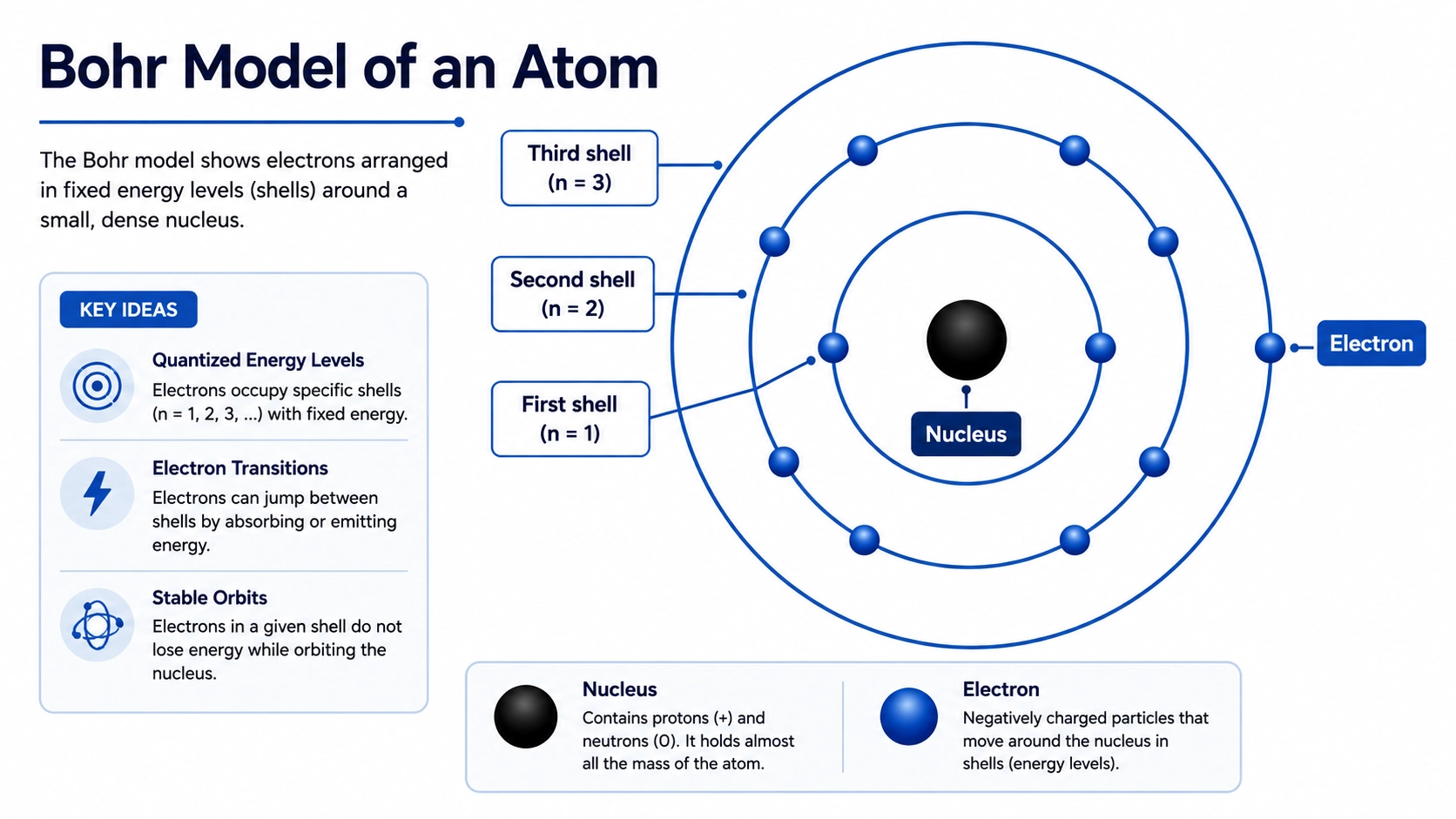
This simplified Bohr model shows the nucleus at the centre with electrons arranged in shells around it.
Atomic Number and Mass Number
The atomic number, symbol Z, is the number of protons in the nucleus of an atom.
The mass number, symbol A, is the total number of protons and neutrons in the atom.
For a neutral atom, the number of electrons is equal to the number of protons.
An ion does not have equal numbers of protons and electrons. A positive ion has lost electrons and a negative ion has gained electrons, so number of electrons = number of protons – charge on the ion. The numbers of protons and neutrons do not change when an ion forms.
Example: In 73Li, the atom has 3 protons and 7 – 3 = 4 neutrons. A neutral lithium atom also has 3 electrons.
Ion example: In 2412Mg2+, there are 12 protons, 24 – 12 = 12 neutrons and 12 – 2 = 10 electrons. In 199F−, there are 9 protons, 19 – 9 = 10 neutrons and 9 + 1 = 10 electrons. Both ions have 10 electrons, so they are described as isoelectronic.
Quick Check: Count the Particles
Answer six quick questions on the particles in atoms and ions.
Isotopes
Isotopes are atoms with the same number of protons but different numbers of neutrons.
Because isotopes of the same element have the same number of protons, they have the same atomic number. Their mass numbers are different because the number of neutrons is different.
Isotopes normally have very similar chemical properties because they have the same electronic structure. They may have slightly different physical properties because their masses are different.
| Isotope | Symbol | Number of protons | Number of neutrons | Number of electrons in a neutral atom |
|---|---|---|---|---|
| chlorine-35 | 3517Cl | 17 | 18 | 17 |
| chlorine-37 | 3717Cl | 17 | 20 | 17 |
Exam focus: Isotopes differ in neutrons, not protons. If the number of protons changes, it is a different element.
Quick Check: Write the Full Symbol
Turn each set of particle numbers into a full symbol on paper, then flip the card to check.
Quick Check: Explain the Properties of an Isotope
Write a short explanation, then compare it with the mark points and the model answer.
Relative Isotopic Mass
Relative isotopic mass is the mass of one atom of an isotope compared with one twelfth of the mass of one atom of carbon-12.
Carbon-12 is used as the standard because one atom of carbon-12 is defined as exactly 12 atomic mass units.
This relative scale avoids using extremely small masses in kilograms when comparing atoms and isotopes.
| Term | Meaning | Exam wording to use |
|---|---|---|
| Atomic mass unit | One twelfth of the mass of one atom of carbon-12. | Use 1/12 and carbon-12. |
| Relative isotopic mass | The mass of one atom of an isotope on the carbon-12 scale. | Refer to one atom of an isotope. |
| Relative atomic mass | The weighted mean mass of atoms of an element compared with 1/12 of carbon-12. | This is covered in more depth in RAM calculations. |
Quick Check: Using the Carbon-12 Scale
Compare each atom with one twelfth of the mass of a carbon-12 atom and type the missing number.
Relative Molecular Mass and Relative Formula Mass
The relative formula mass, Mr, is found by adding together the relative atomic masses of all the atoms shown in a formula.
The term relative molecular mass, sometimes written RMM, should only be used for substances that exist as molecules. Relative formula mass is the safer term because it applies to molecular substances, ionic compounds and giant structures. The specification states that the term relative formula mass should be used for compounds with giant structures.
Relative formula mass, Mr: the sum of the relative atomic masses of all atoms in the formula of a substance.
| Substance | Formula | Calculation | Mr |
|---|---|---|---|
| Carbon dioxide | CO2 | 12.0 + (2 × 16.0) | 44.0 |
| Calcium carbonate | CaCO3 | 40.1 + 12.0 + (3 × 16.0) | 100.1 |
| Magnesium nitrate | Mg(NO3)2 | 24.3 + 2(14.0 + 3 × 16.0) | 148.3 |
Exam focus: brackets multiply everything inside them. In Mg(NO3)2, there are two nitrogen atoms and six oxygen atoms.
Quick Check: Relative Formula Mass with Brackets
Work out each relative formula mass on paper, then type your answer.
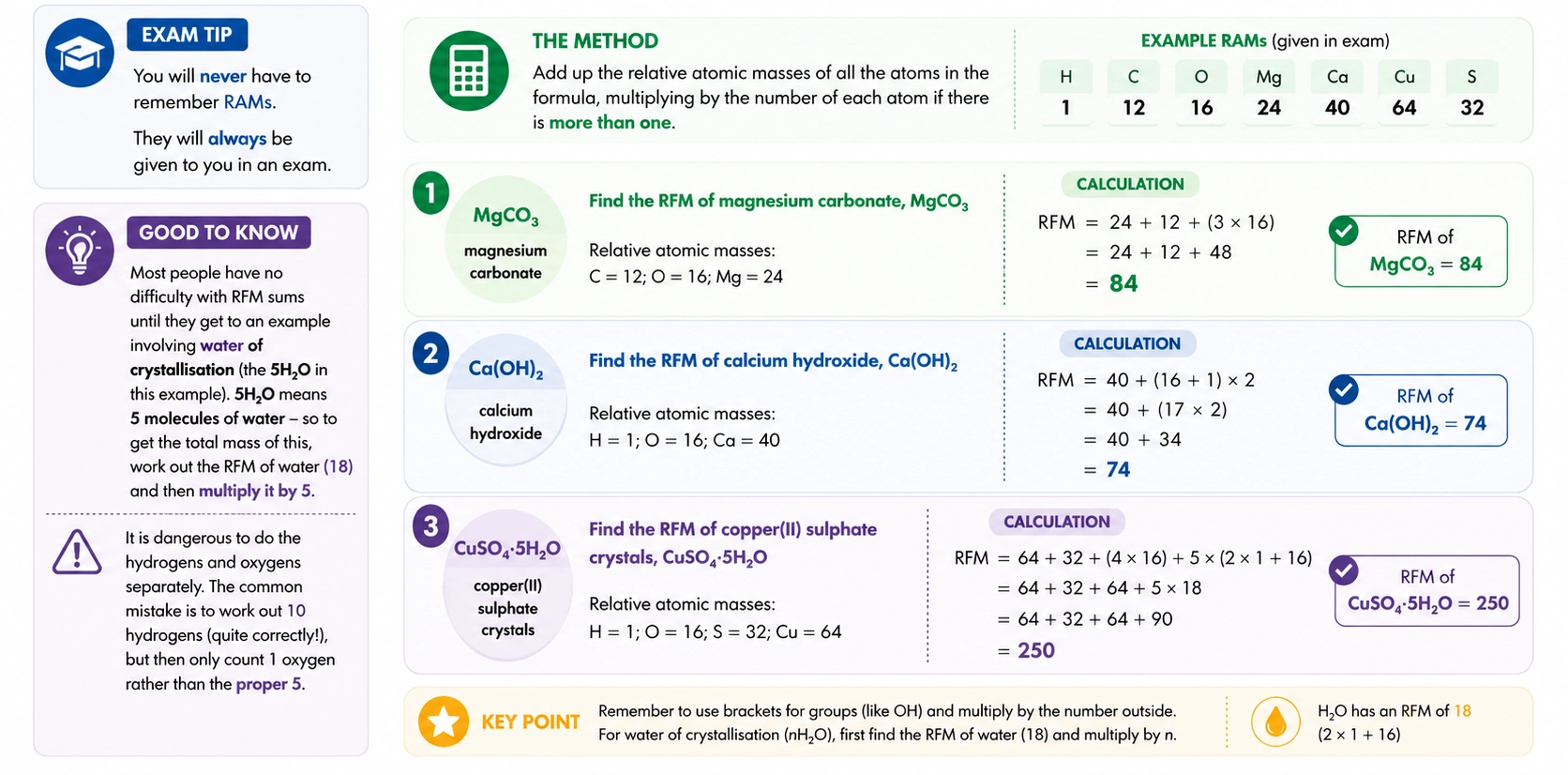
Relative formula mass is calculated by counting each atom in the formula and adding the correct relative atomic masses.
Common Exam Points
Atomic structure questions often reward precise definitions and careful counting. The most important terms are atomic number, mass number, isotope, neutron number and relative isotopic mass.
Do not confuse atomic number and mass number
Atomic number is the number of protons. Mass number is the total number of protons and neutrons.
Use A – Z for neutrons
The number of neutrons is found by subtracting the atomic number from the mass number.
Neutral atoms have equal protons and electrons
If the atom is neutral, the positive charge from protons is balanced by the negative charge from electrons. In an ion the numbers are not equal: a 2+ ion has two fewer electrons than protons, and a 2− ion has two more.
Isotopes have the same electronic structure
This explains why isotopes of the same element have similar chemical properties.
How Ideas About the Atom Have Changed
AQA asks you to appreciate that our picture of the atom has been built up and corrected over time. Each model explained the evidence of its day and was replaced when new experiments could not be explained.
| Model | Scientist and date | What it said | Why it changed |
|---|---|---|---|
| Solid sphere | Dalton, 1803 | Atoms are tiny, indivisible, solid spheres; atoms of one element are identical | Discovery of the electron showed atoms have parts |
| Plum pudding | Thomson, 1904 | A sphere of positive charge with negative electrons dotted through it | Alpha particles fired at gold foil were sometimes bounced straight back |
| Nuclear atom | Rutherford, 1911 | A tiny, dense, positive nucleus with electrons around it and mostly empty space | Could not explain why electrons do not spiral into the nucleus or why atoms give line spectra |
| Planetary shells | Bohr, 1913 | Electrons orbit in fixed shells of definite energy; light is emitted when they drop between shells | Worked for hydrogen but not for larger atoms |
| Quantum model | 1920s onwards | Electrons occupy orbitals, regions of space described by sub-shells s, p, d; the neutron (Chadwick, 1932) completes the nucleus | The current model, used throughout this course |
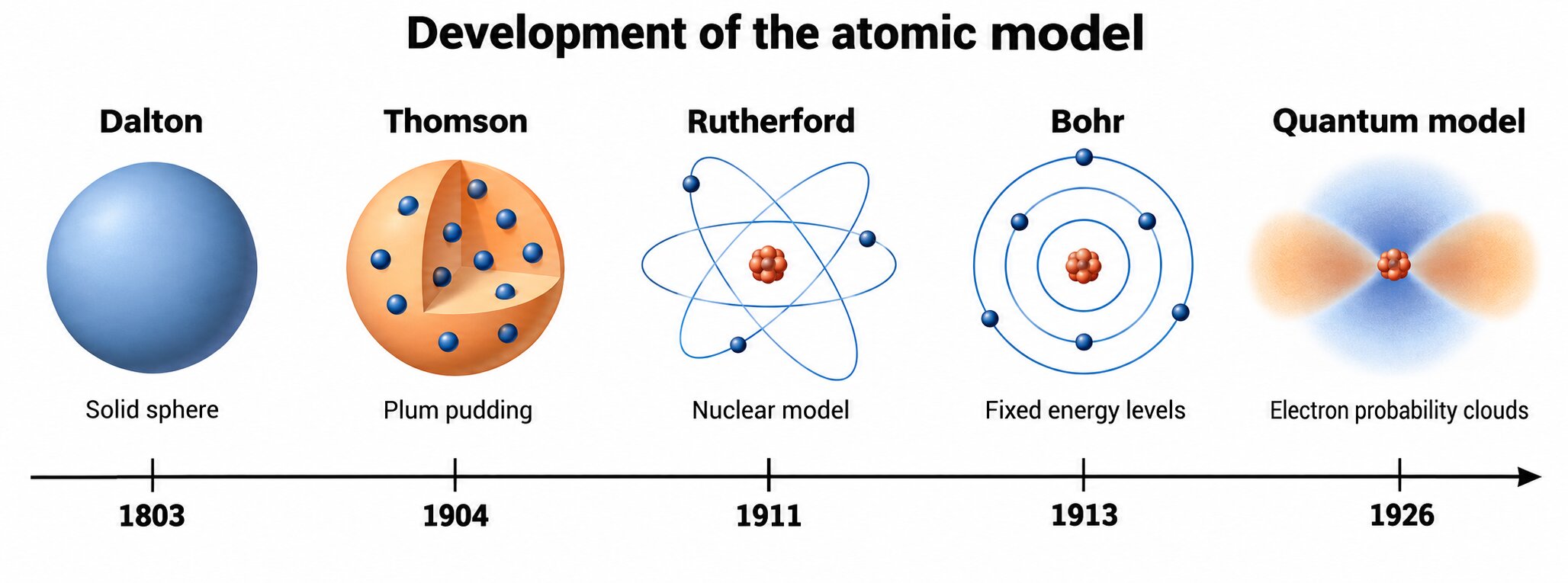
Five models of the atom. Each one kept what worked in the previous model and fixed what it could not explain.
Key idea: A scientific model is accepted while it explains the evidence and replaced when it cannot; the atom described on this page is the current model, not the final word.
Quick Check: Testing the Plum Pudding Model
Predict what the older model of the atom says should happen in the alpha scattering experiment.
QuickSnap
For this page, the essential idea is that the nucleus contains protons and neutrons, while electrons occupy regions around the nucleus. Atomic number counts protons, mass number counts protons plus neutrons, and isotopes have the same number of protons but different numbers of neutrons.
Subatomic particles
Protons have charge +1, neutrons have charge 0, and electrons have charge -1. Protons and neutrons have relative mass 1, while electrons have a much smaller relative mass of about 1/1840.
Atomic number and mass number
Atomic number, Z, gives the number of protons. Mass number, A, gives the number of protons plus neutrons.
Isotopes
Isotopes are atoms of the same element with the same number of protons but different numbers of neutrons.
Carbon-12 scale
Relative isotopic mass compares one atom of an isotope with one twelfth of the mass of one atom of carbon-12.
Master Atomic Structure and the Periodic Table for AQA A Level Chemistry
Continue from these free revision notes into the full 3.1.1 and 3.2.1 Atomic Structure and the Periodic Table course. The five guided video lessons are ready now; the AQA MCQ bank, teacher-marked short-answer questions, supplementary lessons and KASP spec-point mapping are being completed.
Guided video teaching
Learn the chemistry and exam technique through structured video lessons with worked examples and walkthroughs.
Instant MCQ feedback
Auto-marked MCQ quizzes provide immediate diagnostic feedback for every answer choice.
Teacher-marked SAQs
Submit written exam responses and receive chemistry specialist feedback with improvement guidance.
Progress tracking
Identify strengths and weaknesses across the full 3.1.1 and 3.2.1 specification with targeted reporting.
See how the course works
Click play to start the course preview animation.
Some ionic radii are shown.
| Ion | Ionic radius / nm |
|---|---|
| Na+ | 0.102 |
| K+ | 0.138 |
| F− | 0.133 |
| Cl− | 0.180 |
Which compound has the strongest ionic bonding?
Explain why the metallic bonding in magnesium is much stronger than that in sodium.
Atomic Structure FAQs
Use these quick answers to check the definitions most commonly assessed in early atomic structure questions.
What is the atomic number?
The atomic number is the number of protons in the nucleus of an atom. It is also called Z.
What is the mass number?
The mass number is the total number of protons and neutrons in the nucleus of an atom. It is also called A.
How do you calculate the number of neutrons?
Use number of neutrons = mass number – atomic number. In symbols, this is A – Z.
What are isotopes?
Isotopes are atoms with the same number of protons but different numbers of neutrons.
Why do isotopes have similar chemical properties?
Isotopes of the same element have the same number of electrons and the same electronic structure, so they normally react in similar ways.
Copyright notice: This OLS revision content, including the explanations, layout, diagrams, tables and embedded learning structure, is authored for Online Learning System by Dr. Mohammed Al-Fatah. It may not be copied, reproduced, redistributed or adapted without written permission.
Keep this note — free
Save your progress across every AQA topic. A free account remembers which topics you have covered, saves your question scores, and syncs across your phone and laptop.
- Track every topic you have finished
- Keep your practice-question scores
- No payment, no card, free forever
Already registered? Log in