Time of Flight
A concise AQA A Level Chemistry revision guide to the time of flight (TOF) mass spectrometer: how ions are made by electrospray or electron impact, accelerated to the same kinetic energy, drift along the flight tube and are detected, and how flight time gives the mass-to-charge ratio (3.1.1.2).
Why AQA Uses the Time of Flight Instrument
The Mass Spectrometer page describes an instrument that bends ions in a magnetic field. AQA examines a different design, the time of flight (TOF) mass spectrometer, which has no magnet at all. Ions are given the same kinetic energy and then race along an empty tube: lighter ions move faster and reach the detector first, so the flight time reveals the mass-to-charge ratio.
Whatever the design, the spectrometer produces the same output: a plot of relative abundance against m/z. Everything on the RAM Calculations and Predicting Diatomic Mass Spectra pages still applies.
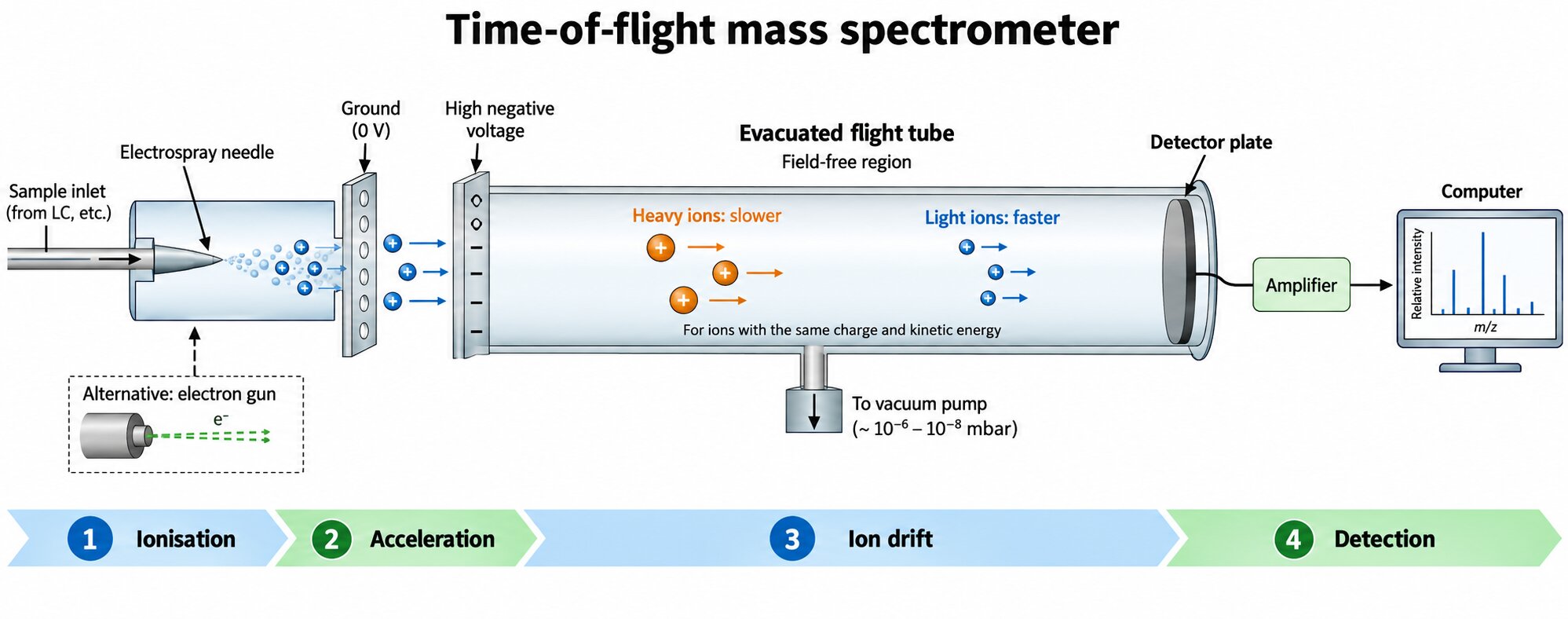
The four stages of a TOF mass spectrometer. The whole instrument is kept under vacuum so that ions do not collide with air molecules.
Key idea: TOF separates ions by how long they take to cover a fixed distance. Same kinetic energy, different mass, therefore different speed and different flight time.
Stage 1: Ionisation
Ions are needed because only charged particles can be accelerated by an electric field and counted by the detector. AQA names two methods.
| Method | How it works | Ion formed | Used for |
|---|---|---|---|
| Electrospray ionisation | The sample is dissolved in a volatile, polar solvent and pushed through a fine hypodermic needle held at a high positive voltage. The tiny droplets lose solvent and each molecule picks up a proton from the solvent. | XH+, so the ion has a mass one unit greater than the molecule: X + H+ → XH+ | Large, fragile molecules such as proteins that would break up under electron impact |
| Electron impact | The sample is vaporised and bombarded with high-energy electrons from an electron gun. Each impact knocks one electron out of the molecule or atom. | X+, a molecular ion or atomic ion with the same mass as the original particle: X → X+ + e− | Elements and small, robust molecules |
The distinction matters in calculations. An electrospray peak at m/z 181 for a singly charged ion means the molecule itself has a relative molecular mass of 180, because one proton (mass 1) was added. An electron-impact peak at m/z 180 means the molecular mass is 180.
Exam sentence: Electrospray: the sample gains a proton to form XH⁺. Electron impact: a high-energy electron knocks an electron out of the sample to form X⁺. Write the equation and state which ion forms.
Stage 2: Acceleration to the Same Kinetic Energy
The positive ions are attracted towards a negatively charged plate. Every ion with the same charge passes through the same potential difference, so each gains the same kinetic energy, whatever its mass.
Kinetic energy is linked to mass and speed by
KE = ½ m v² so v = √(2KE / m)
Because KE is the same for every ion, a heavier ion must move more slowly than a lighter one. Doubling the mass reduces the speed by a factor of √2, not by half.
Key idea: Same kinetic energy is the whole point. If ions had the same speed instead, mass could not be measured from flight time at all.
Stage 3: Ion Drift Along the Flight Tube
After the acceleration region there is no further field. The ions drift at constant speed along an evacuated tube of fixed length d, so their flight time is
t = d / v and, substituting for v, t = d √(m / 2KE)
Flight time is proportional to the square root of the mass. Ions of higher mass arrive later. Because the tube is a vacuum, no collisions slow the ions or knock them off course.
| Ion | Mass of one ion / kg | Speed for KE = 1.20 × 10⁻¹³ J | Flight time for d = 1.00 m |
|---|---|---|---|
| 12C+ | 1.99 × 10⁻²⁶ | 3.47 × 10⁶ m s−1 | 2.88 × 10⁻⁷ s |
| 63Cu+ | 1.05 × 10⁻²⁵ | 1.51 × 10⁶ m s−1 | 6.62 × 10⁻⁷ s |
| 208Pb+ | 3.45 × 10⁻²⁵ | 8.34 × 10⁵ m s−1 | 1.20 × 10⁻⁶ s |
The mass of one ion in kilograms is the relative mass divided by the Avogadro constant and converted from grams: m = (M / 1000) / L. For 63Cu that is 0.063 / (6.022 × 10²³) = 1.05 × 10⁻²⁵ kg.
Stage 4: Detection and Data Analysis
The ions strike a negatively charged detector plate. Each positive ion gains an electron from the plate, and that flow of electrons is a tiny electric current. The size of the current is proportional to the number of ions arriving, so it measures abundance; the time of arrival gives m/z.
A computer converts the arrival times into m/z values using the flight-time equation and plots relative abundance against m/z: the mass spectrum. For an element the spectrum shows one peak per isotope; for a compound it shows the molecular ion and any fragments.
Exam sentence: Ions are detected when they gain an electron at the detector plate, producing a current whose size depends on the number of ions. The flight time gives m/z and the current gives abundance.
Worked Calculation: Flight Time of an Ion
Question. A 35Cl+ ion is accelerated to a kinetic energy of 1.35 × 10⁻¹³ J and drifts along a 0.850 m flight tube. Calculate its flight time. (L = 6.022 × 10²³ mol−1)
- Mass of one ion: m = 0.035 / (6.022 × 10²³) = 5.81 × 10⁻²⁶ kg
- Speed: v = √(2 × 1.35 × 10−13 / 5.81 × 10⁻²⁶) = √(4.65 × 10¹²) = 2.16 × 10⁶ m s−1
- Flight time: t = 0.850 / 2.16 × 106 = 3.94 × 10⁻⁷ s
Working backwards. If an unknown ion in the same instrument takes 4.21 × 10⁻⁷ s, then v = 0.850 / 4.21 × 10−7 = 2.02 × 10⁶ m s−1, m = 2KE / v² = 2 × 1.35 × 10−13 / (2.02 × 10⁶)² = 6.62 × 10⁻²⁶ kg, and M = m × L × 1000 = 39.9 g mol−1: the ion is 40Ar+.
Key idea: Keep everything in SI units: kilograms, metres, joules, seconds. Convert the relative mass to the mass of one ion in kilograms before you touch the equation.
Common Exam Mistakes
- Saying ions are separated by a magnetic field. There is no magnet in a TOF instrument: separation happens by flight time in a field-free tube.
- Giving the ions the same speed. They have the same kinetic energy; speed depends on mass.
- Forgetting the extra proton in electrospray. The peak appears at M + 1, so subtract 1 to find the relative molecular mass.
- Using the relative mass in grams. Divide by the Avogadro constant and convert to kilograms first.
- Describing detection as “the ion hits the plate”. The mark is for the ion gaining an electron and the resulting current.
Exam sentence: In a time of flight mass spectrometer ions with the same kinetic energy but different masses travel at different speeds, so they reach the detector at different times; the flight time is used to find m/z.
Check Your Understanding
Use these short activities to check the time of flight ideas on ions and values that do not appear on this page.
Master Atomic Structure and the Periodic Table for AQA A Level Chemistry
Continue from these free revision notes into the full 3.1.1 and 3.2.1 Atomic Structure and the Periodic Table course. The five guided video lessons are ready now; the AQA MCQ bank, teacher-marked short-answer questions, supplementary lessons and KASP spec-point mapping are being completed.
Guided video teaching
Learn the chemistry and exam technique through structured video lessons with worked examples and walkthroughs.
Instant MCQ feedback
Auto-marked MCQ quizzes provide immediate diagnostic feedback for every answer choice.
Teacher-marked SAQs
Submit written exam responses and receive chemistry specialist feedback with improvement guidance.
Progress tracking
Identify strengths and weaknesses across the full 3.1.1 and 3.2.1 specification with targeted reporting.
See how the course works
Click play to start the course preview animation.
Some ionic radii are shown.
| Ion | Ionic radius / nm |
|---|---|
| Na+ | 0.102 |
| K+ | 0.138 |
| F− | 0.133 |
| Cl− | 0.180 |
Which compound has the strongest ionic bonding?
Explain why the metallic bonding in magnesium is much stronger than that in sodium.
Copyright notice: This OLS revision content, including the explanations, layout, diagrams, tables and embedded learning structure, is authored for Online Learning System by Dr. Mohammed Al-Fatah. It may not be copied, reproduced, redistributed or adapted without written permission.
Keep this note — free
Save your progress across every AQA topic. A free account remembers which topics you have covered, saves your question scores, and syncs across your phone and laptop.
- Track every topic you have finished
- Keep your practice-question scores
- No payment, no card, free forever
Already registered? Log in