RAM Calculations
A concise AQA A Level Chemistry revision guide to calculating relative atomic mass from isotopic abundances, mass spectra and missing isotope data.
GCSE Recap: Isotopes and a Weighted Mean
Before you start, check what you remember about isotopes and about finding a mean when there are more of some atoms than others.
What Relative Atomic Mass Means
Relative atomic mass, Ar, is the weighted mean mass of an atom of an element compared with one twelfth of the mass of a carbon-12 atom.
Most elements exist as a mixture of isotopes. This means the relative atomic mass is usually not a whole number, because it depends on both the relative isotopic masses and the relative abundances of those isotopes.
Key idea: the isotope that is more abundant has a greater effect on the final Ar value.
Quick Check: Which Isotope Dominates?
No calculator needed: use the relative atomic mass to judge the abundances.
The Relative Atomic Mass Formula
To calculate Ar, multiply each isotopic mass by its abundance, add the results, then divide by the total abundance.
Ar = Σ(isotopic mass × abundance) ÷ Σ(abundance)
If percentage abundances are used, the total abundance is usually 100.| Data type | How to divide | Typical exam wording |
|---|---|---|
| Percentage abundance | Divide by 100 | 20.0% of atoms are boron-10 and 80.0% are boron-11 |
| Relative abundance from a mass spectrum | Divide by the sum of the peak abundances | The peaks have relative abundances of 114.0, 0.2 and 11.2 |
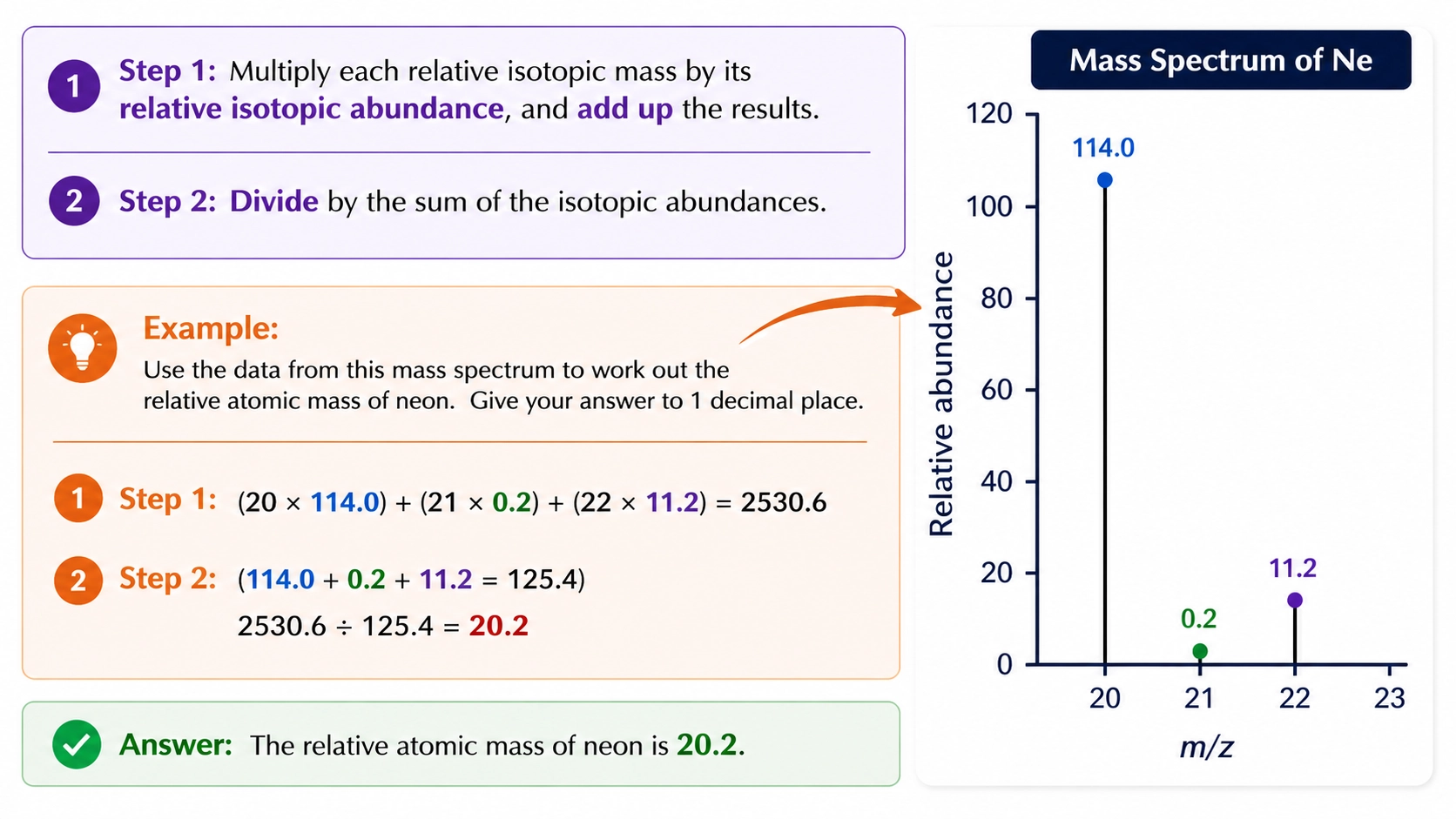
Mass spectrum peak heights act as relative abundances, so they must be included in the weighted mean calculation.
Calculating Ar from Isotopic Abundances
When the abundances are percentages, the calculation is straightforward because the total abundance is 100.
Example: boron
20.0% of boron atoms have relative isotopic mass 10.0 and 80.0% have relative isotopic mass 11.0.
Step 1: multiply and add
(20.0 × 10.0) + (80.0 × 11.0) = 200.0 + 880.0 = 1080.0
Step 2: divide by 100
1080.0 ÷ 100 = 10.8
Exam focus: do not simply average 10.0 and 11.0. The answer is closer to 11.0 because boron-11 is more abundant.
Quick Check: Calculate with New Percentages
Calculate each relative atomic mass on paper and type it to the stated number of decimal places.
Calculating Ar from a Mass Spectrum
In a simple isotope mass spectrum, the x-axis gives the m/z values. If the ions have a 1+ charge, these m/z values can usually be treated as the relative isotopic masses.
The height of each peak shows the relative abundance of that isotope. Use these peak heights in the weighted mean calculation.
Example: chlorine
Chlorine has peaks at m/z 35 and m/z 37 with abundances of 75% and 25%, a 3:1 ratio.
Calculation
Ar = [(35 × 75) + (37 × 25)] ÷ 100 = 35.5.
Quick Check: A Thallium Spectrum
Use the two peaks of a new spectrum to find a relative atomic mass.
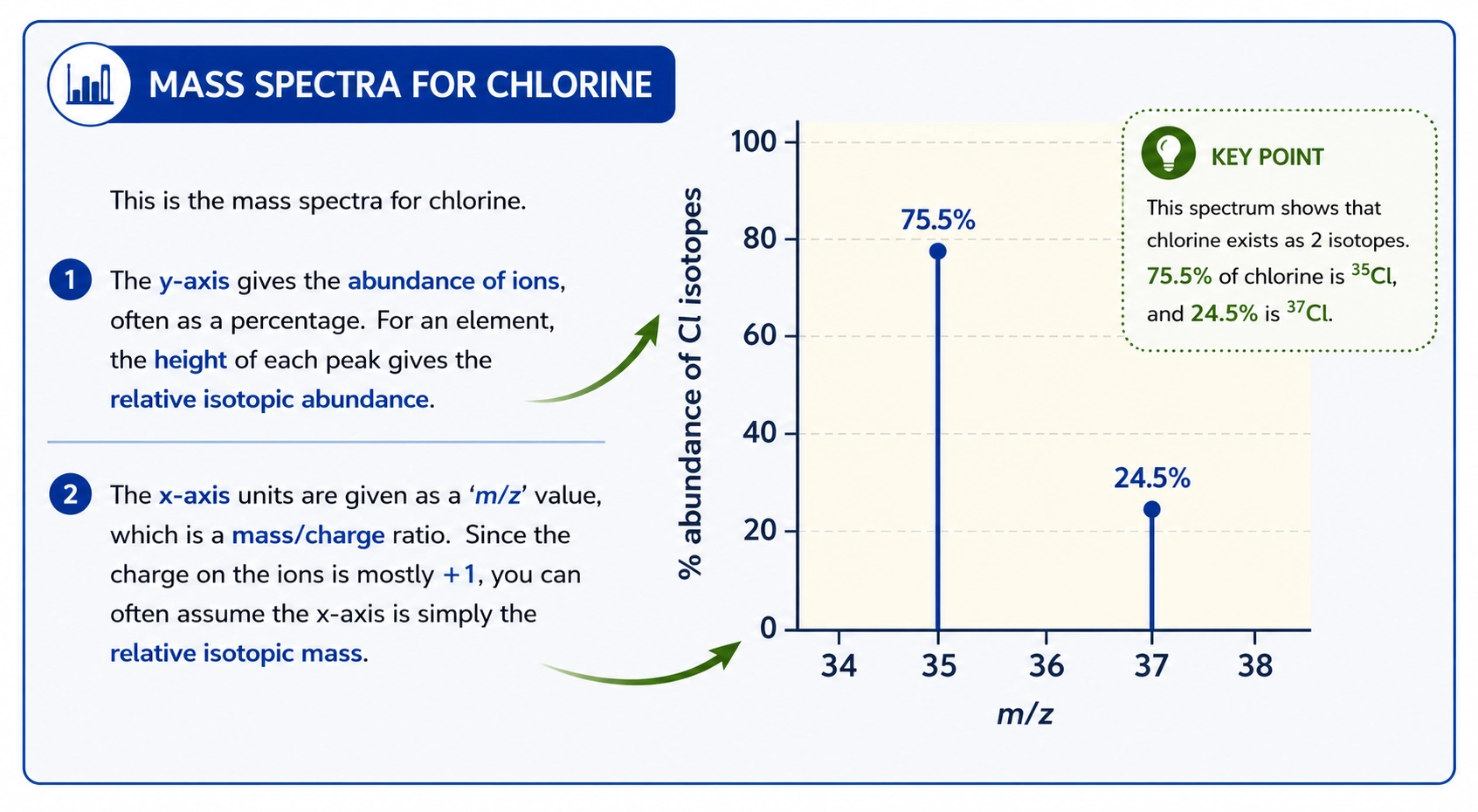
The two chlorine peaks show that chlorine-35 is more abundant than chlorine-37, so the Ar is closer to 35 than 37.
When Abundances Are Not Percentages
Some questions give relative abundances that do not add up to 100. In these cases, divide by the sum of the relative abundances, not by 100.
Example: neon spectrum
Masses 20, 21 and 22 have relative abundances of 114.0, 0.2 and 11.2.
Step 1: multiply and add
(20 × 114.0) + (21 × 0.2) + (22 × 11.2) = 2530.6
Step 2: divide by total abundance
Total abundance = 114.0 + 0.2 + 11.2 = 125.4
2530.6 ÷ 125.4 = 20.2
Common mistake: only divide by 100 when the abundances are percentages that total 100.
Quick Check: Abundances That Do Not Total 100
Work out each answer on paper before you flip the card.
Finding Missing Isotope Data
Some questions give the Ar and some isotope data, then ask for the abundance or isotopic mass of a missing isotope. Use the same weighted mean equation, but rearrange it.
Example: silicon abundance
Silicon has three isotopes. 92.23% is 28Si and 4.67% is 29Si. The remaining isotope has abundance:
100.00 − 92.23 − 4.67 = 3.10%
Example: silicon mass
If Ar = 28.1 and the final isotope has mass X:
28.1 = [(28 × 92.23) + (29 × 4.67) + (X × 3.10)] ÷ 100
Rearranged result
2810 = 2717.87 + 3.10X
92.13 = 3.10X
X = 29.7, so the isotope is treated as 30Si.
Exam focus: isotopic mass numbers are normally whole numbers, so a calculated value close to 30 represents silicon-30.
A common question gives the Ar of an element with two isotopes and asks for both abundances. Let the abundance of one isotope be x%. The other must be (100 − x)%.
Example: rhenium abundances
A sample of rhenium contains only 185Re and 187Re. Its Ar is 186.2. Let the abundance of 185Re be x%, so 187Re is (100 − x)%.
Step 1: write the equation
186.2 = [185x + 187(100 − x)] ÷ 100
Step 2: solve for x
18620 = 185x + 18700 − 187x
2x = 80, so x = 40
185Re = 40% and 187Re = 60%.
Check: 186.2 is closer to 187 than to 185, so 187Re must be the more abundant isotope. The two abundances must add up to 100.
Quick Check: Find the Missing Data
Rearrange the weighted mean equation to find a missing abundance and a missing isotopic mass.
Quick Check: Is That Answer Sensible?
In each round, pick the one statement that is accurate.
Common Exam Points
These points are useful for short calculation questions and explanations linked to mass spectra.
Use peak height as abundance
In simple mass spectra, the peak height gives the relative abundance of that isotope.
Check the total abundance
If the data are percentages, divide by 100. If they are relative abundances, divide by their total.
Use m/z carefully
If the charge is 1+, the m/z value is usually treated as the relative isotopic mass. If the charge is not 1+, the mass-to-charge ratio must be considered directly.
Round only at the end
Keep extra figures during the calculation, then round to the number of decimal places requested in the question.
QuickSnap Summary
Ar is a weighted mean, so both isotopic mass and abundance matter.
Multiply each isotope mass by its abundance.
Add all of the mass × abundance values.
Divide by the total abundance. For percentages, this is normally 100.
For a mass spectrum, use the m/z values as isotope masses when the ions are 1+ and use peak heights as relative abundances.
To find both abundances of a two-isotope element from its Ar, use x and (100 − x), then solve the weighted mean equation.
Master Atomic Structure and the Periodic Table for AQA A Level Chemistry
Continue from these free revision notes into the full 3.1.1 and 3.2.1 Atomic Structure and the Periodic Table course. The five guided video lessons are ready now; the AQA MCQ bank, teacher-marked short-answer questions, supplementary lessons and KASP spec-point mapping are being completed.
Guided video teaching
Learn the chemistry and exam technique through structured video lessons with worked examples and walkthroughs.
Instant MCQ feedback
Auto-marked MCQ quizzes provide immediate diagnostic feedback for every answer choice.
Teacher-marked SAQs
Submit written exam responses and receive chemistry specialist feedback with improvement guidance.
Progress tracking
Identify strengths and weaknesses across the full 3.1.1 and 3.2.1 specification with targeted reporting.
See how the course works
Click play to start the course preview animation.
Some ionic radii are shown.
| Ion | Ionic radius / nm |
|---|---|
| Na+ | 0.102 |
| K+ | 0.138 |
| F− | 0.133 |
| Cl− | 0.180 |
Which compound has the strongest ionic bonding?
Explain why the metallic bonding in magnesium is much stronger than that in sodium.
RAM Calculations FAQs
Use these quick answers to secure the key wording for AQA A Level Chemistry.
What is relative atomic mass?
Relative atomic mass is the weighted mean mass of an atom of an element compared with one twelfth of the mass of a carbon-12 atom.
Why is relative atomic mass often not a whole number?
It is a weighted mean of the masses of different isotopes, using their relative abundances.
How do you calculate Ar from percentage abundances?
Multiply each isotopic mass by its percentage abundance, add the results, then divide by 100.
How do you calculate Ar from mass spectrum peaks?
Use the m/z values as isotope masses for 1+ ions, use the peak heights as relative abundances, then divide by the sum of the peak heights.
Why is chlorine’s Ar about 35.5?
Chlorine-35 is more abundant than chlorine-37, so the weighted mean lies closer to 35 than to 37.
What is the most common RAM calculation mistake?
The most common mistake is dividing by 100 when the abundances are relative peak heights that do not total 100.
Copyright notice: This OLS revision content, including the explanations, layout, diagrams, tables and embedded learning structure, is authored for Online Learning System by Dr. Mohammed Al-Fatah. It may not be copied, reproduced, redistributed or adapted without written permission.
Keep this note — free
Save your progress across every AQA topic. A free account remembers which topics you have covered, saves your question scores, and syncs across your phone and laptop.
- Track every topic you have finished
- Keep your practice-question scores
- No payment, no card, free forever
Already registered? Log in