Successive Ionisation Energies
A concise revision guide to successive ionisation energies, why each ionisation energy increases, and how large jumps reveal an element’s group and electronic structure.
GCSE Recap: Shells and Outer Electrons
Before you start, check that you can read groups, periods and outer electrons from an electron arrangement.
What Are Successive Ionisation Energies?
Successive ionisation energies are the energies required to remove electrons one after another from the same element in the gaseous state.
The first ionisation energy removes one electron from a neutral gaseous atom. The second ionisation energy removes one electron from a gaseous 1+ ion. The third ionisation energy removes one electron from a gaseous 2+ ion, and so on.
General equation: the nth ionisation energy is the energy needed for X(n−1)+(g) → Xn+(g) + e−, for one mole of gaseous ions. For example, the third ionisation energy of sodium is Na²⁺(g) → Na³⁺(g) + e⁻.
Core idea: successive ionisation energy data shows how strongly each electron is held as electrons are removed from the atom or ion one at a time.
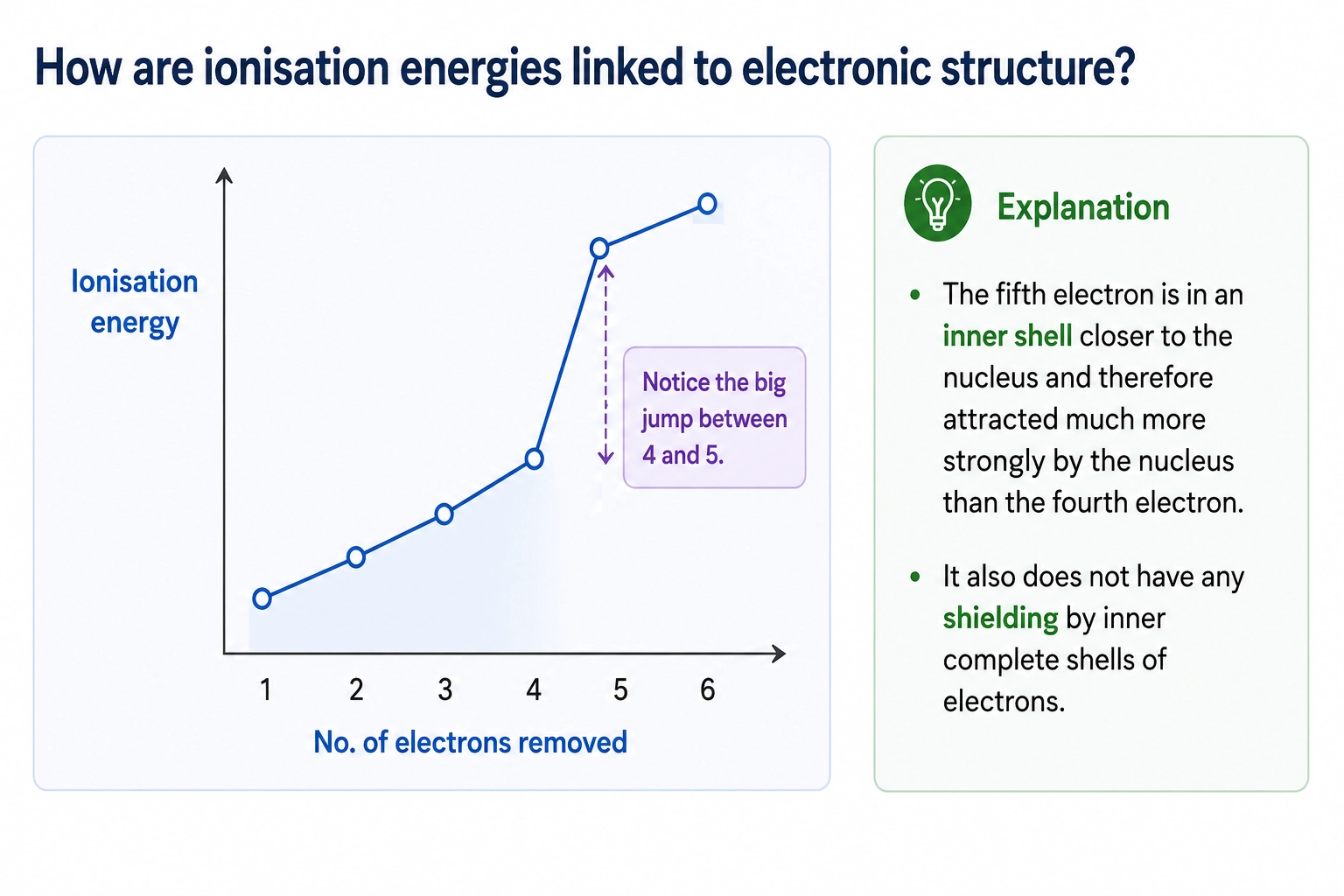
The large rises occur when removal moves from an outer shell into an inner shell that is closer to the nucleus.
Why Each Ionisation Energy Increases
Each ionisation energy is normally larger than the previous one because, after each electron is removed, the species becomes more positively charged.
The remaining electrons are attracted more strongly by the nucleus. There is also less electron-electron repulsion between the remaining electrons. This means it becomes harder to remove the next electron, so more energy is required each time.
A positive ion forms
Removing the first electron forms a positive ion, so the remaining electrons experience stronger attraction.
Electron-electron repulsion decreases
With fewer electrons left, there is less repulsion between electrons, so the remaining electrons are held more strongly.
The next electron is harder to remove
More energy is needed to overcome the stronger attraction between the nucleus and the next electron.
Quick Check: A Rise Without a Change of Shell
Decide why the second ionisation energy of silicon is larger than the first.
Why Big Jumps Happen
A big jump in successive ionisation energy shows that an electron is being removed from a shell closer to the nucleus.
Electrons in inner shells are closer to the nucleus and have less shielding from inner complete shells. They are therefore much more strongly attracted to the nucleus, so a much larger amount of energy is needed to remove them.
Exam focus: A big jump means the previous electron was the last electron in the outer shell. The next electron comes from an inner shell.
Quick Check: Explain a Big Jump
Write a short explanation, then compare it with the mark points and the model answer.
The position of the jump is used to infer how many electrons were in the outer shell before ionisation reached the next shell.
Using the First Big Jump to Find the Group
The first large jump tells you how many electrons were removed before the atom started losing electrons from an inner shell.
For main-group elements, count how many electrons are removed before the first big jump. That number gives the group number for Group 1 to Group 7 elements. For example, if the first big jump is between the second and third ionisation energies, the element is in Group 2. A noble gas has a full outer shell of eight electrons, so its first big jump comes after the eighth ionisation energy (after the second for helium).
| Pattern in successive ionisation energy | Outer-shell electrons | Likely group |
|---|---|---|
| Big jump between 1st and 2nd ionisation energies | 1 electron removed before the jump | Group 1 |
| Big jump between 2nd and 3rd ionisation energies | 2 electrons removed before the jump | Group 2 |
| Big jump between 3rd and 4th ionisation energies | 3 electrons removed before the jump | Group 3 |
| Big jump between 7th and 8th ionisation energies | 7 electrons removed before the jump | Group 7 |
Method: count the number of ionisation energies before the first major jump. This tells you the number of outer-shell electrons.
Common mistake: do not stop at the first rise that looks large. The second ionisation energy can be two or three times the first even when both electrons come from the same shell. Compare the size of every step and choose the one that is far bigger than the others.
Quick Check: Find the Group from the Data
Find the first big jump in each set of data and type the group number or the symbol.
Using the Graph to Find Electronic Structure
Successive ionisation energy graphs can also be used to work out the number of electrons in each shell.
Start from the right-hand side of the graph and work from right to left. Count how many points appear before each big jump. This gives the number of electrons in each shell, starting with the first shell closest to the nucleus.
The vertical axis is usually a logarithmic scale, plotted as log₁₀(ionisation energy). The values cover a very wide range: for sodium, from 496 kJ mol⁻¹ for the first electron to about 159 000 kJ mol⁻¹ for the eleventh. On an ordinary scale the first few points would be squashed along the bottom of the graph. A log scale fits every point on one graph and still shows the big jumps between shells.
Sodium example: one electron is removed before the first big jump, so sodium has one outer electron and belongs to Group 1.
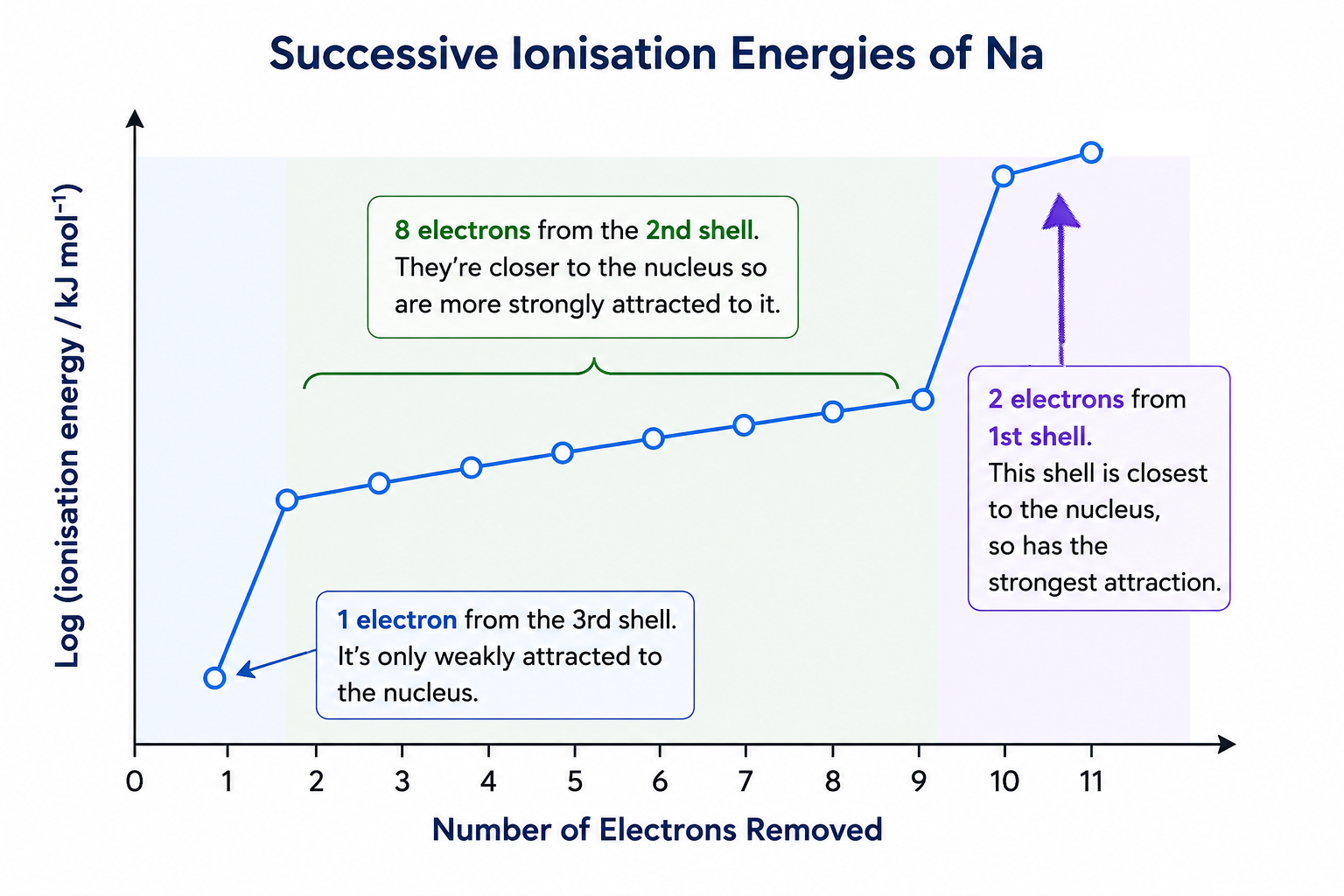
For sodium, the graph shows 2 electrons in the first shell, 8 in the second shell and 1 in the third shell.
Worked Pattern Example
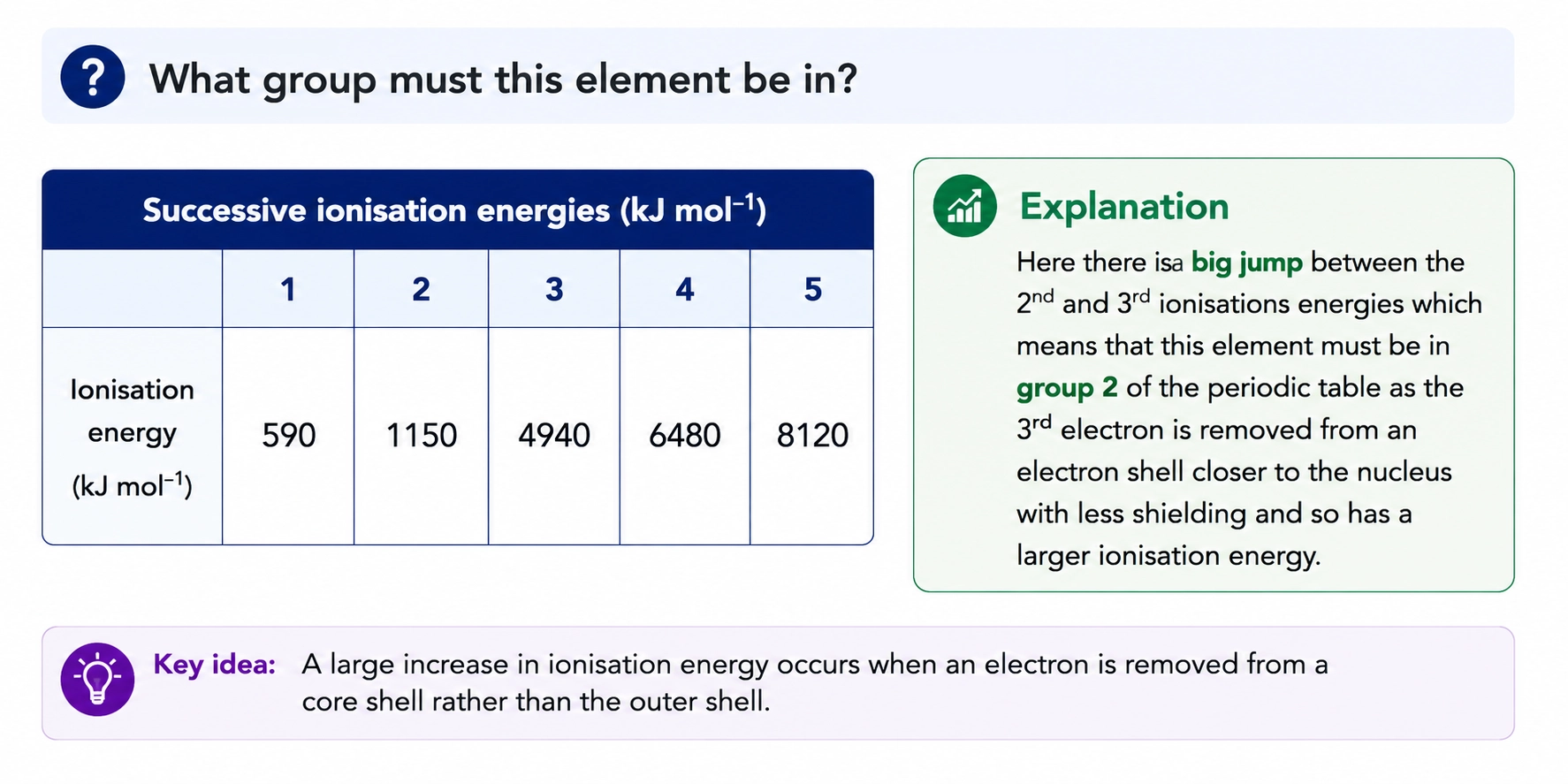
Suppose an element has the following successive ionisation energies:
| Ionisation number | 1st | 2nd | 3rd | 4th | 5th |
|---|---|---|---|---|---|
| Ionisation energy / kJ mol⁻¹ | 590 | 1150 | 4940 | 6480 | 8120 |
There is a large jump between the second and third ionisation energies. This means two electrons were removed before the first large jump, so the element has two electrons in its outer shell.
A metal loses its outer-shell electrons when it forms ions. This element therefore forms 2+ ions, so its chloride has the formula XCl₂.
Conclusion: the element is in Group 2 because the third electron is removed from an inner shell closer to the nucleus with less shielding.
Quick Check: Structure, Formula and Graph
Answer three questions that use successive ionisation energy data in different ways.
Quick Check: Pick the Accurate Statement
In each round, choose the one statement that is accurate.
Common Exam Points
- Successive ionisation energies increase because each electron is removed from an increasingly positive species.
- After an electron is removed, attraction between the nucleus and the remaining electrons increases.
- Large jumps show that the next electron is being removed from a shell closer to the nucleus.
- The number of electrons removed before the first big jump gives the number of outer-shell electrons.
- The first large jump can be used to identify the group for main-group elements.
- Always explain jumps using distance from the nucleus, shielding and nuclear attraction.
- Do not simply say “it is in a new shell”. State that the electron is in a shell closer to the nucleus and is more strongly attracted.
QuickSnap
This text summary condenses the page into the essential exam ideas.
- Successive ionisation energies remove electrons one at a time from gaseous atoms or ions.
- Each value increases because the remaining electrons are attracted more strongly after a positive ion forms.
- A big jump means the next electron is being removed from an inner shell closer to the nucleus.
- Group number can be found by counting how many electrons are removed before the first big jump.
- Electronic structure can be inferred by counting groups of points between large jumps.
- Graph axis: usually log₁₀(ionisation energy), because the values cover a very wide range.
- Ion charge: a metal with n electrons before the first big jump forms n+ ions.
- Exam explanations should mention distance from the nucleus, shielding and nuclear attraction.
Master Atomic Structure and the Periodic Table for AQA A Level Chemistry
Continue from these free revision notes into the full 3.1.1 and 3.2.1 Atomic Structure and the Periodic Table course. The five guided video lessons are ready now; the AQA MCQ bank, teacher-marked short-answer questions, supplementary lessons and KASP spec-point mapping are being completed.
Guided video teaching
Learn the chemistry and exam technique through structured video lessons with worked examples and walkthroughs.
Instant MCQ feedback
Auto-marked MCQ quizzes provide immediate diagnostic feedback for every answer choice.
Teacher-marked SAQs
Submit written exam responses and receive chemistry specialist feedback with improvement guidance.
Progress tracking
Identify strengths and weaknesses across the full 3.1.1 and 3.2.1 specification with targeted reporting.
See how the course works
Click play to start the course preview animation.
Some ionic radii are shown.
| Ion | Ionic radius / nm |
|---|---|
| Na+ | 0.102 |
| K+ | 0.138 |
| F− | 0.133 |
| Cl− | 0.180 |
Which compound has the strongest ionic bonding?
Explain why the metallic bonding in magnesium is much stronger than that in sodium.
FAQs
Use these answers to check the common exam logic behind successive ionisation energy questions.
Why do successive ionisation energies increase?
They increase because each electron is removed from a species with a greater positive charge. The remaining electrons are held more strongly by the nucleus, so more energy is needed to remove the next electron.
What does a large jump in successive ionisation energy show?
A large jump shows that the next electron is being removed from an inner shell closer to the nucleus. This electron experiences less shielding and stronger nuclear attraction.
How can successive ionisation energies show the group number?
Count how many electrons are removed before the first large jump. For main-group elements, this number is the number of outer-shell electrons and therefore indicates the group number.
How does the sodium graph show that sodium is in Group 1?
Sodium has one electron removed before the first large jump. This shows it has one outer-shell electron, so sodium belongs to Group 1.
What should an exam answer include when explaining a jump?
An exam answer should state that the electron is removed from a shell closer to the nucleus, with less shielding and stronger attraction to the nucleus.
Copyright notice: This OLS revision content, including the explanations, layout, diagrams, tables and embedded learning structure, is authored for Online Learning System by Dr. Mohammed Al-Fatah. It may not be copied, reproduced, redistributed or adapted without written permission.
Keep this note — free
Save your progress across every AQA topic. A free account remembers which topics you have covered, saves your question scores, and syncs across your phone and laptop.
- Track every topic you have finished
- Keep your practice-question scores
- No payment, no card, free forever
Already registered? Log in