The Mole and Avogadro Constant
A focused AQA revision guide to the mole, amount of substance, molar mass and the Avogadro constant. These ideas are used throughout quantitative chemistry, so the aim is to make the meaning of one mole clear before applying it to calculations.
GCSE Recap: Relative Formula Mass
Before you start, check that you can still work out a relative formula mass the GCSE way.
The Mole
In chemistry, a mole is a measure of amount of substance. It lets chemists count particles by weighing substances, rather than trying to count individual atoms, ions or molecules directly.
The important point is that the formula must always be stated. For example, 1 mole of oxygen atoms, O, is not the same as 1 mole of oxygen molecules, O2.
Mole: the SI unit for amount of substance. The abbreviation for mole is mol.
Key idea: always quote the formula when referring to a mole of a substance, because different formulae have different molar masses.
Why the Formula Must Be Quoted
If a formula is not stated, the meaning of the calculation can become ambiguous. This is especially important for elements that exist as molecules and for hydrated salts.
| Expression | Meaning | Molar mass used |
|---|---|---|
| 1 mol of oxygen atoms, O | One mole of separate oxygen atoms. | 16 g mol-1 |
| 1 mol of oxygen molecules, O2 | One mole of oxygen molecules, each containing two oxygen atoms. | 32 g mol-1 |
| 1 mol of anhydrous copper(II) sulfate, CuSO4 | Copper(II) sulfate with no water of crystallisation. | 160 g mol-1 |
| 1 mol of hydrated copper(II) sulfate, CuSO4.5H2O | Copper(II) sulfate crystals containing water of crystallisation. | 250 g mol-1 |
Working Out Masses
The mass of one mole of a substance is found by working out its relative formula mass, then attaching the unit grams.
Rule: mass of 1 mole of a substance = relative formula mass in grams.
For example, iron(II) sulfate crystals have the formula FeSO4.7H2O. Using H = 1, O = 16, S = 32 and Fe = 56:
RFM of FeSO4.7H2O: 56 + 32 + (4 × 16) + 7 × [(2 × 1) + 16] = 278. Therefore, 1 mol of FeSO4.7H2O has a mass of 278 g.
For oxygen gas, the formula is O2, so the relative formula mass is 2 × 16 = 32. Therefore, 1 mol of O2 has a mass of 32 g.
Quick Check: Which Formula, Which Mass?
Pick the mass of one mole for each formula as quickly as you can.
Simple Calculations with Moles
The most common mole calculation links mass, amount of substance and molar mass.
Core equation: amount of substance = mass ÷ molar mass
In symbols, this is usually written as:
n = m ÷ M, where n is amount in mol, m is mass in g and M is molar mass in g mol-1.
| Question type | Method | Example |
|---|---|---|
| Find mass from moles | mass = amount × molar mass | 0.200 mol of CaCO3 has mass 0.200 × 100 = 20.0 g |
| Find moles from mass | amount = mass ÷ molar mass | 54 g of H2O is 54 ÷ 18 = 3.00 mol |
| Find molar mass | molar mass = mass ÷ amount | 10.0 g of a substance containing 0.250 mol has M = 40.0 g mol-1 |
Quick Check: Mass, Amount and Molar Mass
Work each calculation out on paper before you turn the card.
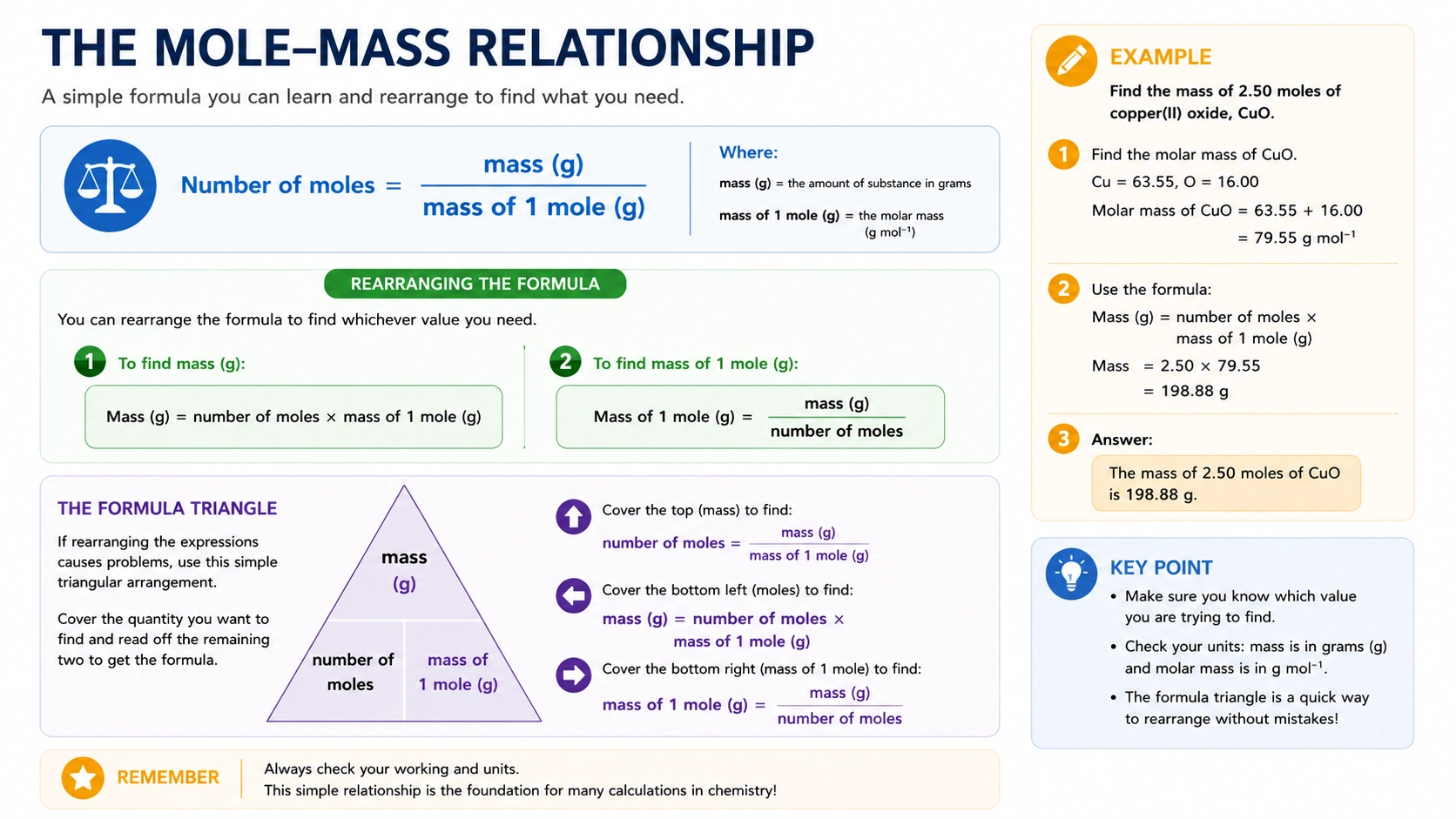
The mole-mass triangle helps students rearrange the relationship between mass, amount and molar mass.
Avogadro Constant
The Avogadro constant is the number of specified particles in 1 mole of a substance. For AQA A Level Chemistry, use the Avogadro constant, L = 6.022 × 10²³ mol-1, unless a question gives a different value.
The particles being counted depend on the formula being discussed. You may be counting atoms, molecules, ions or formula units.
Avogadro constant, L: the number of specified particles per mole, 6.022 × 10²³ mol-1.
Core equation: number of specified particles = amount of substance, n × Avogadro constant, L.
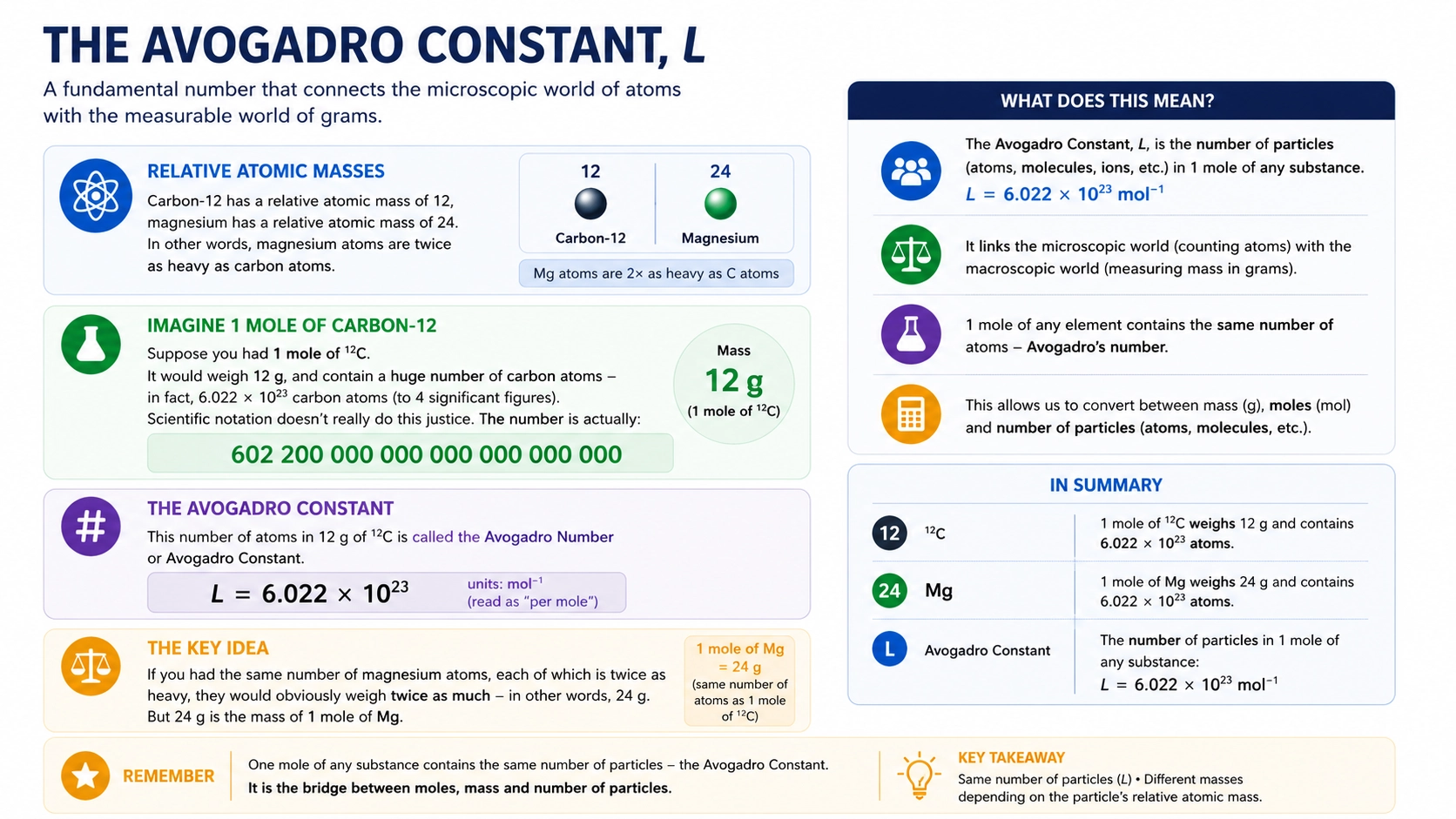
The Avogadro constant connects a measurable amount in moles to the number of particles present.
Using Avogadro Constant in Calculations
To calculate the number of particles, first work out the amount in moles. Then multiply by the Avogadro constant.
| Example | Working | Answer |
|---|---|---|
| How many atoms are in 6.00 g of tin, Sn? | amount = 6.00 ÷ 118.7 = 0.0505 mol. Number of atoms = 0.0505 × 6.022 × 1023 | 3.04 × 10²² atoms |
| How many molecules are in 9.00 g of water, H2O? | amount = 9.00 ÷ 18.0 = 0.500 mol. Number of molecules = 0.500 × 6.022 × 1023 | 3.01 × 10²³ molecules |
| How many chloride ions are in 0.0100 mol of MgCl2? | Each formula unit of MgCl2 contains two chloride ions, so chloride ions = 0.0100 × 2 × 6.022 × 1023 | 1.20 × 10²² chloride ions |
Exam focus: read the question carefully. A question may ask for molecules, total atoms, ions or formula units, and these are not always the same thing.
Quick Check: The Route from Mass to Atoms
Drag the steps of the calculation into the right order.
Quick Check: Masses and Particles
Type each answer to 3 significant figures.
Defining the Mole for AQA
For AQA, a mole is best treated as an amount of substance containing the Avogadro constant number of specified particles.
Definition: one mole is the amount of substance containing 6.022 × 10²³ specified particles.
The phrase specified particles means the particles you are choosing to count. These can be atoms, molecules, ions or formula units.
| Substance described | Specified particles | What 1 mol contains |
|---|---|---|
| Oxygen atoms, O | Atoms | 6.022 × 10²³ oxygen atoms |
| Oxygen molecules, O2 | Molecules | 6.022 × 10²³ oxygen molecules |
| Sodium chloride, NaCl | Formula units | 6.022 × 10²³ NaCl formula units |
| Magnesium ions, Mg2+ | Ions | 6.022 × 10²³ Mg2+ ions |
Quick Check: Counting Ions
Decide exactly which particles the question is asking you to count.
Quick Check: Which Statement Is Right?
In each round, choose the one correct statement about moles and particles.
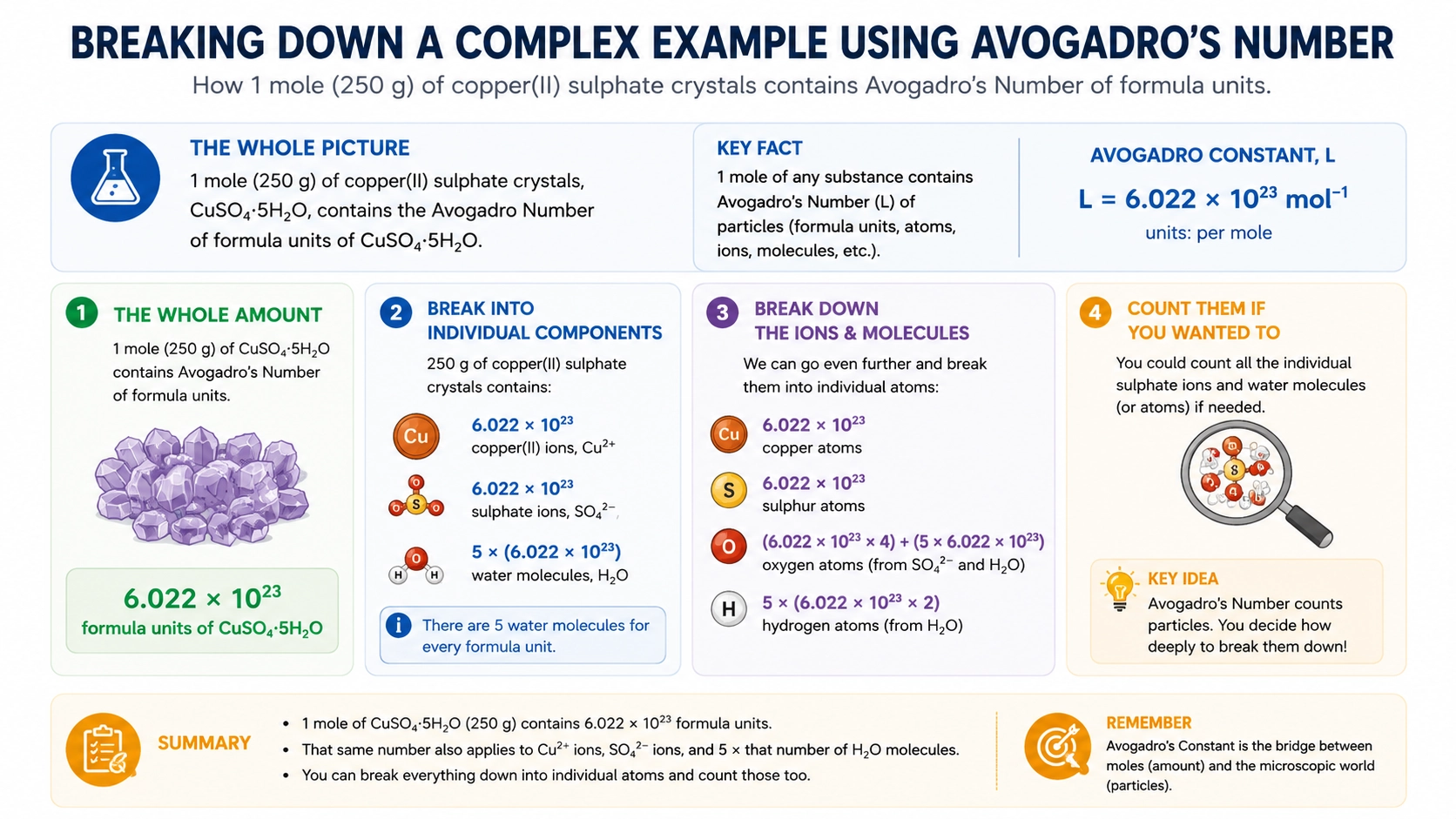
One mole always contains the Avogadro constant number of the specified particles, but the particle type must be identified.
Common Exam Points
- A mole is a measure of amount of substance.
- The abbreviation for mole is mol.
- Always quote the formula when stating the amount of a substance.
- The mass of 1 mole of a substance is its relative formula mass in grams.
- Use n = m ÷ M for mole-mass calculations.
- Use number of specified particles = amount × Avogadro constant for specified-particle calculations.
- The Avogadro constant is 6.022 × 10²³ mol-1.
- Check whether the question asks for atoms, molecules, ions, formula units or total atoms.
- For ionic compounds such as NaCl, use the term formula units rather than molecules.
- For hydrated salts, include water of crystallisation in the formula mass.
QuickSnap
This text summary condenses the page into the essential exam ideas.
- Mole: a measure of amount of substance.
- Formula matters: O and O2 have different molar masses.
- Mass of 1 mol: relative formula mass written in grams.
- Mole-mass equation: n = m ÷ M.
- Avogadro constant: 6.022 × 10²³ mol-1.
- Specified-particle equation: number of specified particles = amount × Avogadro constant.
- Specified particle type: identify whether the question means atoms, molecules, ions or formula units.
Master Amount of Substance for AQA A Level Chemistry
Continue from these free revision notes into the full 3.1.2 Amount of Substance course, covering moles, Avogadro constant, empirical and molecular formulae, reacting masses, concentration, titrations, gas volumes, percentage yield and atom economy with guided video teaching, diagnostic MCQ practice, teacher-marked short-answer questions and a personalised progress report.
Guided video teaching
Learn the chemistry and exam technique through structured video lessons with worked examples and walkthroughs.
Instant MCQ feedback
Auto-marked MCQ quizzes provide immediate diagnostic feedback for every answer choice.
Teacher-marked SAQs
Submit written exam responses and receive chemistry specialist feedback with improvement guidance.
Progress tracking
Identify strengths and weaknesses across the full 3.1.2 Amount of Substance specification, including mole calculations, formulae, solution calculations, gas calculations, yield and atom economy.
See how the course works
Click play to start the course preview animation.
A student prepares a sodium hydroxide solution.
| Quantity | Value |
|---|---|
| Concentration of NaOH | 0.200 mol dm−3 |
| Volume used | 25.0 cm3 |
| Volume in dm3 | 0.0250 dm3 |
What amount of NaOH is present in the 25.0 cm3 sample?
Calculate the mass of CaCO3 that reacts with 25.0 cm3 of 0.200 mol dm−3 HCl.
CaCO3 + 2HCl → CaCl2 + H2O + CO2
FAQs
These questions address common misconceptions students have when learning the mole and Avogadro constant.
What is a mole in chemistry?
A mole is a measure of amount of substance. It represents a fixed number of specified particles, such as atoms, molecules, ions or formula units.
Why must I quote the formula when using moles?
The formula tells you exactly what particles or substance are being counted. For example, 1 mol of oxygen atoms, O, has a mass of 16 g, while 1 mol of oxygen molecules, O2, has a mass of 32 g.
How do I calculate the number of moles from mass?
Use amount = mass ÷ molar mass. The mass should be in grams and the molar mass should be in g mol-1.
What is the Avogadro constant?
The Avogadro constant is the number of particles in 1 mole of a substance. It is 6.022 × 10²³ mol-1.
What is the difference between molecules and formula units?
Molecules are discrete covalent particles, such as H2O or O2. Formula units describe the simplest ratio of ions in an ionic compound, such as NaCl or MgCl2.
Copyright notice: This OLS revision content, including the explanations, layout, diagrams, tables and embedded learning structure, is authored for Online Learning System by Dr. Mohammed Al-Fatah. It may not be copied, reproduced, redistributed or adapted without written permission.
Keep this note — free
Save your progress across every AQA topic. A free account remembers which topics you have covered, saves your question scores, and syncs across your phone and laptop.
- Track every topic you have finished
- Keep your practice-question scores
- No payment, no card, free forever
Already registered? Log in