Molecular Formula
A focused revision guide to molecular formulae for AQA A Level Chemistry. This page shows how to convert empirical formulae into molecular formulae using relative molecular mass, percentage composition and worked examples.
GCSE Recap: Relative Formula Mass
Before you start, check that you can work out a relative formula mass when there are brackets and numbers in front.
What Is a Molecular Formula?
The molecular formula shows the number of atoms of each element in one molecule of a compound. It gives more information than an empirical formula because it gives the atom count in the molecule, not just the simplest ratio.
For example, the empirical formula of glucose is CH2O, but the molecular formula is C6H12O6. The molecular formula is six times the empirical formula.
Definition: A molecular formula shows the number of atoms of each element in one molecule of the compound.
Key distinction: an empirical formula gives the simplest ratio, while a molecular formula gives the molecular formula of a molecule.
Quick Check: Molecular or Already Simplest?
Click every molecular formula that is the same as its empirical formula.
The Core Relationship
To find a molecular formula from an empirical formula, compare the relative molecular mass of the whole compound with the relative formula mass of the empirical formula.
n = Mr of compound ÷ Mr of empirical formula
Then multiply every subscript in the empirical formula by n. The value of n should be a whole number because a molecule contains a whole-number multiple of the empirical formula.
Step 1 — Find the Mr of the empirical formula
Add the relative atomic masses for one empirical formula.
Step 2 — Divide the compound Mr by the empirical formula Mr
This gives the multiplier, n.
Step 3 — Multiply the empirical formula by n
Multiply every element subscript by the same multiplier to get the molecular formula.
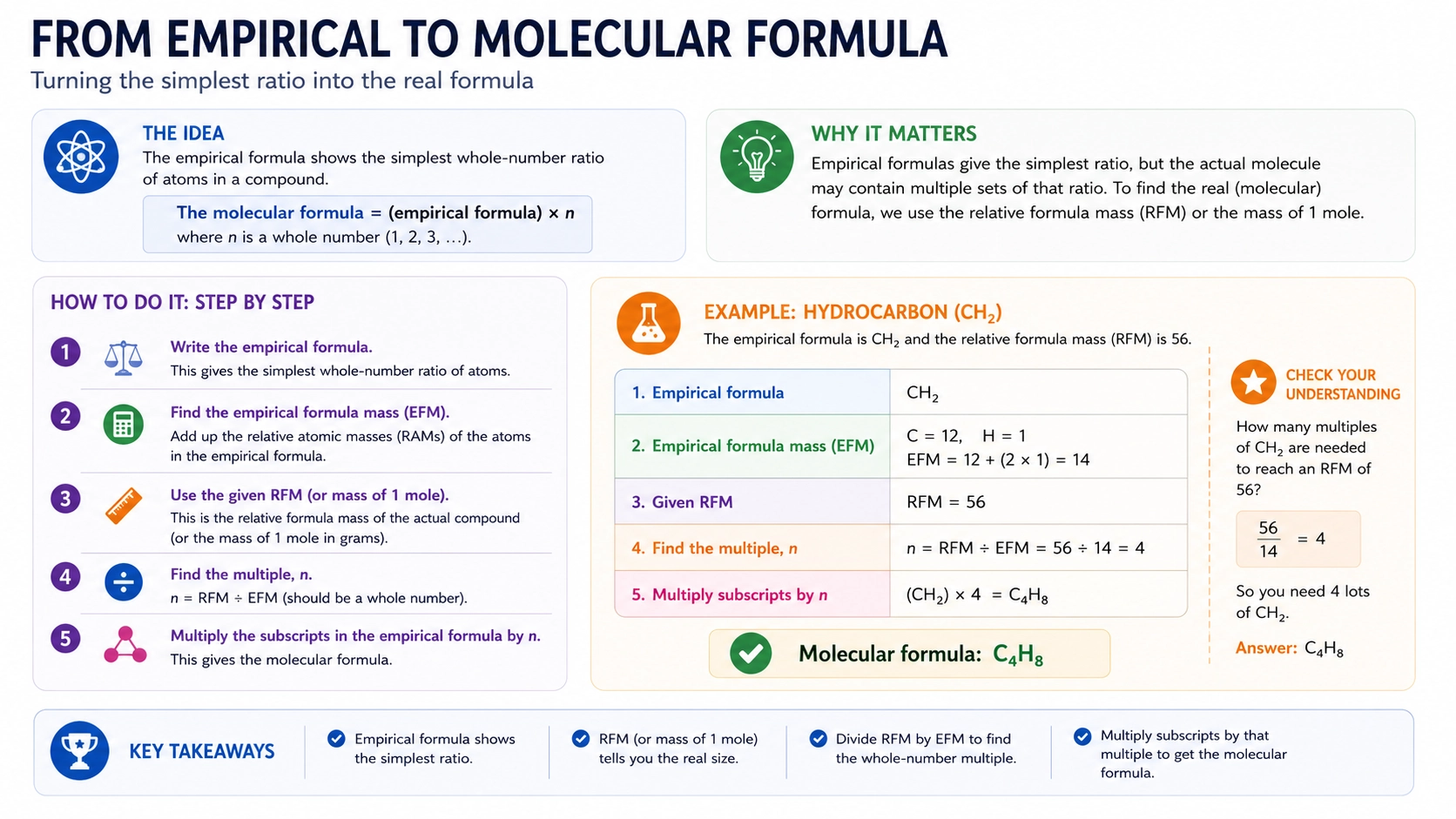
The molecular formula is found by checking how many times the empirical formula mass fits into the relative molecular mass of the compound.
Worked Example: Empirical Formula Given
Determine the molecular formula of a compound with empirical formula C3H6O and Mr = 116.
Step 1 — Find the Mr of the empirical formula
Mr of C3H6O = 36 + 6 + 16 = 58.
Step 2 — Find the multiplier
n = 116 ÷ 58 = 2.
Molecular formula: C6H12O2. The empirical formula C3H6O has been multiplied by 2.
Quick Check: From Empirical to Molecular Formula
Find n on paper, then type the molecular formula.
Shortcut Method from Percentage Composition
If you are given percentage composition and the relative molecular mass of the compound, you can find the molecular formula directly. Instead of first writing the empirical formula, find the mass of each element in one mole of the compound.
For a compound with Mr = 46 containing 52.2% C, 13.0% H and 34.8% O, the percentage tells you what fraction of the 46 g mol-1 belongs to each element.
Step 1 — Find the mass of each element in one mole
Step 2 — Convert each mass into moles of atoms
Molecular formula: C2H6O. This shortcut works because the percentage composition is applied to one mole of compound.
Quick Check: Use the Shortcut Method
Find the molecular formula directly from the percentage composition and the relative molecular mass.
When the Mr Is Not Exact
The relative molecular mass does not always need to match perfectly because experimental data may contain rounding. The important point is that the molecular formula must be a whole-number multiple of the empirical formula.
| Calculation | Likely value of n | Exam decision |
|---|---|---|
| 119.8 ÷ 60 = 1.997 | 2 | Round to 2 because the value is extremely close to a whole number. |
| 178.9 ÷ 30 = 5.963 | 6 | Round to 6 if the data clearly supports a whole-number multiple. |
| 116 ÷ 58 = 2 | 2 | Use 2 directly. |
Exam tip: never multiply only one element. The multiplier applies to the whole empirical formula.
Quick Check: Molecular Formula Problems
Work out each molecular formula on paper before you flip the card.
Empirical Formula vs Molecular Formula
Different compounds may have the same empirical formula but different molecular formulae. This is why relative molecular mass is needed to identify the molecular formula.
| Empirical formula | Empirical formula Mr | Compound Mr | n | Molecular formula |
|---|---|---|---|---|
| CH2O | 30 | 30 | 1 | CH2O |
| CH2O | 30 | 60 | 2 | C2H4O2 |
| CH2O | 30 | 180 | 6 | C6H12O6 |
| HO | 17 | 34 | 2 | H2O2 |
Quick Check: Empirical or Molecular?
In each round, pick the one statement that is accurate.
Common Exam Points
- The molecular formula shows the number of atoms of each element in one molecule.
- The empirical formula shows the simplest whole-number ratio of atoms.
- To move from empirical formula to molecular formula, you must be given the compound Mr or enough data to work it out.
- Find the Mr of the empirical formula before calculating the multiplier.
- The multiplier must be a whole number, allowing for sensible rounding of experimental data.
- Apply the multiplier to every atom in the empirical formula, not just the first element.
- If n = 1, the empirical formula and molecular formula are the same.
- Ionic compounds are normally represented by formula units, so the language of molecular formula is mainly used for covalent molecular substances.
QuickSnap
This text summary condenses the page into the essential exam ideas.
- Molecular formula: the number of atoms of each element in one molecule.
- Empirical formula: the simplest whole-number ratio of atoms in a compound.
- Multiplier: n = Mr of compound ÷ Mr of empirical formula.
- Method: find the empirical formula Mr, calculate n, then multiply every subscript by n.
- Rounding: experimental Mr data may not be exact, but n should be rounded sensibly to a whole number.
- Shortcut method: percentage composition and Mr can be used together to find the mass of each element in one mole of compound.
- Common error: do not multiply only one element. The whole empirical formula is multiplied.
Master Amount of Substance for AQA A Level Chemistry
Continue from these free revision notes into the full 3.1.2 Amount of Substance course, covering moles, Avogadro constant, empirical and molecular formulae, reacting masses, concentration, titrations, gas volumes, percentage yield and atom economy with guided video teaching, diagnostic MCQ practice, teacher-marked short-answer questions and a personalised progress report.
Guided video teaching
Learn the chemistry and exam technique through structured video lessons with worked examples and walkthroughs.
Instant MCQ feedback
Auto-marked MCQ quizzes provide immediate diagnostic feedback for every answer choice.
Teacher-marked SAQs
Submit written exam responses and receive chemistry specialist feedback with improvement guidance.
Progress tracking
Identify strengths and weaknesses across the full 3.1.2 Amount of Substance specification, including mole calculations, formulae, solution calculations, gas calculations, yield and atom economy.
See how the course works
Click play to start the course preview animation.
A student prepares a sodium hydroxide solution.
| Quantity | Value |
|---|---|
| Concentration of NaOH | 0.200 mol dm−3 |
| Volume used | 25.0 cm3 |
| Volume in dm3 | 0.0250 dm3 |
What amount of NaOH is present in the 25.0 cm3 sample?
Calculate the mass of CaCO3 that reacts with 25.0 cm3 of 0.200 mol dm−3 HCl.
CaCO3 + 2HCl → CaCl2 + H2O + CO2
FAQs
These questions address the most common points of confusion students encounter when converting empirical formulae into molecular formulae.
What is the difference between an empirical formula and a molecular formula?
The empirical formula shows the simplest whole-number ratio of atoms in a compound. The molecular formula shows the number of atoms of each element in one molecule. For example, CH2O can be an empirical formula, while C6H12O6 is the molecular formula of glucose.
How do I find the molecular formula from the empirical formula?
Find the Mr of the empirical formula, divide the compound Mr by this value, then multiply every subscript in the empirical formula by the answer.
What if the Mr division does not give an exact whole number?
Small differences can occur because of rounding in experimental data. If the value is very close to a whole number, round sensibly. A molecular formula must be a whole-number multiple of the empirical formula.
Can the empirical formula and molecular formula be the same?
Yes. If the multiplier n is 1, the empirical formula and molecular formula are identical. Water is H2O as both its empirical and molecular formula.
Can I find the molecular formula directly from percentage composition?
Yes, if the compound Mr is also given. Find the mass of each element in one mole of compound using the percentage composition, then divide by the relevant Ar values to find the number of atoms of each element.
Copyright notice: This OLS revision content, including the explanations, layout, diagrams, tables and embedded learning structure, is authored for Online Learning System by Dr. Mohammed Al-Fatah. It may not be copied, reproduced, redistributed or adapted without written permission.
Keep this note — free
Save your progress across every AQA topic. A free account remembers which topics you have covered, saves your question scores, and syncs across your phone and laptop.
- Track every topic you have finished
- Keep your practice-question scores
- No payment, no card, free forever
Already registered? Log in