Gas Volumes and the Ideal Gas Equation
An AQA-focused revision guide to gas volume calculations, the molar volume of a gas at room temperature and pressure, reacting gas volumes and the ideal gas equation pV = nRT.
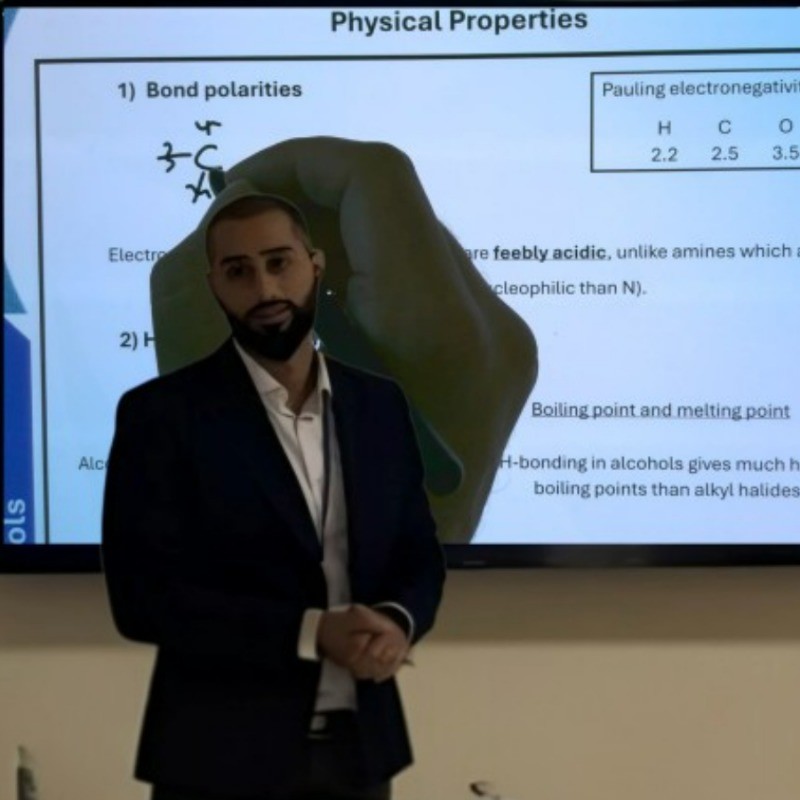
Avogadro’s Law
Avogadro’s law states that equal volumes of any gases, measured under the same conditions of temperature and pressure, contain equal numbers of molecules (or atoms, if the gas is monatomic).
This means that for gases, the volume ratio in a reaction is the same as the mole ratio. If 1 mol of gas A occupies a certain volume under set conditions, then 2 mol of any other gas will occupy double that volume under the same conditions.
Avogadro’s law: equal volumes of gases at the same temperature and pressure contain equal numbers of particles.
Why it matters: Avogadro’s law lets you treat gas volumes in a balanced equation as mole ratios, provided all the gases are measured under the same conditions.
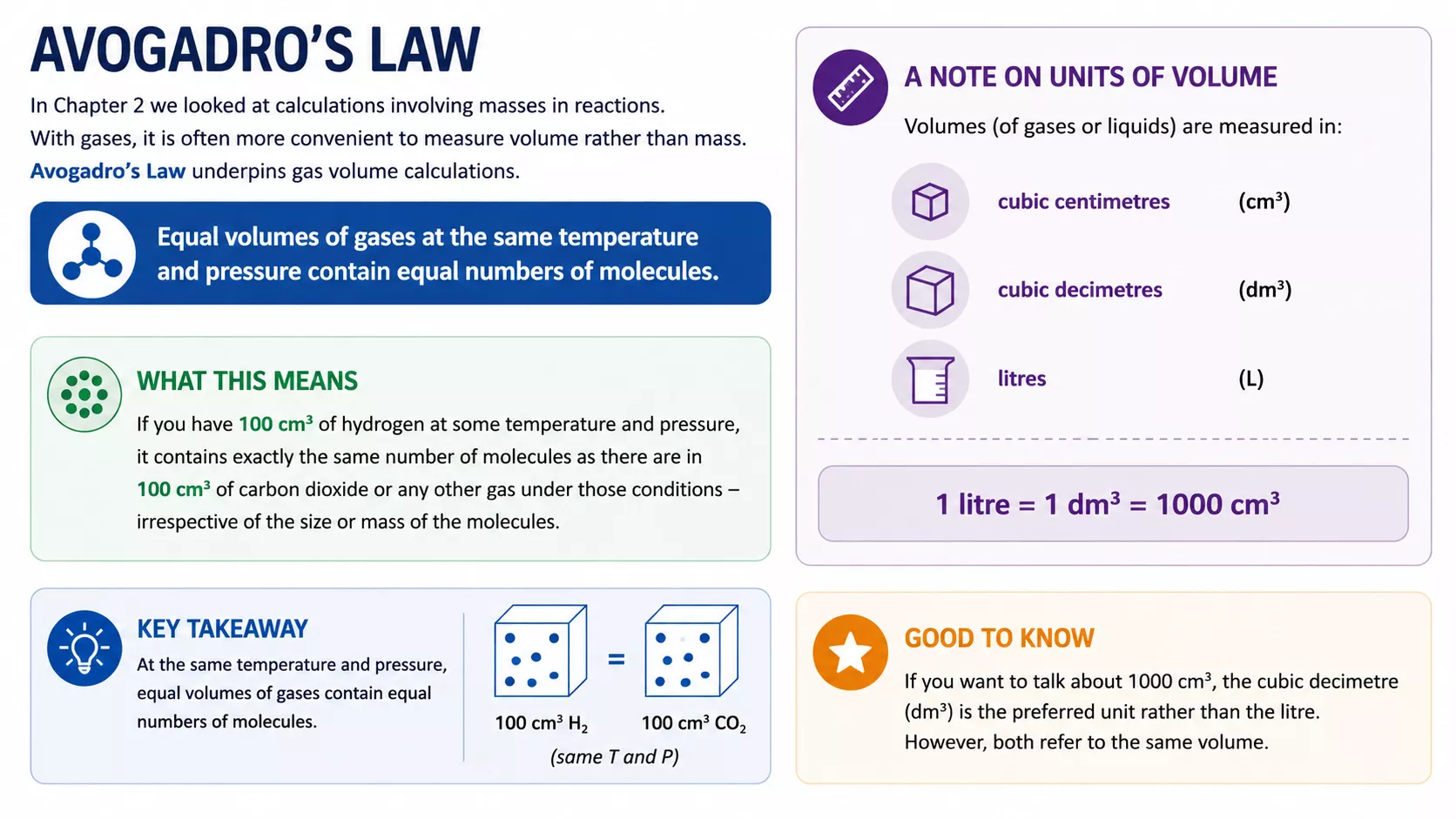
Different gases at the same temperature and pressure pack the same number of particles into the same volume, regardless of the size of the molecules.
The Molar Volume of a Gas
The molar volume is the volume occupied by one mole of a gas at a specified temperature and pressure. Because Avogadro’s law applies, every gas has the same molar volume under the same conditions.
For AQA A Level Chemistry, use the molar volume at room temperature and pressure when a question gives gas volumes at r.t.p.:
| Conditions | Symbol | Molar volume | Equivalent in cm3 |
|---|---|---|---|
| Room temperature and pressure | r.t.p. | 24.0 dm3 mol−1 | 24 000 cm3 mol−1 |
The two key relationships you will use repeatedly are:
Unit check: if the volume is in cm3, divide by 24 000 instead of 24. Always check whether the question gives dm3 or cm3 before substituting.
Quick Check: Using Avogadro's Law
Answer five quick questions by reasoning about moles and volumes, with no calculator needed.
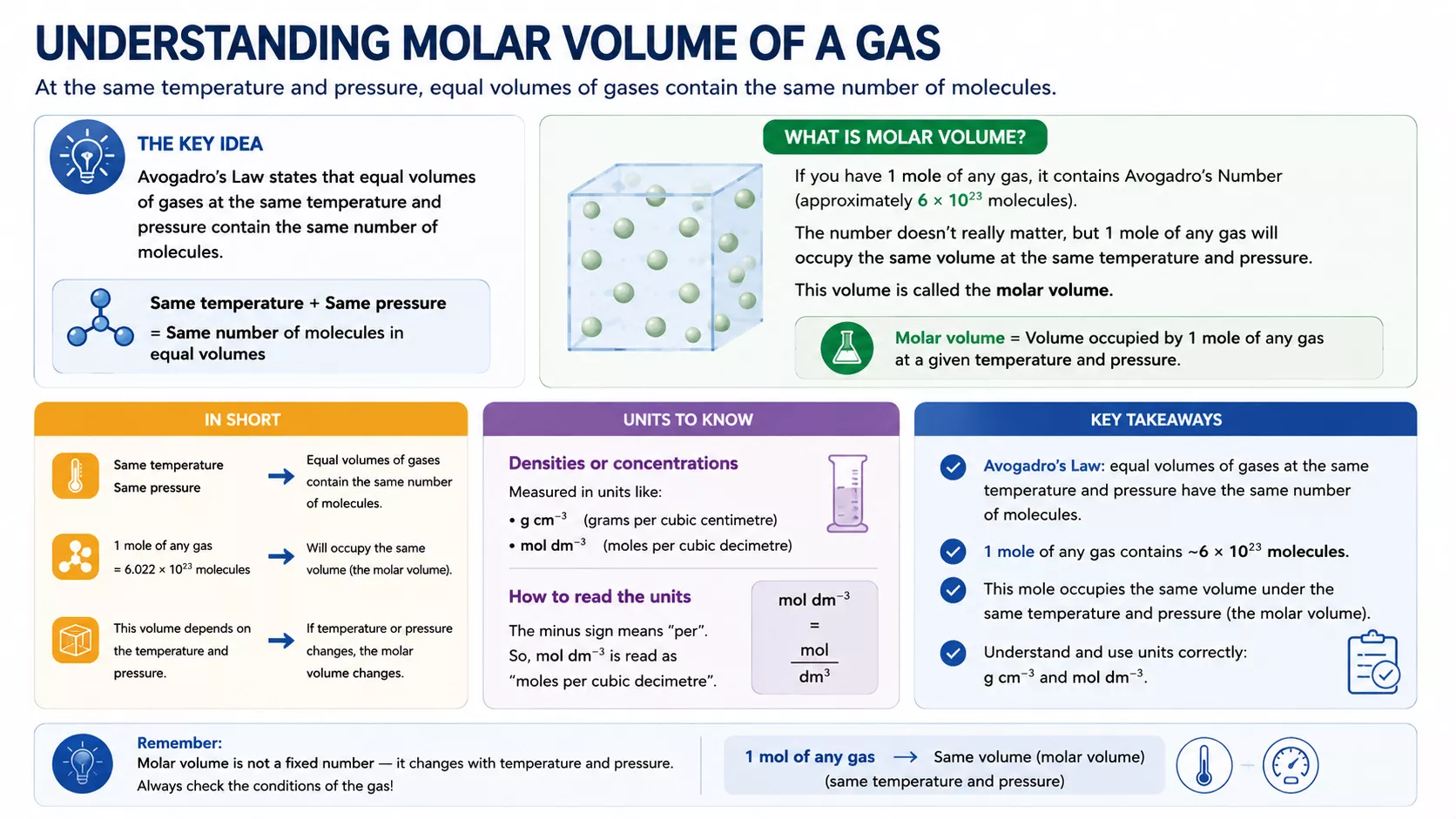
One mole of any gas occupies the same volume under fixed conditions, which is what makes converting between amount of substance and gas volumes so straightforward.
Worked Example: 1 Mole of Oxygen
Calculate the volume occupied by 1 mole of oxygen gas at r.t.p.
Setting up the calculation
At r.t.p., the molar volume of a gas is 24.0 dm3 mol−1. This value applies to every gas, including oxygen, because of Avogadro’s law.
Answer: 1 mol of O2 occupies 24.0 dm3 at r.t.p., which equals 24 000 cm3. The identity of the gas does not matter for this calculation; nitrogen, hydrogen and carbon dioxide would all give the same molar volume under the same conditions.
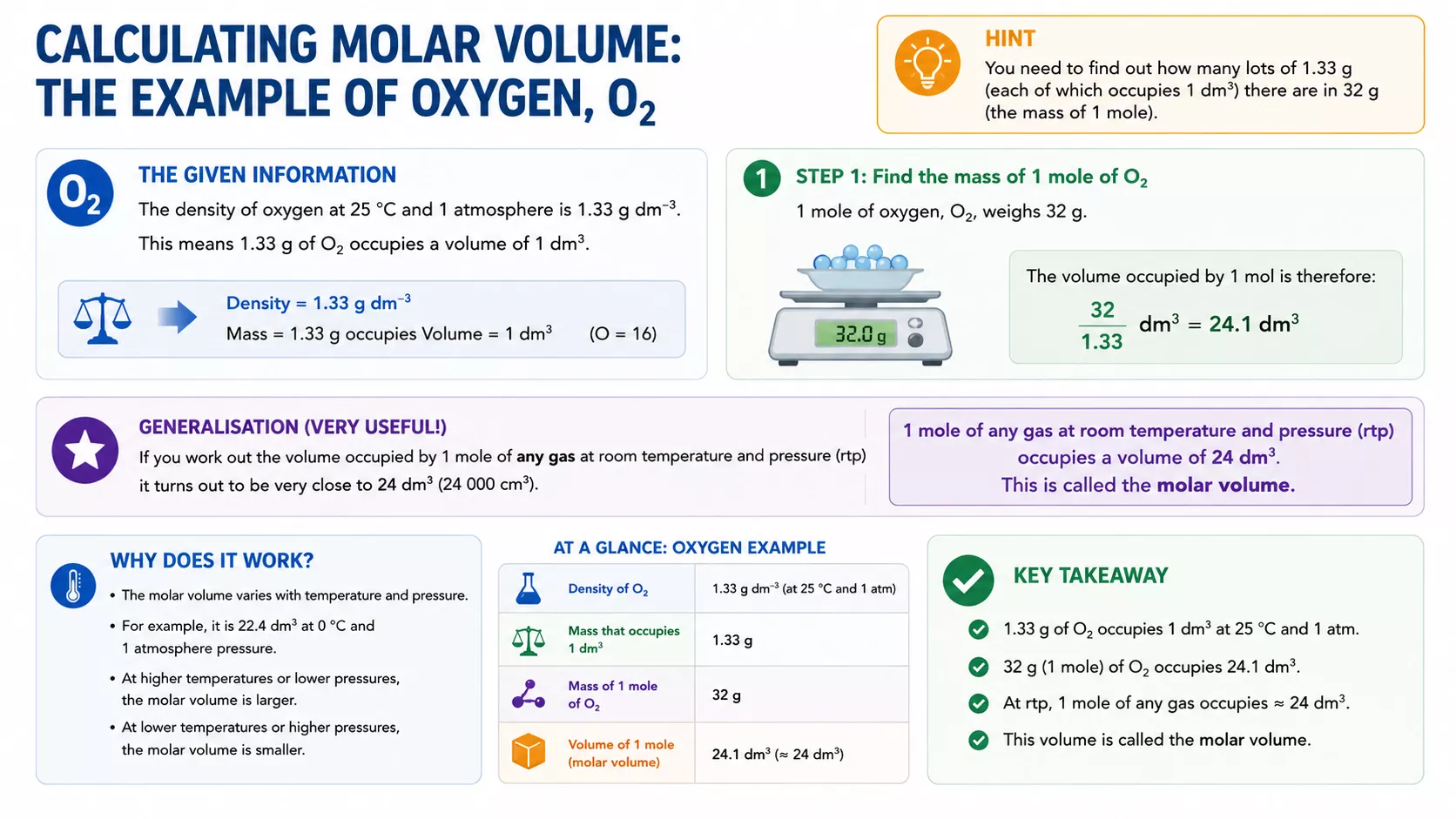
Because the molar volume value already accounts for the conditions, the calculation reduces to a single multiplication by 24.
Simple Calculations Using the Molar Volume
The molar volume can be used in two directions: to find the volume from a known mass, or to find the mass from a known volume. The strategy is always the same; convert to amount of substance first.
Example A — Volume from mass
Calculate the volume of 0.01 g of hydrogen at r.t.p. (H = 1, so 1 mol H2 = 2 g).
Example B — Mass from volume
Calculate the mass of 100 cm3 of CO2 at r.t.p. (C = 12, O = 16, so 1 mol CO2 = 44 g).
Exam tip: convert cm3 values into dm3 by dividing by 1000, or use 24 000 cm3 mol−1 directly. Mixing units is the most common source of error in molar volume questions.
Gas density: density = mass ÷ volume. One mole of a gas has a mass of Mr in grams and occupies 24.0 dm3 at r.t.p., so the density in g dm−3 is Mr ÷ 24.0. For oxygen, 32.0 ÷ 24.0 = 1.33 g dm−3. Under the same conditions, a gas with a larger Mr is denser.
Quick Check: Moles, Masses and Gas Volumes
Work through six calculations on paper, then flip each card to check your answer and working.
Calculations From Equations Involving Gases
When a balanced equation involves gases, you can use the molar volume together with the stoichiometric ratio to convert between gas volumes and masses, or between volumes of different gases.
The general strategy has three steps:
Step 1 — Convert the given quantity into amount of substance
Use mass → amount (divide by Mr) or volume → amount (divide by 24.0 dm3 mol−1 at r.t.p.).
Step 2 — Apply the mole ratio
Use the balancing numbers from the balanced equation to convert the amount of the known substance into amount of the substance you need.
Step 3 — Convert amount into the required answer
Use amount → mass (multiply by Mr) or amount → volume (multiply by 24.0 dm3 mol−1 at r.t.p.).
Example C — Mass of aluminium for a fixed gas volume
A student produces hydrogen by reacting aluminium with excess dilute hydrochloric acid. The hydrogen is collected in a 100 cm3 gas syringe at r.t.p. What is the maximum mass of aluminium that can be used without exceeding the syringe capacity? (Al = 27, molar volume = 24 000 cm3 at r.t.p.)
Balanced equation: 2Al + 6HCl → 2AlCl3 + 3H2
Example D — Reacting volumes of gases
500 cm3 of methane is burned at 1 atm and 300 K. Calculate the volume of oxygen needed and the volume of CO2 produced under the same conditions.
Balanced equation: CH4(g) + 2O2(g) → CO2(g) + 2H2O(l)
Because Avogadro’s law applies, the volume ratio matches the mole ratio for gases at the same conditions. CH4 : O2 : CO2 is 1 : 2 : 1.
Water is a liquid under these conditions and so does not contribute to the gas volume.
Reacting volumes shortcut: for gas-only reactions, you can skip the conversion to amount of substance entirely and just apply the volume ratio directly, as long as all gases are at the same temperature and pressure.
Quick Check: Equations With a Gas
Use the three-step method on five new reactions, then flip each card to check your working.
Quick Check: Reacting Gas Volumes
Use volume ratios to fill in each gap, watching for liquid products and leftover gas.
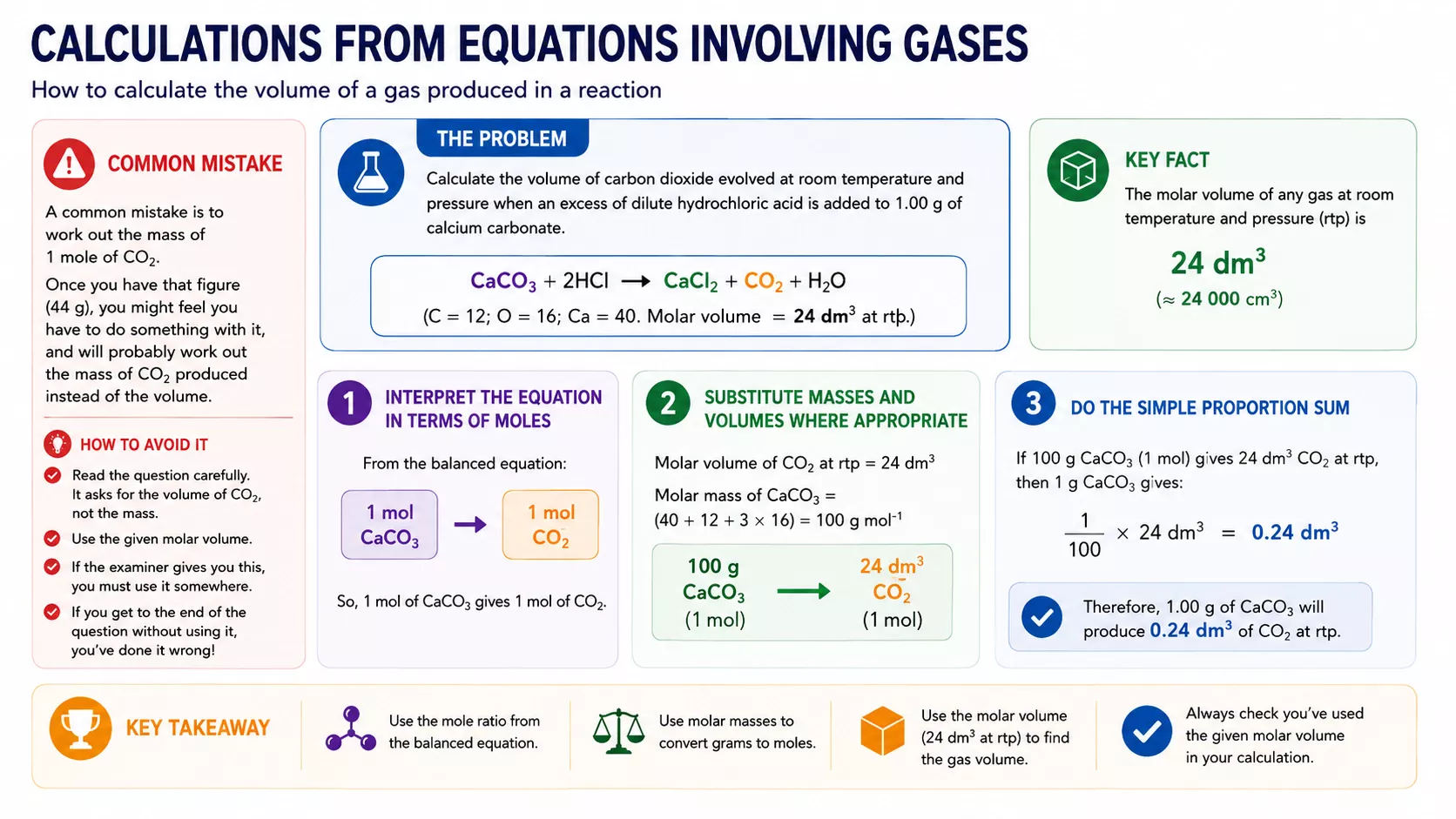
The stoichiometric numbers in a balanced equation map directly onto gas volumes when every reacting species is in the gas phase.
The Ideal Gas Equation
The molar volume value of 24.0 dm3 mol−1 only works at room temperature and pressure. For any other temperature or pressure, use the ideal gas equation:
Where the quantities and their SI units are:
| Symbol | Quantity | SI unit | Conversion notes |
|---|---|---|---|
| p | Pressure | Pa (pascal) | 1 kPa = 1000 Pa; 1 atm = 101 325 Pa. |
| V | Volume | m3 | 1 dm3 = 1 × 10⁻³ m3; 1 cm3 = 1 × 10⁻⁶ m3. |
| n | Amount of gas | mol | Use mol directly. |
| R | Gas constant | J K−1 mol−1 | R = 8.31 J K−1 mol−1. |
| T | Temperature | K (kelvin) | Add 273 to convert °C to K. |
Key idea: the ideal gas equation applies to all gases and to mixtures of gases. For a mixture, n is the total amount of all gases present.
Unit warning: almost every mark lost in ideal gas questions comes from unit conversion errors. Convert pressure to Pa, volume to m3 and temperature to K before substituting any numbers.
Quick Check: Units in pV = nRT
Choose the substitution in which every quantity has been converted correctly.
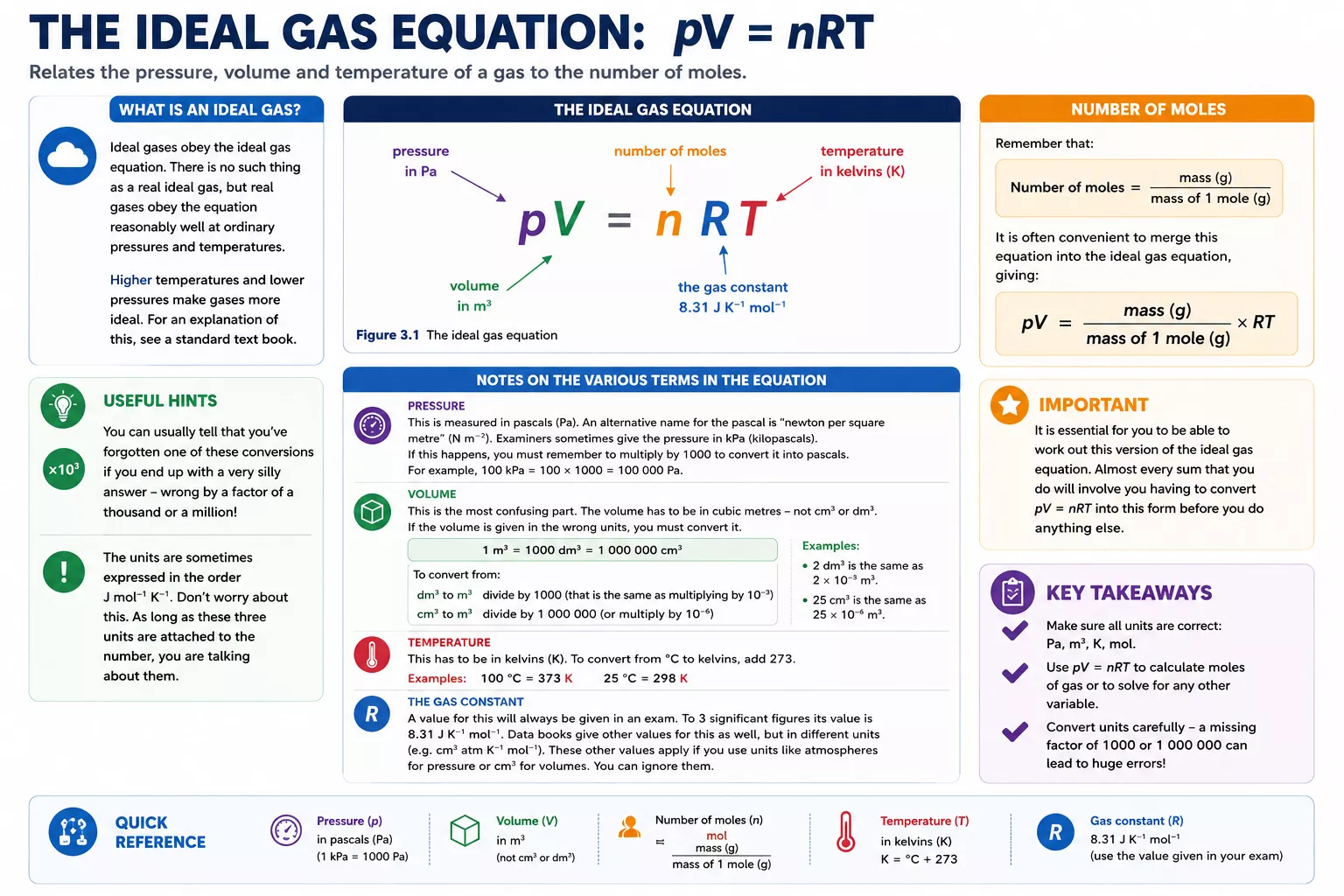
Memorising the equation is the easy part; converting every quantity into SI units before substituting is what separates a correct answer from a wrong one.
Ideal Gas Equation Worked Examples
Example E — Finding mass of a gas
Calculate the mass of Cl2 gas at a pressure of 100 kPa, temperature 20 °C and volume 500 cm3. (Cl = 35.5; R = 8.31)
n = pV / RT = (100 000 × 5 × 10−4) / (8.31 × 293) = 0.0205 mol
Mass = n × Mr = 0.0205 × 71 = 1.46 g
Example F — Finding the relative formula mass of a volatile liquid
0.150 g of a volatile liquid was injected into a sealed gas syringe placed in an oven at 70 °C. The pressure was 100 kPa and the measured gas volume was 80 cm3. Calculate the Mr of the liquid. (R = 8.31)
n = pV / RT = (100 000 × 8 × 10−5) / (8.31 × 343) = 0.00281 mol
Mr = mass / amount = 0.150 / 0.00281 = 53.4 g mol−1
Example G — Changing the conditions of a gas
40 cm3 of oxygen and 60 cm3 of carbon dioxide, each at 298 K and 100 kPa, were placed into an evacuated flask of volume 0.50 dm3. Calculate the pressure of the gas mixture in the flask at 298 K.
At constant temperature and for a fixed amount of gas, pressure is inversely proportional to volume.
Total starting volume of gas at 100 kPa = 40 + 60 = 100 cm3; new volume = 0.50 dm3 = 500 cm3.
p2 = (p1V1) / V2 = (100 000 × 100) / 500 = 20 000 Pa
Example H: Changing temperature and pressure
A fixed amount of gas occupies 250 cm3 at 27 °C and 100 kPa. Calculate its volume at 127 °C and 200 kPa.
The amount of gas is unchanged, so use p1V1/T1 = p2V2/T2. Temperatures must be in kelvin. The pressure and volume units only need to match on both sides.
Approach for changing-conditions questions: either work out the amount of substance using pV = nRT and then put it back into the equation with the new conditions, or use the combined form p1V1/T1 = p2V2/T2. The combined form is faster when the amount of gas is unchanged.
Quick Check: Ideal Gas Calculations
Work through six calculations on paper, then flip each card to check your answer and working.
Quick Check: Choosing the Right Method
In each round, pick the one statement about gas calculations that is accurate.
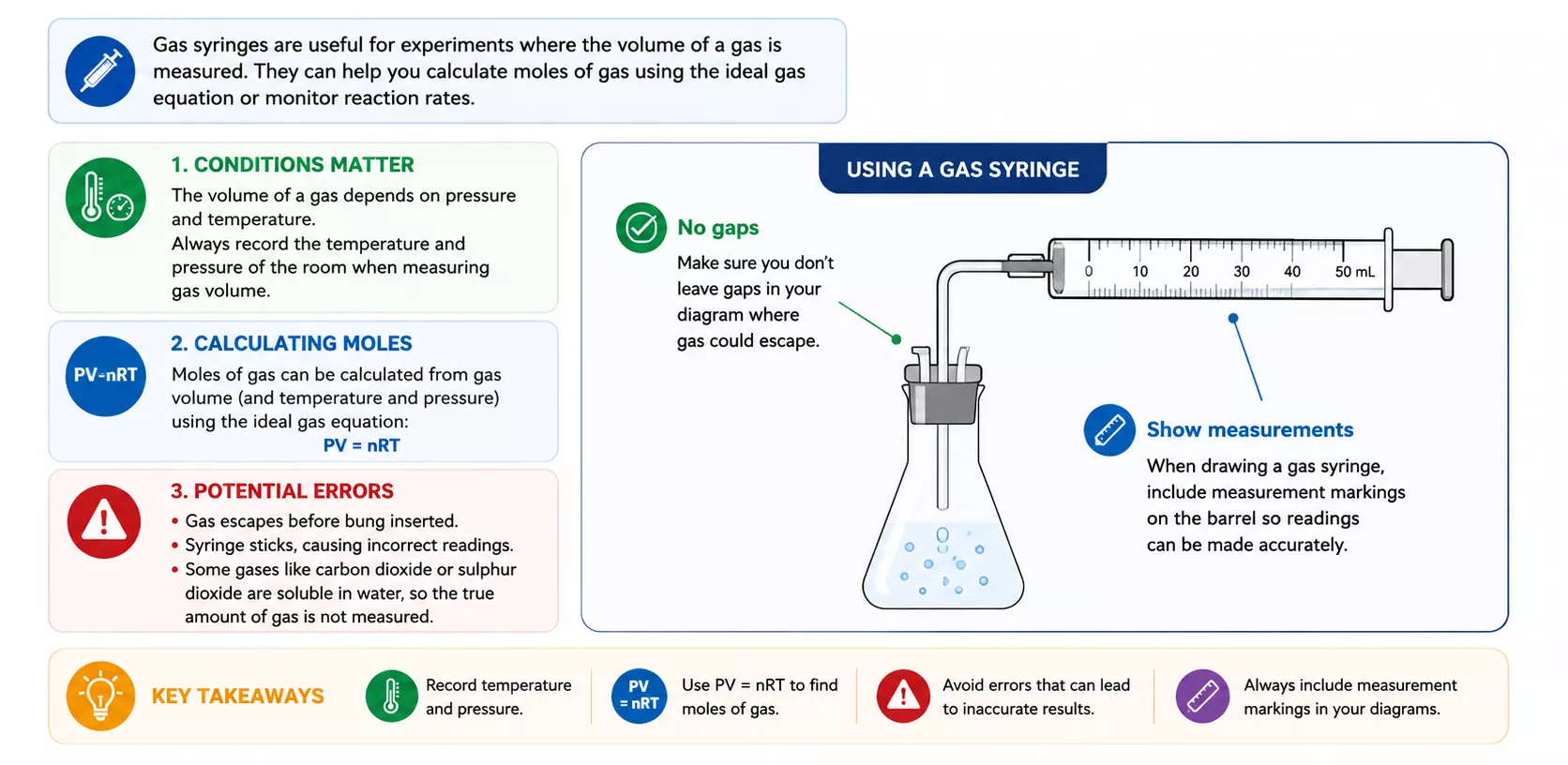
Gas syringes are a common apparatus for collecting and measuring gas volumes at known temperature and pressure, which links practical work directly to molar volume and ideal gas calculations.
Common Exam Points
- Avogadro’s law lets you treat gas volume ratios as mole ratios, provided every gas is measured at the same temperature and pressure.
- The molar volume at r.t.p. is 24.0 dm3 mol−1, which equals 24 000 cm3 mol−1.
- Always convert temperature to kelvin by adding 273 before using pV = nRT.
- Convert pressure to pascals: 1 kPa = 1000 Pa.
- Convert volume to m3: divide cm3 by 1 × 106, or dm3 by 1000.
- R = 8.31 J K−1 mol−1 in SI units. This value only works with Pa, m3 and K.
- For mixtures, n in pV = nRT is the total amount of gas in the mixture.
- Show every unit conversion clearly on your script; markers award method marks even if the final number is wrong.
QuickSnap
This text summary condenses the page into the essential exam ideas.
- Avogadro’s law: equal volumes of gases at the same temperature and pressure contain equal numbers of particles.
- Molar volume at r.t.p.: 24.0 dm3 mol−1 = 24 000 cm3 mol−1.
- Amount of gas at r.t.p.: volume in dm3 ÷ 24.0, or volume in cm3 ÷ 24 000.
- Reacting volumes: for gas-only reactions, volume ratio = mole ratio from the balanced equation.
- Ideal gas equation: pV = nRT, using Pa, m3, mol, J K−1 mol−1 and K.
- R = 8.31 J K−1 mol−1.
- Temperature: always convert °C to K by adding 273.
- Finding Mr of a gas: use pV = nRT to find amount, then Mr = mass ÷ amount.
Master Amount of Substance for AQA A Level Chemistry
Continue from these free revision notes into the full 3.1.2 Amount of Substance course, covering moles, Avogadro constant, empirical and molecular formulae, reacting masses, concentration, titrations, gas volumes, percentage yield and atom economy with guided video teaching, diagnostic MCQ practice, teacher-marked short-answer questions and a personalised progress report.
Guided video teaching
Learn the chemistry and exam technique through structured video lessons with worked examples and walkthroughs.
Instant MCQ feedback
Auto-marked MCQ quizzes provide immediate diagnostic feedback for every answer choice.
Teacher-marked SAQs
Submit written exam responses and receive chemistry specialist feedback with improvement guidance.
Progress tracking
Identify strengths and weaknesses across the full 3.1.2 Amount of Substance specification, including mole calculations, formulae, solution calculations, gas calculations, yield and atom economy.
See how the course works
Click play to start the course preview animation.
A student prepares a sodium hydroxide solution.
| Quantity | Value |
|---|---|
| Concentration of NaOH | 0.200 mol dm−3 |
| Volume used | 25.0 cm3 |
| Volume in dm3 | 0.0250 dm3 |
What amount of NaOH is present in the 25.0 cm3 sample?
Calculate the mass of CaCO3 that reacts with 25.0 cm3 of 0.200 mol dm−3 HCl.
CaCO3 + 2HCl → CaCl2 + H2O + CO2
FAQs
These questions address the most common points of confusion students encounter when working with molar volume and the ideal gas equation.
What is the molar volume of a gas at r.t.p.?
At room temperature and pressure, one mole of gas occupies 24.0 dm3, which is equivalent to 24 000 cm3.
Why do all gases have the same molar volume?
Avogadro’s law states that equal volumes of gases at the same temperature and pressure contain equal numbers of particles. The size of the particles makes almost no difference compared with the space between them, so all gases occupy the same volume per mole under the same conditions.
When do I use pV = nRT instead of the molar volume value?
Use 24.0 dm3 mol−1 at r.t.p. For other temperature or pressure values, use pV = nRT with pressure in Pa, volume in m3, amount in mol and temperature in K.
What units must I use in the ideal gas equation?
Pressure in pascals (Pa), volume in cubic metres (m3), amount of substance (mol), R in J K−1 mol−1 (8.31), and temperature in kelvin (K). Convert °C to K by adding 273, kPa to Pa by multiplying by 1000, and cm3 to m3 by multiplying by 1 × 10⁻⁶.
How do I handle a mixture of gases in pV = nRT?
In a mixture, n is the total amount of gas. The equation applies to the mixture as a whole, provided the gases do not react with each other.
How do I find the relative formula mass of a volatile liquid?
Vaporise a known mass of the liquid and measure its gas volume at a known temperature and pressure. Use pV = nRT to find the amount of vapour produced, then calculate Mr using Mr = mass ÷ amount.
Copyright notice: This OLS revision content, including the explanations, layout, diagrams, tables and embedded learning structure, is authored for Online Learning System by Dr. Mohammed Al-Fatah. It may not be copied, reproduced, redistributed or adapted without written permission.
Keep this note — free
Save your progress across every AQA topic. A free account remembers which topics you have covered, saves your question scores, and syncs across your phone and laptop.
- Track every topic you have finished
- Keep your practice-question scores
- No payment, no card, free forever
Already registered? Log in