Polymerisation Reactions
A concise revision guide to addition polymerisation, how alkene monomers form poly(alkenes), how to recognise repeating units and why poly(ethene) and poly(propene) have useful material properties, with the AQA 3.3.4.3 rules for naming addition polymers. The properties of poly(alkenes), PVC and plasticisers have their own page.
GCSE Recap: Monomers and Chains
Answer three quick GCSE questions before you start.
What Is Addition Polymerisation?
Addition polymerisation is a chain-forming reaction in which many alkene molecules join together to form a long-chain polymer.
The alkene molecules are the monomers. During polymerisation, the carbon-carbon double bonds open up, allowing the monomers to connect into a long saturated carbon chain.
No small molecule is eliminated during addition polymerisation, so there are no by-products.
Key idea: Addition polymers form when many alkene monomers join together by opening their C=C double bonds.
Quick Check: Which Bonds Change?
Apply the idea to a monomer that is not on this page.
From Ethene to Poly(ethene)
Ethene, CH2=CH2, is an alkene monomer. When many ethene molecules polymerise, the C=C double bond in each monomer opens and the carbon atoms form new C-C single bonds to neighbouring monomers.
The polymer formed is poly(ethene). The repeat unit is written in brackets, with an n outside the brackets to show that the unit is repeated many times.
Equation focus: Include n before the monomer and n after the bracketed repeating unit when writing addition polymerisation equations.
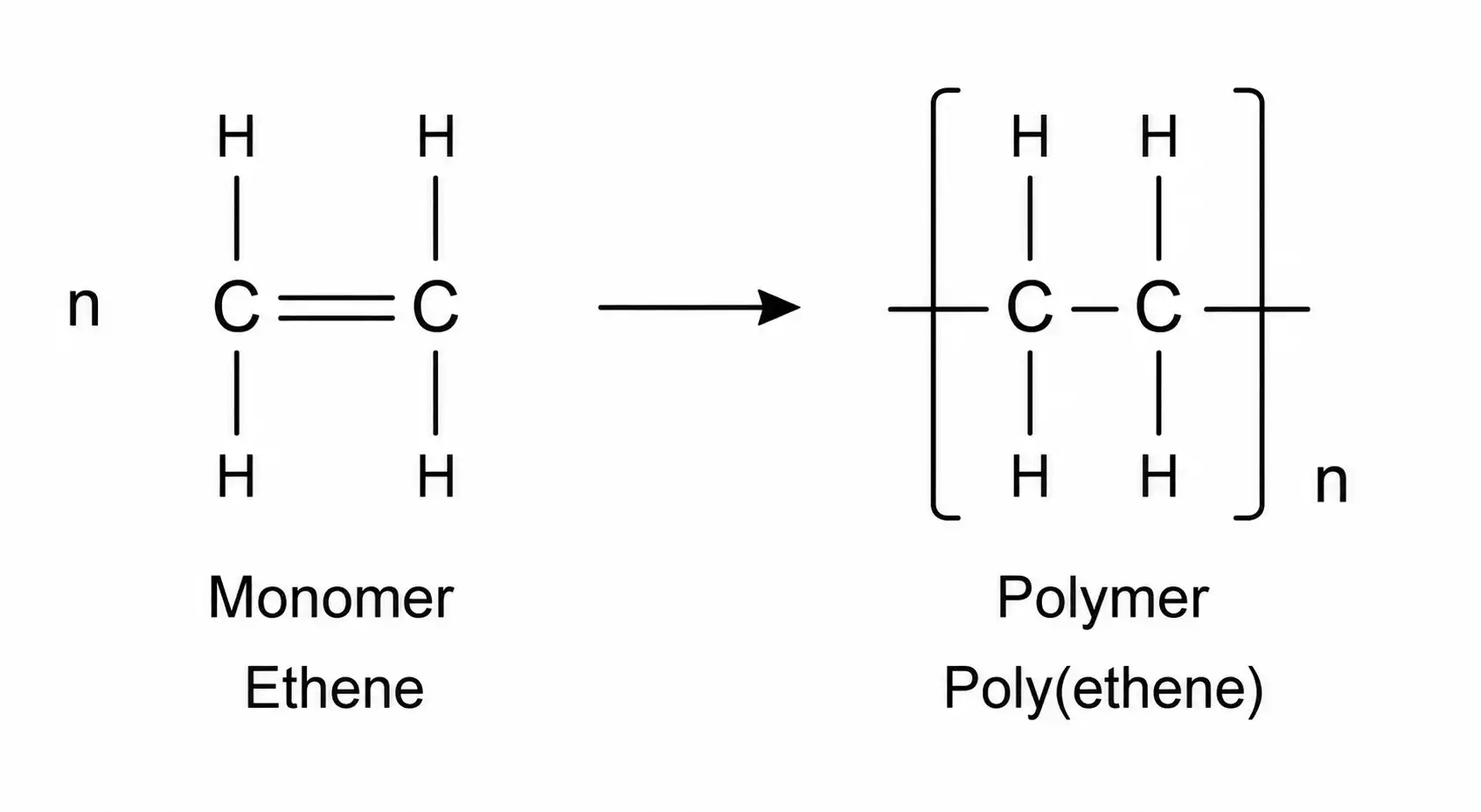
The C=C bond in ethene changes into single bonds in the polymer chain, giving a bracketed repeating unit.
Recognising Repeating Units
A repeating unit is the smallest section of the polymer chain that repeats over and over again.
To recognise the repeating unit in a poly(alkene), look for the section of the carbon chain that came from one alkene monomer. The double bond is no longer present in the polymer because it has opened during the addition reaction.
The brackets should cut through single bonds at both ends of the repeating unit. This shows that the chain continues on both sides.
Repeating unit: The section of a polymer chain that is repeated many times to form the polymer.
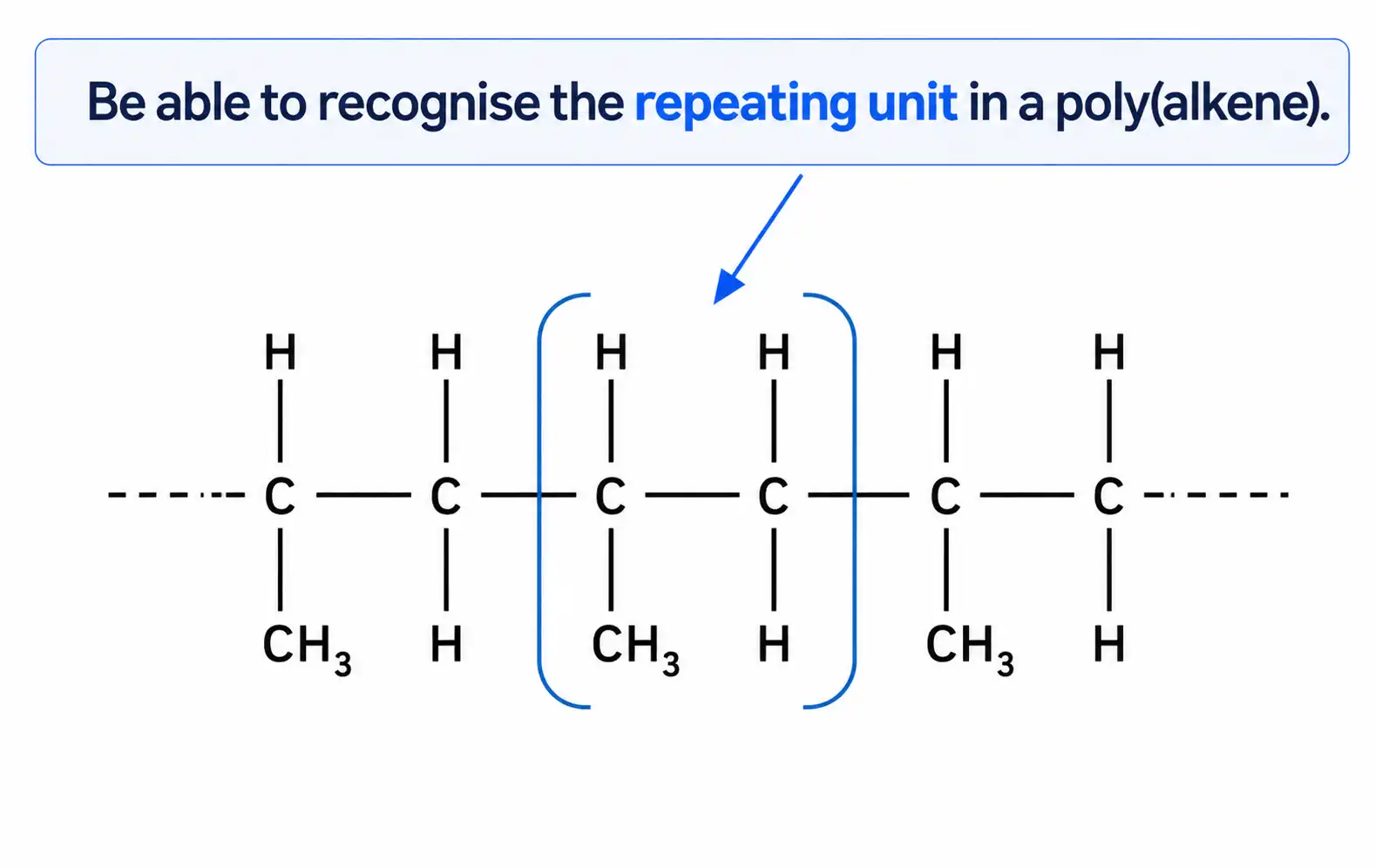
The bracketed section identifies one repeat of the polymer chain and the open bonds show that the chain continues.
Quick Check: Build a Repeat Unit
Drag the words and numbers into place to work out a repeat unit for yourself.
From Propene to Poly(propene)
Propene can also undergo addition polymerisation. Each propene monomer opens its C=C double bond and links to other monomers to form poly(propene).
The CH3 group from propene remains attached to every other carbon in the polymer repeat unit. This side group helps make poly(propene) stiffer than poly(ethene).
Exam focus: When converting a monomer into a repeat unit, keep every substituent attached to the same carbon. Only the C=C bond changes into C-C single bonds.
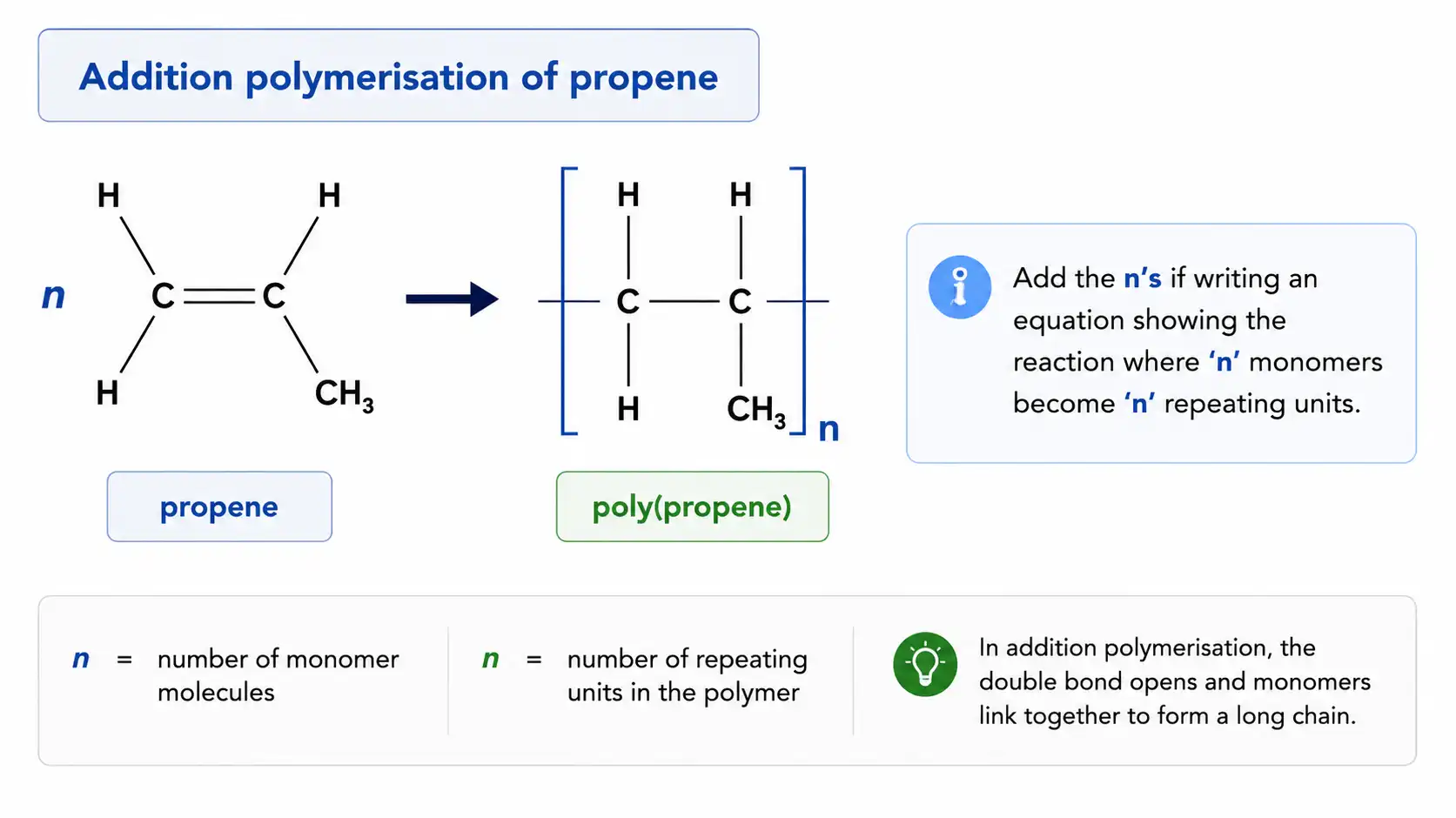
The CH3 side group remains part of the repeat unit when propene forms poly(propene).
Quick Check: Spot the Wrong Repeat Unit
Click every suggested repeat unit that does not match its monomer.
Quick Check: Work Backwards to the Monomer
Answer as quickly as you can, going from the chain back to the molecule it came from.
Properties and Uses of Poly(alkenes)
Different poly(alkenes) have different physical properties because their repeat units and side groups are different.
Poly(ethene) is widely used for plastic bags, buckets and bottles. It is useful because it is flexible, easy to mould, waterproof, chemically resistant and has low density.
Poly(propene) forms a stiffer polymer, so it is suitable for products that need greater strength and rigidity. It is commonly used in utensils, storage containers, fibres, ropes and carpets.
| Polymer | Useful properties | Common uses |
|---|---|---|
| Poly(ethene) | Flexible, easy to mould, waterproof, chemically resistant and low density. | Plastic bags, buckets and bottles. |
| Poly(propene) | Stiffer, stronger and more rigid than many simple flexible plastics. | Utensils, storage containers, fibres, ropes and carpets. |
Quick Check: Pick the Accurate Statement
In each round, choose the one statement that is accurate.
Naming Addition Polymers
AQA expects the IUPAC name of an addition polymer. The polymer is named poly(monomer): the systematic name of the monomer is written in brackets after the prefix poly. Ethene forms poly(ethene), propene forms poly(propene) and chloroethene forms poly(chloroethene), better known as PVC.
| Monomer | Polymer name | Everyday name |
|---|---|---|
| Ethene, CH2=CH2 | Poly(ethene) | Polythene |
| Propene, CH2=CHCH3 | Poly(propene) | Polypropylene |
| Chloroethene, CH2=CHCl | Poly(chloroethene) | PVC |
| Phenylethene, CH2=CHC6H5 | Poly(phenylethene) | Polystyrene |
Exam focus: Keep the brackets and keep the monomer name unchanged: poly(propene), not polypropene. A repeat unit drawn from a section of chain must show exactly two carbon atoms in the backbone with their side groups, and the monomer is recovered by putting the C=C bond back.
Properties of Poly(alkenes)
AQA 3.3.4.3 also asks why addition polymers are unreactive, how the intermolecular forces between poly(alkene) chains decide their properties, and how a plasticiser changes PVC. These are covered on the Polymer Properties and PVC page.
Where to go next: Finish the repeat unit and naming work on this page first, then move on to polymer properties, which is where most of the extended-answer marks in 3.3.4.3 are found.
Common Exam Mistakes
- Do not draw a C=C double bond inside the polymer repeat unit. The double bond opens during addition polymerisation.
- Do not forget the n before the monomer and after the bracketed repeat unit in a polymerisation equation.
- Do not remove side groups such as CH3 when converting propene into poly(propene).
- Do not describe addition polymerisation as forming a small molecule by-product.
Master Alkenes for AQA A Level Chemistry
Continue from these free revision notes into the full 3.3.4 Alkenes course. The guided video lessons are ready now; the AQA MCQ bank, teacher-marked short-answer questions and KASP spec-point report are being written, and the course opens for enrolment as soon as they are complete.
Guided video teaching
Learn the chemistry and exam technique through structured video lessons with worked examples and walkthroughs.
Instant MCQ feedback
Auto-marked MCQ quizzes provide immediate diagnostic feedback for every answer choice.
Teacher-marked SAQs
Submit written exam responses and receive chemistry specialist feedback with improvement guidance.
Progress tracking
Identify strengths and weaknesses across the full 3.3.4 specification with targeted reporting.
See how the course works
Click play to start the course preview animation.
Some ionic radii are shown.
| Ion | Ionic radius / nm |
|---|---|
| Na+ | 0.102 |
| K+ | 0.138 |
| F− | 0.133 |
| Cl− | 0.180 |
Which compound has the strongest ionic bonding?
Explain why the metallic bonding in magnesium is much stronger than that in sodium.
Copyright notice: This OLS revision content, including the explanations, layout, diagrams, tables and embedded learning structure, is authored for Online Learning System by Dr. Mohammed Al-Fatah. It may not be copied, reproduced, redistributed or adapted without written permission.
Keep this note — free
Save your progress across every AQA topic. A free account remembers which topics you have covered, saves your question scores, and syncs across your phone and laptop.
- Track every topic you have finished
- Keep your practice-question scores
- No payment, no card, free forever
Already registered? Log in