Reactions of Alkenes
Use this landing page to move quickly between the main alkene reaction revision pages for AQA A Level Chemistry 3.3.4. These pages cover the electrophilic addition reactions with halogens, hydrogen halides and concentrated sulfuric acid, the bromine water test for unsaturation, and the hydration of alkenes with steam.
Choose a Reactions of Alkenes Page
Alkenes react because the carbon-carbon double bond contains an electron-rich pi bond. These pages separate the key addition reactions and chemical tests so students can revise reagents, conditions, products and observations clearly.
Key idea: Most alkene reactions are addition reactions. The pi bond breaks, two new sigma bonds form and the atoms from the reagent add across the C=C double bond.
Halogens
Revise the addition reactions of alkenes with halogens, including how the C=C bond reacts with Br₂ and Cl₂.
Start revisingHydrogen Halide
Learn how hydrogen halides add across the C=C bond and how major products can form with unsymmetrical alkenes.
Start revisingBromine Water
Review the bromine water test for unsaturation, including the colour change from orange to colourless.
Start revisingSulfuric Acid
Learn how concentrated sulfuric acid adds across the C=C bond to form an alkyl hydrogensulfate, and how hydrolysis then gives an alcohol.
Start revisingSteam
Learn how steam adds to alkenes to produce alcohols. AQA places this hydration mechanism in 3.3.5.1 Alcohol production.
Start revisingHow to Use These Pages
Start with halogen and hydrogen halide addition to secure the core electrophilic addition pattern, then apply the same mechanism to concentrated sulfuric acid. Finish with bromine water as the test for unsaturation and the hydration of alkenes with steam.
Exam focus: Be able to outline the mechanisms for HBr, H2SO4 and Br2, explain major and minor products from unsymmetrical alkenes using carbocation stability, and describe the bromine water colour change.
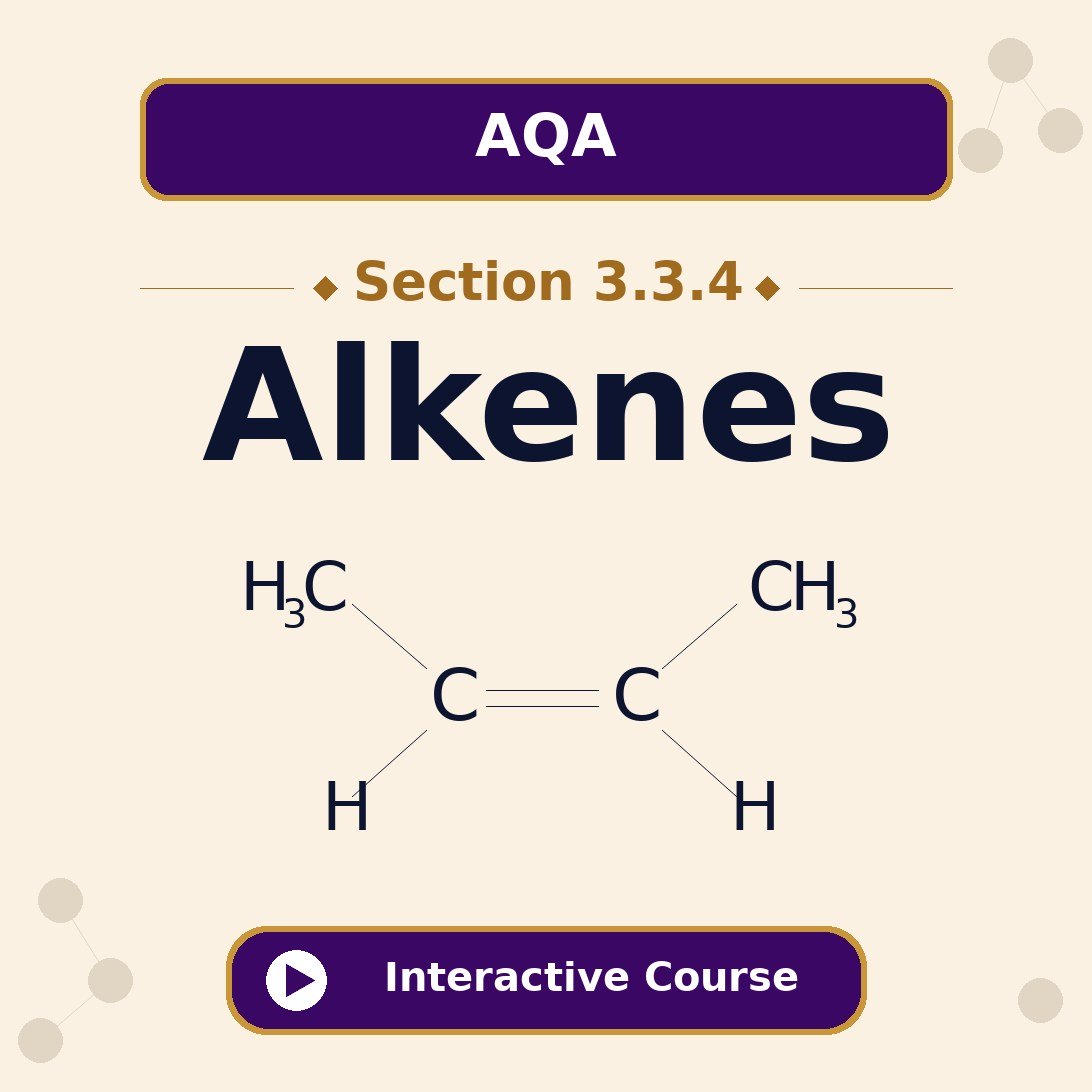
Master Alkenes for AQA A Level Chemistry
Continue from these free revision notes into the full 3.3.4 Alkenes course. The guided video lessons are ready now; the AQA MCQ bank, teacher-marked short-answer questions and KASP spec-point report are being written, and the course opens for enrolment as soon as they are complete.
Guided video teaching
Learn the chemistry and exam technique through structured video lessons with worked examples and walkthroughs.
Instant MCQ feedback
Auto-marked MCQ quizzes provide immediate diagnostic feedback for every answer choice.
Teacher-marked SAQs
Submit written exam responses and receive chemistry specialist feedback with improvement guidance.
Progress tracking
Identify strengths and weaknesses across the full 3.3.4 specification with targeted reporting.
See how the course works
Click play to start the course preview animation.
Some ionic radii are shown.
| Ion | Ionic radius / nm |
|---|---|
| Na+ | 0.102 |
| K+ | 0.138 |
| F− | 0.133 |
| Cl− | 0.180 |
Which compound has the strongest ionic bonding?
Explain why the metallic bonding in magnesium is much stronger than that in sodium.
Copyright notice: This revision page, including its written explanations, layout and teaching sequence, is produced for Online Learning System by Dr. Mohammed Al-Fatah. It is intended for student revision and may not be copied, redistributed or republished without permission.
Keep this note — free
Save your progress across every AQA topic. A free account remembers which topics you have covered, saves your question scores, and syncs across your phone and laptop.
- Track every topic you have finished
- Keep your practice-question scores
- No payment, no card, free forever
Already registered? Log in