Reactions of Alkenes with Steam
A concise revision guide to the reaction of alkenes with steam, including the conversion of ethene into ethanol, the use of concentrated phosphoric acid and why the reaction is carried out industrially rather than in a school laboratory.
GCSE Recap: Alcohols and Addition Reactions
Before you start, check what an alcohol is, what addition means and where ethanol comes from.
The Overall Reaction
Alkenes react with steam, H2O(g), to form alcohols. This reaction is called hydration because water is added across the carbon-carbon double bond.
For example, ethene reacts with steam to form ethanol.
The reaction converts the alkene functional group into an alcohol functional group. The C=C double bond opens, one hydrogen atom adds to one carbon atom, and an -OH group adds to the other carbon atom.
Key idea: Steam adds across the C=C double bond, so the alkene becomes an alcohol.
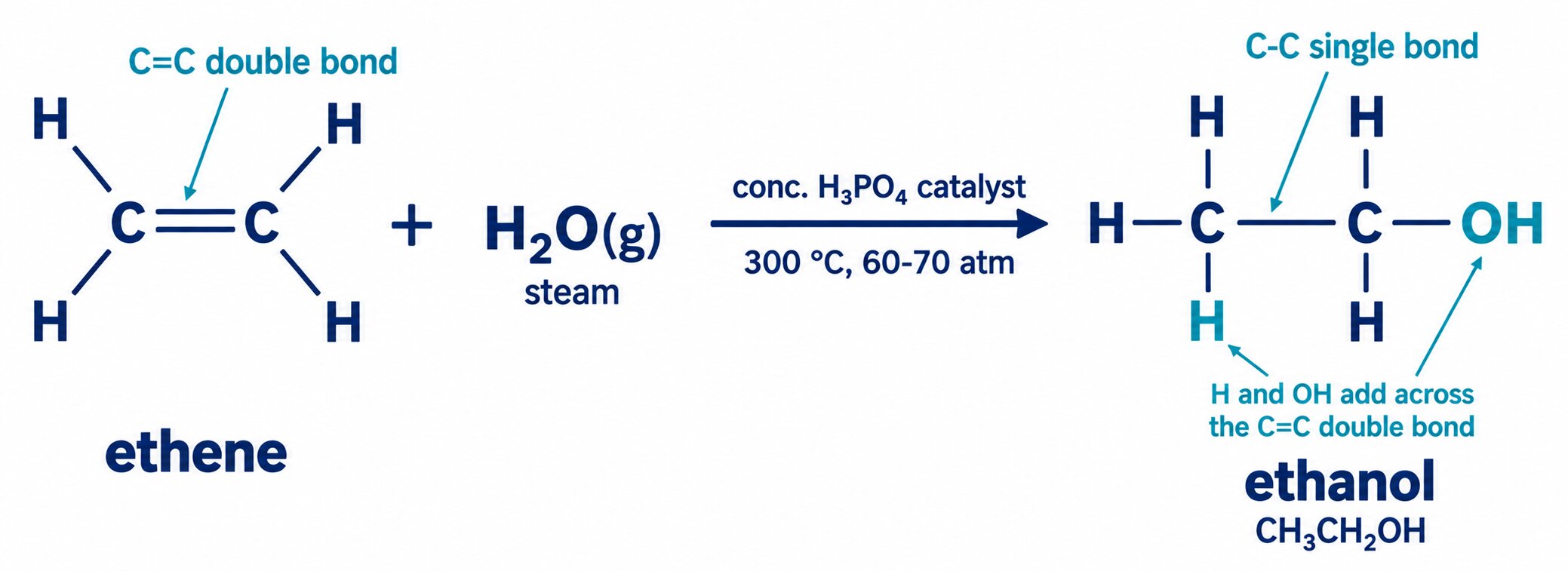
The displayed equation shows water added across the C=C double bond of ethene to produce ethanol.
Quick Check: Name the Alcohol
Apply the reaction to an alkene that this page does not use.
Conditions for Hydration
The hydration of ethene is carried out using steam and a catalyst of concentrated H3PO4, which is phosphoric acid.
The reaction also needs a high temperature, usually around 300 to 600 °C, and a high pressure of about 70 atm.
These conditions are much more severe than the conditions normally used in a school laboratory, so the reaction is treated as an industrial process.
Exam focus: Include both the reagent and the conditions: steam, concentrated H3PO4, high temperature and high pressure.
Quick Check: Justify the Conditions
In each round, choose the one statement that is accurate.
Where This Sits in the AQA Specification
AQA lists the hydration of alkenes under 3.3.5.1 Alcohol production rather than under alkenes. The specification states that alcohols are produced industrially by the hydration of alkenes in the presence of an acid catalyst, and asks you to outline the mechanism for the reaction of an alkene with steam.
The mechanism is the same electrophilic addition pattern used with HBr and H2SO4. The acid catalyst supplies H+, which is the electrophile. The π bond attacks H+ to give a carbocation, a water molecule donates a lone pair to the carbocation, and finally a proton is lost from the oxygen atom to regenerate the catalyst and give the alcohol.
Step 1: the π bond attacks H+
The alkene donates its π electrons to a proton from the acid catalyst, forming a carbocation.
Step 2: water attacks the carbocation
A lone pair on the oxygen atom of H2O forms a new C-O bond, giving a protonated alcohol.
Step 3: the catalyst is regenerated
The oxygen atom loses H+, leaving the alcohol and returning the proton to the catalyst.
Exam focus: Show the positive charge on the oxygen atom of the protonated alcohol before the final proton is lost. Omitting that intermediate is a common way to lose a mark.
Quick Check: Order the Mechanism
Drag the stages into the order in which they happen.
Why This Is an Addition Reaction
This reaction is an addition reaction because atoms are added across the C=C double bond.
The alkene starts as an unsaturated molecule. During hydration, the double bond opens and the atoms from water are added to the two carbon atoms from the original double bond.
In the hydration of ethene, this produces only one main product: ethanol.
Hydration: An addition reaction in which water, usually as steam in this industrial process, adds across a carbon-carbon double bond to form an alcohol.
Remember: For steam, the functional group change is alkene to alcohol. This is different from hydrogenation, which converts an alkene into an alkane.
Quick Check: Two Additions Compared
Drag the words into place to complete the comparison of the two reactions.
Industrial Advantages and Exam Mistakes
The process is preferred industrially because no waste products are formed, giving the reaction a high atom economy.
Producing only one main product also makes separation simpler and cheaper, reducing overall processing costs.
A common exam error is to describe the reaction as a normal laboratory preparation. The very high pressure makes the process unsuitable for typical laboratory use.
Exam focus: Link the industrial scale to the high pressure, and link the efficiency to no waste products and easier product separation.
Quick Check: Explain the Industrial Choice
Write a short explanation, then compare it with the mark points and the model answer.
Master Alkenes for AQA A Level Chemistry
Continue from these free revision notes into the full 3.3.4 Alkenes course. The guided video lessons are ready now; the AQA MCQ bank, teacher-marked short-answer questions and KASP spec-point report are being written, and the course opens for enrolment as soon as they are complete.
Guided video teaching
Learn the chemistry and exam technique through structured video lessons with worked examples and walkthroughs.
Instant MCQ feedback
Auto-marked MCQ quizzes provide immediate diagnostic feedback for every answer choice.
Teacher-marked SAQs
Submit written exam responses and receive chemistry specialist feedback with improvement guidance.
Progress tracking
Identify strengths and weaknesses across the full 3.3.4 specification with targeted reporting.
See how the course works
Click play to start the course preview animation.
Some ionic radii are shown.
| Ion | Ionic radius / nm |
|---|---|
| Na+ | 0.102 |
| K+ | 0.138 |
| F− | 0.133 |
| Cl− | 0.180 |
Which compound has the strongest ionic bonding?
Explain why the metallic bonding in magnesium is much stronger than that in sodium.
Copyright notice: This OLS revision content, including the explanations, layout, diagrams, tables and embedded learning structure, is authored for Online Learning System by Dr. Mohammed Al-Fatah. It may not be copied, reproduced, redistributed or adapted without written permission.
Keep this note — free
Save your progress across every AQA topic. A free account remembers which topics you have covered, saves your question scores, and syncs across your phone and laptop.
- Track every topic you have finished
- Keep your practice-question scores
- No payment, no card, free forever
Already registered? Log in