Properties of Addition Polymers and PVC
A concise AQA A Level Chemistry revision guide to why addition polymers are unreactive, the van der Waals forces between poly(alkene) chains, the effect of chain length and branching, and how plasticisers change the properties of poly(chloroethene), PVC.
GCSE Recap: What Melting Really Breaks
Before you start, check what is actually overcome when a molecular solid melts.
What Makes Poly(alkenes) Different
Once an alkene has polymerised, the product no longer behaves like an alkene. The C=C double bond that made the monomer reactive has been used up in forming the chain, and the physical properties of the polymer are decided by the forces between the chains rather than by any reactive group.
AQA 3.3.4.3 asks for three linked ideas: why addition polymers are unreactive, the nature of the intermolecular forces between poly(alkene) molecules, and the typical uses of poly(chloroethene), PVC, including how a plasticiser modifies its properties.
Key idea: Chemical reactivity depends on the bonds within a chain; physical properties such as melting point and flexibility depend on the forces between chains.
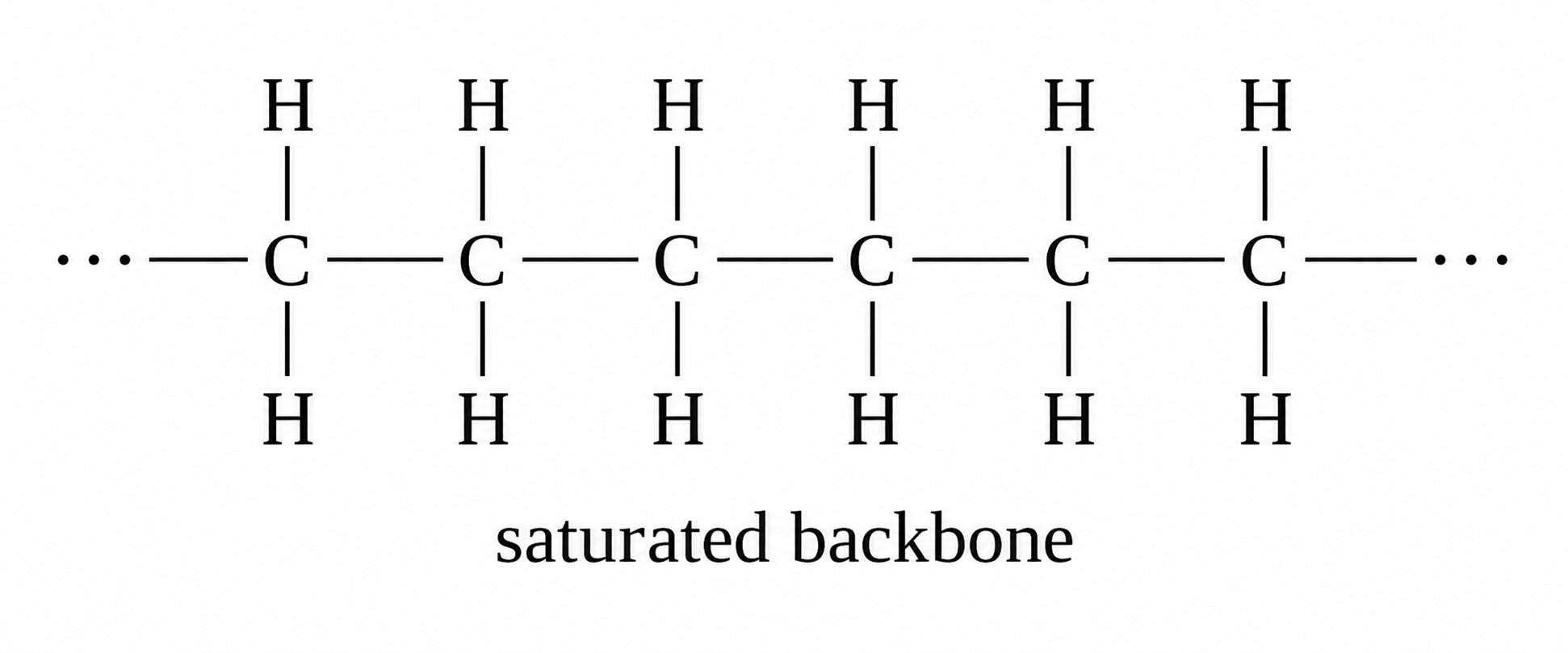
A poly(alkene) chain contains only single bonds, so there is no double bond left to react.
Why Addition Polymers Are Unreactive
Poly(alkenes) are saturated: the reactive π bond of the monomer has been used up in forming the chain. The backbone consists only of strong, non-polar C-C and C-H σ bonds, so there is no centre of high electron density for an electrophile to attack and no polar bond for a nucleophile to attack.
This chemical inertness is why poly(alkenes) are so useful for packaging, pipes and containers, and also why they are difficult to break down and persist in the environment.
Exam sentence: Addition polymers are unreactive because the chain contains only strong non-polar C-C and C-H single bonds and has no C=C double bond.
Quick Check: Bromine Water and Poly(propene)
Decide whether the explanation given is the right one, then read the feedback.
Intermolecular Forces Between Poly(alkene) Chains
The chains in a poly(alkene) are held together only by van der Waals forces (induced dipole-dipole forces), because the molecules are non-polar. These forces are weak between any one pair of atoms, but they act along the whole length of a very long chain, so the total attraction is large.
The strength of the intermolecular forces depends on the chains. Longer chains have more points of contact and stronger forces. Branched chains cannot pack closely, so the forces between them are weaker. This is why low-density poly(ethene), which is branched, is soft and flexible, while high-density poly(ethene), which is largely unbranched, is stiffer and stronger with a higher melting point.
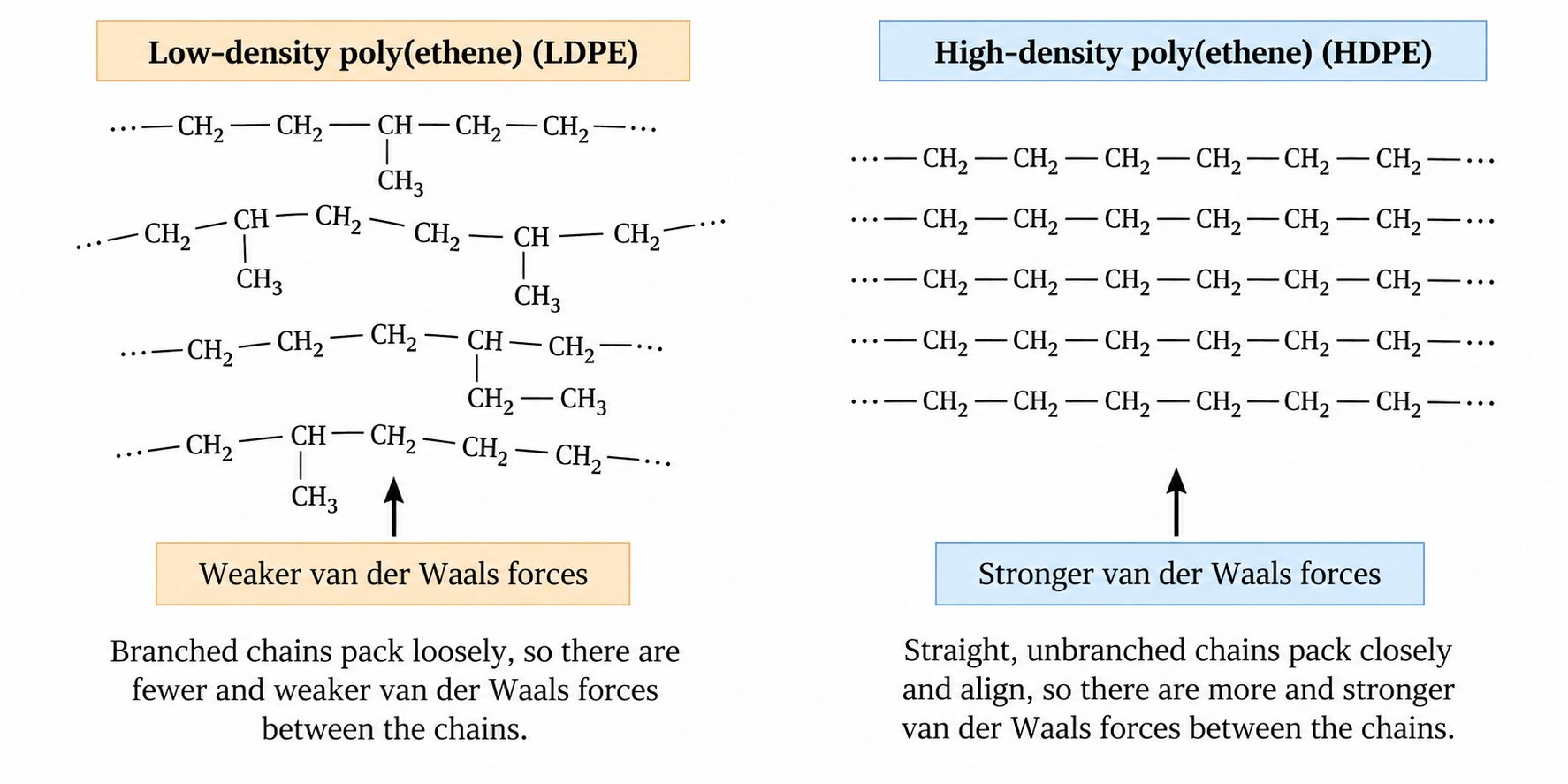
Branched chains cannot pack closely, so the van der Waals forces between them are weaker than between unbranched chains.
| Feature of the chains | Effect on intermolecular forces | Effect on the polymer |
|---|---|---|
| Longer chains | More van der Waals forces along the chain | Higher melting point, stronger material |
| Branched chains | Chains pack less closely, weaker forces | Lower density, softer and more flexible |
| Polar side groups (for example Cl in PVC) | Permanent dipole-dipole forces added | Harder and more rigid than poly(ethene) |
Exam focus: Name the force: van der Waals (induced dipole-dipole) forces between chains. Then link chain length or branching to how closely the chains pack and how strong the forces are.
Quick Check: Rank Five Samples
Put the five samples in order of melting point, highest first.
Quick Check: A Polar Side Group
Work out which forces act between the chains of each polymer, then drag the terms in.
PVC and Plasticisers
Poly(chloroethene), PVC, is a rigid, hard-wearing polymer. The C-Cl bonds are polar, so the chains attract one another by permanent dipole-dipole forces as well as van der Waals forces, and unplasticised PVC (uPVC) is stiff enough for window frames, drainpipes and guttering.
The properties of PVC can be modified by adding a plasticiser. Plasticiser molecules sit between the polymer chains, pushing them apart. This weakens the intermolecular forces between the chains, so they can slide over one another more easily and the polymer becomes soft and flexible. Plasticised PVC is used for cable insulation, flooring, clothing and hosepipes.
![PVC: the correct repeat unit -[CH2-CHCl]n- with its polar C-Cl bond, beside unplasticised and plasticised chains](https://www.onlinelearningsystem.net/xyz/wp-content/uploads/2026/09/fix-57.jpg)
Poly(chloroethene) structure with unplasticised PVC chains close together and plasticised PVC with plasticiser molecules between the chains
Plasticiser molecules sit between the PVC chains and weaken the forces holding the chains together.
| Form of PVC | Intermolecular forces between chains | Properties | Typical uses |
|---|---|---|---|
| Unplasticised PVC (uPVC) | Chains close together, strong forces | Rigid, hard, durable | Window frames, pipes, guttering |
| Plasticised PVC | Plasticiser molecules between chains, weaker forces | Soft, flexible | Cable insulation, flooring, clothing, hoses |
Exam sentence: A plasticiser is a small molecule that fits between the polymer chains, weakening the intermolecular forces between them so the chains can move past each other and the polymer becomes more flexible.
Quick Check: Explain the Cracked Cable
Write a short explanation, then compare it with the mark points and the model answer.
Quick Check: Burning Two Kinds of PVC
Decide which article gives off more hydrogen chloride for every kilogram burned.
Common Exam Mistakes
- Saying poly(ethene) is unreactive because it is a solid or because it is large. The reason is the saturated backbone of strong, non-polar C-C and C-H bonds.
- Calling the forces between poly(ethene) chains hydrogen bonds or covalent bonds. They are van der Waals (induced dipole-dipole) forces, made significant only by the length of the chains.
- Explaining the higher melting point of unbranched poly(ethene) without mentioning closer packing of the chains.
- Saying a plasticiser reacts with PVC. It does not bond to the chains; it sits between them and weakens the intermolecular forces.
Exam focus: Link every property to a force: reactivity to the bonds inside the chain, melting point and flexibility to the forces between chains.
Master Alkenes for AQA A Level Chemistry
Continue from these free revision notes into the full 3.3.4 Alkenes course. The guided video lessons are ready now; the AQA MCQ bank, teacher-marked short-answer questions and KASP spec-point report are being written, and the course opens for enrolment as soon as they are complete.
Guided video teaching
Learn the chemistry and exam technique through structured video lessons with worked examples and walkthroughs.
Instant MCQ feedback
Auto-marked MCQ quizzes provide immediate diagnostic feedback for every answer choice.
Teacher-marked SAQs
Submit written exam responses and receive chemistry specialist feedback with improvement guidance.
Progress tracking
Identify strengths and weaknesses across the full 3.3.4 specification with targeted reporting.
See how the course works
Click play to start the course preview animation.
Some ionic radii are shown.
| Ion | Ionic radius / nm |
|---|---|
| Na+ | 0.102 |
| K+ | 0.138 |
| F− | 0.133 |
| Cl− | 0.180 |
Which compound has the strongest ionic bonding?
Explain why the metallic bonding in magnesium is much stronger than that in sodium.
Copyright notice: This OLS revision content, including the explanations, layout, diagrams, tables and embedded learning structure, is authored for Online Learning System by Dr. Mohammed Al-Fatah. It may not be copied, reproduced, redistributed or adapted without written permission.
Keep this note — free
Save your progress across every AQA topic. A free account remembers which topics you have covered, saves your question scores, and syncs across your phone and laptop.
- Track every topic you have finished
- Keep your practice-question scores
- No payment, no card, free forever
Already registered? Log in