IUPAC Rules
A concise revision guide to the key IUPAC naming rules used in A Level organic chemistry, including formula types, displayed formulae, skeletal formulae, carbon chain prefixes, functional group naming and numbering rules.
GCSE Recap: Bonds in a Displayed Formula
Before you start, check that you remember how many bonds each kind of atom forms and what makes a compound a hydrocarbon.
Key Organic Chemistry Definitions
Before naming organic compounds, you need to recognise the basic language used to describe formulae, bonding and families of compounds.
Hydrocarbon
A compound consisting of hydrogen and carbon only.
Saturated
A compound containing single carbon-carbon bonds only.
Unsaturated
A compound containing at least one C=C double bond.
Molecular formula
The formula showing the actual number of each type of atom in a molecule.
Empirical formula
The simplest whole number ratio of atoms of each element in a compound.
General formula
An algebraic formula for a homologous series, such as CnH2n for alkenes.
Structural formula
The minimal detail needed to show the arrangement of atoms in a molecule, such as CH3CH2CH2CH3.
Displayed formula
A formula showing all covalent bonds present in a molecule.
Key idea: IUPAC naming depends on identifying the carbon skeleton, the functional group and the correct numbering system.
Quick Check: Which Kind of Formula?
Decide quickly which term describes each formula or compound.
Empirical and Molecular Formulae in Organic Chemistry
AQA 3.3.1.1 lists the empirical formula alongside the molecular, general, structural, displayed and skeletal formulae as ways of representing an organic compound. The empirical formula is the simplest whole-number ratio of the atoms of each element; the molecular formula gives the actual number of atoms of each element in one molecule. For organic compounds the two are often different, because carbon chains repeat the same CH2 unit.
| Compound | Molecular formula | Empirical formula | Comment |
|---|---|---|---|
| Ethane | C2H6 | CH3 | Divide both numbers by 2 |
| Butene | C4H8 | CH2 | Every alkene has the empirical formula CH2 |
| Ethanoic acid | C2H4O2 | CH2O | Shares its empirical formula with methanal, CH2O, and glucose, C6H12O6 |
| Methane | CH4 | CH4 | Already the simplest ratio, so the two formulae are the same |
Finding the empirical formula from composition
A compound contains 40.0% carbon, 6.7% hydrogen and 53.3% oxygen by mass. Divide each percentage by the relative atomic mass to get the mole ratio: C 40.0 / 12.0 = 3.33, H 6.7 / 1.0 = 6.7, O 53.3 / 16.0 = 3.33. Dividing by the smallest value gives C 1 : H 2 : O 1, so the empirical formula is CH2O.
Scaling up to the molecular formula
The empirical formula mass of CH2O is 30.0. If the compound has a relative molecular mass of 60.0, then 60.0 / 30.0 = 2 and the molecular formula is C2H4O2, which could be ethanoic acid. If the relative molecular mass were 30.0 the compound would be methanal, CH2O. The empirical formula alone never identifies an organic compound: you need the relative molecular mass, usually from a mass spectrum, and then the structural formula to decide which isomer it is.
Exam focus: Show every step: percentages to moles, divide by the smallest, multiply to whole numbers, then compare the empirical formula mass with Mr. State clearly which formula is empirical and which is molecular.
Quick Check: Empirical and Molecular Formulae
Complete the comparison of two six-carbon hydrocarbons.
Quick Check: From Percentages to Molecular Formula
Work out the molecular formula on paper, then choose your answer.
Displayed and Skeletal Formulae
When drawing organic compounds, add hydrogen atoms so that each carbon forms four bonds. In saturated hydrocarbons, the arrangement of bonds around each carbon atom is tetrahedral, with a bond angle of approximately 109.5°.
A skeletal formula is a simplified way of representing an organic molecule. Hydrogen atoms bonded to carbon are omitted, showing only the carbon skeleton and any functional groups attached.
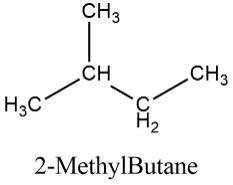
2-methylbutane shows a branched carbon skeleton with four bonds around each carbon.
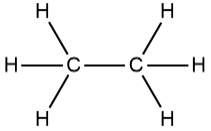
Ethane can be represented with all C-H and C-C covalent bonds shown.
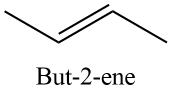
But-2-ene uses a skeletal formula, with carbon atoms at line ends and vertices.
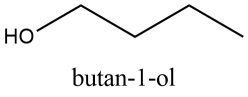
Functional groups, such as OH in alcohols, are shown explicitly in skeletal formulae.
Exam focus: In skeletal formulae, carbon atoms and carbon-bonded hydrogen atoms are usually not written, but heteroatoms and functional groups must still be shown.
Quick Check: Read a Skeletal Formula
Picture the skeletal formula described and work out its molecular formula.
Naming Carbon Chains
The first step in IUPAC naming is to identify and count the longest continuous carbon chain. This gives the parent name of the compound.
Next, identify any branched side chains and count the number of carbon atoms in each branch. The correct prefix is then added to the parent name.
| Code | Number of carbons | Used in parent names such as |
|---|---|---|
| meth | 1 | methane |
| eth | 2 | ethane, ethene |
| prop | 3 | propane, propene |
| but | 4 | butane, but-2-ene |
| pent | 5 | pentane |
| hex | 6 | hexane |
| hept | 7 | heptane |
| oct | 8 | octane |
| non | 9 | nonane |
| dec | 10 | decane |
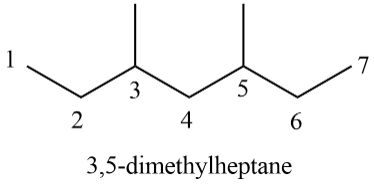
The longest continuous chain is counted first, then methyl branches are located using numbers.
Quick Check: Find the Longest Chain
Name a branched alkane whose longest chain is not the one written in a straight line.
Functional Groups and Suffix Rules
A functional group is an atom or group of atoms responsible for giving a homologous series its characteristic chemical reactions. In names, a functional group may be shown using either a prefix or a suffix.
Suffix starts with a vowel
If the suffix starts with a vowel, the final -e is removed from the parent alkane name. Examples include propan-1-ol, butan-1-amine, ethanoic acid, ethanoyl chloride and butanamide.
Suffix starts with a consonant
If the suffix starts with a consonant, the final -e is not removed from the parent alkane name. Examples include propanenitrile and pentane-2,4-dione.
Two or more of the same functional group
If there are two or more of the same functional group and di- or tri- is used, the final -e is not removed. Examples include ethane-1,2-diol and propane-1,2,3-triol.
The number 1 shows that the OH group is attached to the first carbon in the chain.
Quick Check: Keep the e or Drop It?
Click every name in which the final e of the stem has been handled wrongly.
Numbering Rules and Alphabetical Order
Numbers are only included in names when they are needed to avoid ambiguity. When numbering a carbon chain, functional groups take priority over branched side chains when assigning the lowest possible number.
Words and numbers in organic names are separated using dashes. When more than one number is used, numbers are separated by commas.
If a molecule contains more than one functional group or side chain, the groups are listed in alphabetical order, ignoring multiplicative prefixes such as di- or tri-.
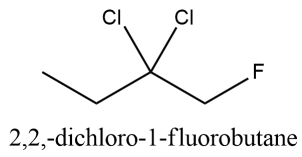
2,2-dichloro-1-fluorobutane shows comma-separated numbers and alphabetical ordering by functional group prefix.
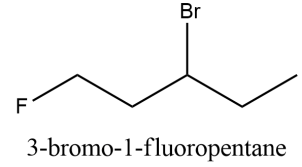
Bromo is written before fluoro because prefixes are listed alphabetically.
Remember: The correct name depends on choosing the longest chain, assigning the lowest possible numbers and writing substituents in alphabetical order.
Quick Check: Naming in the Right Order
Put the steps for naming a branched alcohol into the order in which you would carry them out.
Homologous Series and Functional Group Priority
A homologous series is a family of organic compounds with the same functional group and the same general formula. Members of a homologous series show a gradual change in physical properties as chain length increases, but similar chemical properties because they contain the same functional group.
Each successive compound in a homologous series differs from the previous compound by a CH2 unit.
| Priority rule | What it means | Example exam wording |
|---|---|---|
| Highest priority group | The functional group with the highest priority is given the suffix and the lowest possible number. | Identify the principal functional group before numbering the chain. |
| Other functional groups | Other functional groups are named using prefixes. | Halogeno groups such as bromo, chloro and fluoro are written as prefixes. |
| Double and triple bonds | Alkenes and alkynes use suffixes even when another functional group is present. | Name the carbon chain and include the position of the C=C bond if required. |
Functional group priority, highest to lowest: carboxylic acids > aldehydes > ketones > alcohols > alkenes > halogenoalkanes.
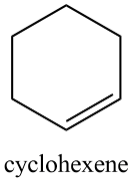
Cyclohexene contains a C=C double bond in a cyclic carbon skeleton.
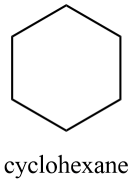
Cyclohexane is saturated because it contains carbon-carbon single bonds only.
Quick Check: Spot the Correct Name
In each round pick the one accurate statement about a name or a homologous series.
Master Introduction to Organic Chemistry and Alkanes for AQA A Level Chemistry
Continue from these free revision notes into the full 3.3.1 and 3.3.2 Introduction to Organic Chemistry and Alkanes course. The six guided video lessons are ready now; the AQA MCQ bank, teacher-marked short-answer questions, supplementary lessons and KASP spec-point report are being written, and the course opens for enrolment as soon as they are complete.
Guided video teaching
Learn the chemistry and exam technique through structured video lessons with worked examples and walkthroughs.
Instant MCQ feedback
Auto-marked MCQ quizzes provide immediate diagnostic feedback for every answer choice.
Teacher-marked SAQs
Submit written exam responses and receive chemistry specialist feedback with improvement guidance.
Progress tracking
Identify strengths and weaknesses across the full 3.3.1 and 3.3.2 specification with targeted reporting.
See how the course works
Click play to start the course preview animation.
Some ionic radii are shown.
| Ion | Ionic radius / nm |
|---|---|
| Na+ | 0.102 |
| K+ | 0.138 |
| F− | 0.133 |
| Cl− | 0.180 |
Which compound has the strongest ionic bonding?
Explain why the metallic bonding in magnesium is much stronger than that in sodium.
Copyright notice: This OLS revision content, including the explanations, layout, diagrams, tables and embedded learning structure, is authored for Online Learning System by Dr. Mohammed Al-Fatah. It may not be copied, reproduced, redistributed or adapted without written permission.
Keep this note — free
Save your progress across every AQA topic. A free account remembers which topics you have covered, saves your question scores, and syncs across your phone and laptop.
- Track every topic you have finished
- Keep your practice-question scores
- No payment, no card, free forever
Already registered? Log in