Isomerism
A concise revision guide to structural isomerism in organic chemistry, including chain isomerism, position isomerism and functional group isomerism.
GCSE Recap: Molecular and Structural Formulae
Check that you can count atoms in a structural formula and know what a molecular formula leaves out.
What Are Structural Isomers?
Structural isomers are compounds that have the same molecular formula but different structural formulae.
This means the compounds contain the same number of each type of atom, but the atoms are connected in a different order. In organic chemistry, this usually changes the carbon skeleton, the position of a functional group or the functional group itself.
Definition: Structural isomers have the same molecular formula but different structural formulae. The difference is in how the atoms are arranged and bonded together.
Exam focus: To decide whether two compounds are structural isomers, compare the molecular formula first, then compare how the atoms are connected.
Quick Check: Same Molecular Formula?
Work out each molecular formula to find the one true isomer of hexane.
Chain Isomerism
Chain isomerism occurs when compounds have the same molecular formula but different structures of the carbon skeleton.
The carbon chain may be straight or branched. For example, pentane, 2-methylbutane and 2,2-dimethylpropane all have the molecular formula C5H12, but their carbon skeletons are different.
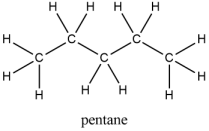
Pentane
A straight-chain alkane with five carbon atoms.
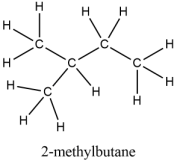
2-methylbutane
A branched isomer with the same molecular formula as pentane.
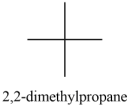
2,2-dimethylpropane
A more highly branched isomer of C5H12.
Quick Check: Isomers or the Same Compound?
Decide whether each pair shows chain isomers, one compound drawn twice, or two compounds that are not isomers.
Position Isomerism
Position isomerism occurs when compounds have the same molecular formula but different structures because the same functional group is in a different position on the same carbon skeleton.
For example, 1-bromopropane and 2-bromopropane both have the formula C3H7Br, but the bromine atom is attached to a different carbon atom.
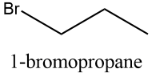
1-bromopropane
The bromine atom is attached to carbon 1 of the propane chain.
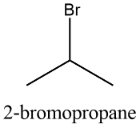
2-bromopropane
The bromine atom is attached to carbon 2 of the propane chain.
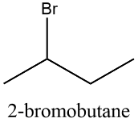
Halogenoalkanes are useful examples for practising position isomerism because the halogen can occupy different positions on the carbon chain.
Quick Check: Spot the Position Isomer
Only one of these four structures is a position isomer of pentan-1-ol.
Quick Check: Counting Isomers
Draw the isomers on paper and count them before you flip each card.
Functional Group Isomerism
Functional group isomerism occurs when compounds have the same molecular formula but the atoms are arranged to give different functional groups.
This is more than a change in the position of the same group. The compounds belong to different homologous series, so they may have different chemical reactions and physical properties.
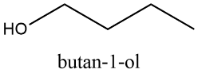
Butan-1-ol
An alcohol, identified by the hydroxyl functional group, -OH.
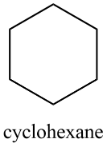
Cyclohexane
A cyclic hydrocarbon structure, useful for recognising that connectivity and functional group type both matter.
Important: Two structures are only isomers if they have the same molecular formula. Do not classify compounds as isomers simply because their structures look similar or contain related atoms.
Quick Check: Every Isomer of Pent-1-ene
Click all the compounds that share the molecular formula of pent-1-ene.
Comparing the Types of Structural Isomerism
The table below summarises the difference between the three common types of structural isomerism used in this topic.
| Type of isomerism | What changes? | Typical example |
|---|---|---|
| Chain isomerism | The arrangement of the carbon skeleton changes. | Pentane, 2-methylbutane and 2,2-dimethylpropane. |
| Position isomerism | The same functional group is attached at a different position on the same carbon skeleton. | 1-bromopropane and 2-bromopropane. |
| Functional group isomerism | The atoms are arranged to give different functional groups. | Compounds with the same molecular formula but different homologous-series membership. |
Exam focus: Always check the molecular formula before naming the type of isomerism. Same formula first, then decide what structural feature has changed.
Quick Check: Which Type of Isomerism?
Pick the accurate statement about each new pair of compounds.
Common Exam Mistakes
- Do not say structural isomers have the same structural formula. They have the same molecular formula but different structural formulae.
- Do not confuse chain isomerism with position isomerism. Chain isomerism changes the carbon skeleton.
- Do not describe position isomerism as a different functional group. It is the same functional group in a different position.
- Do not ignore the molecular formula. If the molecular formula is different, the compounds are not isomers.
Isomerism Summary
Structural isomers
Same molecular formula, different structural formulae.
Chain isomerism
The carbon skeleton changes from straight-chain to branched.
Position isomerism
The same functional group is in a different position on the carbon skeleton.
Functional group isomerism
The same atoms are arranged to give different functional groups.
Master Introduction to Organic Chemistry and Alkanes for AQA A Level Chemistry
Continue from these free revision notes into the full 3.3.1 and 3.3.2 Introduction to Organic Chemistry and Alkanes course. The six guided video lessons are ready now; the AQA MCQ bank, teacher-marked short-answer questions, supplementary lessons and KASP spec-point report are being written, and the course opens for enrolment as soon as they are complete.
Guided video teaching
Learn the chemistry and exam technique through structured video lessons with worked examples and walkthroughs.
Instant MCQ feedback
Auto-marked MCQ quizzes provide immediate diagnostic feedback for every answer choice.
Teacher-marked SAQs
Submit written exam responses and receive chemistry specialist feedback with improvement guidance.
Progress tracking
Identify strengths and weaknesses across the full 3.3.1 and 3.3.2 specification with targeted reporting.
See how the course works
Click play to start the course preview animation.
Some ionic radii are shown.
| Ion | Ionic radius / nm |
|---|---|
| Na+ | 0.102 |
| K+ | 0.138 |
| F− | 0.133 |
| Cl− | 0.180 |
Which compound has the strongest ionic bonding?
Explain why the metallic bonding in magnesium is much stronger than that in sodium.
Copyright notice: This OLS revision content, including the explanations, layout, diagrams, tables and embedded learning structure, is authored for Online Learning System by Dr. Mohammed Al-Fatah. It may not be copied, reproduced, redistributed or adapted without written permission.
Keep this note — free
Save your progress across every AQA topic. A free account remembers which topics you have covered, saves your question scores, and syncs across your phone and laptop.
- Track every topic you have finished
- Keep your practice-question scores
- No payment, no card, free forever
Already registered? Log in