Curly Arrows and Mechanisms
A concise AQA A Level Chemistry revision guide to the conventions used in reaction mechanisms: what a curly arrow means, the three places an arrow can start, how dipoles show where an arrow points, and how to outline a mechanism step by step (3.3.1.2).
What a Mechanism Shows
A reaction mechanism is a step-by-step description of how the bonds in the reactants break and the bonds in the products form. AQA 3.3.1.2 states that the reactions of organic compounds can be explained using mechanisms, and asks you to outline mechanisms by drawing the structures of the species involved and using curly arrows to represent the movement of electron pairs.
Every mechanism you draw at A Level uses one of two conventions, and the choice depends on how the bonds break.
| Type of mechanism | How bonds break | Arrow used | AQA examples |
|---|---|---|---|
| Free-radical mechanism | Homolytic fission: one electron to each atom | None required by AQA. The unpaired electron is shown as a dot on the radical, for example Cl• | Chlorination of methane (3.3.2.4) |
| Electron-pair mechanism | Heterolytic fission: both electrons to one atom | A full curly arrow showing the movement of a pair of electrons | Electrophilic addition (3.3.4), nucleophilic substitution and elimination (3.3.3) |
Key idea: A curly arrow always represents the movement of a pair of electrons. It never represents the movement of an atom, and it never starts on a positive charge.
Quick Check: Which Kind of Fission?
Decide where the two electrons of each bond end up, then type the word.
Where a Curly Arrow Starts
There are only three places a curly arrow can start, because there are only three places an electron pair can be found: in a lone pair, in a bond that is being used to form a new bond, or in a bond that is breaking. Where the arrow finishes tells you what happens to the electrons.
| The arrow starts from | The arrow points to | What happens | Example |
|---|---|---|---|
| A lone pair on an atom | An atom that is short of electrons | The lone pair becomes a new covalent bond | The lone pair on the oxygen of a water molecule attacking a carbocation during hydration |
| A covalent bond | An atom outside that bond | The bond breaks and its electrons form a new bond to the atom pointed at | The C=C π bond attacking the H atom of HBr |
| A covalent bond | One of the two atoms in that bond | The bond breaks heterolytically; that atom keeps both electrons and becomes negative | The H-Br bond breaking to give Br– |
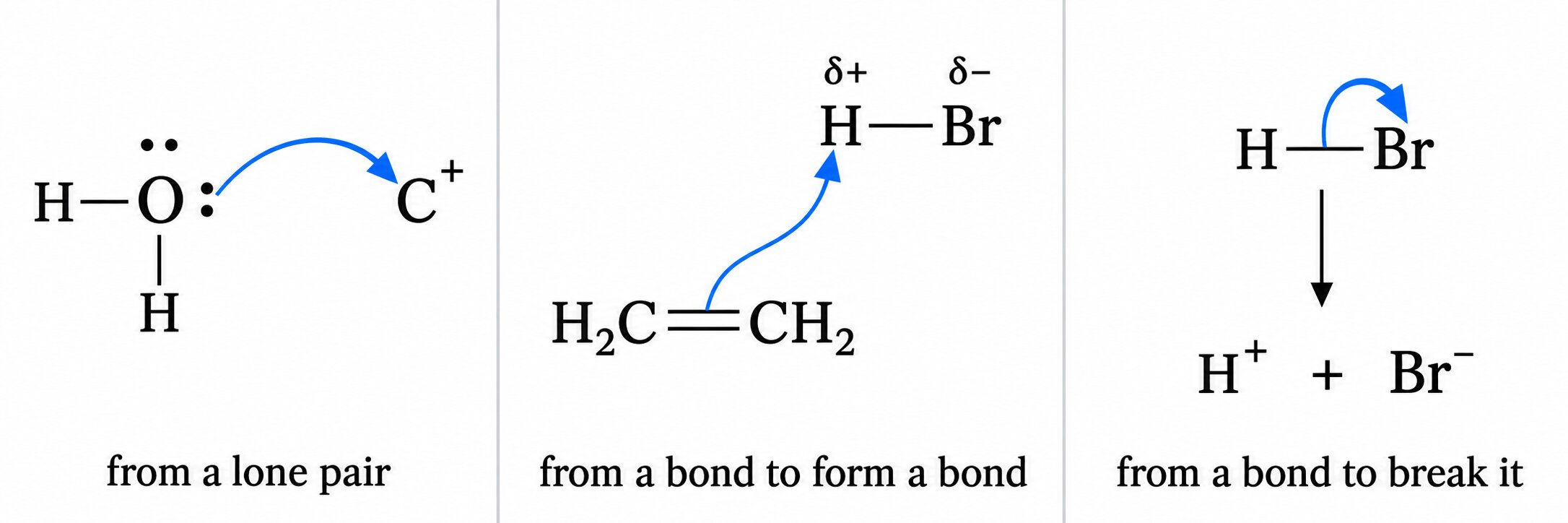
The three curly-arrow conventions required by AQA 3.3.1.2: a bond forms from a lone pair, a bond forms from another bond, and a bond breaks.
Exam focus: Start the arrow exactly on the electron pair: on the lone pair, or on the middle of the bond. An arrow that starts on an atom or on a charge is marked wrong even if it points to the right place.
Quick Check: Where Must the Arrow Start?
Only one of the four places named holds the pair of electrons that becomes the new bond.
Dipoles: Where the Arrow Points
Electron pairs move towards atoms that are short of electron density. In a polar bond the more electronegative atom carries a partial negative charge, δ–, and the other atom a partial positive charge, δ+. Marking the dipole on the reactant tells you which atom the first arrow will point to.
- In H-Br, bromine is more electronegative, so the bond is Hδ+-Brδ–. The π bond of an alkene attacks the Hδ+ atom.
- In a C-Cl bond, chlorine is more electronegative, so the carbon is δ+. A nucleophile such as OH– attacks the Cδ+ atom.
- In Br2 there is no permanent dipole, but the electron-rich π bond of an alkene induces one as the molecule approaches, giving Brδ+-Brδ–.
Exam sentence: The curly arrow goes from the electron pair to the δ+ atom, and at the same time the polar bond breaks with its electrons moving to the δ- atom.
Quick Check: Where Does the Arrow Point?
Four rapid questions on species the page has not used.
Outlining a Mechanism: A Worked Example
AQA asks you to outline a mechanism, which means drawing every species involved with the correct charges and lone pairs, and showing each electron-pair movement with a curly arrow. Take the reaction of chloromethane with hydroxide ions, a nucleophilic substitution you will meet in 3.3.3.
- Draw the reactants with their dipoles and lone pairs. Chloromethane is drawn with the C-Cl bond marked Cδ+-Clδ–. The hydroxide ion is drawn as –:OH with its lone pair and negative charge shown.
- Draw the arrow that forms the new bond. A curly arrow starts on the lone pair of the hydroxide oxygen and points to the δ+ carbon atom.
- Draw the arrow that breaks the old bond. A second curly arrow starts on the middle of the C-Cl bond and points to the chlorine atom, which takes both electrons.
- Draw the products. Methanol, CH3OH, and a chloride ion, Cl–. Check that the charges balance: one negative charge on each side.
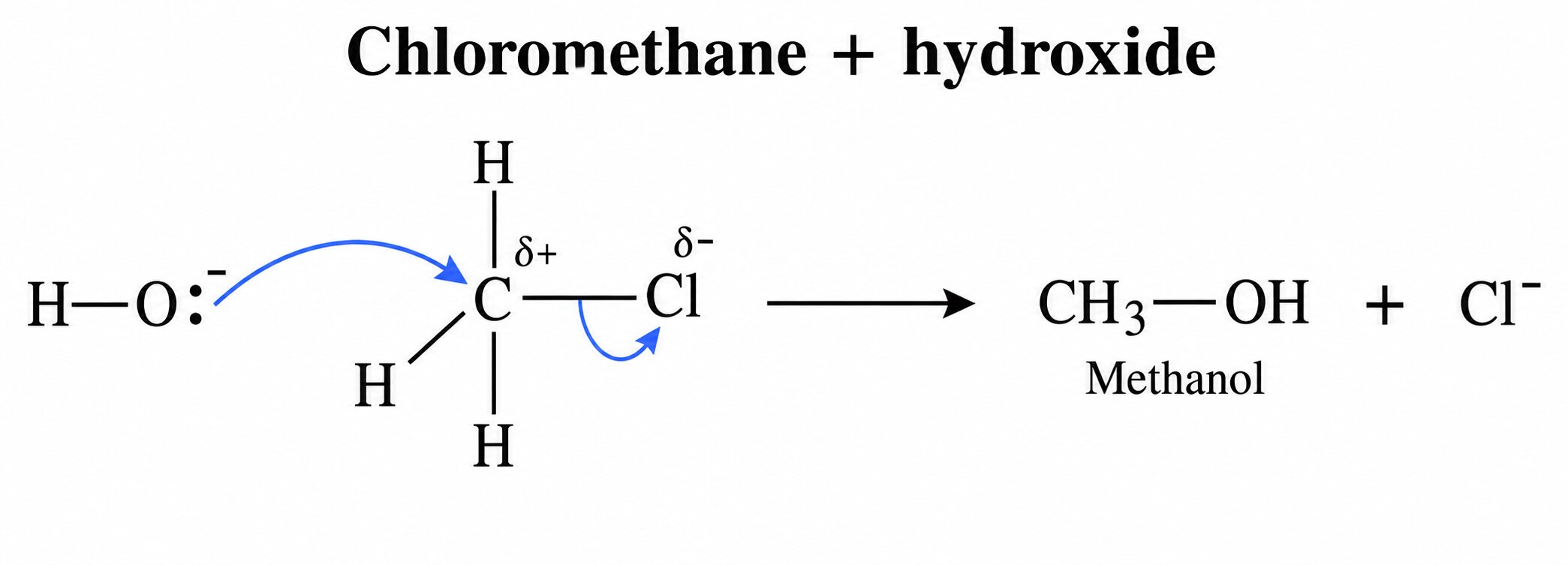
Outlining a mechanism: the arrow from the lone pair forms the C-O bond while the arrow from the C-Cl bond breaks it, giving methanol and a chloride ion.
Exam focus: Two arrows in the same step must be consistent: if a new bond forms at a carbon atom, an old bond at that carbon must break in the same step or the carbon would have five bonds.
Quick Check: Build the Mechanism
Drag the six stages into the order you would draw them.
Free-Radical Mechanisms Are Different
In a free-radical mechanism the bonds break homolytically, so only single electrons move. AQA does not require curly arrows here. Instead you write balanced equations for each step and show the unpaired electron on each radical as a dot.
For example, in the propagation steps of the chlorination of methane you write Cl• + CH4 → HCl + •CH3, then •CH3 + Cl2 → CH3Cl + Cl•. No arrows are drawn, but every radical must carry its dot.
| Feature | Electron-pair mechanism | Free-radical mechanism |
|---|---|---|
| Bond fission | Heterolytic | Homolytic |
| Species formed | Ions (carbocations, halide ions) and molecules | Radicals with an unpaired electron |
| What AQA asks you to draw | Structures with curly arrows, dipoles, lone pairs and charges | Balanced equations for initiation, propagation and termination with dots on the radicals |
| Where you meet it | Alkenes (3.3.4), halogenoalkanes (3.3.3) | Alkanes (3.3.2.4) |
Key idea: Dot for a radical, curly arrow for a pair. Mixing the two conventions on one diagram is a common way to lose marks.
Quick Check: An Arrow in a Radical Step
Decide whether the arrow described belongs in this step.
Quick Check: Pick the Accurate Statement
In each round, choose the one statement that describes the arrows correctly.
Common Exam Mistakes
- Starting a curly arrow on an atom, a δ+ symbol or a positive charge instead of on the electron pair.
- Pointing the arrow the wrong way, from the electron-poor atom towards the electron pair.
- Forgetting the lone pair on a nucleophile such as OH–, H2O or NH3, so the first arrow has nowhere to start.
- Leaving out the dipole, or drawing it the wrong way round, so the arrow attacks the δ– atom.
- Omitting the charge on an intermediate, for example a carbocation drawn without its positive sign.
- Using curly arrows in a free-radical mechanism, or leaving the dots off the radicals.
Exam sentence: A curly arrow shows the movement of a pair of electrons: it starts on a lone pair or a bond and points to where the electrons go.
Master Introduction to Organic Chemistry and Alkanes for AQA A Level Chemistry
Continue from these free revision notes into the full 3.3.1 and 3.3.2 Introduction to Organic Chemistry and Alkanes course. The six guided video lessons are ready now; the AQA MCQ bank, teacher-marked short-answer questions, supplementary lessons and KASP spec-point report are being written, and the course opens for enrolment as soon as they are complete.
Guided video teaching
Learn the chemistry and exam technique through structured video lessons with worked examples and walkthroughs.
Instant MCQ feedback
Auto-marked MCQ quizzes provide immediate diagnostic feedback for every answer choice.
Teacher-marked SAQs
Submit written exam responses and receive chemistry specialist feedback with improvement guidance.
Progress tracking
Identify strengths and weaknesses across the full 3.3.1 and 3.3.2 specification with targeted reporting.
See how the course works
Click play to start the course preview animation.
Some ionic radii are shown.
| Ion | Ionic radius / nm |
|---|---|
| Na+ | 0.102 |
| K+ | 0.138 |
| F− | 0.133 |
| Cl− | 0.180 |
Which compound has the strongest ionic bonding?
Explain why the metallic bonding in magnesium is much stronger than that in sodium.
Free Radical Substitution FAQs
These questions summarise the core exam points on alkane substitution and free radicals.
Why are alkanes usually unreactive?
Alkanes are usually unreactive because they contain strong C-C and C-H bonds. These bonds require a large amount of energy to break.
What condition is needed for alkanes to react with chlorine?
Ultraviolet light is needed. UV light provides enough energy to break the Cl-Cl bond by homolytic fission, forming chlorine radicals.
What is a free radical?
A free radical is a species with an unpaired electron. The unpaired electron is usually represented using a dot, such as Cl•.
Why is the reaction called substitution?
It is called substitution because a hydrogen atom in the alkane is replaced by a halogen atom.
Why can a mixture of products form?
After the first substitution, the haloalkane product can undergo further substitution. This can replace more hydrogen atoms and produce a mixture of chlorinated products.
Copyright notice: This OLS revision content, including the explanations, layout, diagrams, tables and embedded learning structure, is authored for Online Learning System by Dr. Mohammed Al-Fatah. It may not be copied, reproduced, redistributed or adapted without written permission.
Keep this note — free
Save your progress across every AQA topic. A free account remembers which topics you have covered, saves your question scores, and syncs across your phone and laptop.
- Track every topic you have finished
- Keep your practice-question scores
- No payment, no card, free forever
Already registered? Log in