Ester
A concise revision guide to ester functional groups, ester naming, the alkyl part from the alcohol, the carboxylate part from the carboxylic acid, and ester priority in IUPAC names.
GCSE Recap: Where Esters Come From
Before you start, check what you remember from GCSE about making esters and what they are like.
What Is an Ester?
An ester is an organic compound containing the ester functional group, written as RCOOR’. This contains a carbonyl group, C=O, directly bonded to an oxygen atom that is also bonded to another carbon group.
The ester group is often shown as -COO-. The carbonyl carbon belongs to the carboxylate part of the name, while the group attached to the single-bonded oxygen gives the alkyl part of the name.
Key idea: An ester has the pattern carbonyl carbon, oxygen, carbon. This is different from a carboxylic acid, which has the pattern -COOH.
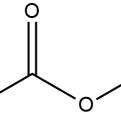
The ester functional group contains a C=O bond next to an oxygen atom bonded to another carbon group.
Quick Check: Is It an Ester?
Decide quickly whether each structural formula is an ester, a carboxylic acid or neither.
Naming Esters: Two Parts
An ester name is made of two parts. The first part is the alkyl group from the alcohol. The second part is the carboxylate part from the carboxylic acid.
The carboxylate part is named second and ends in -oate. For example, an ester made from methanol and ethanoic acid is named methyl ethanoate.
| Part of ester name | Where it comes from | Usual naming pattern | Example in methyl ethanoate |
|---|---|---|---|
| Alkyl part | Alcohol | Named first, often ending in -yl | methyl |
| Carboxylate part | Carboxylic acid | Named second, ending in -oate | ethanoate |
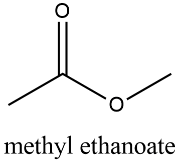
In methyl ethanoate, methyl is the alkyl part from the alcohol and ethanoate is the carboxylate part from the acid.
Quick Check: Build the Ester Name
Type the name of the ester made from each alcohol and carboxylic acid.
Numbering the Acid Part
In the carboxylate part of an ester name, the carbon chain is numbered from the carbonyl carbon. This carbon is carbon 1 of the acid-derived part.
No position number is usually needed for the ester group because the ester functional group is at the end of the carboxylate chain. The name focuses on the alkyl group followed by the acid-derived -oate ending.
Exam focus: Work backwards from the name. The first word is attached to the oxygen atom. The second word tells you the carbon chain containing the carbonyl carbon.
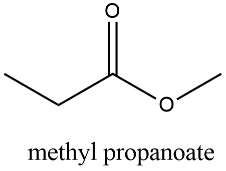
Methyl propanoate has a methyl group attached to the ester oxygen and a three-carbon propanoate chain containing the carbonyl carbon.
Quick Check: From Structure to Name
Name an ester from its structural formula by finding the carbonyl carbon first.
Ester Priority in IUPAC Names
Esters have lower priority than carboxylic acids. If a -COOH group is present in the same molecule, the compound is named as a carboxylic acid rather than using the ester suffix as the main functional group.
In this situation, the ester group is named as an alkoxycarbonyl substituent. This reflects the lower naming priority of esters compared with carboxylic acids.
No higher-priority acid group
Use the ester naming pattern: alkyl name first, then carboxylate name ending in -oate.
Carboxylic acid group present
The -COOH group takes priority, so the ester is treated as a substituent rather than the main suffix.
Quick Check: Which Group Wins?
Apply the priority rule to a molecule that contains both an ester group and a carboxylic acid group.
Common Ester Examples
The names methyl ethanoate and methyl propanoate show how ester names combine an alkyl group with a carboxylate part.
Changing the carboxylate chain changes the second part of the name. Ethanoate contains two carbon atoms in the acid-derived chain, while propanoate contains three carbon atoms in the acid-derived chain.
Methyl ethanoate contains a methyl group and an ethanoate chain.
Methyl propanoate contains the same alkyl group but a longer carboxylate chain.
Quick Check: Spot the Correct Name
In each round pick the one accurate statement and watch for names written the wrong way round.
Master Introduction to Organic Chemistry and Alkanes for AQA A Level Chemistry
Continue from these free revision notes into the full 3.3.1 and 3.3.2 Introduction to Organic Chemistry and Alkanes course. The six guided video lessons are ready now; the AQA MCQ bank, teacher-marked short-answer questions, supplementary lessons and KASP spec-point report are being written, and the course opens for enrolment as soon as they are complete.
Guided video teaching
Learn the chemistry and exam technique through structured video lessons with worked examples and walkthroughs.
Instant MCQ feedback
Auto-marked MCQ quizzes provide immediate diagnostic feedback for every answer choice.
Teacher-marked SAQs
Submit written exam responses and receive chemistry specialist feedback with improvement guidance.
Progress tracking
Identify strengths and weaknesses across the full 3.3.1 and 3.3.2 specification with targeted reporting.
See how the course works
Click play to start the course preview animation.
Some ionic radii are shown.
| Ion | Ionic radius / nm |
|---|---|
| Na+ | 0.102 |
| K+ | 0.138 |
| F− | 0.133 |
| Cl− | 0.180 |
Which compound has the strongest ionic bonding?
Explain why the metallic bonding in magnesium is much stronger than that in sodium.
Copyright notice: This OLS revision content, including the explanations, layout, diagrams, tables and embedded learning structure, is authored for Online Learning System by Dr. Mohammed Al-Fatah. It may not be copied, reproduced, redistributed or adapted without written permission.
Keep this note — free
Save your progress across every AQA topic. A free account remembers which topics you have covered, saves your question scores, and syncs across your phone and laptop.
- Track every topic you have finished
- Keep your practice-question scores
- No payment, no card, free forever
Already registered? Log in