Reforming
A concise revision guide to how reforming changes straight-chain alkanes into branched, cyclic and aromatic hydrocarbons to improve the quality of motor fuels.
Where This Sits in the Cambridge Specification
Reforming is not in the Cambridge syllabus. It is included as background to the cracking content in 14.1.1 and 14.1.4.
What Is Reforming?
Reforming is a chemical process that converts straight-chain alkanes into hydrocarbons with different structures.
The products of reforming can include branched alkanes, cyclic alkanes and aromatic hydrocarbons.
This is important because the new structures burn more smoothly than straight-chain alkanes, which is what a petrol engine needs. They do not burn more cleanly: aromatic products tend to give more soot.
Reforming: the conversion of straight-chain alkanes into branched, cyclic or aromatic hydrocarbons to improve the quality of fuels.
Key idea: Reforming changes the structure of hydrocarbon molecules. It is not just a physical separation process.
Why Reforming Is Used
Reforming is used to increase the octane number of fuels. Fuels with a higher octane number are more resistant to engine knocking.
Engine knocking happens when the fuel-air mixture ignites unevenly in the engine. This makes the engine run less smoothly and can reduce efficiency.
The products of reforming are therefore valuable in the manufacture of motor fuels.
| Fuel property | Meaning | Why reforming helps |
|---|---|---|
| Higher octane number | The fuel is more resistant to engine knocking. | Branched, cyclic and aromatic hydrocarbons tend to burn more smoothly than straight-chain alkanes. |
| Smoother combustion | The fuel burns in a more controlled way in the engine, without knocking. | The molecular structure of the fuel is changed to produce more useful motor-fuel components. |
Exam focus: Link reforming to increased octane number and improved resistance to engine knocking.
Quick Check: What the Octane Numbers Show
Use the data for three isomers to decide what reforming achieves.
What Types of Hydrocarbons Are Made?
During reforming, the carbon skeleton of the hydrocarbon is rearranged or changed. This can produce several types of hydrocarbon structure.
| Product type | Structural feature | Why it matters for fuel |
|---|---|---|
| Branched alkanes | The carbon chain contains side branches. | These are useful in petrol because they are associated with smoother burning. |
| Cyclic alkanes | The carbon atoms form a ring. | Ring structures can be converted into more valuable fuel components. |
| Aromatic hydrocarbons | The molecule contains a benzene ring. | Aromatic hydrocarbons can increase the octane number of motor fuels. |
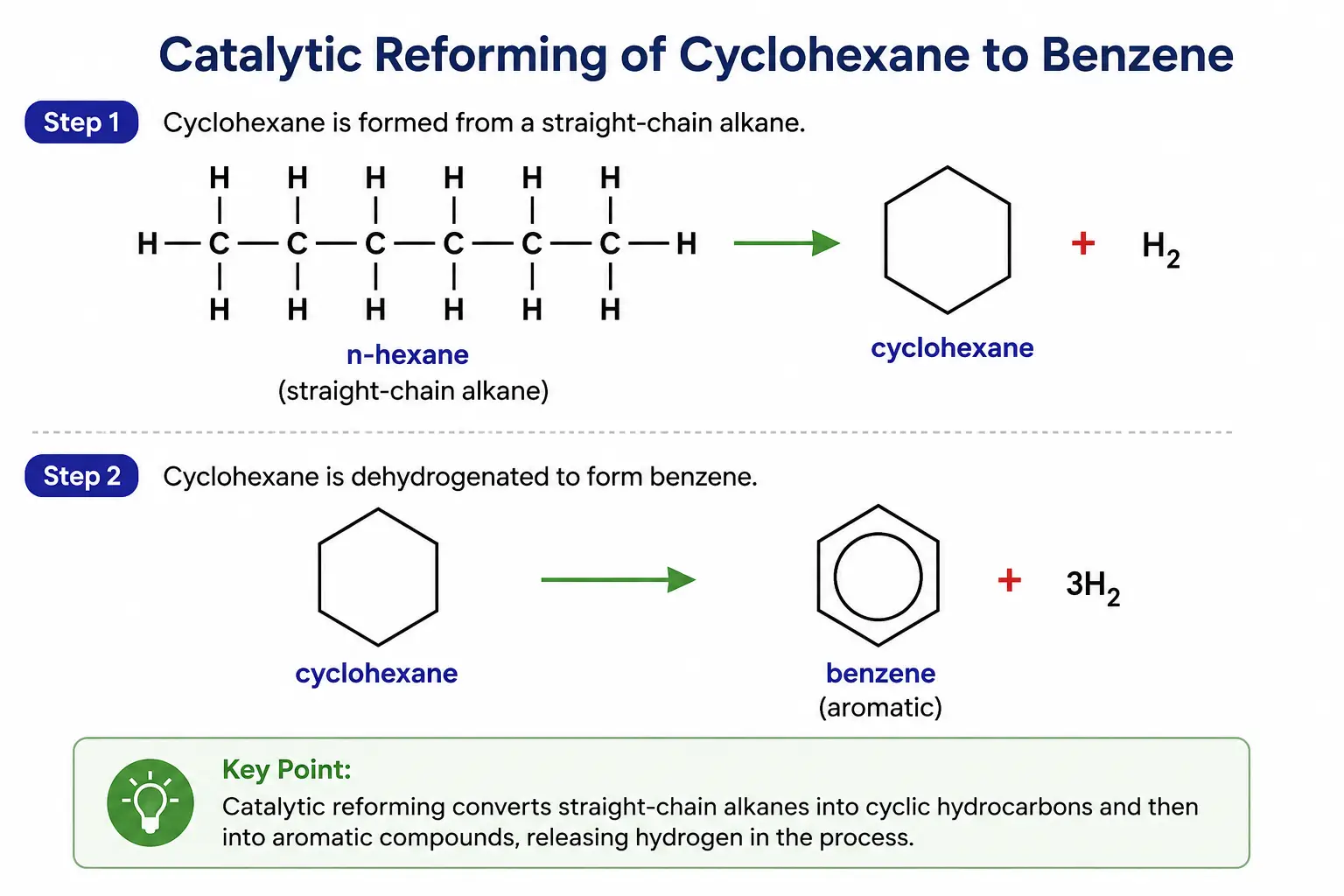
A cyclic alkane can be converted into an aromatic hydrocarbon, producing hydrogen as a by-product.
Quick Check: Branched, Cyclic or Aromatic?
Classify each molecule leaving the reformer as quickly as you can.
Example Reforming Equation
An example of reforming is the conversion of a straight-chain alkane into an aromatic hydrocarbon and hydrogen.
C7H16 → C7H8 + 4H2
In this example heptane, C7H16, becomes methylbenzene, C7H8, which is a benzene ring carrying a CH3 group, so the product is aromatic. The hydrogen atoms removed from the hydrocarbon leave as H2.
Reforming is carried out over a platinum catalyst at about 500 °C and a moderate pressure.
Important: Reforming changes chemical structures and produces new molecules. This makes it a chemical process, unlike fractional distillation.
Quick Check: How Much Hydrogen?
Balance each reforming equation by typing the number of hydrogen molecules.
Reforming Compared with Fractional Distillation and Cracking
Reforming is part of the wider processing of crude oil fractions, but it must not be confused with fractional distillation or cracking.
| Process | What happens? | Physical or chemical? |
|---|---|---|
| Fractional distillation | Crude oil is separated into fractions by differences in boiling point. | Physical process. |
| Cracking | Large hydrocarbons are broken into smaller alkanes and alkenes. | Chemical process. |
| Reforming | Straight-chain alkanes are changed into branched, cyclic or aromatic hydrocarbons. | Chemical process. |
Remember: Fractional distillation separates molecules. Cracking breaks molecules. Reforming changes molecular structure to improve fuel quality.
Quick Check: Which Refinery Process?
In each round, pick the one statement that is accurate.
Common Exam Mistakes
- Do not describe reforming as a separation process. Reforming is a chemical process.
- Do not say reforming only makes smaller molecules. That describes cracking more closely.
- Do not forget the purpose of reforming. It is used to increase the octane number of fuels.
- Do not confuse aromatic hydrocarbons with ordinary cyclic alkanes. Aromatic hydrocarbons contain a benzene ring.
- Do not write hydrogen as H when it is produced as a molecule. Use H2.
Master Introduction to Organic Chemistry and Alkanes for Cambridge International AS & A Level Chemistry
Continue from these free revision notes into the full Topics 13 and 14.1 Introduction to Organic Chemistry and Alkanes course. The guided video lessons are ready now; the Cambridge International MCQ bank, teacher-marked short-answer questions and KASP spec-point report are being written, and the course opens for enrolment as soon as they are complete.
Guided video teaching
Learn the chemistry and exam technique through structured video lessons with worked examples and walkthroughs.
Instant MCQ feedback
Auto-marked MCQ quizzes provide immediate diagnostic feedback for every answer choice.
Teacher-marked SAQs
Submit written exam responses and receive chemistry specialist feedback with improvement guidance.
Progress tracking
Identify strengths and weaknesses across the full Topics 13 and 14.1 specification with targeted reporting.
See how the course works
Click play to start the course preview animation.
Some ionic radii are shown.
| Ion | Ionic radius / nm |
|---|---|
| Na+ | 0.102 |
| K+ | 0.138 |
| F− | 0.133 |
| Cl− | 0.180 |
Which compound has the strongest ionic bonding?
Explain why the metallic bonding in magnesium is much stronger than that in sodium.
Reforming FAQs
Use these quick answers to check the key exam points for reforming in crude oil processing.
What is reforming in crude oil processing?
Reforming is a chemical process that converts straight-chain alkanes into branched alkanes, cyclic alkanes and aromatic hydrocarbons.
Why is reforming used?
Reforming is used to increase the octane number of fuels, making them more resistant to engine knocking and more suitable for motor fuels.
Is reforming a chemical or physical process?
Reforming is a chemical process because hydrocarbon structures are changed and new molecules are formed.
What types of hydrocarbons can reforming produce?
Reforming can produce branched alkanes, cyclic alkanes and aromatic hydrocarbons.
How is reforming different from cracking?
Cracking breaks large hydrocarbons into smaller molecules. Reforming changes the structure of hydrocarbons to produce higher-octane fuel components.
Copyright notice: This OLS revision content, including the explanations, layout, diagrams, tables and embedded learning structure, is authored for Online Learning System by Dr. Mohammed Al-Fatah. It may not be copied, reproduced, redistributed or adapted without written permission.
Keep this note — free
Save your progress across every Cambridge topic. A free account remembers which topics you have covered, saves your question scores, and syncs across your phone and laptop.
- Track every topic you have finished
- Keep your practice-question scores
- No payment, no card, free forever
Already registered? Log in