Unreactivity of Alkanes
A concise Cambridge International AS Level Chemistry revision guide to why alkanes are generally unreactive, including towards polar reagents (14.1.5), and to the free-radical substitution of ethane by chlorine and by bromine in ultraviolet light, the examples the Cambridge syllabus specifies (14.1.2).
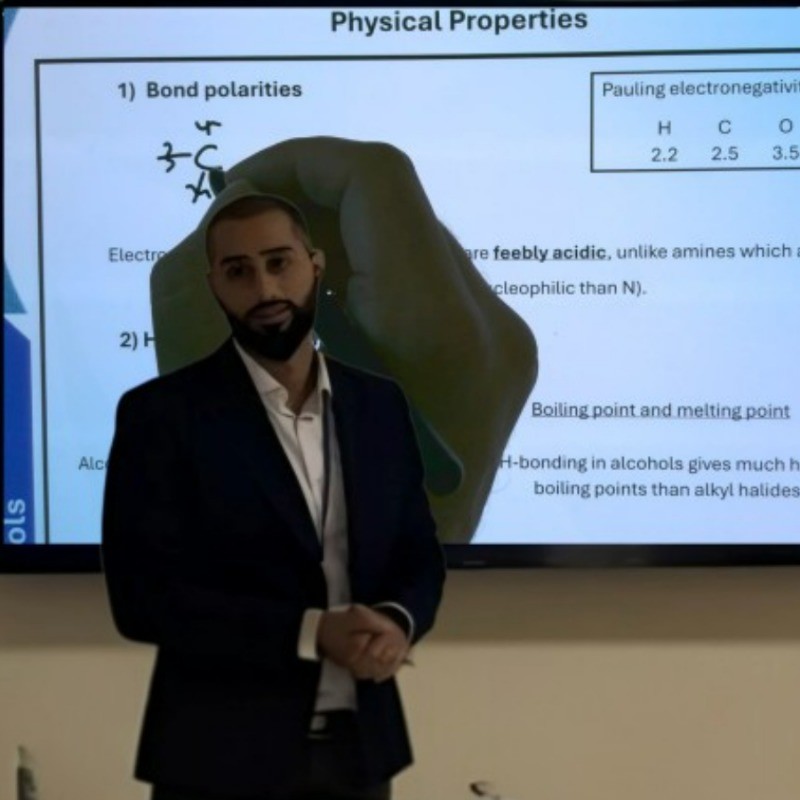
GCSE Recap: Burning a Hydrocarbon
Before you start, check the one reaction of alkanes you already know well.
Why Alkanes Are Generally Unreactive
Alkanes do not react with acids, alkalis, oxidising agents such as acidified potassium manganate(VII), or reducing agents at room temperature. Cambridge 14.1.5 asks you to explain this general unreactivity, including towards polar reagents, in terms of two properties of the C-H bond.
| Property of the C-H bond | Explanation | Consequence |
|---|---|---|
| High bond strength | The C-H bond enthalpy is about +410 kJ mol-1 and the C-C bond about +350 kJ mol-1, so a large amount of energy is needed to break them | Reactions only start with a flame, a high temperature or ultraviolet light |
| Relative lack of polarity | Carbon (2.5) and hydrogen (2.1) have similar electronegativities, so the C-H bond has almost no dipole and the molecule has no δ+ or δ– centres | Polar reagents, nucleophiles and electrophiles are not attracted to any part of the molecule |
Compare a halogenoalkane, where the polar C-Cl bond gives a δ+ carbon that hydroxide ions attack, or an alkene, where the electron-rich π bond attracts electrophiles. An alkane has neither a polar bond nor a π bond, so the only reactions on the syllabus are combustion, which needs a flame, and free-radical substitution, which needs ultraviolet light.
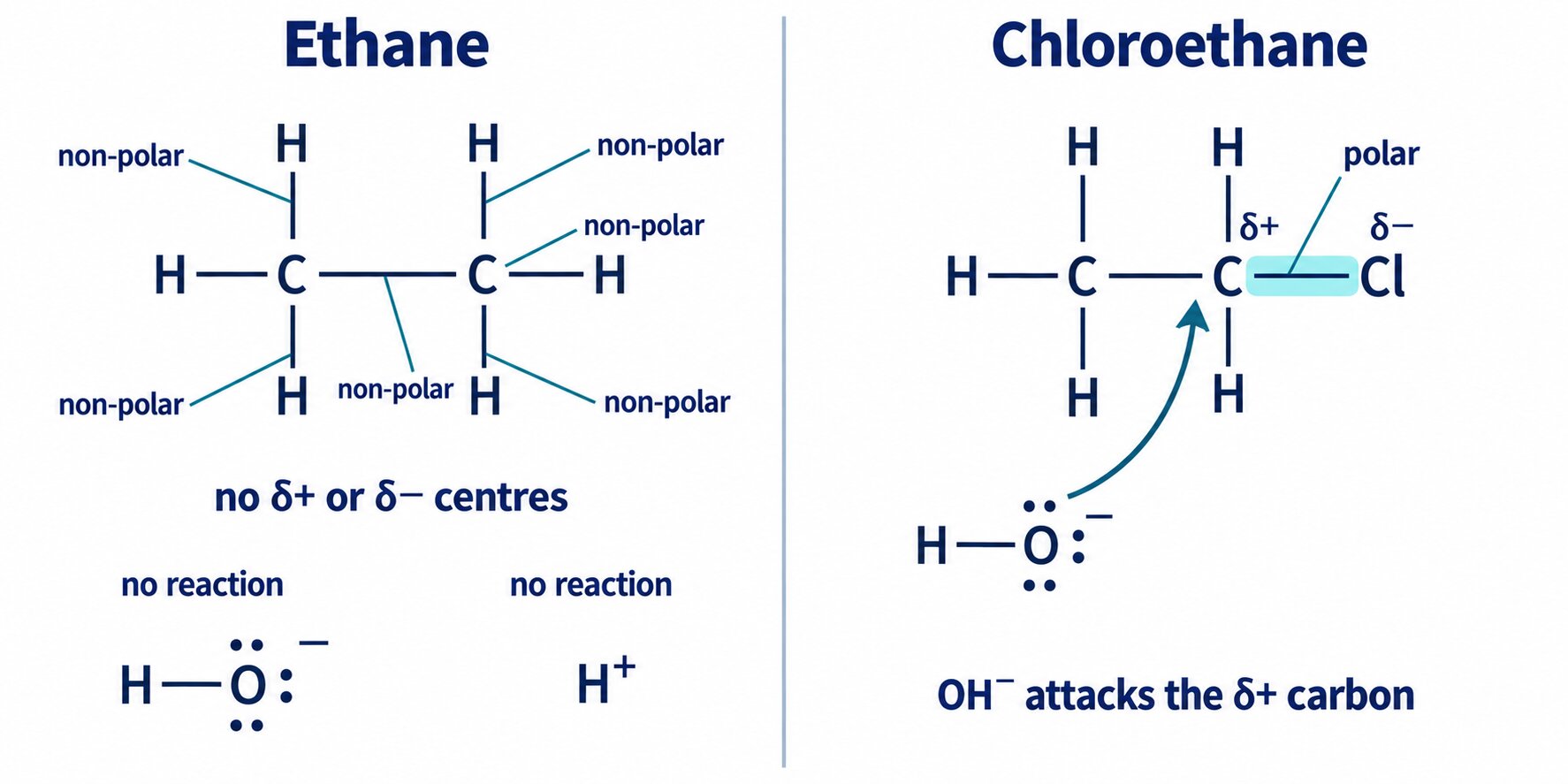
Ethane has no polar bond for a polar reagent to attack; chloroethane does.
Exam sentence: Alkanes are unreactive towards polar reagents because the C-H bonds are strong and have very little polarity, so there is no electron-deficient or electron-rich site to attack.
Quick Check: Explain Three Experiments
Write a short explanation, then compare it with the mark points and the model answer.
Free-Radical Substitution of Ethane by Chlorine
Cambridge 14.1.2(b) specifies the free-radical substitution of alkanes by Cl2 and by Br2 in the presence of ultraviolet light as exemplified by the reactions of ethane. The overall equation for monosubstitution is C2H6 + Cl2 → C2H5Cl + HCl, and the mechanism has the three stages described on the Free Radical Substitution page.
| Stage | Equation | Comment |
|---|---|---|
| Initiation | Cl2 → 2Cl• | Ultraviolet light breaks the Cl-Cl bond homolytically |
| Propagation 1 | Cl• + C2H6 → HCl + •C2H5 | The chlorine radical removes a hydrogen atom, forming an ethyl radical |
| Propagation 2 | •C2H5 + Cl2 → C2H5Cl + Cl• | The ethyl radical takes a chlorine atom and regenerates Cl• |
| Termination | 2Cl• → Cl2; Cl• + •C2H5 → C2H5Cl; 2•C2H5 → C4H10 | Two radicals combine; the butane product is evidence for the ethyl radical |
All six hydrogen atoms of ethane are equivalent, so only one monochlorinated product forms. With excess chlorine, further substitution gives 1,1-dichloroethane and 1,2-dichloroethane and eventually C2Cl6.
Exam focus: Write the propagation steps with a radical on each side, and include the termination step that forms butane; it is the one examiners use to test whether you understand that ethyl radicals are present.
Quick Check: Counting the Products
Decide how many different monochlorinated products each alkane can give.
Quick Check: Which Tube Reacts?
Decide which set of conditions is the only one that gets past a strong, non-polar C-H bond.
Free-Radical Substitution of Ethane by Bromine
Bromine reacts with ethane in the same way, but more slowly, because the Br-Br bond is weaker and the Br• radical is less reactive than Cl•, so the first propagation step (removing a hydrogen atom) is slower. The overall equation is C2H6 + Br2 → C2H5Br + HBr.
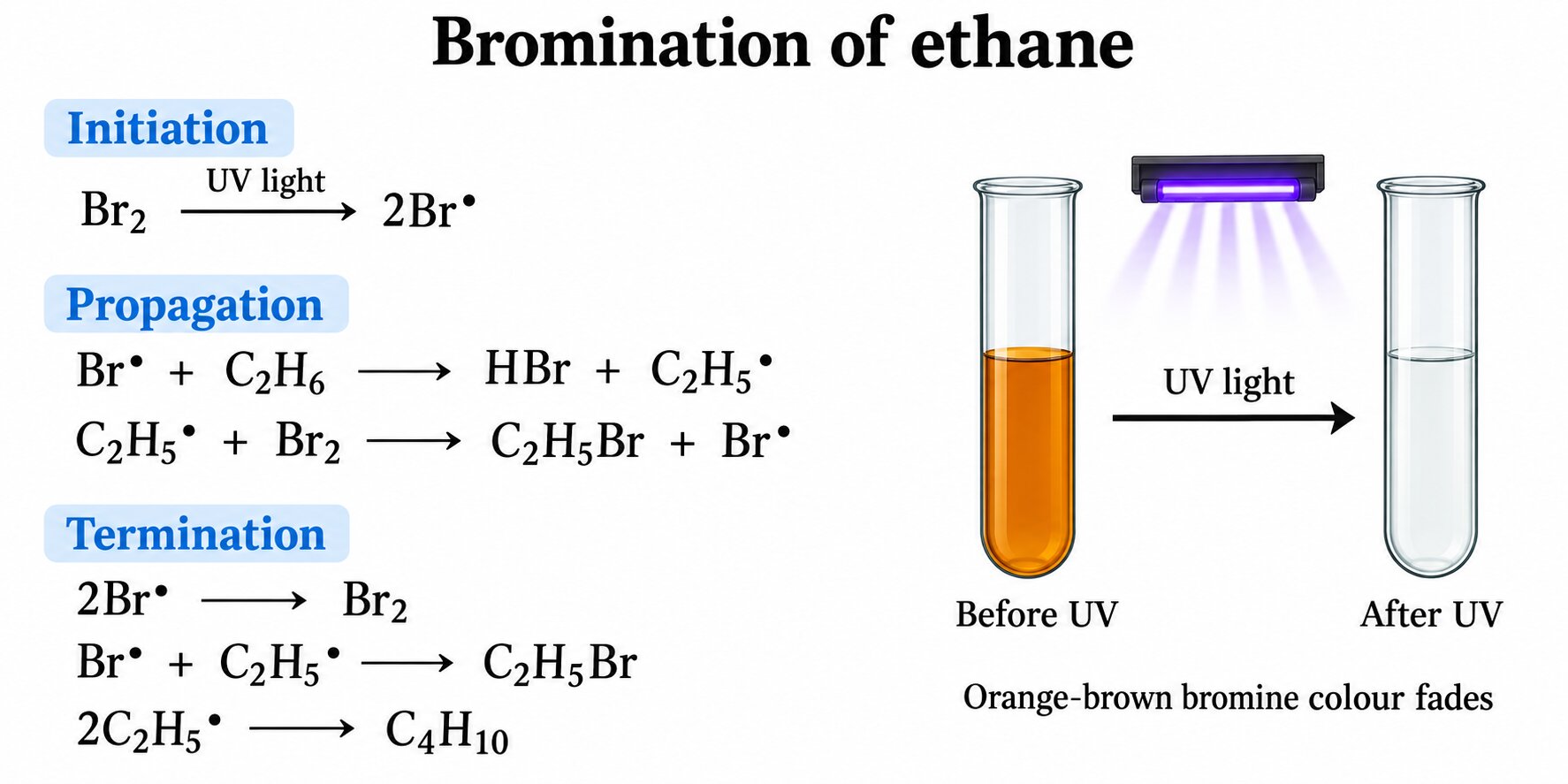
Bromination of ethane in ultraviolet light: the orange-brown colour of bromine fades as bromoethane and hydrogen bromide form.
| Feature | Chlorination | Bromination |
|---|---|---|
| Product of monosubstitution | Chloroethane, C2H5Cl | Bromoethane, C2H5Br |
| Observation | Pale green colour fades; misty fumes of HCl | Orange-brown colour fades; misty fumes of HBr |
| Rate | Faster | Slower: Br• is a less reactive radical |
| Test for the hydrogen halide | White fumes with ammonia | White fumes with ammonia |
Exam sentence: Ethane reacts with chlorine or bromine only in ultraviolet light, by free-radical substitution: the halogen molecule undergoes homolytic fission to give radicals, which substitute for a hydrogen atom in propagation steps.
Quick Check: Pick the Accurate Statement
In each round, choose the one statement that is accurate.
Common Exam Mistakes
- Explaining unreactivity with “alkanes are saturated” alone. The syllabus wants the strength and the lack of polarity of the C-H bonds.
- Saying alkanes do not react with polar reagents because they are non-polar molecules. The point is that the bonds themselves have no dipole, so there is no site to attack.
- Using methane equations when the question specifies ethane, or writing the ethyl radical as C2H5 without the dot.
- Expecting the reaction to happen in the dark. Without ultraviolet light there is no initiation step.
Exam sentence: C-H bonds are strong and almost non-polar, so alkanes ignore polar reagents; they react only in combustion and, under ultraviolet light, by free-radical substitution with chlorine or bromine.
Master Introduction to Organic Chemistry and Alkanes for Cambridge International AS & A Level Chemistry
Continue from these free revision notes into the full Topics 13 and 14.1 Introduction to Organic Chemistry and Alkanes course. The guided video lessons are ready now; the Cambridge International MCQ bank, teacher-marked short-answer questions and KASP spec-point report are being written, and the course opens for enrolment as soon as they are complete.
Guided video teaching
Learn the chemistry and exam technique through structured video lessons with worked examples and walkthroughs.
Instant MCQ feedback
Auto-marked MCQ quizzes provide immediate diagnostic feedback for every answer choice.
Teacher-marked SAQs
Submit written exam responses and receive chemistry specialist feedback with improvement guidance.
Progress tracking
Identify strengths and weaknesses across the full Topics 13 and 14.1 specification with targeted reporting.
See how the course works
Click play to start the course preview animation.
Some ionic radii are shown.
| Ion | Ionic radius / nm |
|---|---|
| Na+ | 0.102 |
| K+ | 0.138 |
| F− | 0.133 |
| Cl− | 0.180 |
Which compound has the strongest ionic bonding?
Explain why the metallic bonding in magnesium is much stronger than that in sodium.
Free Radical Substitution FAQs
These questions summarise the core exam points on alkane substitution and free radicals.
Why are alkanes usually unreactive?
Alkanes are usually unreactive because they contain strong C-C and C-H bonds. These bonds require a large amount of energy to break.
What condition is needed for alkanes to react with chlorine?
Ultraviolet light is needed. UV light provides enough energy to break the Cl-Cl bond by homolytic fission, forming chlorine radicals.
What is a free radical?
A free radical is a species with an unpaired electron. The unpaired electron is usually represented using a dot, such as Cl•.
Why is the reaction called substitution?
It is called substitution because a hydrogen atom in the alkane is replaced by a halogen atom.
Why can a mixture of products form?
After the first substitution, the haloalkane product can undergo further substitution. This can replace more hydrogen atoms and produce a mixture of chlorinated products.
Copyright notice: This OLS revision content, including the explanations, layout, diagrams, tables and embedded learning structure, is authored for Online Learning System by Dr. Mohammed Al-Fatah. It may not be copied, reproduced, redistributed or adapted without written permission.
Keep this note — free
Save your progress across every Cambridge topic. A free account remembers which topics you have covered, saves your question scores, and syncs across your phone and laptop.
- Track every topic you have finished
- Keep your practice-question scores
- No payment, no card, free forever
Already registered? Log in