Thermal and Catalytic Cracking
A concise AQA A Level Chemistry revision guide to the two types of cracking named in 3.3.2.2: the conditions and products of thermal cracking, the zeolite catalyst and products of catalytic cracking, and the economic reasons why cracking is carried out.
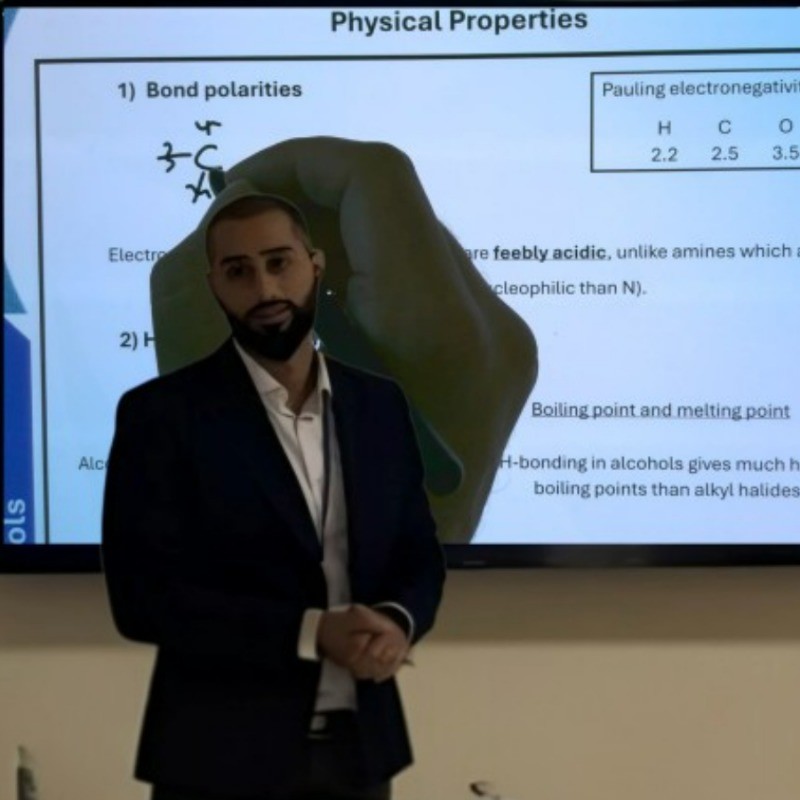
GCSE Recap: From Crude Oil to Shorter Molecules
Before you start, check what distillation gives a refinery and what cracking does to a chain.
Why AQA Names Two Types of Cracking
Cracking breaks C-C bonds in the long-chain alkanes from crude oil to give shorter, more useful molecules. AQA 3.3.2.2 goes further than most specifications: it names thermal cracking and catalytic cracking separately, states the conditions for each, and asks for the products each is used to make. The general cracking page covers the idea; this page covers the AQA detail.
| Thermal cracking | Catalytic cracking | |
|---|---|---|
| Temperature | High, around 700 to 1200 K | High, around 720 K |
| Pressure | High, up to about 7000 kPa | Slight, a little above atmospheric |
| Catalyst | None | Zeolite |
| How the C-C bond breaks | Homolytic fission, giving radicals (mechanism not required) | Via carbocation intermediates on the catalyst surface (mechanism not required) |
| Main products | A high percentage of alkenes, plus some shorter alkanes | Branched alkanes, cycloalkanes and aromatic hydrocarbons |
| Used mainly to make | Alkenes for polymers and other chemicals | Motor fuels and aromatic hydrocarbons |
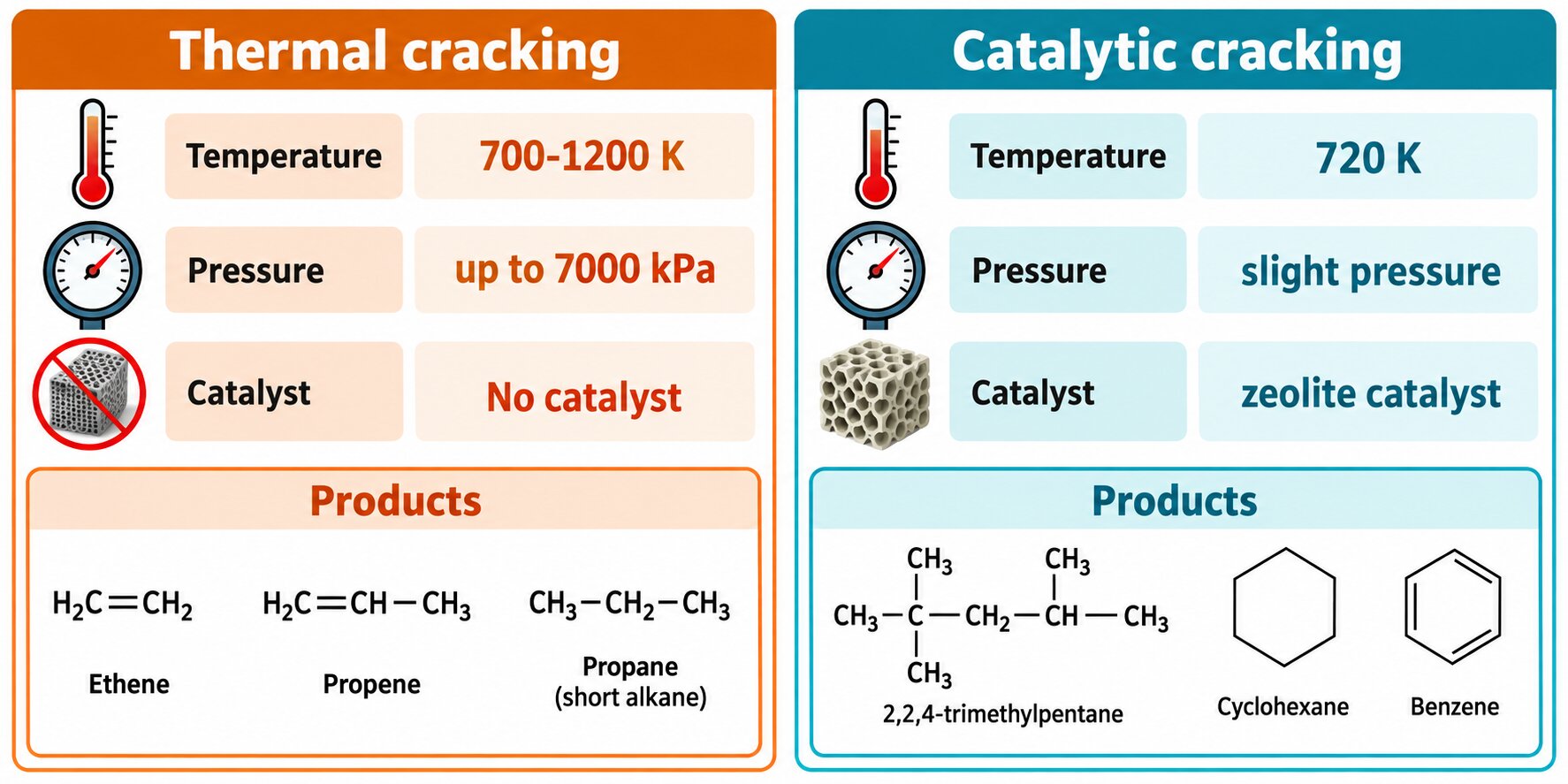
The AQA comparison: thermal cracking uses high temperature and high pressure to make alkenes; catalytic cracking uses a zeolite catalyst at slight pressure to make motor fuels and aromatics.
Exam focus: Learn the table as pairs: thermal = high pressure + high temperature + alkenes; catalytic = slight pressure + high temperature + zeolite + motor fuels and aromatics.
Thermal Cracking
In thermal cracking the alkane vapour is heated to a high temperature under high pressure for a very short time. The energy breaks C-C bonds homolytically, forming free radicals which then rearrange into the products. Because hydrogen atoms are lost as the chains break, the products contain a high percentage of alkenes.
A long alkane can crack in many ways, so a mixture forms. Every equation must balance, and one product is always an alkene:
- C14H30 → C8H18 + C6H12 (octane and hexene)
- C14H30 → C10H22 + 2C2H4 (decane and two molecules of ethene)
- C14H30 → C14H28 + H2 (an alkene and hydrogen, when only a C-H bond breaks)
Exam sentence: Thermal cracking takes place at high temperature and high pressure and produces a high percentage of alkenes, which are the starting materials for addition polymers.
Quick Check: Balance the Cracking Equations
Work out the missing formula or number in each equation on paper, then type it in.
Catalytic Cracking
Catalytic cracking uses a zeolite catalyst at a high temperature and a slight pressure, only a little above atmospheric. Zeolites are aluminosilicates with a honeycomb structure of pores, which gives a very large surface area and lets the catalyst select molecules by size. The catalyst allows the reaction to run at a lower temperature and pressure than thermal cracking, which cuts the energy cost.
The products are different because the reaction goes through carbocation intermediates rather than radicals. Carbocations rearrange to the more stable branched forms, so catalytic cracking gives mainly:
- Branched alkanes, such as 2,2,4-trimethylpentane, which burn smoothly in petrol engines (high octane number);
- Cycloalkanes;
- Aromatic hydrocarbons, such as benzene and methylbenzene, used as fuel components and as chemical feedstocks.
| Feature of the zeolite catalyst | Why it matters |
|---|---|
| Honeycomb structure with many pores | Very large surface area, so the reaction is fast |
| Acidic sites on the surface | Generate the carbocations that rearrange to branched products |
| Pores of a fixed size | Only molecules that fit can react, which controls the product mix |
| Solid catalyst | Easily separated from the gaseous products and regenerated |
Exam sentence: Catalytic cracking takes place at a slight pressure, high temperature and in the presence of a zeolite catalyst, and is used mainly to produce motor fuels and aromatic hydrocarbons.
Quick Check: Pore Size in a Zeolite
Use what the pores do to predict how this catalyst would handle a heavy feedstock.
Quick Check: Explain the Two Octane Numbers
Write a short explanation, then compare it with the mark points and the model answer.
The Economic Reasons for Cracking
Fractional distillation gives the fractions in the proportions found in crude oil, but demand does not match supply. The short-chain fractions (petrol, and gases such as ethene) are in high demand and command high prices, while the long-chain fractions (heavy fuel oil, bitumen) are in surplus and sell cheaply. Cracking converts the cheap surplus into the valuable products.
| Economic reason | Explanation |
|---|---|
| Matches supply to demand | Long-chain fractions that would otherwise be surplus are turned into the petrol and gases that customers want |
| Makes more valuable products | Petrol and alkenes sell for far more per tonne than heavy fuel oil |
| Provides alkenes as feedstock | Ethene and propene from thermal cracking are the monomers for poly(ethene) and poly(propene) and the starting point for many other chemicals |
| Improves fuel quality | Branched and aromatic products from catalytic cracking give petrol with a higher octane number |
Exam focus: An “explain the economic reasons” question needs both halves: the long-chain fractions are in low demand and low value, and the short-chain products are in high demand and high value.
Quick Check: Which Cracker?
Decide which process each refinery observation points to, or whether it fits both.
Quick Check: Judge the Claims
In each round, choose the one statement that is accurate.
Common Exam Mistakes
- Swapping the pressures: thermal cracking is high pressure, catalytic cracking is slight pressure.
- Saying that catalytic cracking produces mainly alkenes. Alkenes are the main product of thermal cracking; catalytic cracking gives motor fuels and aromatics.
- Naming the catalyst as “a metal” or “platinum”. AQA expects zeolite.
- Writing a cracking equation that does not balance, or one with no alkene among the products.
- Answering an economics question with chemistry only. Mention demand, surplus and value.
Exam sentence: Cracking is carried out because the long-chain fractions from distillation are in low demand, while the shorter alkanes and alkenes produced are in high demand and are more valuable.
Master Introduction to Organic Chemistry and Alkanes for AQA A Level Chemistry
Continue from these free revision notes into the full 3.3.1 and 3.3.2 Introduction to Organic Chemistry and Alkanes course. The six guided video lessons are ready now; the AQA MCQ bank, teacher-marked short-answer questions, supplementary lessons and KASP spec-point report are being written, and the course opens for enrolment as soon as they are complete.
Guided video teaching
Learn the chemistry and exam technique through structured video lessons with worked examples and walkthroughs.
Instant MCQ feedback
Auto-marked MCQ quizzes provide immediate diagnostic feedback for every answer choice.
Teacher-marked SAQs
Submit written exam responses and receive chemistry specialist feedback with improvement guidance.
Progress tracking
Identify strengths and weaknesses across the full 3.3.1 and 3.3.2 specification with targeted reporting.
See how the course works
Click play to start the course preview animation.
Some ionic radii are shown.
| Ion | Ionic radius / nm |
|---|---|
| Na+ | 0.102 |
| K+ | 0.138 |
| F− | 0.133 |
| Cl− | 0.180 |
Which compound has the strongest ionic bonding?
Explain why the metallic bonding in magnesium is much stronger than that in sodium.
Cracking FAQ
Quick answers to common cracking questions for AQA A Level Chemistry.
What is cracking in organic chemistry?
Cracking is a chemical process where large hydrocarbon molecules are broken into smaller, more useful molecules by breaking carbon-carbon covalent bonds.
What products are formed during cracking?
Cracking usually forms a mixture of smaller alkanes and alkenes. Hydrogen gas may also be produced depending on the reaction.
Why does cracking need a high temperature?
Cracking needs a high temperature because strong covalent C-C bonds must be broken, so enough energy is required for the reaction to occur.
Why is catalytic cracking economically useful?
Catalytic cracking converts longer hydrocarbons that may be in excess into shorter alkanes and alkenes that are in greater demand and have higher commercial value.
Copyright notice: This OLS revision content, including the explanations, layout, diagrams, tables and embedded learning structure, is authored for Online Learning System by Dr. Mohammed Al-Fatah. It may not be copied, reproduced, redistributed or adapted without written permission.
Keep this note — free
Save your progress across every AQA topic. A free account remembers which topics you have covered, saves your question scores, and syncs across your phone and laptop.
- Track every topic you have finished
- Keep your practice-question scores
- No payment, no card, free forever
Already registered? Log in