Hydrated Salts and Water of Crystallisation
A concise OCR A Level Chemistry A revision guide to anhydrous and hydrated salts, water of crystallisation, and finding the formula of a hydrated salt from percentage composition, mass data and heating to constant mass (2.1.3(d)).
GCSE Recap: Mass Lost When Crystals Are Heated
Before you start, check what the mass lost on heating crystals tells you.
Anhydrous, Hydrated and Water of Crystallisation
Many ionic solids crystallise with water molecules locked into the lattice in a fixed ratio. This is water of crystallisation. A salt containing it is hydrated; the same salt with the water driven off is anhydrous.
| Term | Meaning | Example |
|---|---|---|
| Hydrated salt | Crystals that contain water of crystallisation in a fixed ratio | CuSO₄·5H₂O, blue |
| Anhydrous salt | The salt with no water of crystallisation | CuSO₄, white |
| Water of crystallisation | The water molecules bound in the crystal lattice, shown after a dot in the formula | The 5H₂O in CuSO₄·5H₂O |
| Degree of hydration | The number of water molecules per formula unit, x in MgSO₄·xH₂O | x = 7 for Epsom salt |
The dot in CuSO₄·5H₂O does not mean multiply: it separates the salt from its water. The relative formula mass includes the water: 159.6 + 5 × 18.0 = 249.6.
Key idea: Heating a hydrated salt drives off the water of crystallisation; the mass lost is the mass of water, and the mass left is the anhydrous salt.
Quick Check: Reading a Dot Formula
Four quick questions on what the water written after the dot adds to a formula.
Finding x from Percentage Composition
If a hydrated salt is 36.1% water by mass, the rest is the anhydrous salt. Treat it exactly like an empirical formula calculation with two “elements”: the anhydrous salt and water.
Example. Hydrated calcium chloride, CaCl₂·xH₂O, contains 49.3% water.
| CaCl₂ | H₂O | |
|---|---|---|
| Mass in 100 g | 50.7 g | 49.3 g |
| M | 111.0 | 18.0 |
| Moles | 0.457 | 2.74 |
| Ratio | 1 | 6.0 |
So x = 6 and the salt is CaCl₂·6H₂O.
Exam sentence: Divide the mass of anhydrous salt and the mass of water by their relative formula masses, then divide both by the smaller number of moles to find x.
Quick Check: Finding x from a Percentage
Find the degree of hydration of a salt from the percentage of water in its crystals.
Finding x from Heating to Constant Mass
In the laboratory the water is driven off by gentle heating in a crucible until the mass no longer changes: heating to constant mass. The difference between the hydrated and anhydrous masses is the water lost.
Example. 2.50 g of hydrated copper(II) sulfate is heated to constant mass, leaving 1.60 g of anhydrous salt.
- Mass of water = 2.50 − 1.60 = 0.90 g, so n(H₂O) = 0.90 / 18.0 = 0.0500 mol
- n(CuSO₄) = 1.60 / 159.6 = 0.0100 mol
- Ratio CuSO₄ : H₂O = 1 : 5, so the formula is CuSO₄·5H₂O
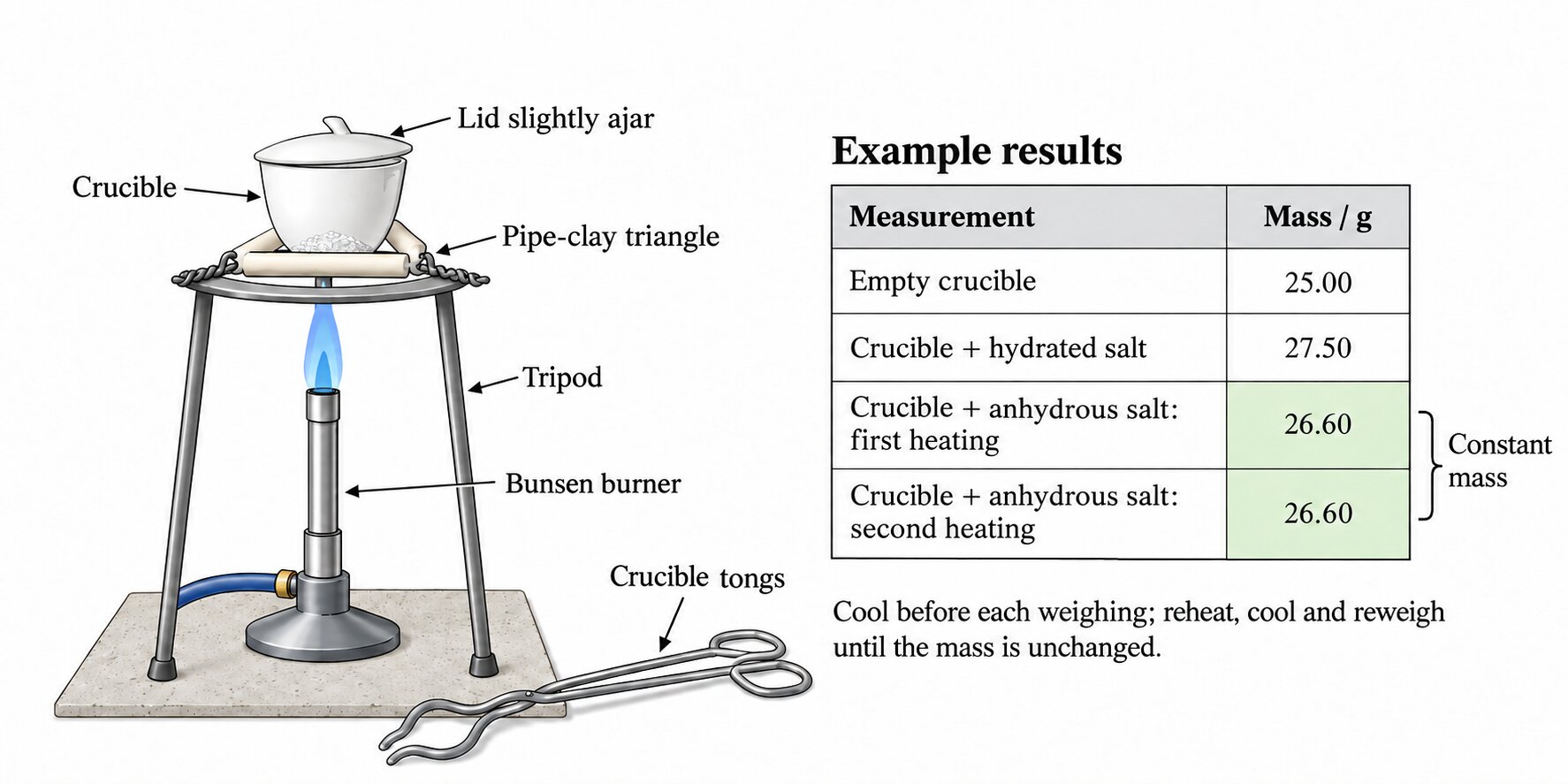
Heat, cool in a desiccator, weigh, and repeat until two masses agree: only then has all the water gone.
Key idea: Constant mass proves the reaction is complete. Two successive weighings that agree are the evidence.
Quick Check: Work Out the Degree of Hydration
Work each card out on paper, then flip it to check every step of your working.
Evaluating the Experiment
Exam questions often ask why the value of x came out too high or too low.
- Not heated to constant mass: some water remains, the “anhydrous” mass is too high, the water mass too low, so x is too low.
- Heated too strongly: the salt itself decomposes (copper(II) sulfate gives black copper(II) oxide), too much mass is lost, so x is too high.
- Crystals absorb water while cooling: the anhydrous mass rises again, so x is too low; cool in a desiccator.
- Spitting: solid lost from the crucible counts as “water”, so x is too high; use a lid.
Exam sentence: If the salt is not heated to constant mass, water remains in the solid, the mass of water is underestimated and the calculated value of x is too low.
Quick Check: Too High or Too Low?
In each round, pick the statement that gets the effect on x right.
Common Exam Mistakes
- Treating the dot as a multiplication sign.
- Leaving the water out of the relative formula mass of the hydrated salt.
- Dividing the water moles by the salt moles the wrong way round: x is water per salt.
- Rounding a ratio of 4.9 to 4; it is 5.
Exam sentence: x = moles of water ÷ moles of anhydrous salt, where the moles of water come from the mass lost on heating to constant mass.
Copyright notice: This OLS revision content, including the explanations, layout, diagrams, tables and embedded learning structure, is authored for Online Learning System by Dr. Mohammed Al-Fatah. It may not be copied, reproduced, redistributed or adapted without written permission.
Keep this note — free
Save your progress across every OCR A topic. A free account remembers which topics you have covered, saves your question scores, and syncs across your phone and laptop.
- Track every topic you have finished
- Keep your practice-question scores
- No payment, no card, free forever
Already registered? Log in