Measuring Mass, Volume and Gas Volume
A concise OCR A Level Chemistry A revision guide to the techniques and procedures for measuring mass, volumes of solutions and volumes of gases in quantitative experiments, and the uncertainty each brings (2.1.3(i)).
GCSE Recap: Volumes, Gases and Balances
Before you start, check three measuring ideas you already met at GCSE.
Measuring Mass
Masses are measured on a balance reading to two or three decimal places. For a solid that will be transferred, weigh by difference: weigh the weighing boat with the solid, tip the solid into the vessel, then reweigh the boat. The difference is the mass actually transferred, so any solid stuck to the boat does not count.
| Situation | Technique | Why |
|---|---|---|
| Solid for a standard solution | Weigh by difference into the beaker | Only the mass that reached the beaker enters the calculation |
| Hydrated salt to be heated | Weigh crucible empty, with salt, and after each heating | Mass changes are followed to constant mass |
| Hygroscopic solid (e.g. NaOH) | Weigh quickly with the lid on | It absorbs water from the air and gains mass while you watch |
Key idea: The uncertainty of a balance is ± half its last digit per reading; weighing by difference involves two readings, so the uncertainty doubles.
Quick Check: Weighing by Difference
Type the mass, or the missing word, for each of these weighings.
Measuring Volumes of Solutions
Different glassware suits different jobs. The choice is about precision: how closely the true volume matches the reading.
| Apparatus | Typical uncertainty | Used for |
|---|---|---|
| Volumetric (graduated) pipette, 25.0 cm³ | ± 0.06 cm³ | Transferring one exact volume, e.g. the sample to be titrated |
| Burette, 50.00 cm³ | ± 0.05 cm³ per reading | Delivering a variable volume and reading it to 0.05 cm³ |
| Volumetric flask, 250 cm³ | ± 0.3 cm³ | Making up a standard solution to an exact volume |
| Measuring cylinder, 50 cm³ | ± 0.5 cm³ | Rough volumes where precision does not matter, e.g. solvent for dissolving |
| Beaker | Not calibrated for measurement | Holding and mixing only |
Read every meniscus at eye level with the bottom of the curve on the line. Rinse a pipette and burette with the solution they will hold, never with water, or the concentration is diluted.
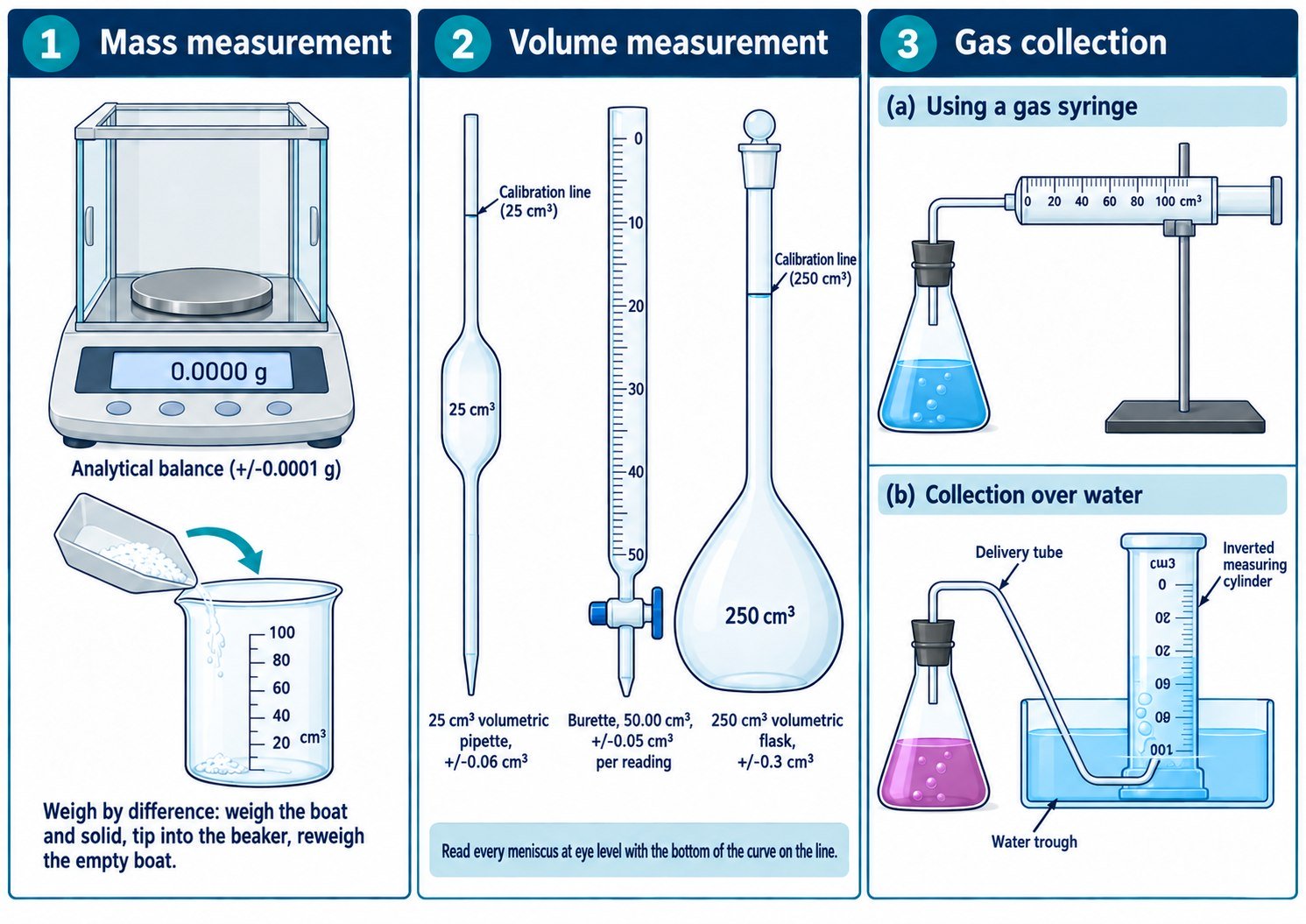
Three-panel diagram of laboratory apparatus: an analytical balance with a weighing boat, a volumetric pipette, burette and volumetric flask with their uncertainties, and a gas syringe and upturned measuring cylinder over water for collecting gas
Mass by difference, exact volumes by pipette, burette and volumetric flask, and gas volumes by syringe or displacement of water.
Quick Check: Pick the Apparatus
Five jobs, five pieces of apparatus: choose the right one for each.
Measuring Volumes of Gases
A gas made in a reaction is collected and its volume measured in one of two ways.
- Gas syringe: the reaction flask is sealed and connected to a syringe whose plunger moves out as gas forms. Precise (± 0.5 cm³ on a 100 cm³ syringe) and works for any gas, but the syringe can stick and the volume is limited to 100 cm³.
- Displacement of water: the gas is led by a delivery tube into an upturned measuring cylinder or burette full of water; the water level falls as gas collects. Simple, but useless for gases that dissolve in water such as ammonia, hydrogen chloride or, partly, carbon dioxide.
Record the temperature and pressure: a gas volume only has meaning at stated conditions, and converting it to moles uses either the molar gas volume (24.0 dm³ mol⁻¹ at RTP) or pV = nRT.
Exam sentence: A gas syringe measures the volume of gas directly; collection over water fails for soluble gases because some of the gas dissolves.
Quick Check: Measuring a Larger Volume of Gas
Decide how this gas should be collected and measured.
Percentage Uncertainty
Each measurement carries an uncertainty, and the exam asks you to compare them.
% uncertainty = (uncertainty of the apparatus ÷ quantity measured) × 100
A burette reading has an uncertainty of ± 0.05 cm³, and a titre uses two readings, so a titre of 23.40 cm³ has an uncertainty of ± 0.10 cm³: 0.10 / 23.40 × 100 = 0.43%. A mass of 0.120 g on a two-decimal-place balance (± 0.005 g per reading, two readings) has 0.010 / 0.120 × 100 = 8.3%, so the mass is the measurement to improve, for example by weighing a larger sample.
Key idea: To reduce a percentage uncertainty, measure a larger quantity with the same apparatus or use more precise apparatus.
Quick Check: The Weakest Measurement
Work out both percentage uncertainties before you choose.
Quick Check: What Actually Improves a Measurement
In each round, pick the one statement that is accurate.
Common Exam Mistakes
- Rinsing the pipette or burette with water before use, which dilutes the solution.
- Using a measuring cylinder where a pipette or volumetric flask is required.
- Collecting a soluble gas over water.
- Forgetting that a titre is the difference of two burette readings, so its uncertainty is twice the reading uncertainty.
Exam sentence: Use a pipette for a fixed exact volume, a burette for a variable volume read to 0.05 cm³, and a volumetric flask to make up a solution to an exact volume.
Copyright notice: This OLS revision content, including the explanations, layout, diagrams, tables and embedded learning structure, is authored for Online Learning System by Dr. Mohammed Al-Fatah. It may not be copied, reproduced, redistributed or adapted without written permission.
Keep this note — free
Save your progress across every OCR A topic. A free account remembers which topics you have covered, saves your question scores, and syncs across your phone and laptop.
- Track every topic you have finished
- Keep your practice-question scores
- No payment, no card, free forever
Already registered? Log in