Empirical Formula
A focused revision guide to empirical formulae for OCR A Level Chemistry A. This page covers the definition, the three-step method and worked examples using both mass data and percentage composition for this section.
GCSE Recap: Formulae and Ratios
Three quick GCSE questions on reading a formula and simplifying a ratio, which are the two skills this whole page rests on.
What Is an Empirical Formula?
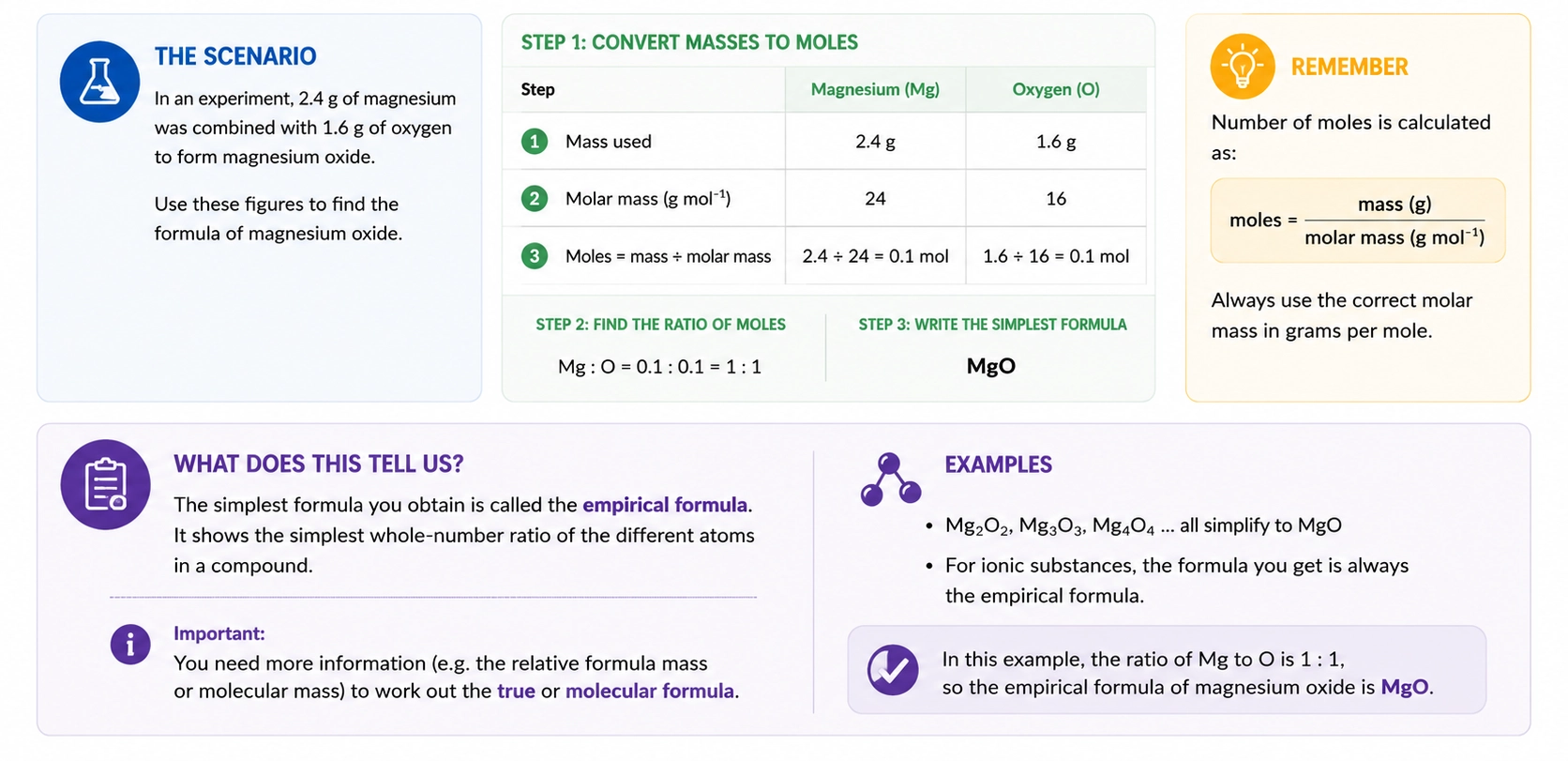
The empirical formula of a compound is the simplest whole-number ratio of the atoms of each element present. It does not show the actual number of atoms in one molecule; it shows the ratio in its most reduced form.
For example, glucose has the molecular formula C6H12O6, but its empirical formula is CH2O because the ratio of C : H : O reduces to 1 : 2 : 1.
Definition: The empirical formula is the simplest ratio of atoms of each element in the compound.
Key distinction: the empirical formula and the molecular formula can be the same (for example, water is H2O in both) or different (for example, hydrogen peroxide has the molecular formula H2O2 but the empirical formula HO).
Quick Check: Reduce Five Molecular Formulae
Cut each molecular formula down to its simplest whole-number ratio.
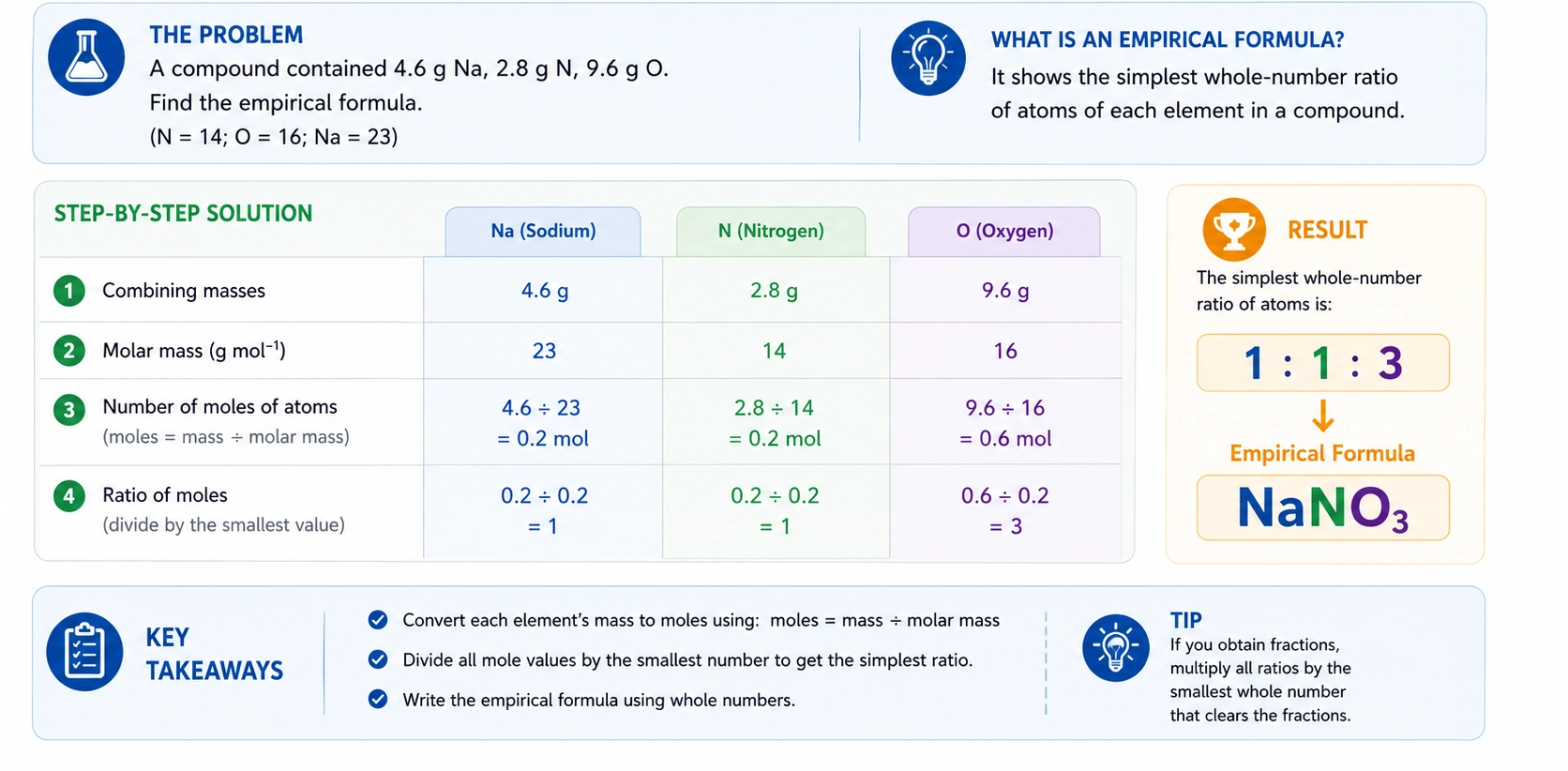
Dividing by atomic mass converts mass into moles, and dividing by the smallest mole value gives the simplest whole-number ratio.
The General Method
The same three-step method applies whether you are given the mass of each element or the percentage mass of each element. Percentage values can be treated directly as if they were masses in grams.
Step 1 – Divide by atomic mass
Divide the mass (or percentage mass) of each element by its relative atomic mass. This converts the value into an amount in moles.
Step 2 – Divide by the smallest
Divide each mole value from Step 1 by the smallest mole value obtained. This scales the ratio so the smallest element has a value of 1.
Step 3 – Scale to whole numbers if needed
If the ratios are not whole numbers, multiply all values by the smallest integer that converts them all to whole numbers. Common examples: multiply by 2 if you get 0.5, or by 3 if you get 0.33.
Data types: the method works for (1) the mass of each element in a sample, and (2) the percentage mass of each element in the compound. The steps are identical for both.
Worked Example: Using Mass Data
Calculate the empirical formula for a compound that contains 1.82 g of K, 5.93 g of I and 2.24 g of O.
Step 1 – Divide each mass by the atomic mass
Step 2 – Divide by the smallest (0.0465)
Empirical formula: KIO3 – potassium iodate. The ratio of K : I : O is 1 : 1 : 3.
Quick Check: Three Oxides From Mass Data
Run the three-step method on three experiments, one of which needs the mass of oxygen to be found by difference.
Worked Example: Using Percentage Composition
Calculate the empirical formula of a compound that contains 40.0% C, 6.7% H and 53.3% O by mass.
Treat each percentage as a mass in grams and apply the same method.
Step 1 – Divide each percentage by the atomic mass
Step 2 – Divide by the smallest (3.33)
Empirical formula: CH2O – the ratios are already whole numbers so Step 3 is not needed here.
Quick Check: A Compound From Percentage Data
One calculation from percentages, with three of the commonest wrong answers offered alongside the right one.
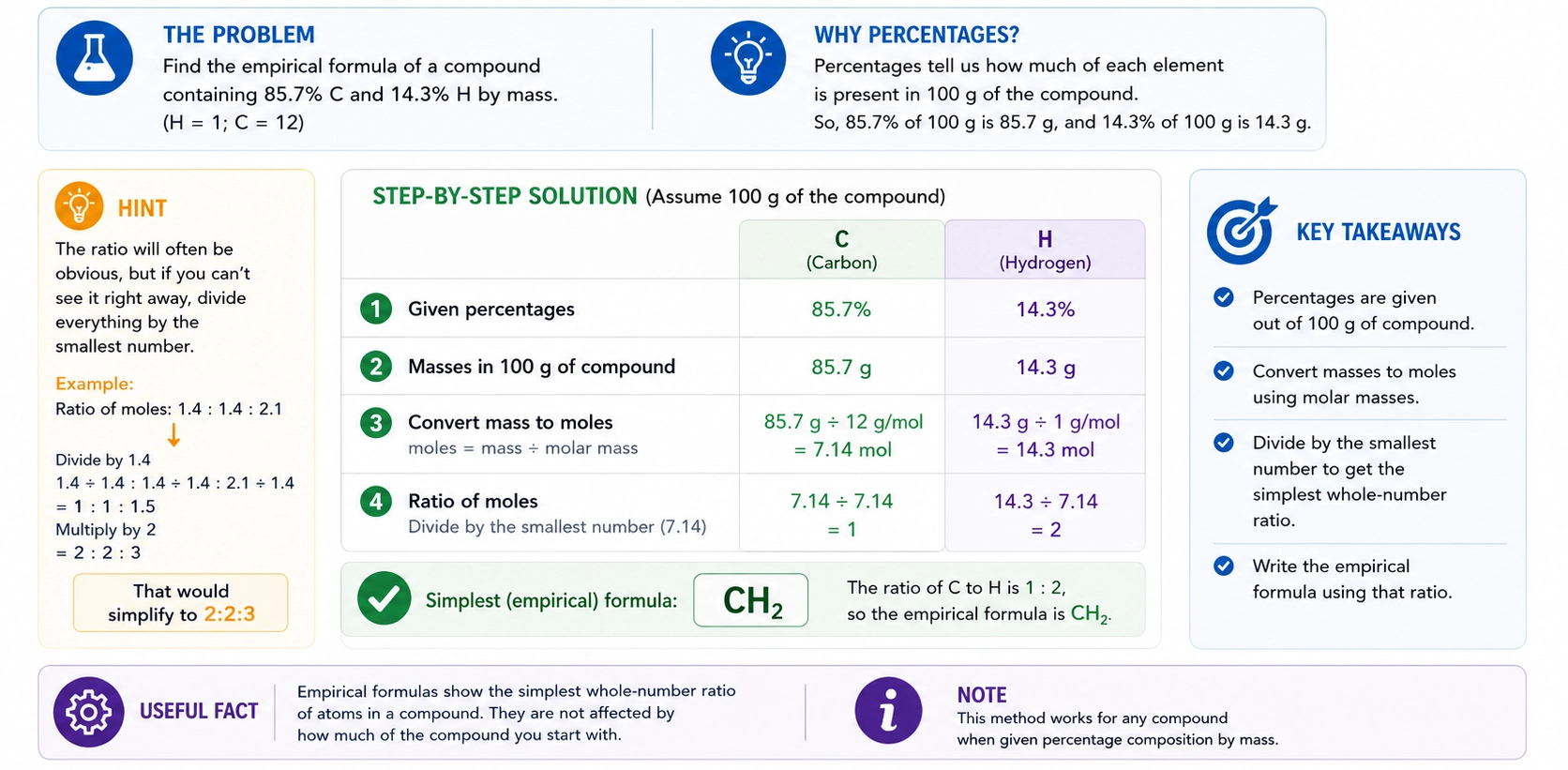
Percentage values are used exactly like mass values in grams because the calculation only depends on relative proportions, not absolute amounts.
When Step 3 Is Needed: Scaling to Whole Numbers
After dividing by the smallest mole value, the ratios are not always whole numbers. You need to recognise when to multiply and by how much.
| Ratio value after Step 2 | What it suggests | Action |
|---|---|---|
| 1.0, 2.0, 3.0 (whole number) | Ratios are already whole numbers. | No further step needed. Write the empirical formula directly. |
| Approximately 1.5 | Corresponds to a 3:2 relationship. | Multiply all ratios by 2. |
| Approximately 1.33 or 1.67 | Corresponds to a 4:3 or 5:3 relationship. | Multiply all ratios by 3. |
| Approximately 1.25 or 1.75 | Corresponds to a 5:4 or 7:4 relationship. | Multiply all ratios by 4. |
Worked example with Step 3: a compound gives mole ratios of N : O = 1 : 1.5 after Step 2. Multiply both by 2 to give N : O = 2 : 3. The empirical formula is N2O3.
Exam tip: small rounding differences are expected. If a ratio comes out as 1.98 or 2.03, round it to 2. Only multiply up when the value is clearly not close to a whole number (for example, 1.5 or 1.33).
Quick Check: Work It Out, Then Turn the Card
Five calculations to do on paper, with the full working on the back of each card.
Empirical Formulae from Combustion Data
When an organic compound is burned completely in excess oxygen, the products are carbon dioxide and water. These products can be collected and weighed to find the empirical formula of the original compound.
The method for using combustion data is:
- Find the mass of carbon from the mass of CO2 produced: mass of C = mass of CO2 × (12 / 44).
- Find the mass of hydrogen from the mass of H2O produced: mass of H = mass of H2O × (2 / 18).
- If the compound contains oxygen, find the mass of O by subtracting the masses of C and H from the original sample mass.
- Apply the standard three-step method to the masses of C, H, and O.
Key assumption: all the carbon in the original compound ends up as CO2, and all the hydrogen ends up as H2O. This is only valid when combustion is complete.
Quick Check: One Combustion Calculation, Four Decisions
Follow a single set of combustion data through to its empirical formula, choosing the accurate statement at each step.
Combustion analysis links the masses of CO2 and H2O back to the carbon and hydrogen content of the original compound.
Linking the Empirical Formula to the Molecular Formula
Once you have the empirical formula, you can find the molecular formula if you are also given the relative molecular mass (Mr) of the compound.
The relationship is:
Molecular formula = (empirical formula) × n, where n = Mr of compound ÷ Mr of empirical formula unit
For example, if the empirical formula is CH2O (Mr = 30) and the compound has Mr = 180, then n = 180 ÷ 30 = 6, giving the molecular formula C6H12O6.
| Compound | Empirical formula | Mr of compound | n | Molecular formula |
|---|---|---|---|---|
| Glucose | CH2O | 180 | 6 | C6H12O6 |
| Ethene | CH2 | 28 | 2 | C2H4 |
| Hydrogen peroxide | HO | 34 | 2 | H2O2 |
| Water | H2O | 18 | 1 | H2O |
Note: when the empirical formula and the molecular formula are the same, n = 1. This is always true for ionic compounds, which do not have discrete molecules.
Quick Check: Finding n
Two compounds, two relative molecular masses, and one reminder about ionic compounds.
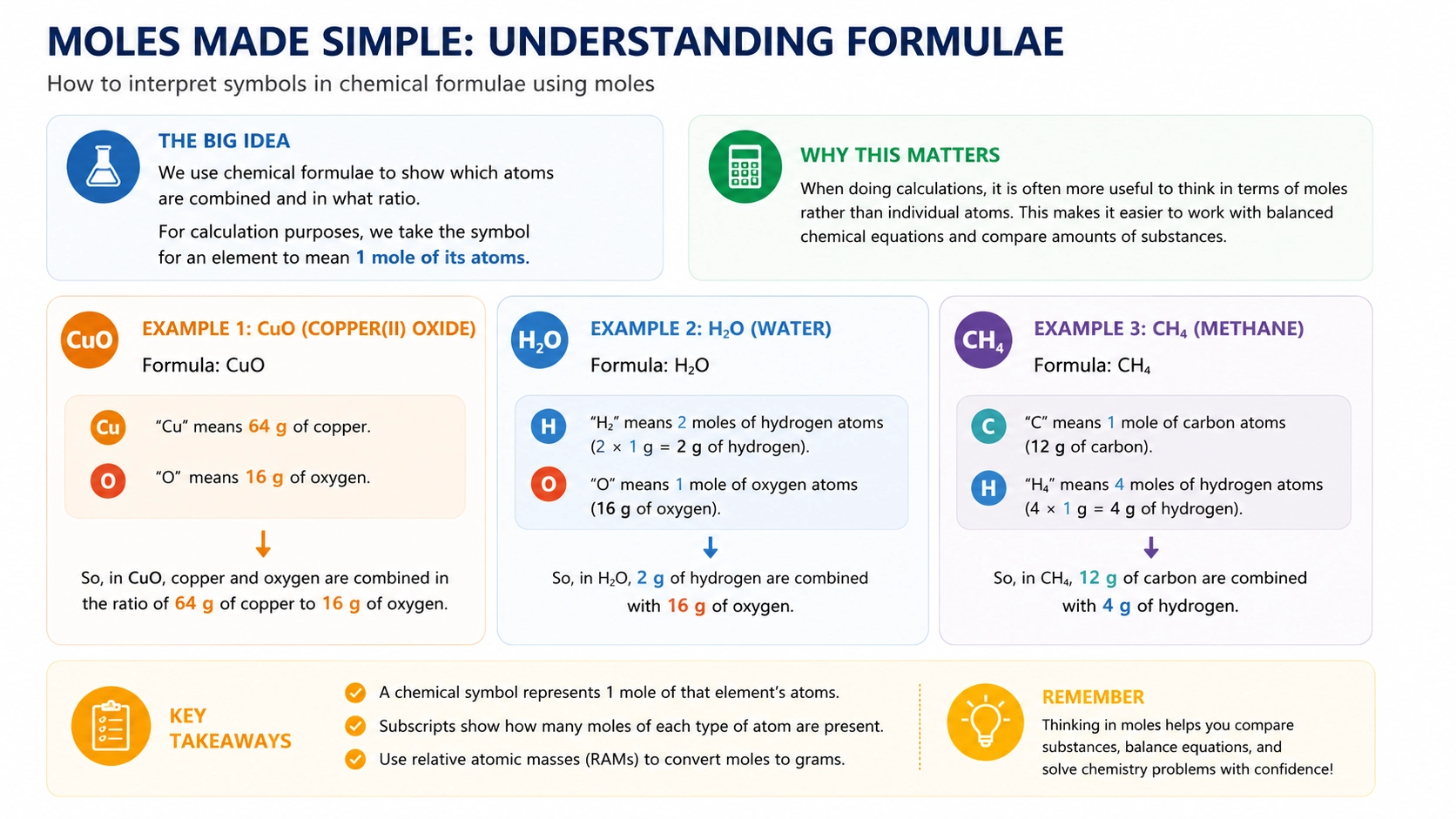
Understanding moles is the foundation of the empirical formula method: every step converts mass data into a mole ratio before simplifying.
Common Exam Points
- The empirical formula shows the simplest whole-number ratio of atoms, not the actual number of atoms per molecule.
- When percentage data is given, you can treat the percentages directly as masses in grams because the method only depends on the ratio.
- Always divide by the relative atomic mass (Ar), not the molecular mass, in Step 1.
- After dividing by the smallest, look carefully at whether the ratios are already whole numbers before deciding whether Step 3 is needed.
- A ratio of 1.5 means you must multiply by 2; a ratio of 1.33 means you must multiply by 3. Do not round 1.5 to 2.
- Ionic compounds only have empirical formulae, never molecular formulae, because they consist of a lattice rather than discrete molecules.
- To find the molecular formula, you need both the empirical formula and the relative molecular mass (Mr).
- Show all working clearly: marks are awarded for each correct step, even if the final formula contains an error.
QuickSnap
This text summary condenses the page into the essential exam ideas.
- Empirical formula: the simplest whole-number ratio of atoms of each element in a compound.
- Step 1: divide the mass (or percentage) of each element by its relative atomic mass to get moles.
- Step 2: divide all mole values by the smallest mole value.
- Step 3: multiply up to whole numbers if any ratio is not already a whole number (for example, multiply by 2 if a ratio is 1.5).
- Percentage data: treat percentage values exactly like masses in grams; the method is identical.
- Combustion analysis: use masses of CO2 and H2O to find masses of C and H, then apply the method.
- Molecular formula: multiply the empirical formula by n, where n = Mr of compound divided by Mr of one empirical unit.
- Ionic compounds: only ever have empirical formulae.
FAQs
These questions address the most common points of confusion students encounter when working with empirical formulae.
What is the difference between an empirical formula and a molecular formula?
The empirical formula shows the simplest whole-number ratio of atoms in a compound. The molecular formula shows the actual number of atoms in one molecule. They can be the same (for example, H2O) or different (for example, glucose has the empirical formula CH2O but the molecular formula C6H12O6).
Can I use percentage composition directly in the calculation?
Yes. You treat the percentage values exactly as if they were masses in grams and apply the same three steps. The calculation works because empirical formulae depend only on the ratio of amounts, not on the actual sample size.
What do I do if the mole ratio comes out as 1.5?
A ratio of 1.5 cannot be rounded to 2. You must multiply all the ratios by 2 to convert them to whole numbers. So a ratio of 1 : 1.5 becomes 2 : 3 after multiplying by 2.
Do ionic compounds have molecular formulae?
No. Ionic compounds consist of a giant lattice rather than discrete molecules, so they only have empirical formulae. For example, sodium chloride is written as NaCl, which already represents the simplest ratio of ions.
How do I find the empirical formula from combustion data?
Convert the mass of CO2 to mass of C using the fraction 12/44, and the mass of H2O to mass of H using 2/18. If the compound contains oxygen, subtract the masses of C and H from the original sample mass to find the mass of O. Then apply the standard three-step method.
Copyright notice: This OLS revision content, including the explanations, layout, diagrams, tables and embedded learning structure, is authored for Online Learning System by Dr. Mohammed Al-Fatah. It may not be copied, reproduced, redistributed or adapted without written permission.
Keep this note — free
Save your progress across every OCR A topic. A free account remembers which topics you have covered, saves your question scores, and syncs across your phone and laptop.
- Track every topic you have finished
- Keep your practice-question scores
- No payment, no card, free forever
Already registered? Log in