Atomic and Ionic Radii
A concise Cambridge International AS Level Chemistry revision guide to how atomic radius and ionic radius change across a period and down a group, why positive ions are smaller than their atoms and negative ions larger, and the isoelectronic ions of Period 3 (1.1.7 and 9.1.1).
GCSE Recap: Shells, Size and Forming Ions
Before you start, check that you can count occupied shells and say what an atom loses or gains when it forms an ion.
What Atomic Radius Means
An atom has no hard edge, so its size is defined by measuring the distance between two nuclei that are bonded together and halving it. For most non-metals the covalent radius (half the distance between two bonded atoms in a molecule) is used; for metals the metallic radius (half the distance between neighbouring ions in the metal lattice) is used. Values are given in nanometres or picometres: sodium is about 0.19 nm, chlorine about 0.10 nm.
Two factors set the size of an atom: how many shells of electrons it has, and how strongly the outer shell is pulled in by the nuclear charge after allowing for shielding by the inner shells.
Key idea: More shells: bigger atom. Higher nuclear charge with the same shielding: smaller atom.
Quick Check: Halve the Distance
Work each radius out on paper from the measured distance between the nuclei, then type it in.
Atomic Radius Across a Period
Across Period 3 from sodium to chlorine the atomic radius decreases. Each element adds one proton to the nucleus and one electron to the same outer shell (the third shell). The inner shells that do the shielding are unchanged, so the outer electrons feel a steadily larger effective nuclear charge and are pulled closer.
| Element | Na | Mg | Al | Si | P | S | Cl |
|---|---|---|---|---|---|---|---|
| Atomic radius / nm | 0.191 | 0.160 | 0.143 | 0.118 | 0.110 | 0.104 | 0.099 |
| Protons | 11 | 12 | 13 | 14 | 15 | 16 | 17 |
Argon is left out of the comparison because as a noble gas it forms no bonds, so its radius is measured differently (a van der Waals radius) and is not comparable.
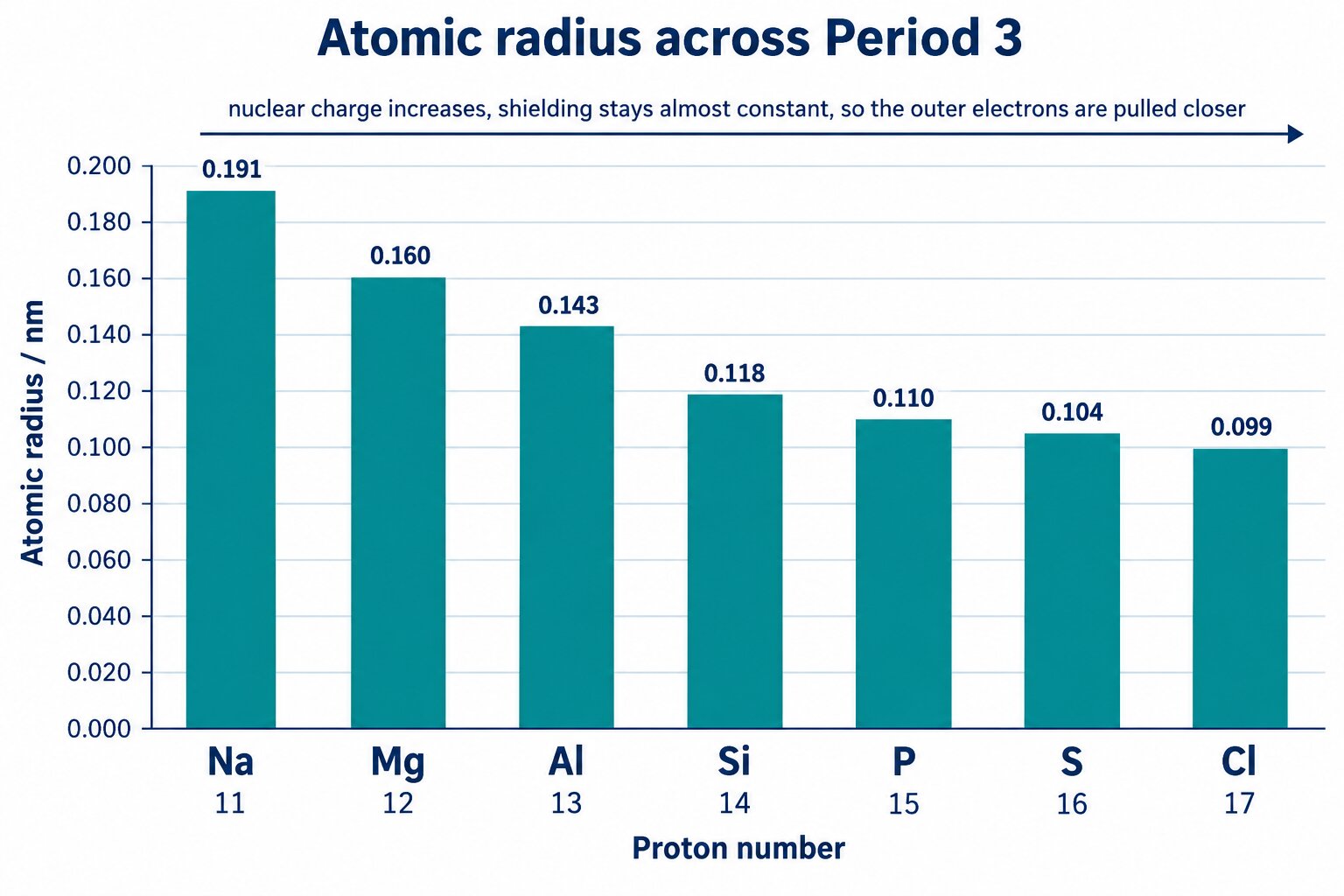
Atomic radius across Period 3 from sodium to chlorine
Atomic radius falls across Period 3 as nuclear charge rises with no extra shielding.
Exam sentence: Across a period the atomic radius decreases because the nuclear charge increases while the electrons are added to the same shell, so shielding is almost constant and the outer electrons are attracted more strongly.
Quick Check: The Odd Value for Neon
Decide why one figure in the data book does not fit the pattern of the others.
Atomic Radius Down a Group
Down any group the atomic radius increases. Each successive element has one more occupied shell, so its outer electrons are further from the nucleus. The extra inner shells also add shielding, which more than cancels the effect of the larger nuclear charge.
| Group 1 | Li | Na | K | Rb |
|---|---|---|---|---|
| Atomic radius / nm | 0.152 | 0.186 | 0.231 | 0.244 |
| Occupied shells | 2 | 3 | 4 | 5 |
Exam sentence: Down a group the atomic radius increases because each element has an extra shell of electrons and more shielding, which outweighs the increase in nuclear charge.
Quick Check: Do Extra Protons Make an Atom Bigger?
Judge the reason given, not just the claim, then read the feedback.
Ionic Radius: Cations Shrink, Anions Grow
When an atom forms a positive ion it loses its outer electrons, usually the whole outer shell. The ion has one shell fewer than the atom, and the remaining electrons are held by the same nuclear charge with less repulsion between them, so a cation is much smaller than its atom: Na 0.191 nm but Na+ 0.102 nm.
When an atom forms a negative ion it gains electrons into the same outer shell. The nuclear charge is unchanged but there is more electron-electron repulsion, so the shell expands: an anion is larger than its atom: Cl 0.099 nm but Cl− 0.181 nm.
Atomic and Ionic Radii Across Period 3 and Down Group 1
Every sphere is drawn to scale against the 0.1 nm ruler, so the sizes can be compared directly. Drag to rotate, scroll or pinch to zoom.
© Dr. Mohammed Al-Fatah – onlinelearningsystem.net
Key idea: Losing a shell makes a cation small; adding electrons to a shell that is already there makes an anion large.
Quick Check: Atom Against Ion
Five quick comparisons between an atom and an ion of the same element.
The Isoelectronic Ions of Period 3
The ions Na+, Mg2+, Al3+, P3−, S2− and Cl− are isoelectronic: every one of them has exactly ten electrons, the configuration 1s2 2s2 2p6 of neon. With identical electron arrangements, only the nuclear charge differs, so the ionic radius falls steadily as the number of protons rises.
| Ion | P3− | S2− | Cl− | Na+ | Mg2+ | Al3+ |
|---|---|---|---|---|---|---|
| Protons | 15 | 16 | 17 | 11 | 12 | 13 |
| Electrons | 18 | 18 | 18 | 10 | 10 | 10 |
| Ionic radius / nm | 0.212 | 0.184 | 0.181 | 0.102 | 0.072 | 0.054 |
Strictly there are two isoelectronic series in Period 3: the cations (ten electrons, like neon) and the anions (eighteen electrons, like argon). Within each series the radius falls as the proton number rises. Across the whole period the ionic radius therefore falls from Na+ to Al3+, jumps up sharply at P3− (an extra shell of electrons), then falls again to Cl−. This is the pattern Cambridge means by the periodicity of ionic radius in 9.1.1.
Exam sentence: Na⁺, Mg²⁺ and Al³⁺ are isoelectronic; the ionic radius decreases from Na⁺ to Al³⁺ because the nuclear charge increases while the number of electrons and the shielding stay the same.
Quick Check: Order the Ten-Electron Ions
Put the six ions in order of radius, largest at the top.
Quick Check: Explain Two Comparisons
Write a short explanation, then compare it with the mark points and the model answer.
Common Exam Mistakes
- Explaining the trend across a period by “more electrons”. The extra electrons are in the same shell; the argument is about nuclear charge and constant shielding.
- Saying a sodium ion is bigger than a sodium atom “because it is charged”. It has lost a whole shell, so it is much smaller.
- Treating Cl− as smaller than Cl because chlorine is “at the end of the period”. The anion has gained an electron and is nearly twice the size of the atom.
- Forgetting the jump between Al3+ and P3−. The anions have an extra shell, so the period’s ionic radii are not one smooth curve.
Exam sentence: Atomic radius falls across a period and rises down a group; cations are smaller and anions larger than their atoms; within an isoelectronic series the radius falls as nuclear charge rises.
Master Atomic Structure and the Periodic Table for Cambridge International AS & A Level Chemistry
Continue from these free revision notes into the full Topics 1 and 9 Atomic Structure and the Periodic Table course. The guided video lessons are ready now; the Cambridge International MCQ bank, teacher-marked short-answer questions and KASP spec-point report are being written, and the course opens for enrolment as soon as they are complete.
Guided video teaching
Learn the chemistry and exam technique through structured video lessons with worked examples and walkthroughs.
Instant MCQ feedback
Auto-marked MCQ quizzes provide immediate diagnostic feedback for every answer choice.
Teacher-marked SAQs
Submit written exam responses and receive chemistry specialist feedback with improvement guidance.
Progress tracking
Identify strengths and weaknesses across the full Topics 1 and 9 specification with targeted reporting.
See how the course works
Click play to start the course preview animation.
Some ionic radii are shown.
| Ion | Ionic radius / nm |
|---|---|
| Na+ | 0.102 |
| K+ | 0.138 |
| F− | 0.133 |
| Cl− | 0.180 |
Which compound has the strongest ionic bonding?
Explain why the metallic bonding in magnesium is much stronger than that in sodium.
Copyright notice: This OLS revision content, including the explanations, layout, diagrams, tables and embedded learning structure, is authored for Online Learning System by Dr. Mohammed Al-Fatah. It may not be copied, reproduced, redistributed or adapted without written permission.
Keep this note — free
Save your progress across every Cambridge topic. A free account remembers which topics you have covered, saves your question scores, and syncs across your phone and laptop.
- Track every topic you have finished
- Keep your practice-question scores
- No payment, no card, free forever
Already registered? Log in