Charged Particles in Electric Fields
A concise Cambridge International AS Level Chemistry revision guide to what happens when beams of protons, neutrons and electrons moving at the same speed pass through an electric field: which way each beam bends, by how much, and how charge and mass decide the answer (1.1.5).
GCSE Recap: Charges, Masses and Attraction
Before you start, check the relative charges and masses of the three subatomic particles and the rule about attraction.
Three Beams, One Field
Imagine three beams of particles fired at the same speed between two parallel, oppositely charged plates: a beam of protons, a beam of neutrons and a beam of electrons. The plates create a uniform electric field that pushes on anything carrying charge.
The particles differ in two ways that matter here: their charge decides the direction of the push, and their mass decides how much the push changes their path.
| Particle | Relative charge | Relative mass | Effect of the field |
|---|---|---|---|
| Proton | +1 | 1 | Deflected towards the negative plate, by a small amount |
| Neutron | 0 | 1 | Not deflected: passes straight through |
| Electron | −1 | 1/1836 (about 0.0005) | Deflected towards the positive plate, by a very large amount |
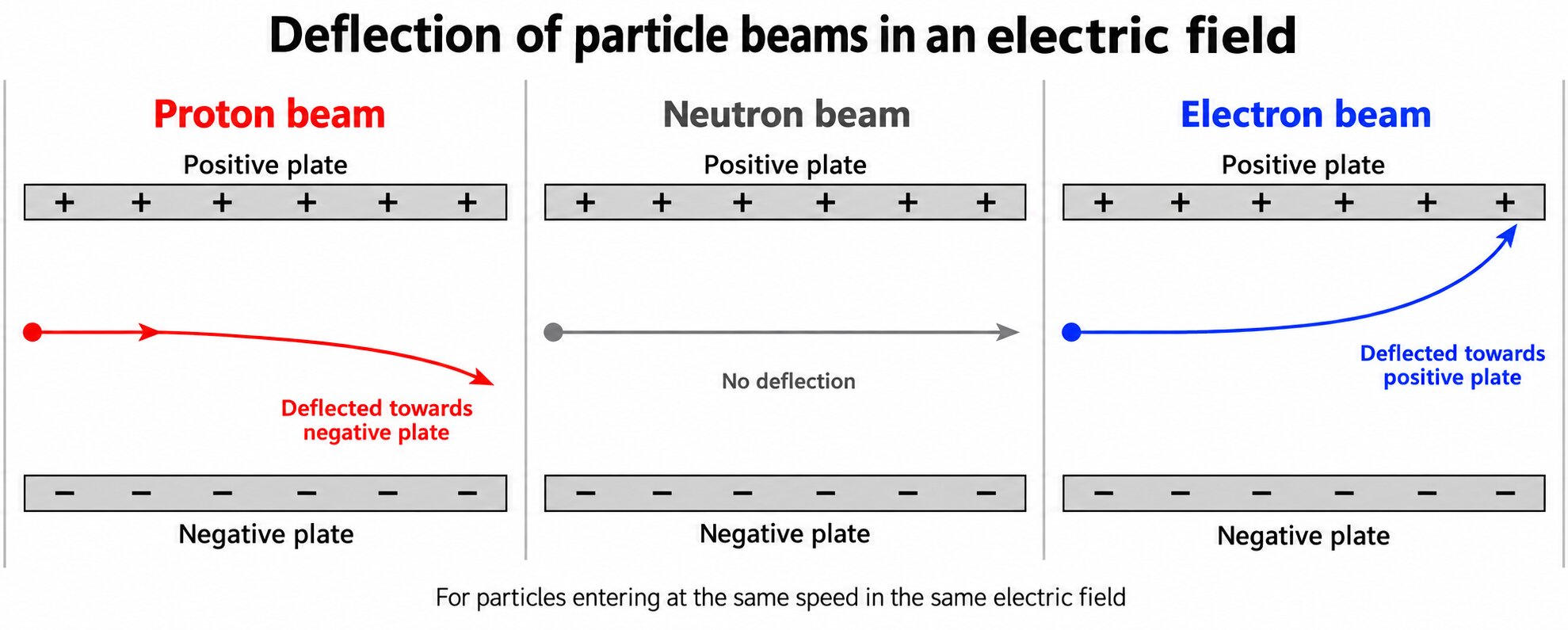
Opposite charges attract: protons bend towards the negative plate and electrons towards the positive plate. The electron, being far lighter, bends far more.
Key idea: Direction comes from charge, size of deflection comes from charge divided by mass. Neutrons have no charge, so the field cannot act on them at all.
Quick Check: Which Way Does Each Beam Bend?
Five quick questions on beams the page has not used; give the direction first, then compare two beams.
Why the Electron Bends So Much More
A charged particle in an electric field experiences a force that depends only on its charge, not on its mass. The proton and the electron carry the same size of charge, so the force on each is the same size, just in opposite directions.
What differs is how much that force changes their motion. The acceleration of a particle is force divided by mass. The electron’s mass is about 1/1836 of the proton’s, so for the same force its acceleration, and therefore its sideways deflection in the time it takes to cross the plates, is about 1836 times greater.
Cambridge summarises this as: the deflection is proportional to charge ÷ mass. For the proton this ratio is 1/1 = 1; for the electron it is 1/(1/1836) = 1836; for the neutron it is 0/1 = 0.
Exam sentence: The electron and proton are deflected in opposite directions because they carry opposite charges; the electron is deflected much more because it has the same charge but a far smaller mass.
Quick Check: Explain a Calcium Ion Beam
Write a short explanation, then compare it with the mark points and the model answer.
Predicting the Deflection of Other Particles
The same rule, deflection proportional to charge divided by mass, lets you compare any charged particle with a proton moving at the same speed.
| Particle | Charge | Mass (relative) | Charge ÷ mass | Deflection compared with a proton |
|---|---|---|---|---|
| Proton, 1H+ | +1 | 1 | 1 | Reference, towards the negative plate |
| Deuteron, 2H+ | +1 | 2 | 0.5 | Half as much, same direction |
| Alpha particle, 4He2+ | +2 | 4 | 0.5 | Half as much, same direction |
| 16O2− ion | −2 | 16 | −0.125 | One eighth as much, towards the positive plate |
| Electron | −1 | 1/1836 | −1836 | About 1836 times as much, towards the positive plate |
Notice that a deuteron and an alpha particle are deflected by the same amount: doubling both the charge and the mass leaves the ratio unchanged. Questions often give you an unfamiliar ion and ask you to place it on a diagram; work out the ratio and compare it with the proton’s.
Key idea: Work out charge ÷ mass for the new particle, compare it with 1 for the proton, and use the sign of the charge for the direction.
Quick Check: Rank Four Beams
Work out charge divided by mass for each particle before you choose.
Quick Check: Work Out the Deflection
Work each comparison out on paper, then flip the card to check your working.
What the Experiment Shows About the Atom
Beams like these were how the subatomic particles were first characterised. The fact that one beam bends towards the negative plate, one bends the other way and one does not bend at all shows that atoms are built from positively charged, negatively charged and neutral particles. The enormous deflection of the electron beam shows that electrons are very light compared with the particles of the nucleus, which is why almost all of an atom’s mass sits in its tiny nucleus (1.1.4).
Exam sentence: Protons and neutrons in the nucleus carry nearly all the mass; the electrons, deflected so easily by a field, contribute almost nothing to it.
Quick Check: Pick the Accurate Statement
In each round, choose the one statement that is accurate.
Common Exam Mistakes
- Sending the proton towards the positive plate. Like charges repel: the positive proton moves towards the negative plate.
- Drawing the proton and electron deflections the same size. The electron bends roughly 1836 times more.
- Saying the neutron is “deflected slightly”. It has no charge, so the deflection is zero.
- Comparing particles by charge alone. A 2+ ion of mass 4 bends exactly as much as a 1+ ion of mass 2.
Exam sentence: In an electric field, protons are deflected towards the negative plate, electrons much more strongly towards the positive plate, and neutrons are undeflected; the deflection depends on the charge to mass ratio.
Master Atomic Structure and the Periodic Table for Cambridge International AS & A Level Chemistry
Continue from these free revision notes into the full Topics 1 and 9 Atomic Structure and the Periodic Table course. The guided video lessons are ready now; the Cambridge International MCQ bank, teacher-marked short-answer questions and KASP spec-point report are being written, and the course opens for enrolment as soon as they are complete.
Guided video teaching
Learn the chemistry and exam technique through structured video lessons with worked examples and walkthroughs.
Instant MCQ feedback
Auto-marked MCQ quizzes provide immediate diagnostic feedback for every answer choice.
Teacher-marked SAQs
Submit written exam responses and receive chemistry specialist feedback with improvement guidance.
Progress tracking
Identify strengths and weaknesses across the full Topics 1 and 9 specification with targeted reporting.
See how the course works
Click play to start the course preview animation.
Some ionic radii are shown.
| Ion | Ionic radius / nm |
|---|---|
| Na+ | 0.102 |
| K+ | 0.138 |
| F− | 0.133 |
| Cl− | 0.180 |
Which compound has the strongest ionic bonding?
Explain why the metallic bonding in magnesium is much stronger than that in sodium.
Copyright notice: This OLS revision content, including the explanations, layout, diagrams, tables and embedded learning structure, is authored for Online Learning System by Dr. Mohammed Al-Fatah. It may not be copied, reproduced, redistributed or adapted without written permission.
Keep this note — free
Save your progress across every Cambridge topic. A free account remembers which topics you have covered, saves your question scores, and syncs across your phone and laptop.
- Track every topic you have finished
- Keep your practice-question scores
- No payment, no card, free forever
Already registered? Log in