Predicting Solubility
A concise revision guide to using enthalpy and entropy changes of solution to predict whether an ionic compound dissolves, and to explain why solubility runs one way for the Group 2 hydroxides and the other way for the Group 2 sulfates.
- 12.19-a
- 12.19-b
- 12.19-c
What these spec points say
- 12.19-a be able to use entropy changes of solution to predict solubility of ionic compounds
- 12.19-b be able to use enthalpy changes of solution to predict solubility of ionic compounds
- 12.19-c be able to discuss trends in solubility of ionic compounds covered in Unit 2
Dissolving as a Feasibility Question
Whether a salt dissolves is a question of feasibility, and feasibility is decided by the total entropy change.
ΔS_total = ΔS_system + ΔS_surroundings
Both terms can be worked out for dissolving, and the enthalpy of solution from the previous page is only half of the story.
ΔS_system is usually positive.
- An ordered lattice becomes a set of mobile ions spread through the solution, which is a large increase in disorder.
- But water molecules that hydrate an ion are held in place around it.
- For a small, highly charged ion such as Mg²⁺ or Al³⁺, so many water molecules are ordered so tightly that ΔS_system can be negative overall.
ΔS_surroundings = −ΔsolH/T.
- An exothermic ΔsolH heats the surroundings and gives a positive term.
- An endothermic ΔsolH gives a negative term.
- Because T is in the denominator, an endothermic salt becomes more soluble as the temperature rises.
Key idea: A salt dissolves if ΔS_total is positive: ΔS_system (usually positive, the ions spread out) + ΔS_surroundings (= −ΔsolH/T). A slightly endothermic salt dissolves because the entropy gain of the system outweighs the small negative surroundings term.
So there are two ways to predict solubility.
| Method | What to do | Prediction |
|---|---|---|
| From ΔsolH alone | look at the sign and size of ΔsolH | large endothermic value: insoluble; small value of either sign: soluble; exothermic value: soluble |
| From ΔS_total | put in both terms at the temperature asked | positive result: the salt dissolves |
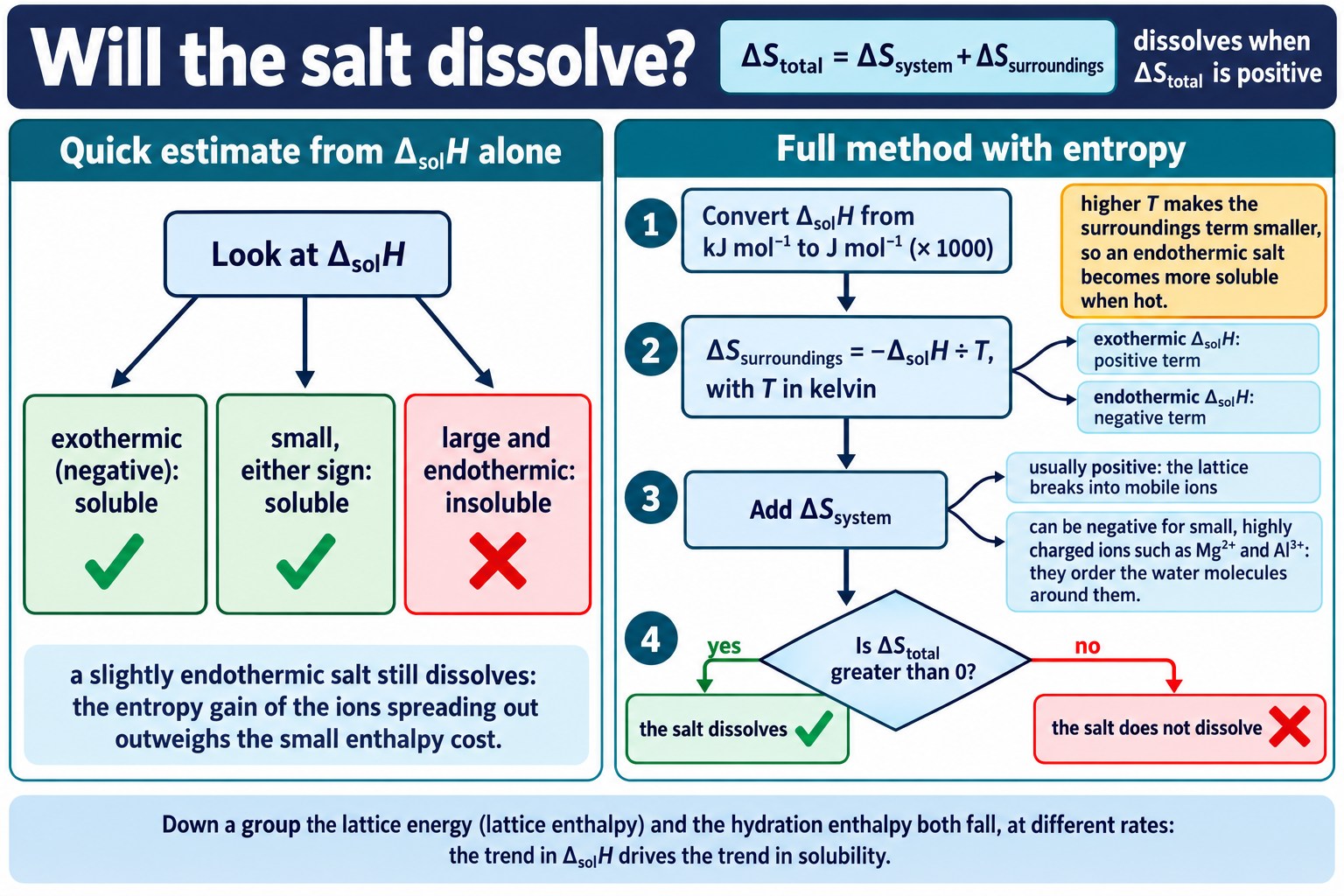
Predicting whether a salt dissolves: a quick estimate from the sign and size of ΔsolH, and the full method that adds ΔS_system to ΔS_surroundings and checks the sign of ΔS_total.
In a series of related salts the lattice energy and the hydration enthalpies change at different rates down the group.
The trend in ΔsolH, and so in ΔS_surroundings, is what drives the trend in solubility.
Exam wording: ΔS_surroundings = −ΔsolH ÷ T with ΔsolH in J mol⁻¹ and T in kelvin. Feasible when ΔS_total > 0. Say which term dominates and why.
Group 2 Hydroxides
The solubility of the Group 2 hydroxides increases down the group. Magnesium hydroxide is sparingly soluble, and barium hydroxide is soluble enough to make a strongly alkaline solution.
Both quantities in the solution cycle fall down the group, because the cation gets larger and its charge density falls.
- The lattice energy becomes less exothermic, so less energy is needed to break the lattice.
- The hydration enthalpy of the cation becomes less exothermic, so less energy is released on hydrating it.
- The trend in ΔsolH depends on which falls faster.
The deciding factor is the small hydroxide ion.
- With a small anion, the size of the cation makes up a large part of the distance between the ion centres.
- So the lattice energy depends strongly on the cation and falls steeply from Mg(OH)₂ to Ba(OH)₂.
- The hydration enthalpy of the cation falls too, but more gently.
- The endothermic term shrinks faster than the exothermic term, so ΔsolH becomes less endothermic down the group.
- ΔS_surroundings becomes less negative, ΔS_total becomes more positive and the hydroxides become more soluble.
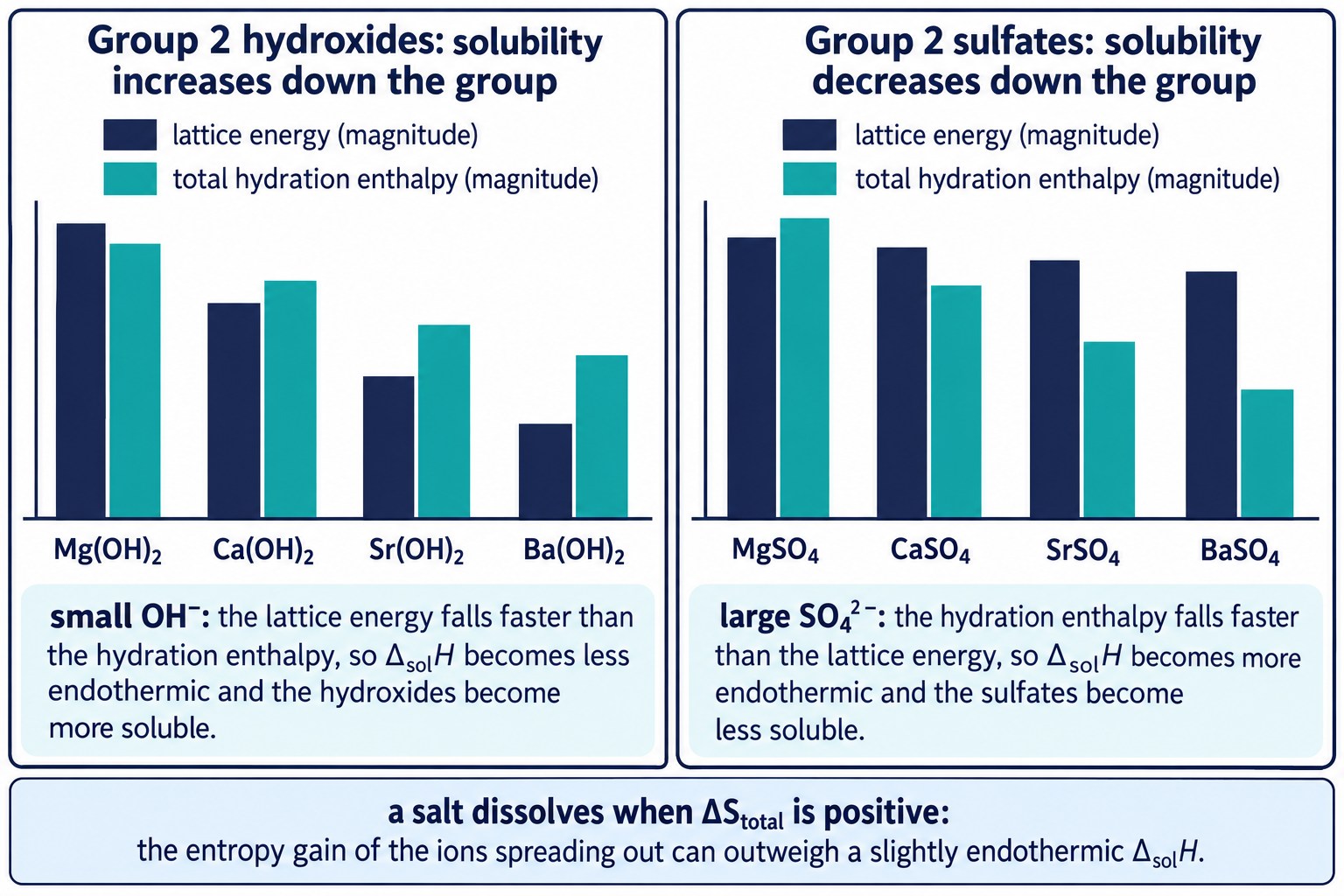
Why the Group 2 hydroxides and sulfates run opposite ways: the lattice energy and the total hydration enthalpy both fall down the group, but with the small OH⁻ ion the lattice energy falls faster and with the large SO₄²⁻ ion the hydration enthalpy falls faster.
Exam wording: Hydroxides: “down the group the lattice energy decreases faster than the hydration enthalpy because the OH⁻ ion is small, so ΔsolH becomes less endothermic and solubility increases”.
Check: Reasoning With ΔsolH and ΔS
Use given enthalpy and entropy data for salts not on this page to decide whether each dissolves at a stated temperature, and identify which term dominates.
Group 2 Sulfates
The Group 2 sulfates run the other way: solubility decreases down the group.
- Magnesium sulfate is very soluble (Epsom salts).
- Calcium sulfate is sparingly soluble.
- Barium sulfate is so insoluble that it is the basis of the sulfate test: a white precipitate with acidified barium chloride.
- Barium sulfate can be swallowed safely as a barium meal even though barium ions are toxic.
The difference is the large sulfate ion.
- SO₄²⁻ is so big that the distance between the ion centres is dominated by the anion.
- Changing the cation from Mg²⁺ to Ba²⁺ alters that distance by a small fraction, so the lattice energy falls only slightly down the group.
- The hydration enthalpy of the cation, however, depends only on the cation and falls steeply as before.
- Now the exothermic term shrinks faster than the endothermic term, so ΔsolH becomes more endothermic down the group.
- ΔS_surroundings becomes more negative and the sulfates become less soluble.
| Trend | Anion | Change in lattice energy down the group | Change in cation hydration enthalpy | Result |
|---|---|---|---|---|
| Hydroxides: solubility increases | OH⁻, small | falls steeply (cation size dominates the ion separation) | falls | ΔsolH less endothermic down the group |
| Sulfates: solubility decreases | SO₄²⁻, large | falls slightly (anion size dominates the ion separation) | falls steeply by comparison | ΔsolH more endothermic down the group |
The same reasoning covers the carbonates, which like the sulfates become less soluble down the group because CO₃²⁻ is also large.
The full set of trends, with the reactions and tests that go with them, is in Topic 8B Groups 1 and 2.
Exam wording: Sulfates: “the SO₄²⁻ ion is large, so the lattice energy changes little down the group while the hydration enthalpy of the cation decreases markedly, so ΔsolH becomes more endothermic and solubility decreases”.
Common Exam Points
Say
- “A salt dissolves when ΔS_total is positive.”
- “ΔS_surroundings = −ΔsolH/T, so an endothermic ΔsolH gives a negative surroundings term.”
- “Down the group both the lattice energy and the hydration enthalpy become less exothermic; the trend in ΔsolH depends on which changes more.”
Do not say
- “The hydroxides dissolve because their lattice energy is small” (it is the rate of change down the group, not the size, that sets the trend).
- “ΔS_system is always positive on dissolving” (small, highly charged ions order the water).
- “Barium sulfate is insoluble because it is unreactive.”
Watch for
- A question that gives ΔsolH and ΔS_system for a salt and asks whether it dissolves at 298 K: convert ΔsolH to joules, work out ΔS_surroundings and add.
- A question that asks why an endothermic salt dissolves more at higher temperature: the surroundings term gets smaller.
- A pair of trends given in one question, hydroxides and sulfates, with the answer hinging on the size of the anion.
Check: Explaining a Solubility Trend
Explain the direction of a solubility trend for a series of salts not on this page from how the lattice energy and the hydration enthalpy change down the group.
FAQs
Use these quick answers to check how solubility is predicted and why the Group 2 trends run opposite ways.
Why does barium sulfate not dissolve?
Because the hydration enthalpies of Ba²⁺ and SO₄²⁻ are far too small to pay for breaking the lattice. The barium ion is large, so its hydration enthalpy is weak, but the sulfate ion is also large, so the lattice term hardly changes down the group. The enthalpy of solution becomes markedly positive and the entropy gain cannot rescue it.
Why do the Group 2 hydroxides get more soluble down the group but the sulfates get less soluble?
The two terms fall at different rates. With a small anion such as OH⁻ the lattice term falls quickly down the group as the cation grows, faster than the hydration enthalpy falls, so dissolving gets easier. With the large SO₄²⁻ ion the lattice term is already small and barely changes, while the hydration enthalpy of the cation still falls, so dissolving gets harder.
Do I need both the enthalpy and the entropy of solution to predict solubility?
Yes. Dissolving is feasible when the total entropy change is positive. The enthalpy of solution decides the entropy change of the surroundings (−ΔsolH/T) and the entropy of solution is the change in the system. A salt with a positive enthalpy of solution can still dissolve if its entropy of solution is large and positive.
Why can the entropy change of solution be negative?
Because small, highly charged ions organise the water molecules around themselves into ordered hydration shells. That loss of freedom for the water can outweigh the gain from breaking up the lattice, so for ions such as Mg²⁺ the entropy of solution is negative even though the lattice has been dispersed.
Why is solubility not simply decided by the sign of the enthalpy of solution?
Because the entropy term also matters, and it becomes more important as the temperature rises. A salt with ΔsolH slightly positive dissolves if the entropy gain is large enough, and one with ΔsolH slightly negative may still be only sparingly soluble if the entropy change is negative. The prediction must use the total entropy change.
Copyright notice: This OLS revision content, including the explanations, layout, diagrams, tables and embedded learning structure, is authored for Online Learning System by Dr. Mohammed Al-Fatah. It may not be copied, reproduced, redistributed or adapted without written permission.
Keep this note — free
Save your progress across every Edexcel IAL topic. A free account remembers which topics you have covered, saves your question scores, and syncs across your phone and laptop.
- Track every topic you have finished
- Keep your practice-question scores
- No payment, no card, free forever
Already registered? Log in