Dynamic Equilibrium
A concise revision guide to reversible reactions and dynamic equilibrium: the two features of equilibrium, the need for a closed system, the position of equilibrium and the rate and concentration graphs as equilibrium is reached.
- 10.1i
- 10.1ii
What these spec points say
- 10.1i know that many reactions are readily reversible and that they can reach a state of dynamic equilibrium in which: the rate of the forward reaction is equal to the rate of the backward reaction
- 10.1ii know that many reactions are readily reversible and that they can reach a state of dynamic equilibrium in which: the concentrations of reactants and products remain constant
GCSE Recap: Reversible Reactions
Three quick questions on reversible reactions and the ⇌ sign from GCSE.
Reversible Reactions
Many reactions are reversible: the products can react together to re-form the reactants.
Blue hydrated copper(II) sulfate loses its water on heating to give the white anhydrous salt, and the white salt turns blue again when water is added.
Reversible reactions are written with the equilibrium sign, ⇌. The reaction from left to right is called the forward reaction, the one from right to left the reverse (backward) reaction.
If the forward reaction is exothermic, the reverse reaction is endothermic by exactly the same amount, because the same bonds are broken and made in the opposite direction.
Key idea: A reversible reaction can go in either direction. Which direction dominates depends on the conditions.
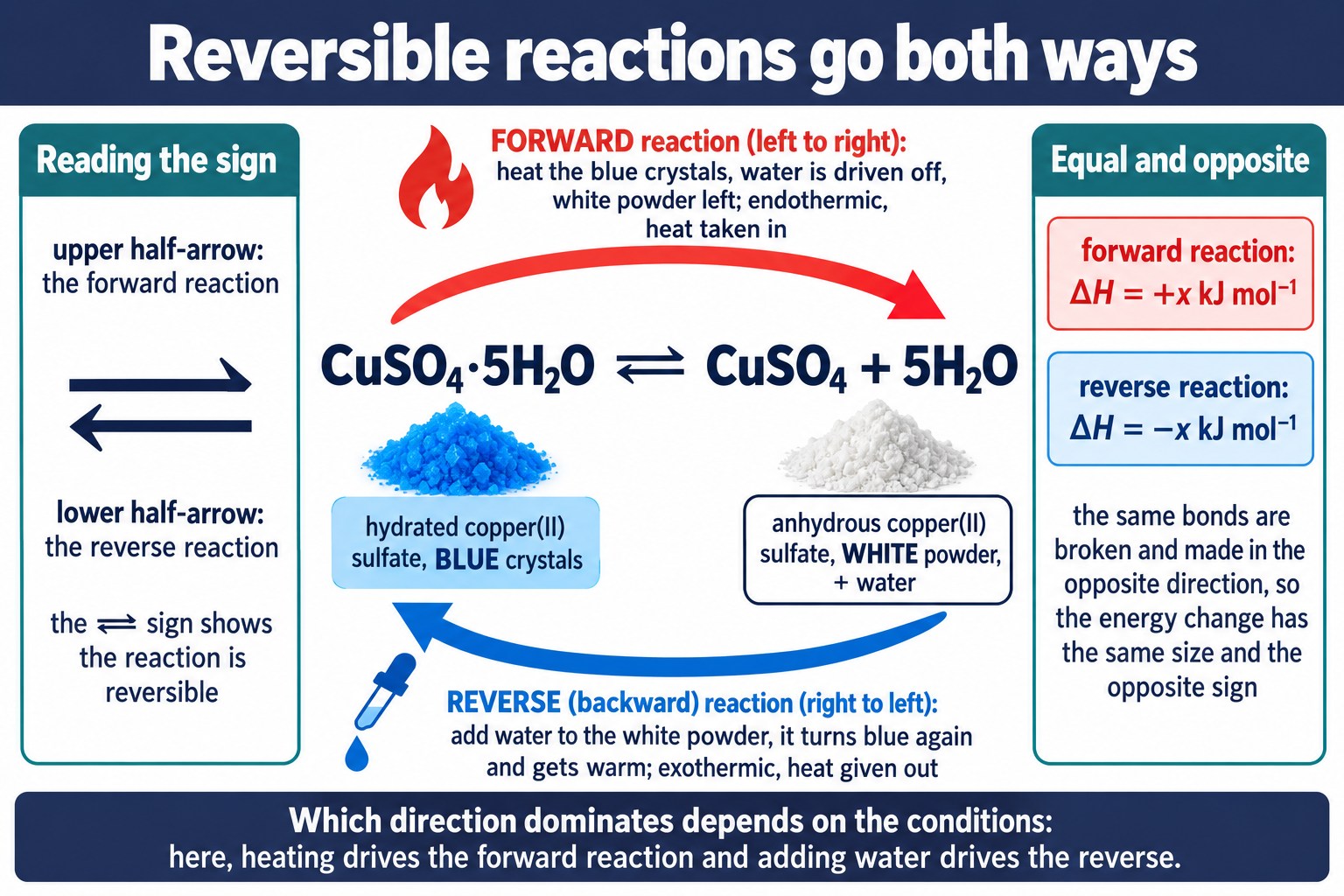
Hydrated copper(II) sulfate shows a reversible reaction: heating drives off water to leave white anhydrous powder, and adding water turns it blue again with an equal and opposite energy change.
The Two Features of Dynamic Equilibrium
Suppose a reversible reaction is started with only reactants in a closed system, one that nothing can enter or leave.
At first the forward reaction is fast, because the reactants are concentrated, and the reverse reaction cannot happen at all because there are no products.
As products build up the reverse reaction gets faster, and as reactants are used up the forward reaction gets slower, until the two rates are equal. From then on the mixture is at dynamic equilibrium.
Dynamic equilibrium has two features that must both be stated:
- the rate of the forward reaction equals the rate of the reverse reaction;
- the concentrations of reactants and products remain constant (constant, not necessarily equal).
The word dynamic matters. Nothing looks to be happening, but both reactions are still going on at the same rate, so there is no overall change. It is like walking up a down escalator at the speed of the escalator: plenty of movement, no change in position.
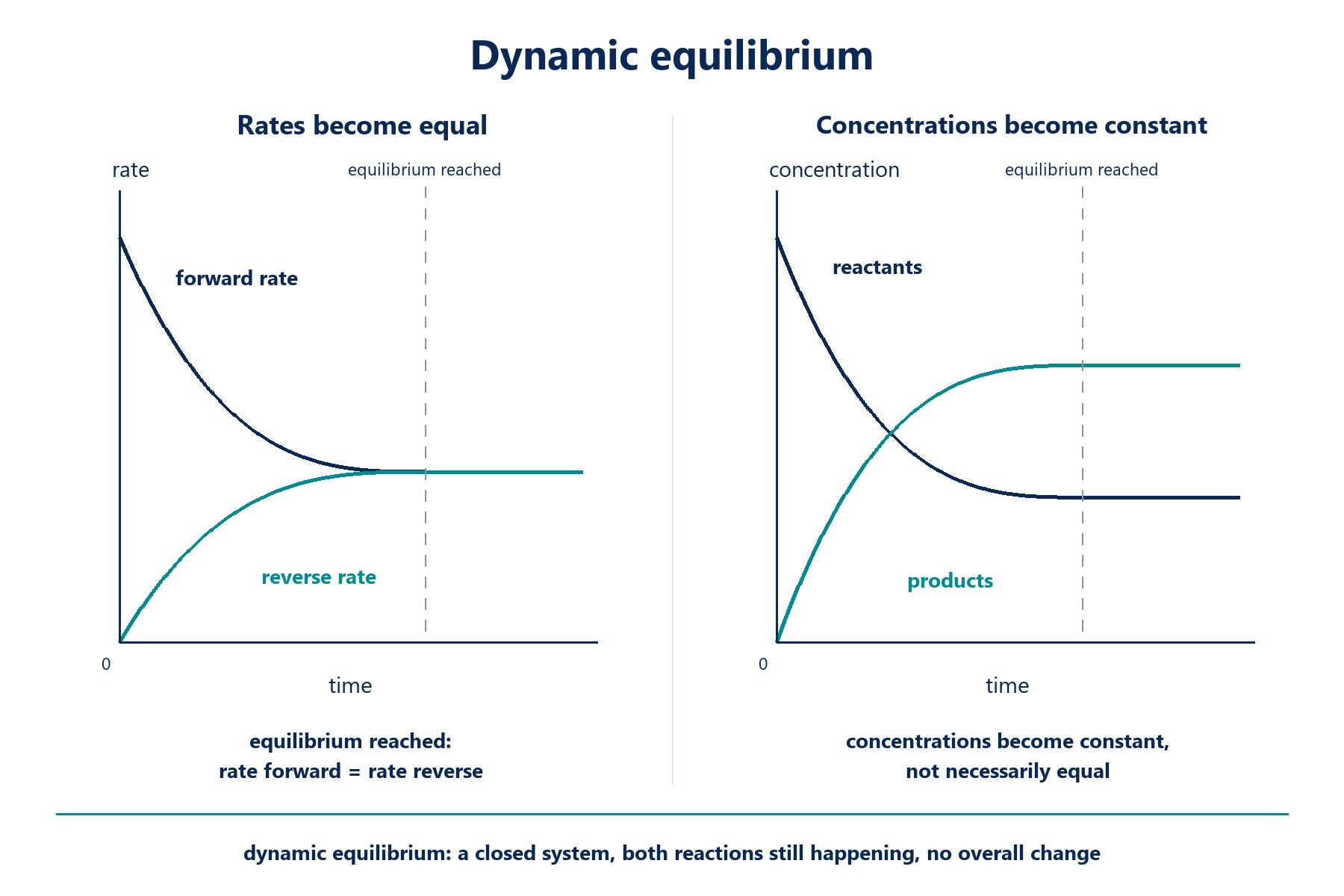
The forward and reverse rates becoming equal, and the reactant and product concentrations levelling off, as a closed system reaches equilibrium.
Definition: Dynamic equilibrium: in a closed system, the forward and reverse reactions occur at equal rates and the concentrations of reactants and products stay constant.
Check: Features of Equilibrium
Decide which statements describe a system at dynamic equilibrium.
Why the System Must Be Closed
Equilibrium can only be reached if none of the substances can escape. In an open flask a gaseous product leaves, so the reverse reaction can never build up to match the forward reaction and the reaction simply goes to completion.
Heating calcium carbonate in an open kiln gives calcium oxide and carbon dioxide until the carbonate is gone.
In a sealed vessel the carbon dioxide stays, the reverse reaction takes place, and an equilibrium is set up.
The position of equilibrium describes the make-up of the equilibrium mixture. If it lies to the right, the mixture is mostly products; if to the left, mostly reactants.
The position depends on the temperature, and for many reactions on the pressure and concentrations, which is the subject of the next page.
Dynamic Equilibrium in a Closed System
Watch colourless N2O4 split into brown NO2 and NO2 pair up again in a sealed box, until both reactions run at the same rate and the amounts stop changing.
© Dr. Mohammed Al-Fatah – onlinelearningsystem.net
Exam wording: “Closed system” means no substance can enter or leave. Energy can still be exchanged with the surroundings; a closed system is not an insulated one.
Check: Closed Systems and Position
Apply the ideas to systems that are not described on this page.
FAQs
Use these quick answers to check the equilibrium ideas.
Are the concentrations of reactants and products equal at equilibrium?
Not usually. They are constant, meaning they stop changing, but the mixture may be mostly products or mostly reactants depending on the position of equilibrium.
Has the reaction stopped at equilibrium?
No. Both the forward and reverse reactions continue at the same rate, so there is no overall change. That is what “dynamic” means.
Why must the system be closed?
If a product escapes, the reverse reaction can never catch up with the forward reaction, so equilibrium is never reached and the reaction goes to completion.
Can equilibrium be reached starting from the products?
Yes. The same equilibrium mixture is reached from either side at the same temperature, which is one of the tests that a true equilibrium has been established.
What does “position of equilibrium” mean?
The composition of the equilibrium mixture. A position to the right means mostly products; to the left means mostly reactants.
Copyright and author footprint: This OLS revision page was written for Online Learning System by Dr. Mohammed Al-Fatah. It is designed for A Level Chemistry revision and should not be copied or redistributed without permission.
Keep this note — free
Save your progress across every Edexcel topic. A free account remembers which topics you have covered, saves your question scores, and syncs across your phone and laptop.
- Track every topic you have finished
- Keep your practice-question scores
- No payment, no card, free forever
Already registered? Log in