The Equilibrium Constant Kc
A concise revision guide to the equilibrium constant Kc: writing the expression from the balanced equation, working out the units, calculating Kc from equilibrium concentrations or amounts, what its size means, and why only temperature changes it.
- 10.4
- 11.2
- 11.5
What these spec points say
- 10.4 be able to deduce an expression for Kc , for homogeneous and heterogeneous systems, in terms of equilibrium concentrations
- 11.2 be able to calculate a value, with units where appropriate, for the equilibrium constant (Kc and Kp) for homogeneous and heterogeneous reactions, from experimental data
- 11.5 understand that the value of the equilibrium constant is not affected by changes in concentration or pressure or by the addition of a catalyst
Writing the Expression for Kc
For a homogeneous equilibrium at a fixed temperature, the concentrations of the substances at equilibrium are linked by the equilibrium constant, Kc. For the general reaction aA + bB ⇌ cC + dD,
Kc = [C]ᶜ [D]ᵈ ÷ [A]ᵃ [B]ᵇ
The square brackets mean the equilibrium concentration in mol dm⁻³, and each concentration is raised to the power of its balancing number in the equation. Products go on top, reactants underneath.
The expression is written from the balanced equation exactly as given, so if the equation is written the other way round or with doubled coefficients, Kc changes to its reciprocal or its square.
For 2SO₂(g) + O₂(g) ⇌ 2SO₃(g): Kc = [SO₃]² ÷ ([SO₂]² [O₂]). For the esterification CH₃COOH + C₂H₅OH ⇌ CH₃COOC₂H₅ + H₂O in a non-aqueous mixture, all four concentrations appear: Kc = [CH₃COOC₂H₅][H₂O] ÷ ([CH₃COOH][C₂H₅OH]).
In a heterogeneous equilibrium, one that contains more than one phase, pure solids and pure liquids are left out of the expression because their concentrations are constant. For CaCO₃(s) ⇌ CaO(s) + CO₂(g), Kc = [CO₂].
Rule: Products over reactants, each concentration raised to its balancing number, all at equilibrium and in mol dm⁻³.
Check: Writing Kc
Write Kc expressions for equilibria not used above.
The Units of Kc
Kc has units that depend on the expression. Write each concentration as mol dm⁻³, raise it to its power, and cancel.
For H₂(g) + I₂(g) ⇌ 2HI(g) the expression is (mol dm⁻³)² ÷ (mol dm⁻³)², so Kc has no units.
For N₂(g) + 3H₂(g) ⇌ 2NH₃(g) it is (mol dm⁻³)² ÷ (mol dm⁻³)⁴ = mol⁻² dm⁶.
For 2SO₂ + O₂ ⇌ 2SO₃ it is (mol dm⁻³)² ÷ (mol dm⁻³)³ = mol⁻¹ dm³.
Exam focus: Always work out and state the units, and write “no units” when they cancel. Marks are lost for a missing or wrong unit.
Calculating Kc
Kc is calculated from equilibrium concentrations, so the first step is often to find those from the amounts given.
When the question gives equilibrium moles and a volume, divide each by the volume in dm³.
When it gives the initial moles and the equilibrium moles of one substance, use the balanced equation to work out how many moles of everything else have reacted or formed, then divide by the volume.
Worked example: 1.00 mol of ethanoic acid and 1.00 mol of ethanol are mixed in a total volume of 0.500 dm³ and at equilibrium 0.667 mol of ester is present.
Step 1: From the equation, 0.667 mol of water has also formed and 0.333 mol of each reactant is left.
Step 2: Concentrations: ester 1.33, water 1.33, acid 0.666, ethanol 0.666 mol dm⁻³.
Answer: Kc = (1.33 × 1.33) ÷ (0.666 × 0.666) = 4.0 (no units). In this reaction the volume cancels, but it does not in general.
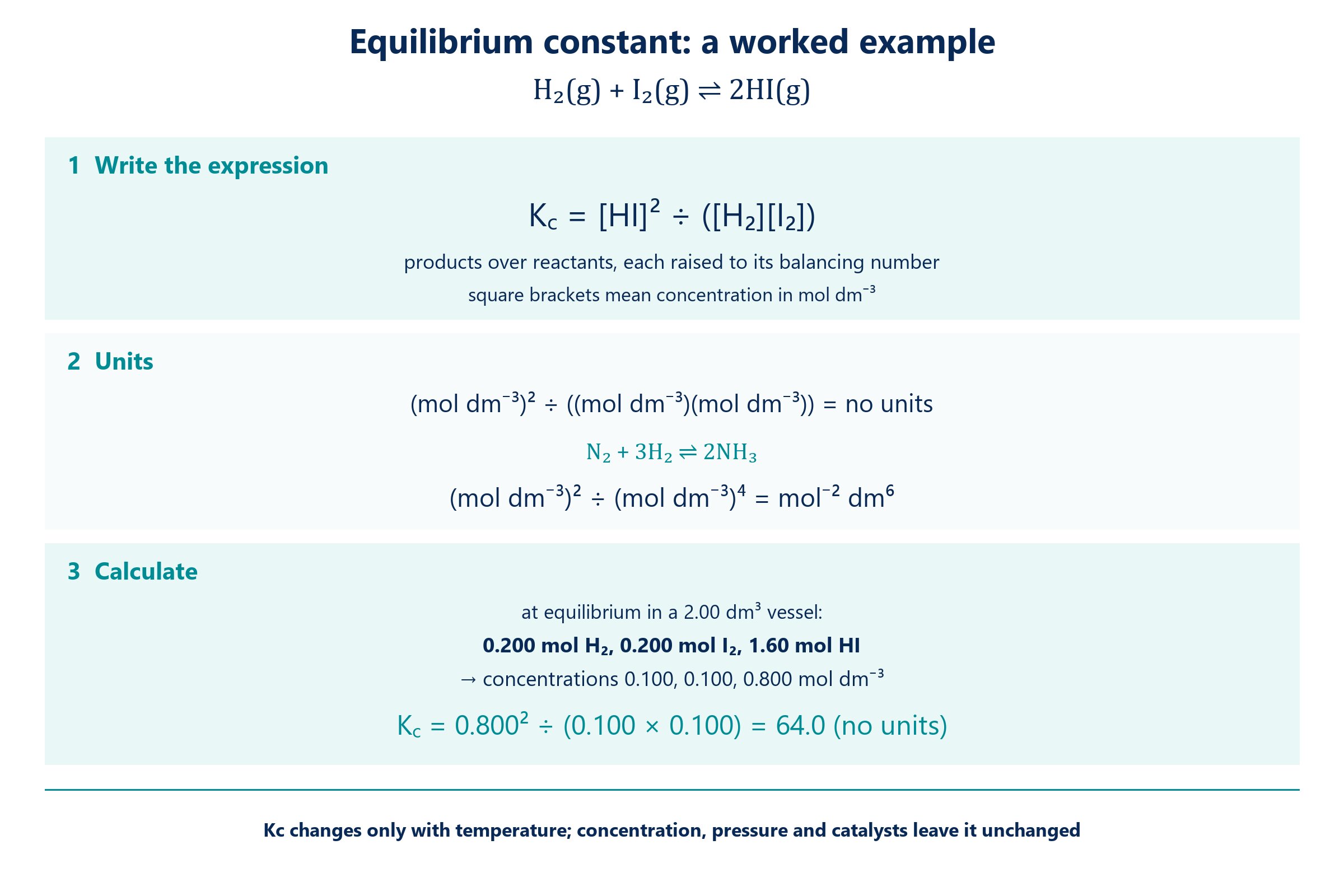
A worked Kc card: writing the expression, working out the units and calculating Kc from equilibrium amounts in a known volume.
Method: 1 Write the expression. 2 Find equilibrium moles from the equation. 3 Divide by the volume in dm³. 4 Substitute. 5 State the units.
Check: Calculating Kc
Calculate Kc for equilibrium mixtures that are not the worked example.
What Kc Tells You and What Changes It
The size of Kc shows where the equilibrium lies. A large Kc (much greater than 1) means the equilibrium mixture is mostly products; a small Kc (much less than 1) means mostly reactants; a value near 1 means comparable amounts of both. The value says nothing about how fast equilibrium is reached.
Kc is constant at a given temperature. Changing a concentration or the pressure moves the position of equilibrium, but the concentrations settle at new values that give the same Kc.
A catalyst does not change Kc, because it changes neither the equilibrium concentrations nor the position.
Only temperature changes Kc. For an exothermic forward reaction, raising the temperature moves the equilibrium to the left and Kc decreases; for an endothermic forward reaction Kc increases with temperature.
Key idea: Concentration, pressure and catalyst: position may move, Kc unchanged. Temperature: position moves and Kc changes.
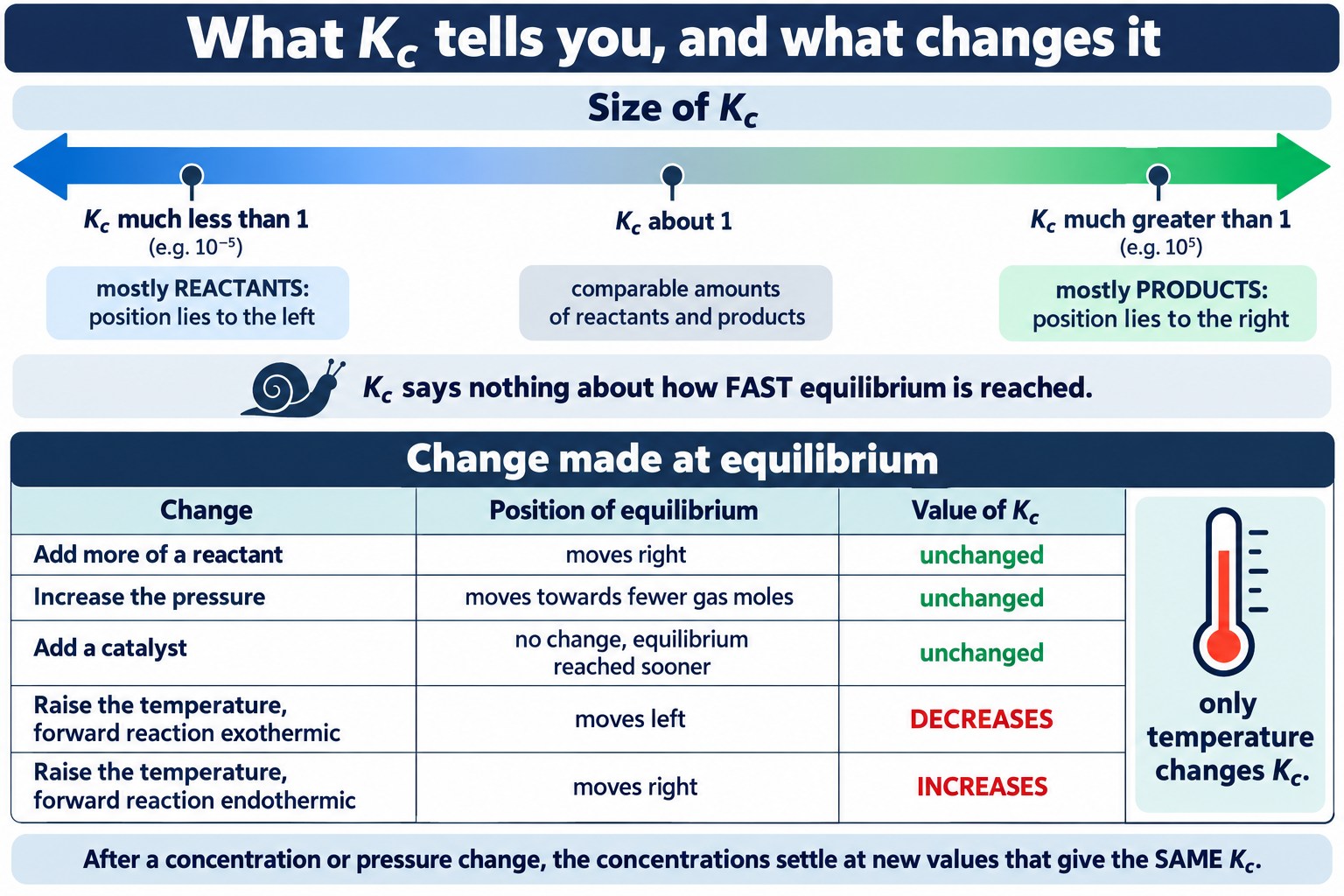
A large Kc means the equilibrium mixture is mostly products and a small Kc mostly reactants, and only a change in temperature changes the value of Kc.
Check: The Meaning of Kc
Interpret values of Kc and decide what changes them.
FAQs
Use these quick answers to check Kc.
What do the square brackets mean?
The concentration of that substance at equilibrium, in mol dm⁻³. Initial concentrations are never used in the expression.
Why does Kc for H₂ + I₂ ⇌ 2HI have no units?
The expression is (mol dm⁻³)² ÷ (mol dm⁻³ × mol dm⁻³), so the units cancel completely.
What does a large value of Kc mean?
The equilibrium lies well to the right: the mixture is mostly products. It says nothing about how quickly equilibrium is reached.
Does adding more reactant change Kc?
No. The position of equilibrium moves to the right, but the new equilibrium concentrations still give the same Kc at that temperature.
What is the only thing that changes Kc?
Temperature. For an exothermic forward reaction Kc falls as the temperature rises; for an endothermic forward reaction it rises.
Copyright and author footprint: This OLS revision page was written for Online Learning System by Dr. Mohammed Al-Fatah. It is designed for A Level Chemistry revision and should not be copied or redistributed without permission.
Keep this note — free
Save your progress across every Edexcel topic. A free account remembers which topics you have covered, saves your question scores, and syncs across your phone and laptop.
- Track every topic you have finished
- Keep your practice-question scores
- No payment, no card, free forever
Already registered? Log in