The Ionic Product of Water, Kw, and Strong Bases
A concise revision guide to the ionic product of water: where Kw comes from, its value and units at 298 K, pKw, why neutral water has a pH below 7 when it is hot, and how to use Kw to calculate the pH of a strong base.
- 25.1.3-d
- 25.1.4(b)
What these spec points say
- 25.1.3-d define mathematically the term Kw and use it in calculations (Kb and the equation Kw = Ka × Kb will not be tested)
- 25.1.4(b) calculate [H+(aq)] and pH values for strong alkalis
The ionic product of water, Kw
Water ionises very slightly. The product [H⁺][OH⁻] stays fixed at a given temperature, and it rises when the water is heated.
© Dr. Mohammed Al-Fatah – onlinelearningsystem.net
Before You Start
This page uses the pH work on page 2, pH and Strong Acids, and the idea of an equilibrium constant from your AS notes (Topic 7 Equilibria).
- pH = −log[H⁺] and [H⁺] = 10⁻ᵖᴴ.
- For aA + bB ⇌ cC + dD, Kc = ([C]ᶜ[D]ᵈ) / ([A]ᵃ[B]ᵇ).
GCSE Recap: Alkalis, Moles and Neutralisation
Three quick questions on the GCSE ideas this page builds on.
Water Dissociates Slightly
Even pure water contains a few ions. A tiny fraction of its molecules transfer a proton to a neighbour:
H₂O(l) ⇌ H⁺(aq) + OH⁻(aq)
Written in full, this is 2H₂O(l) ⇌ H₃O⁺(aq) + OH⁻(aq). The equilibrium lies very far to the left.
From Kc to Kw
Step 1. Kc = ([H⁺][OH⁻]) / ([H₂O]).
Step 2. So few molecules dissociate that [H₂O] stays constant at (1000) / (18.0) = 55.6 mol dm⁻³.
Step 3. Combine the two constants: Kc × [H₂O] = [H⁺][OH⁻].
Answer. This new constant is the ionic product of water, Kw = [H⁺][OH⁻].
- At 298 K, Kw = 1.00 × 10⁻¹⁴ mol² dm⁻⁶.
- Units: mol dm⁻³ × mol dm⁻³ = mol² dm⁻⁶.
- pKw = −log Kw = 14.00 at 298 K.
- Kw applies to every aqueous solution, not only to pure water.
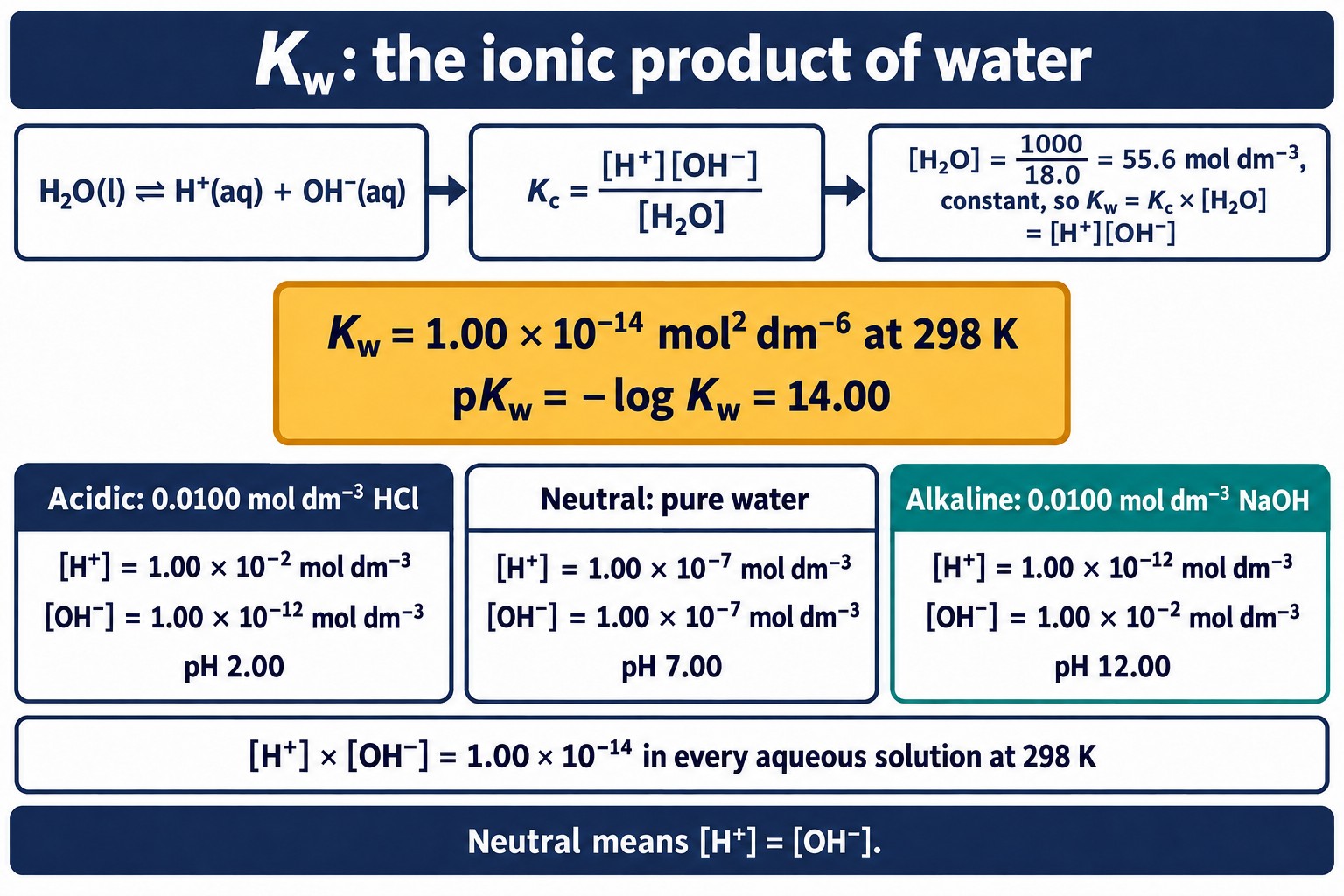
The ionic product of water: Kw found from Kc because the concentration of water is constant, its value at 298 K, and [H⁺] and [OH⁻] in an acidic, a neutral and an alkaline solution.
Definition: The ionic product of water, Kw = [H⁺][OH⁻]. It equals 1.00 × 10⁻¹⁴ mol² dm⁻⁶ at 298 K. Learn the expression without [H₂O], which has been absorbed into the constant.
Neutral, Acidic and Alkaline
In pure water every H₂O that dissociates gives one H⁺ and one OH⁻, so [H⁺] = [OH⁻].
Step 1. Kw = [H⁺]², so [H⁺] = √(1.00 × 10⁻¹⁴) = 1.00 × 10⁻⁷ mol dm⁻³.
Answer. pH of pure water at 298 K = −log(1.00 × 10⁻⁷) = 7.00.
| Solution | Comparison | pH at 298 K |
|---|---|---|
| acidic | [H⁺] greater than [OH⁻] | below 7 |
| neutral | [H⁺] = [OH⁻] | 7.00 |
| alkaline | [H⁺] less than [OH⁻] | above 7 |
- Kw links the two ions. If one goes up, the other must go down.
- In 0.0100 mol dm⁻³ HCl, [H⁺] = 1.00 × 10⁻² mol dm⁻³, so [OH⁻] = (1.00 × 10⁻¹⁴) / (1.00 × 10⁻²) = 1.00 × 10⁻¹² mol dm⁻³.
Key idea: Neutral means [H⁺] = [OH⁻]. It does not mean pH 7. Neutral water has pH 7.00 only at 298 K.
Check: Kw and Neutral Water
Write Kw, use it to link [H⁺] and [OH⁻], and decide whether solutions are acidic, neutral or alkaline, with values not used on this page.
Kw and Temperature
Like every equilibrium constant, Kw changes with temperature. The dissociation of water is endothermic: it is the reverse of neutralisation, which is exothermic.
- Raising the temperature shifts H₂O ⇌ H⁺ + OH⁻ to the right.
- Kw increases, and [H⁺] and [OH⁻] both increase.
- The pH of pure water falls below 7.
| T / K | Kw / mol² dm⁻⁶ | pKw | pH of pure water |
|---|---|---|---|
| 273 | 1.14 × 10⁻¹⁵ | 14.94 | 7.47 |
| 298 | 1.00 × 10⁻¹⁴ | 14.00 | 7.00 |
| 310 | 2.42 × 10⁻¹⁴ | 13.62 | 6.81 |
| 323 | 5.48 × 10⁻¹⁴ | 13.26 | 6.63 |
| 373 | 5.13 × 10⁻¹³ | 12.29 | 6.14 |
Worked example: pure water at 323 K
Step 1. [H⁺] = √Kw = √(5.48 × 10⁻¹⁴) = 2.34 × 10⁻⁷ mol dm⁻³.
Answer. pH = −log(2.34 × 10⁻⁷) = 6.63.
The water is still neutral, because [H⁺] still equals [OH⁻]. A pH below 7 does not make it acidic.
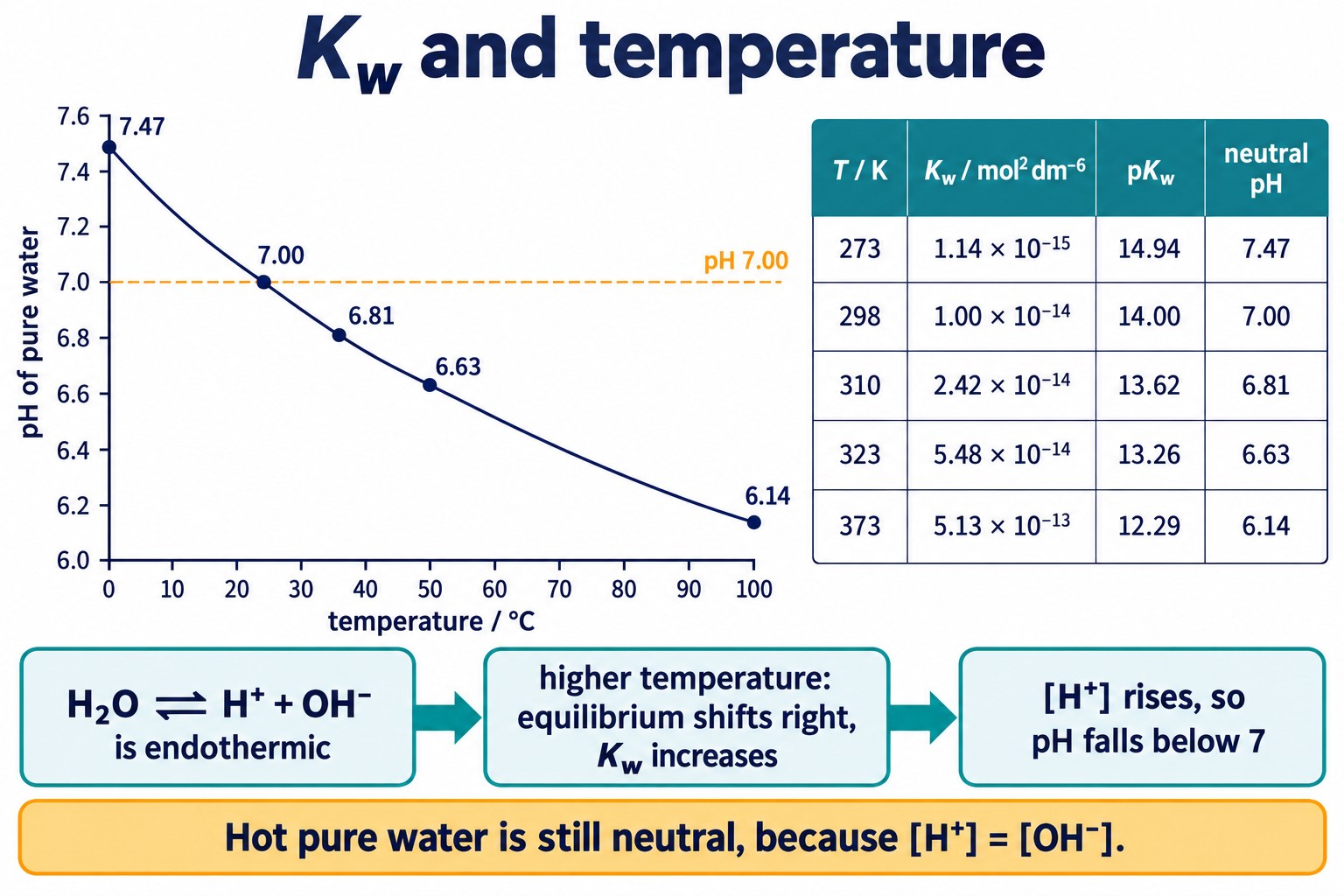
The pH of pure water falling from 7.47 at 0 °C to 6.14 at 100 °C as Kw increases, with Kw and pKw at five temperatures. The water stays neutral throughout.
Exam focus: For the effect of temperature, give all three links: the dissociation is endothermic, so the equilibrium shifts right and Kw rises; [H⁺] rises, so pH falls; [H⁺] = [OH⁻], so it is still neutral.
Check: Kw and Temperature
Explain how Kw and the pH of pure water change with temperature, and calculate neutral pH from Kw values not used on this page.
pH of a Strong alkali
A strong alkali such as sodium hydroxide dissociates completely, so [OH⁻] is known straight from its concentration. Kw then gives [H⁺].
- Find [OH⁻]: the concentration of the base × the number of OH⁻ in its formula.
- Find [H⁺] = (Kw) / ([OH⁻]).
- pH = −log[H⁺].
Worked example 1: sodium hydroxide
Step 1. 0.0500 mol dm⁻³ NaOH: [OH⁻] = 0.0500 mol dm⁻³.
Step 2. [H⁺] = (1.00 × 10⁻¹⁴) / (0.0500) = 2.00 × 10⁻¹³ mol dm⁻³.
Answer. pH = −log(2.00 × 10⁻¹³) = 12.70.
Worked example 2: barium hydroxide
Step 2. [H⁺] = (1.00 × 10⁻¹⁴) / (0.0300) = 3.33 × 10⁻¹³ mol dm⁻³.
Answer. pH = 12.48.
Worked example 3: from a mass
Step 2. [H⁺] = (1.00 × 10⁻¹⁴) / (0.0400) = 2.50 × 10⁻¹³ mol dm⁻³.
Answer. pH = 12.60.
Worked example 4: working back
Answer. [OH⁻] = (1.00 × 10⁻¹⁴) / (3.16 × 10⁻¹²) = 3.16 × 10⁻³ mol dm⁻³, the concentration of NaOH.
An optional shortcut: pOH
- Define pOH = −log[OH⁻]. Taking −log of Kw = [H⁺][OH⁻] gives pKw = pH + pOH.
- For 0.0500 mol dm⁻³ NaOH: pOH = −log(0.0500) = 1.30, so pH = 14.00 − 1.30 = 12.70, as before.
- Either route earns full marks. The Kw route is the one to show if you are unsure.
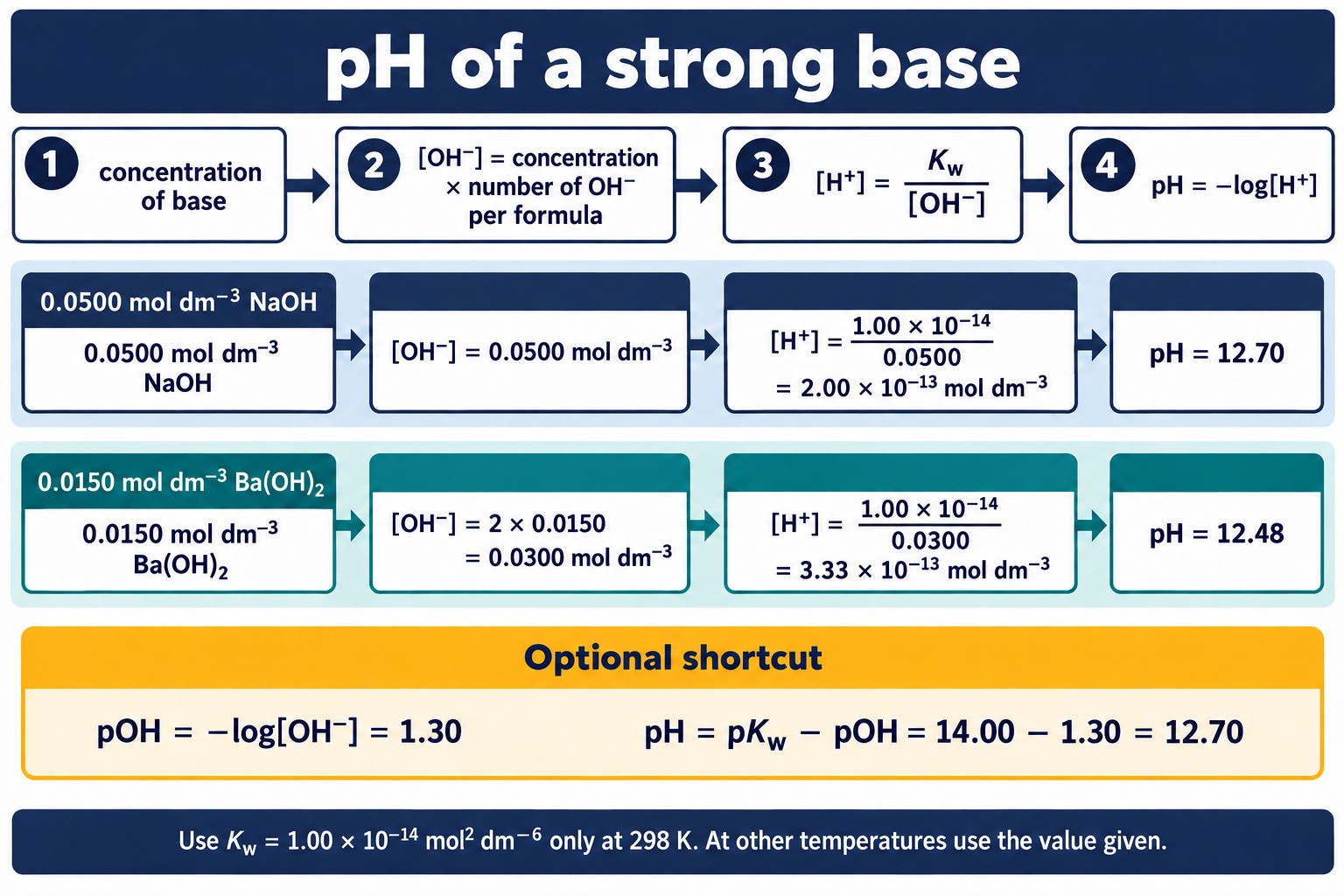
The route to the pH of a strong alkali: hydroxide concentration, then hydrogen ion concentration from Kw, then pH, for sodium hydroxide and barium hydroxide.
Exam focus: Kw = 1.00 × 10⁻¹⁴ mol² dm⁻⁶ only at 298 K. At another temperature use the value given: 0.0100 mol dm⁻³ NaOH at 323 K has [H⁺] = 5.48 × 10⁻¹² and pH 11.26.
Mixing a Strong Acid and a Strong Base
When a strong acid and a strong alkali are mixed, H⁺ + OH⁻ → H₂O removes them 1 : 1. Whichever is in excess sets the pH.
- Find the moles of H⁺ and the moles of OH⁻.
- Subtract to find the moles of the ion in excess.
- Divide by the total volume in dm³.
- Find the pH, using Kw if OH⁻ is in excess.
Worked example: excess alkali
25.0 cm³ of 0.100 mol dm⁻³ HCl is mixed with 30.0 cm³ of 0.100 mol dm⁻³ NaOH.
Step 3. [H⁺] = (1.00 × 10⁻¹⁴) / (9.09 × 10⁻³) = 1.10 × 10⁻¹² mol dm⁻³.
Answer. pH = 11.96.
Worked example: excess acid
Step 2. [H⁺] = (5.00 × 10⁻⁴) / (0.0450) = 0.0111 mol dm⁻³.
Answer. pH = 1.95.
Remember: Use the total volume of the mixture, not the volume of one solution. Forgetting to add the two volumes is the most common error.
Quick Check: Five Harder pH Problems
Work out each answer on paper, then flip the card to compare your method.
Common Exam Points
Say
- “Kw = [H⁺][OH⁻] = 1.00 × 10⁻¹⁴ mol² dm⁻⁶ at 298 K.”
- “[H₂O] is effectively constant, so it is included in Kw.”
- “[H⁺] = (Kw) / ([OH⁻]) = (1.00 × 10⁻¹⁴) / (0.0500) = 2.00 × 10⁻¹³ mol dm⁻³.”
- “At 323 K the water has pH 6.63 but is neutral, because [H⁺] = [OH⁻].”
Do not say
- “Kw = ([H⁺][OH⁻]) / ([H₂O])” (that is Kc).
- “Hot water is acidic because its pH is below 7.”
- “pH of 0.0500 mol dm⁻³ NaOH = −log(0.0500) = 1.30” (that is the pOH).
- “[OH⁻] = 0.0150 mol dm⁻³” for 0.0150 mol dm⁻³ Ba(OH)₂ (there are two OH⁻ per formula).
Watch for
- The temperature: use Kw = 1.00 × 10⁻¹⁴ only at 298 K.
- Group 2 hydroxides such as Ba(OH)₂ and Sr(OH)₂: double the concentration to get [OH⁻].
- Mixtures of acid and alkali: find the excess, then divide by the total volume.
- pH of a strong base above 14 or below 0: possible only above 1 mol dm⁻³.
Check: pH of Strong alkalis and Mixtures
Calculate the pH of strong alkalis, and of mixtures of a strong acid and a strong alkali, with concentrations and volumes not used on this page.
FAQs
Use these quick answers to check the ionic product of water and the pH of strong bases.
Why is [H₂O] left out of Kw?
So few water molecules dissociate that [H₂O] stays constant at about 55.6 mol dm⁻³. It is combined with Kc to give a new constant, Kw = [H⁺][OH⁻], which equals 1.00 × 10⁻¹⁴ mol² dm⁻⁶ at 298 K.
If pure water at 50 °C has a pH of 6.63, is it acidic?
No. Neutral means [H⁺] = [OH⁻], and that is still true. The dissociation of water is endothermic, so heating increases Kw and both ion concentrations. The pH falls below 7, but the water stays neutral.
How do I calculate the pH of a strong base?
Find [OH⁻] from the concentration of the base, multiplied by the number of OH⁻ in its formula. Then [H⁺] = (Kw) / ([OH⁻]) and pH = −log[H⁺]. For 0.0500 mol dm⁻³ NaOH the pH is 12.70.
Can I use pOH instead of Kw?
Yes. pOH = −log[OH⁻] and pH + pOH = pKw, which is 14.00 at 298 K. For 0.0500 mol dm⁻³ NaOH, pOH = 1.30 and pH = 12.70. Both routes give the same answer when the working is shown.
Does Kw apply to solutions of acids and alkalis too?
Yes. Kw = [H⁺][OH⁻] holds in every aqueous solution at a given temperature. In 0.0100 mol dm⁻³ HCl, [H⁺] = 1.00 × 10⁻² mol dm⁻³, so [OH⁻] = 1.00 × 10⁻¹² mol dm⁻³. If one ion rises, the other must fall.

Copyright notice: This OLS revision content, including the explanations, layout, diagrams, tables and embedded learning structure, is authored for Online Learning System by Dr. Mohammed Al-Fatah. It may not be copied, reproduced, redistributed or adapted without written permission.
Keep this note — free
Save your progress across every Cambridge topic. A free account remembers which topics you have covered, saves your question scores, and syncs across your phone and laptop.
- Track every topic you have finished
- Keep your practice-question scores
- No payment, no card, free forever
Already registered? Log in