Solubility Product, Ksp, and the Common Ion Effect
A concise revision guide to the solubility product: what Ksp means for a sparingly soluble salt, how to write the expression and its units, calculating Ksp from a solubility and a solubility from Ksp, and how a common ion lowers the solubility.
- 25.1.7
- 25.1.8
- 25.1.9-a
- 25.1.9-b
- 25.1.10(a)
- 25.1.10(b)
What these spec points say
- 25.1.7 understand and use the term solubility product, Ksp
- 25.1.8 write an expression for Ksp
- 25.1.9-a calculate Ksp from concentrations
- 25.1.9-b calculate concentrations from Ksp
- 25.1.10(a) understand and use the common ion effect to explain the different solubility of a compound in a solution containing a common ion
- 25.1.10(b) perform calculations using Ksp values and concentration of a common ion
What a Solubility Product Is
Many ionic compounds described as insoluble do dissolve very slightly. Stir solid silver chloride into water and a tiny amount goes into solution as separate ions, then no more.
The solution is now saturated, and a dynamic equilibrium exists between the undissolved solid and its aqueous ions.
AgCl(s) ⇌ Ag⁺(aq) + Cl⁻(aq)
- Ions leave the surface of the solid and ions rejoin it at the same rate.
- This is a heterogeneous equilibrium. The solid has a fixed concentration, so it is left out of the expression.
- Otherwise the rules are those for writing Kc in Topic 7 Equilibria.
- What is left is the product of the ion concentrations, the solubility product, Ksp.
Ksp = [Ag⁺][Cl⁻] = 1.8 × 10⁻¹⁰ mol² dm⁻⁶ at 298 K
Definition: Solubility product, Ksp: the product of the concentrations of the ions in a saturated solution of a sparingly soluble salt, each raised to the power of its number in the formula, at a given temperature.
Three conditions come with the definition.
- It applies only to sparingly soluble salts. In concentrated solutions the ions interfere with one another and the simple expression fails.
- The solution must be saturated, with the ions at equilibrium with the solid.
- Like every equilibrium constant, Ksp changes only with temperature. Values are normally quoted at 298 K.
Writing Ksp Expressions and Units
Write the equation for one mole of solid dissolving, then apply the usual rule: each ion concentration is raised to the power of its balancing number. There is no bottom line, because the only reactant is a solid.
| Salt | Equilibrium | Ksp expression | Units |
|---|---|---|---|
| Silver chloride | AgCl(s) ⇌ Ag⁺(aq) + Cl⁻(aq) | [Ag⁺][Cl⁻] | mol² dm⁻⁶ |
| Lead(II) iodide | PbI₂(s) ⇌ Pb²⁺(aq) + 2I⁻(aq) | [Pb²⁺][I⁻]² | mol³ dm⁻⁹ |
| Calcium hydroxide | Ca(OH)₂(s) ⇌ Ca²⁺(aq) + 2OH⁻(aq) | [Ca²⁺][OH⁻]² | mol³ dm⁻⁹ |
| Silver chromate(VI) | Ag₂CrO₄(s) ⇌ 2Ag⁺(aq) + CrO₄²⁻(aq) | [Ag⁺]²[CrO₄²⁻] | mol³ dm⁻⁹ |
The units follow from the expression.
- Two concentrations multiplied: (mol dm⁻³)² = mol² dm⁻⁶.
- Three concentrations multiplied: (mol dm⁻³)³ = mol³ dm⁻⁹.
- A salt such as Fe(OH)₃, with four ions, has Ksp = [Fe³⁺][OH⁻]³ in mol⁴ dm⁻¹².
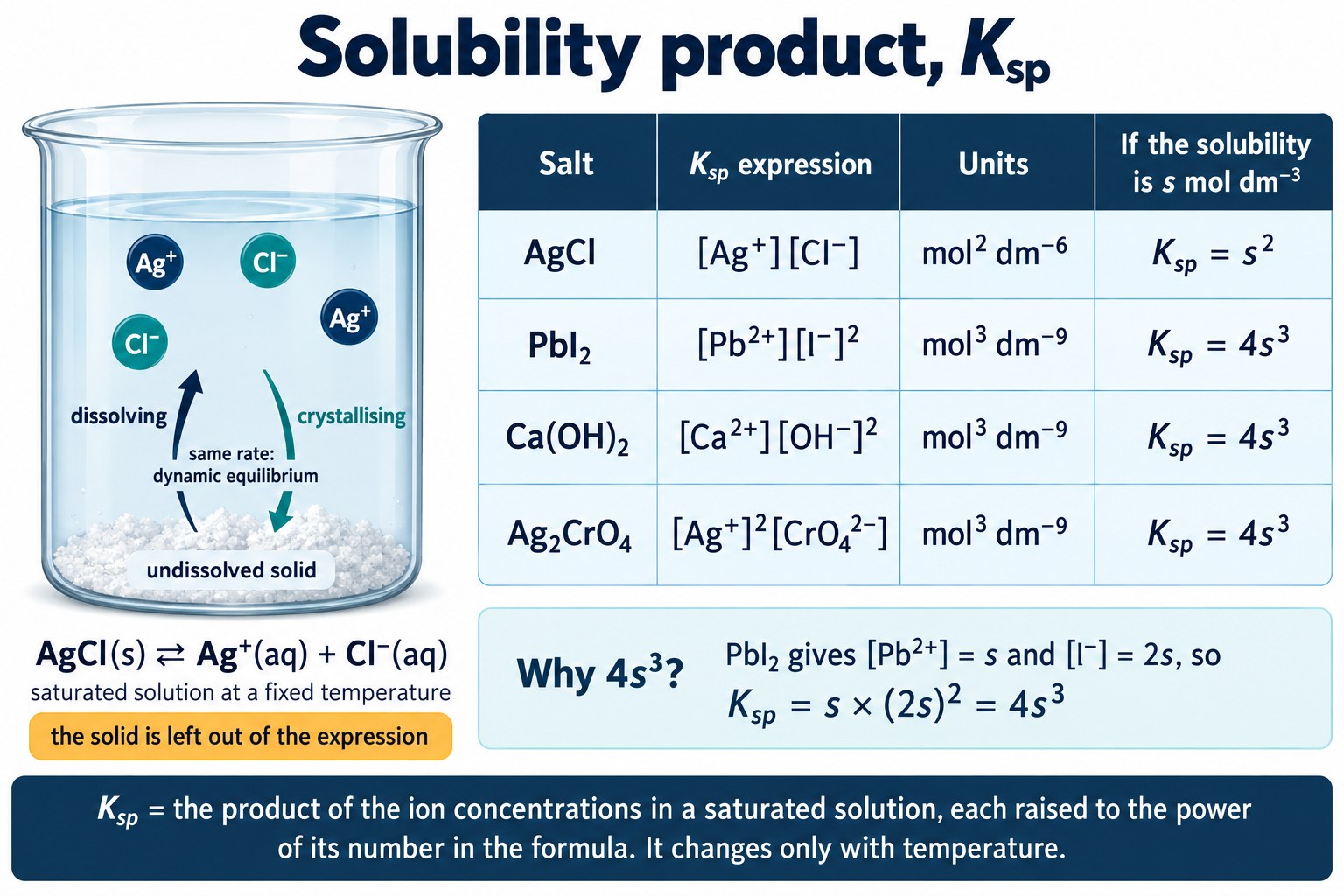
A saturated solution in equilibrium with undissolved solid, and the solubility product expression, its units and its link to the solubility for four salts.
Exam wording: Charges on the ions, square brackets, the correct powers and no solid in the expression. The power on each ion is the number of that ion in the formula, not its charge.
Check: Expressions and Units
Write the solubility product expression and work out its units for sparingly soluble salts not used on this page.
Calculating Ksp From Solubility
The solubility, s, is the amount of solid that dissolves in 1 dm³ of saturated solution. The formula of the salt links each ion concentration to s.
Example 1: lead(II) iodide
The solubility of PbI₂ at 298 K is 1.30 × 10⁻³ mol dm⁻³. Calculate Ksp.
[Pb²⁺] = 1.30 × 10⁻³ mol dm⁻³ [I⁻] = 2 × 1.30 × 10⁻³ = 2.60 × 10⁻³ mol dm⁻³
Step 2: substitute into the expression.
Ksp = [Pb²⁺][I⁻]² = (1.30 × 10⁻³) × (2.60 × 10⁻³)²
Answer: Ksp = 8.79 × 10⁻⁹ mol³ dm⁻⁹
Example 2: a solubility in g dm⁻³
Calcium hydroxide dissolves to the extent of 0.80 g dm⁻³ at 298 K (Mr = 74.1). Calculate Ksp.
Step 1: convert to mol dm⁻³.
s = (0.80) / (74.1) = 0.0108 mol dm⁻³
Step 2: [Ca²⁺] = 0.0108 and [OH⁻] = 2 × 0.0108 = 0.0216 mol dm⁻³.
Ksp = [Ca²⁺][OH⁻]² = 0.0108 × 0.0216²
Answer: Ksp = 5.0 × 10⁻⁶ mol³ dm⁻⁹
Key idea: For a 1:1 salt Ksp = s². For a 1:2 or 2:1 salt Ksp = s × (2s)² = 4s³. The doubled ion is doubled and then squared: forgetting one of the two is the commonest slip.
Calculating Solubility From Ksp
The same relationships run backwards. Let the solubility be s, write each ion concentration in terms of s, and solve.
Example 3: silver chloride
Ksp(AgCl) = 1.8 × 10⁻¹⁰ mol² dm⁻⁶. [Ag⁺] = s and [Cl⁻] = s, so Ksp = s².
s = √(1.8 × 10⁻¹⁰) = 1.34 × 10⁻⁵ mol dm⁻³
In grams (Mr = 143.4) that is 1.34 × 10⁻⁵ × 143.4 = 1.92 × 10⁻³ g dm⁻³, about 2 mg in a litre.
Example 4: silver chromate(VI)
Ksp(Ag₂CrO₄) = 1.1 × 10⁻¹² mol³ dm⁻⁹. [Ag⁺] = 2s and [CrO₄²⁻] = s, so Ksp = (2s)² × s = 4s³.
s³ = (1.1 × 10⁻¹²) / (4) = 2.75 × 10⁻¹³
s = ∛(2.75 × 10⁻¹³) = 6.5 × 10⁻⁵ mol dm⁻³
Compare the two answers.
- Silver chromate(VI) has the smaller Ksp but the larger solubility.
- The two constants have different units and different expressions, so they cannot be compared directly.
- Ksp values rank solubilities only for salts with the same ratio of ions, such as AgCl, AgBr and AgI.
Exam focus: Define s, write every ion concentration in terms of s, substitute into the Ksp expression, then take the square root (1:1 salts) or the cube root after dividing by 4 (1:2 and 2:1 salts).
Check: Ksp and Solubility Calculations
Calculate a solubility product from a solubility, and a solubility from a solubility product, for salts and values not used on this page.
Predicting Precipitation
When two solutions are mixed, a sparingly soluble salt may or may not precipitate. To decide, work out the ion product: the Ksp expression evaluated with the concentrations actually present after mixing.
| Comparison | What happens |
|---|---|
| Ion product less than Ksp | no precipitate: the solution is not saturated |
| Ion product equal to Ksp | the solution is just saturated |
| Ion product greater than Ksp | solid precipitates until the ion product has fallen to Ksp |
Example 5: mixing two solutions
50.0 cm³ of 2.0 × 10⁻³ mol dm⁻³ Pb(NO₃)₂ is added to 50.0 cm³ of 4.0 × 10⁻³ mol dm⁻³ KI. Does PbI₂ precipitate? Ksp = 8.79 × 10⁻⁹ mol³ dm⁻⁹.
Step 1: the volume doubles, so each concentration halves: [Pb²⁺] = 1.0 × 10⁻³ and [I⁻] = 2.0 × 10⁻³ mol dm⁻³.
Step 2: work out the ion product.
[Pb²⁺][I⁻]² = (1.0 × 10⁻³) × (2.0 × 10⁻³)² = 4.0 × 10⁻⁹ mol³ dm⁻⁹
Answer: 4.0 × 10⁻⁹ is less than 8.79 × 10⁻⁹, so no precipitate forms.
Repeat with 2.0 × 10⁻² mol dm⁻³ KI. After mixing, [I⁻] = 1.0 × 10⁻² mol dm⁻³.
[Pb²⁺][I⁻]² = (1.0 × 10⁻³) × (1.0 × 10⁻²)² = 1.0 × 10⁻⁷ mol³ dm⁻⁹
Exam wording: “The ion product, [Pb²⁺][I⁻]², is greater than Ksp, so a precipitate forms.” Always dilute the concentrations for the total volume before multiplying.
Quick Check: Will Salt MX₂ Precipitate?
Work through a mixing problem one step at a time, then flip each card to check.
The Common Ion Effect
A sparingly soluble salt is less soluble in a solution that already contains one of its ions than it is in pure water. This is the common ion effect.
Silver chloride in sodium chloride solution is the standard case. The common ion is Cl⁻.
- In the saturated solution, AgCl(s) ⇌ Ag⁺(aq) + Cl⁻(aq) and [Ag⁺][Cl⁻] = Ksp.
- The sodium chloride supplies a large extra concentration of Cl⁻, so the ion product is greater than Ksp.
- Silver chloride precipitates, removing Ag⁺ and Cl⁻, until the ion product equals Ksp again.
- With [Cl⁻] high, [Ag⁺] must be very low, so very little silver chloride can stay dissolved.
Example 6: solubility with a common ion
Calculate the solubility of AgCl in 0.10 mol dm⁻³ NaCl. Ksp = 1.8 × 10⁻¹⁰ mol² dm⁻⁶.
Ksp = s × 0.10 so s = (1.8 × 10⁻¹⁰) / (0.10)
Answer: s = 1.8 × 10⁻⁹ mol dm⁻³
In pure water the solubility was 1.34 × 10⁻⁵ mol dm⁻³. The common ion has made silver chloride more than 7000 times less soluble, and Ksp has not changed.
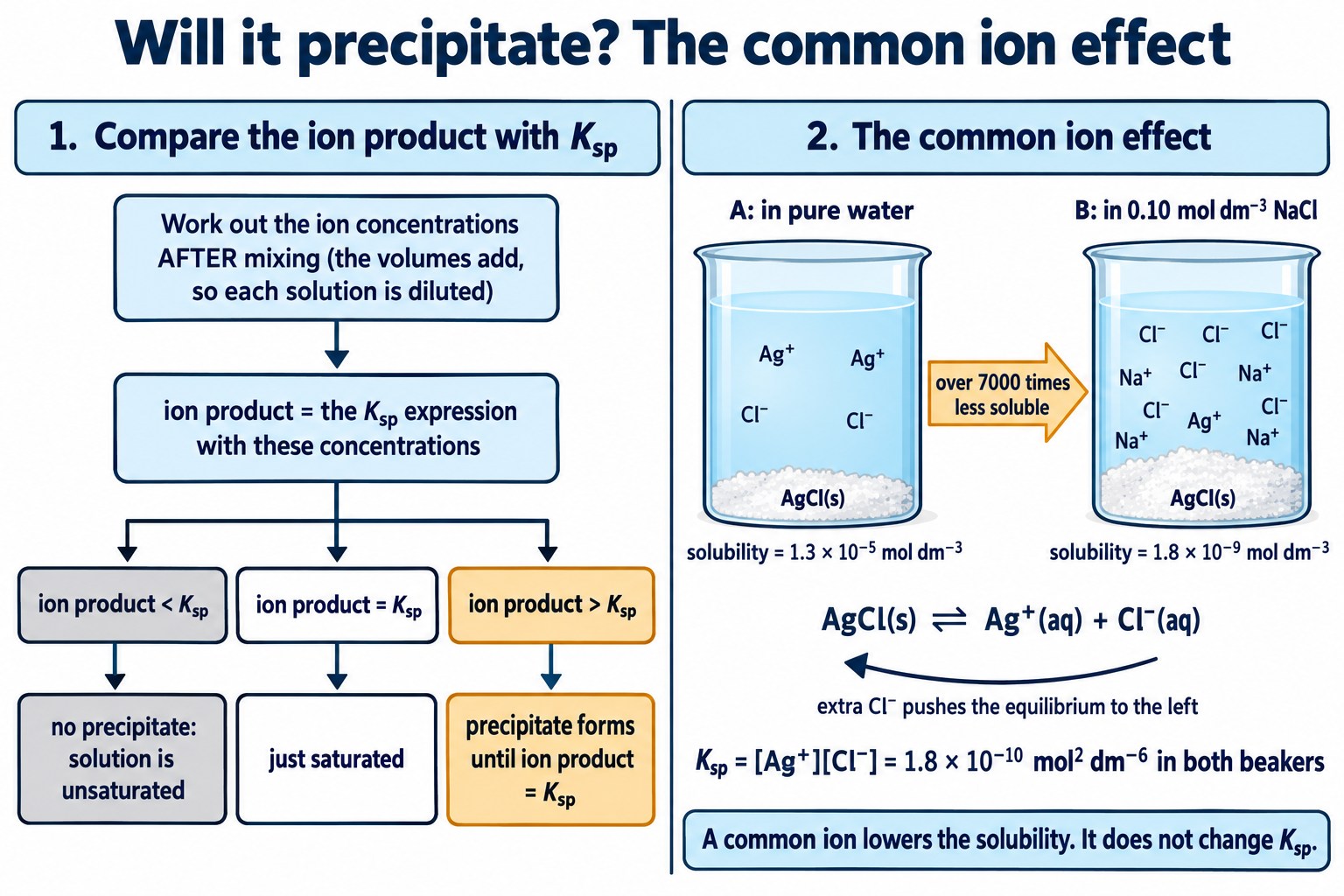
Left: comparing the ion product with Ksp to decide whether a precipitate forms. Right: silver chloride is far less soluble in sodium chloride solution than in water because of the common chloride ion.
- The effect is used when washing a precipitate: barium sulfate is rinsed with dilute sulfuric acid, not water, so that less of it dissolves.
- The common ion must come from a soluble compound, so that its concentration is high.
Key idea: Common ion effect: adding an ion that the salt already contains raises the ion product above Ksp, so the equilibrium shifts towards the solid and the solubility falls. Ksp itself is unchanged.
Check: Precipitation and the Common Ion Effect
Decide whether a precipitate forms when two solutions are mixed, and calculate a solubility in the presence of a common ion, for salts not used on this page.
Common Exam Points
Say
- “Ksp is the product of the concentrations of the ions in a saturated solution, each raised to the power of its number in the formula.”
- “The ion product is greater than Ksp, so a precipitate forms.”
- “The added chloride ions shift the equilibrium AgCl(s) ⇌ Ag⁺(aq) + Cl⁻(aq) to the left, so the solubility decreases.”
Do not say
- “Ksp = ([Ag⁺][Cl⁻]) / ([AgCl])” (the solid is never in the expression).
- “The common ion lowers Ksp” (it lowers the solubility; Ksp changes only with temperature).
- “The salt with the smaller Ksp is always less soluble” (true only for salts with the same ion ratio).
Watch for
- A 1:2 salt, where the anion concentration is 2s and is then squared, giving 4s³.
- Mixing questions: use the concentrations after dilution by the total volume.
- Solubility given in g dm⁻³: convert to mol dm⁻³ with Mr before using it, and convert back if the answer is wanted in grams.
FAQs
Use these quick answers to check solubility product and the common ion effect.
How do I know if a precipitate will form?
Multiply the ion concentrations in the final mixture, each raised to its power in the Ksp expression. If this ionic product is greater than Ksp, a precipitate forms. If it is smaller, the solution stays clear.
What is a solubility product?
It is the product of the equilibrium concentrations of the ions in a saturated solution of a sparingly soluble salt, each raised to the power of its number in the formula, at a stated temperature.
Why is the solid left out of the Ksp expression?
The concentration of a pure solid is constant, so it is absorbed into Ksp. For PbI₂(s) ⇌ Pb²⁺(aq) + 2I⁻(aq), the expression is Ksp = [Pb²⁺][I⁻]² with units mol³ dm⁻⁹.
What is the common ion effect?
A sparingly soluble salt is less soluble in a solution that already contains one of its ions. The extra ion pushes the solubility equilibrium towards the solid, so less dissolves, while Ksp itself stays the same.
How do I get Ksp from a solubility?
Convert the solubility to mol dm⁻³ and call it s. Write each ion concentration in terms of s using the formula, then substitute. For a salt MX₂, [M²⁺] = s and [X⁻] = 2s, so Ksp = 4s³.

Copyright notice: This OLS revision content, including the explanations, layout, diagrams, tables and embedded learning structure, is authored for Online Learning System by Dr. Mohammed Al-Fatah. It may not be copied, reproduced, redistributed or adapted without written permission.
Keep this note — free
Save your progress across every Cambridge topic. A free account remembers which topics you have covered, saves your question scores, and syncs across your phone and laptop.
- Track every topic you have finished
- Keep your practice-question scores
- No payment, no card, free forever
Already registered? Log in