Partition Coefficients, Kpc
A concise revision guide to partition coefficients: what Kpc means for a solute shared between two immiscible solvents, how to calculate and use it in solvent extraction, and how the polarity of the solute and of the solvents decides its value.
- 25.2.1
- 25.2.2
- 25.2.3-a
- 25.2.3-b
What these spec points say
- 25.2.1 state what is meant by the term partition coefficient, Kpc
- 25.2.2 calculate and use a partition coefficient for a system in which the solute is in the same physical state in the two solvents
- 25.2.3-a understand the factors affecting the numerical value of a partition coefficient in terms of the polarity of the solute
- 25.2.3-b understand the factors affecting the numerical value of a partition coefficient in terms of the polarities of the solvents used
What a Partition Coefficient Is
Water and an organic solvent such as hexane do not mix. Shaken together and left to stand, they separate into two layers. Liquids like this are immiscible.
Add a solute that dissolves in both, shake, and the solute shares itself between the two layers.
- Solute molecules cross the boundary in both directions.
- When the two rates are equal, a dynamic equilibrium has been reached: X(aq) ⇌ X(organic).
- The concentration in each layer is then constant, but the two concentrations are not usually equal.
The equilibrium constant for this process is the partition coefficient, Kpc.
Kpc = ([X(organic)]) / ([X(aq)])
Definition: Partition coefficient, Kpc: the ratio of the concentrations of a solute in two immiscible solvents in contact with each other, when equilibrium has been established at a given temperature.
- Kpc has no units: it is one concentration divided by another.
- It can be written either way up, so always state which solvent is on top. The two versions are reciprocals.
- It is constant at a fixed temperature, whatever amount of solute or volume of each solvent is used.
- The solute must be in the same form in both solvents: the same molecules, not ionised in one layer or paired up in the other.
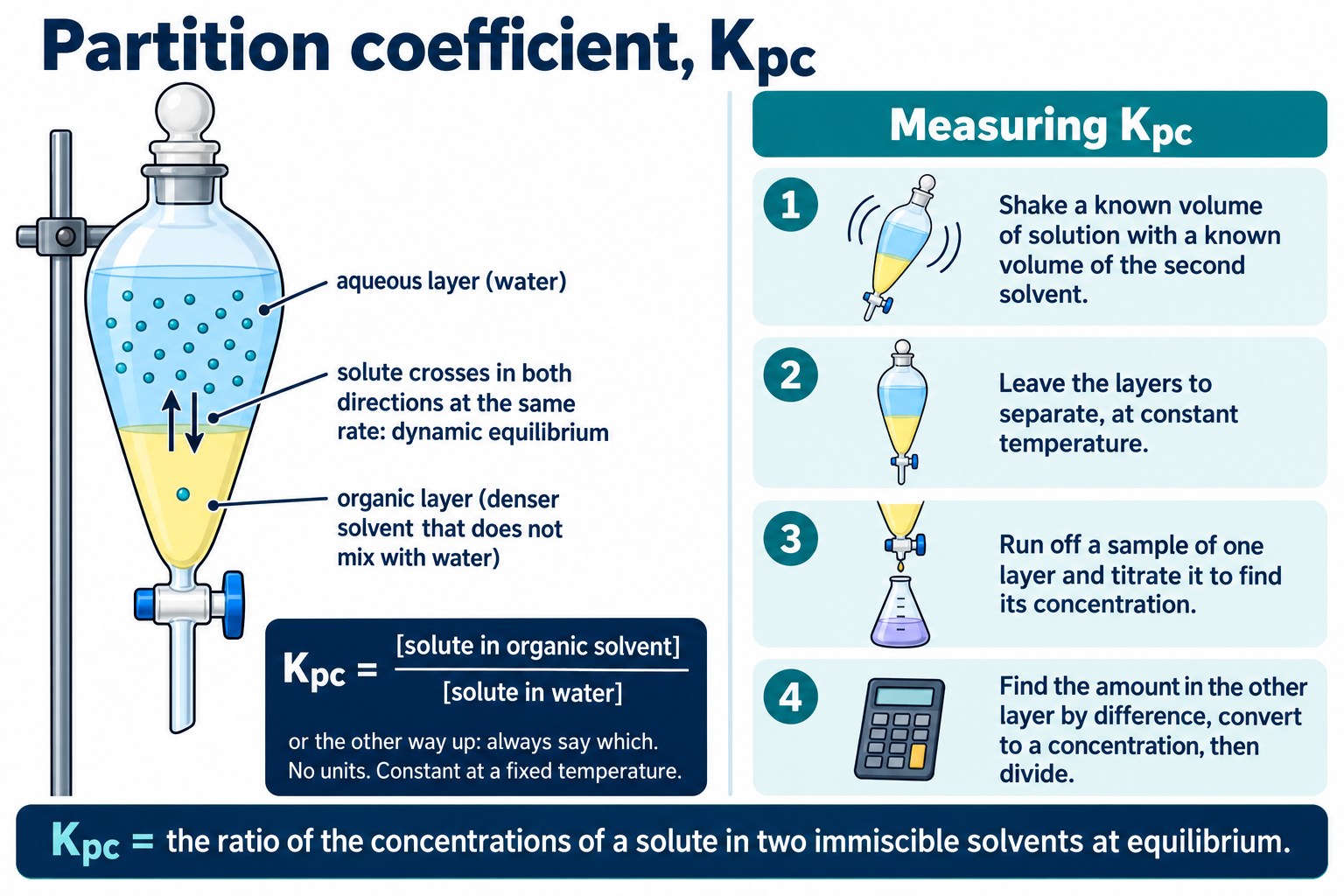
A solute shared between two immiscible layers in a separating funnel, the expression for the partition coefficient, and the four steps of the experiment that measures it.
Finding Kpc by Experiment
The classic experiment shares ammonia between water and an organic solvent, then finds the concentration in the aqueous layer by titration with acid.
- Shake a measured volume of aqueous ammonia with a measured volume of the organic solvent in a separating funnel.
- Leave the layers to settle at a constant temperature.
- Run off the lower layer, then pipette a sample of the aqueous layer and titrate it with standard hydrochloric acid.
- Find the amount of ammonia in the organic layer by difference.
Worked example
100 cm³ of 0.100 mol dm⁻³ aqueous ammonia is shaken with 50.0 cm³ of trichloromethane. At equilibrium, 25.0 cm³ of the aqueous layer needs 24.50 cm³ of 0.100 mol dm⁻³ HCl. NH₃ and HCl react 1:1.
Step 1: amount of NH₃ in the 25.0 cm³ sample = amount of HCl.
(24.50) / (1000) × 0.100 = 2.45 × 10⁻³ mol
Step 2: concentration in the aqueous layer.
[NH₃(aq)] = (2.45 × 10⁻³) / (0.0250) = 0.0980 mol dm⁻³
amount in the organic layer = 0.0100 − 0.00980 = 2.0 × 10⁻⁴ mol
Step 4: concentration in the 50.0 cm³ organic layer.
[NH₃(organic)] = (2.0 × 10⁻⁴) / (0.0500) = 0.0040 mol dm⁻³
Answer: Kpc = ([NH₃(aq)]) / ([NH₃(organic)]) = (0.0980) / (0.0040) = 24.5
Written the other way up, Kpc = ([NH₃(organic)]) / ([NH₃(aq)]) = (0.0040) / (0.0980) = 0.041. Both are correct, as long as the expression is stated.
Exam focus: Use concentrations, not amounts: the two layers usually have different volumes. Find the second amount by subtracting from the starting amount, then divide each amount by the volume of its own layer.
Check: Calculating Kpc
Calculate a partition coefficient from the results of a shaking experiment with titration data, and use a given value to find a concentration, for solutes and solvents not used on this page.
Polarity and the Size of Kpc
The value of Kpc depends on how well the solute dissolves in each solvent, and that depends on the intermolecular forces the solute can form with each.
- A polar solute, or one that forms hydrogen bonds, is attracted strongly to water molecules and favours the aqueous layer.
- A non-polar solute forms only weak attractions with water but mixes freely with a non-polar solvent through instantaneous dipole forces.
- The solvents matter too: the more alike the solute and a solvent are in polarity, the more that solvent holds.
| Solute | Its polarity | Favoured layer | Kpc = ([organic]) / ([aq]) |
|---|---|---|---|
| Ammonia, NH₃ | polar; hydrogen bonds to water | water | much less than 1 |
| Iodine, I₂ | non-polar | hexane | much greater than 1 |
| Butanedioic acid | polar –COOH groups; hydrogen bonds to water | water, over ethoxyethane | less than 1 |
| A long-chain alcohol | one polar –OH group, long non-polar chain | organic solvent | greater than 1 |
Iodine shows the effect clearly. Shaken with water and hexane, almost all of it moves into the hexane, which turns purple while the water is left nearly colourless.
Changing the organic solvent changes Kpc. A slightly polar solvent such as ethoxyethane takes up more of a polar solute than hexane does, so the same solute has a different coefficient with each pair of solvents.
Exam wording: “Iodine is non-polar, so it forms stronger attractions with non-polar hexane molecules than with polar water molecules. It is more soluble in hexane, so Kpc = ([I₂(hexane)]) / ([I₂(aq)]) is large.”
Quick Check: Ranking Kpc from Polarity
Compare how strongly each solute is attracted to water and to hexane.
Solvent Extraction
In solvent extraction an organic product is pulled out of an aqueous mixture by shaking with an immiscible organic solvent, in which it is more soluble. The partition coefficient predicts how much is removed.
A 100 cm³ aqueous solution contains 5.00 g of a compound X. For X, Kpc = ([X(organic)]) / ([X(aq)]) = 4.0. There is 100 cm³ of solvent available.
One extraction with 100 cm³
Let m g of X move into the solvent, leaving (5.00 − m) g in the water. Both volumes are 100 cm³, so they cancel.
4.0 = (m) / (5.00 − m) so 5m = 20.0 and m = 4.00 g
1.00 g of X is left behind.
Two extractions with 50 cm³ each
First portion: the organic layer is now half the volume of the water.
4.0 = ((m) / (50)) / ((5.00 − m) / (100)) = (2m) / (5.00 − m) so m = 3.33 g
That leaves 1.67 g in the water. Each 50 cm³ portion removes two thirds of whatever is present.
Second portion: two thirds of 1.67 g is 1.11 g, leaving 0.56 g.
| Method | Mass extracted / g | Mass left in water / g | Percentage extracted |
|---|---|---|---|
| One 100 cm³ portion | 4.00 | 1.00 | 80% |
| Two 50 cm³ portions | 3.33 + 1.11 = 4.44 | 0.56 | 89% |
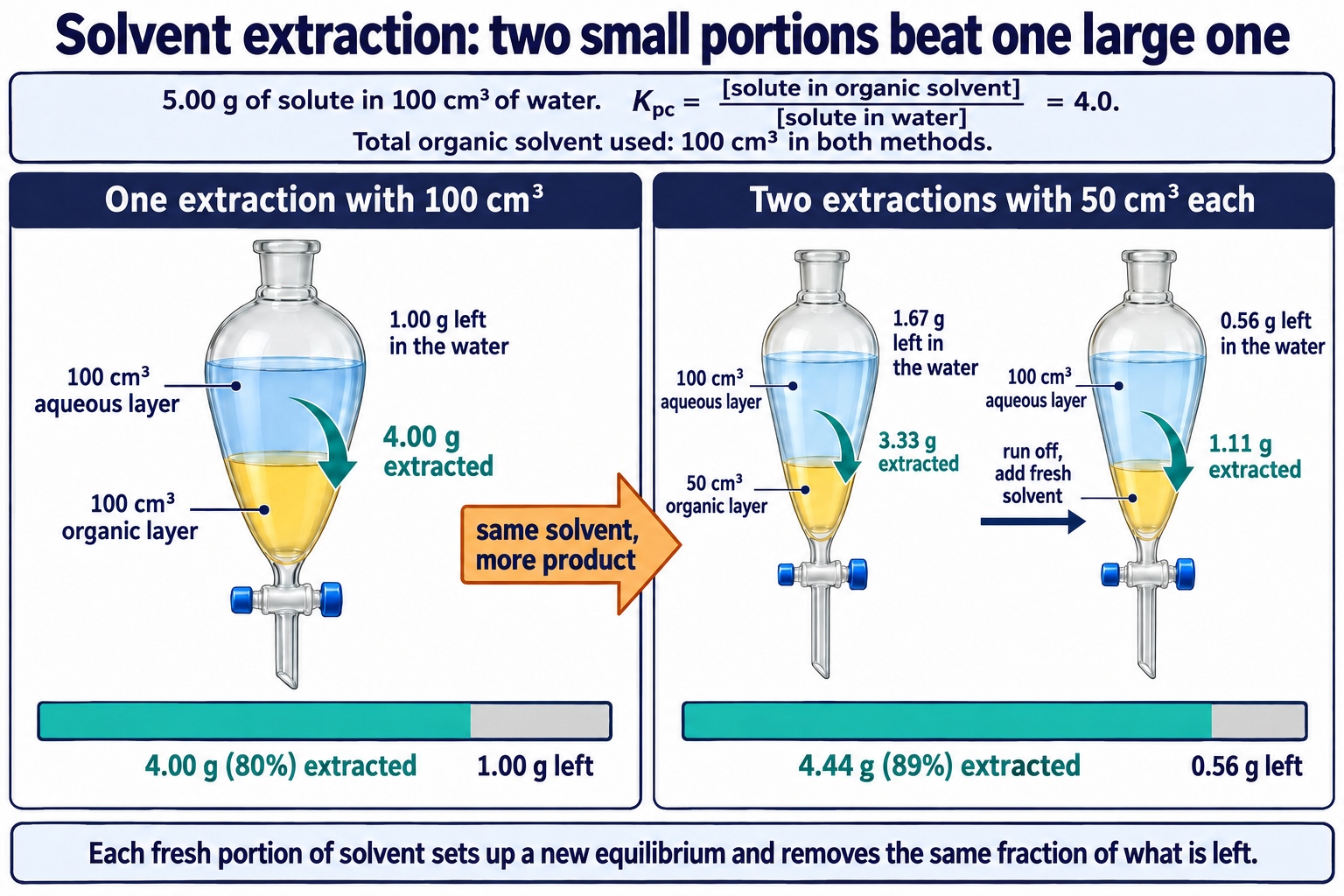
The same 100 cm³ of solvent used as one portion and as two: the two smaller extractions remove 4.44 g of the 5.00 g, against 4.00 g for the single large one.
- Several small portions always extract more than one large portion of the same total volume.
- Each fresh portion sets up a new equilibrium and removes the same fraction of what remains.
- The same partition idea, a solute shared between two phases, is what separates the components of a mixture in chromatography.
Key idea: Solvent extraction works best with a solvent that gives a large Kpc and is immiscible with water, used in several small portions and not one large one.
Quick Check: Extraction with Unequal Volumes
The values here are invented for this exercise, so work through each step on paper before you flip the card.
Common Exam Points
Say
- “Kpc is the ratio of the concentrations of a solute in two immiscible solvents at equilibrium.”
- “Kpc = ([X(organic)]) / ([X(aq)])“, writing out which way up it is.
- “The solute is non-polar, so it is more soluble in the non-polar solvent.”
Do not say
- “Kpc is the ratio of the masses in each layer” (it is a ratio of concentrations; masses work only when the volumes are equal).
- “Kpc has units of mol dm⁻³.”
- “Using more solute changes Kpc” (it is constant at a fixed temperature).
Watch for
- Layers with different volumes: divide each amount by its own volume.
- A titration on a sample of one layer: scale up to the whole layer before subtracting from the starting amount.
- A question that gives Kpc one way up and asks about the other solvent: take the reciprocal.
Check: Polarity and Solvent Extraction
Predict which layer a solute favours from the polarity of the solute and the solvents, and calculate how much is extracted by one or more portions of solvent, with values not used on this page.
FAQs
Use these quick answers to check partition coefficients and solvent extraction.
What is a partition coefficient?
It is the ratio of the concentrations of one solute in two immiscible solvents that are in contact at equilibrium, at a fixed temperature. The solute must be in the same molecular form in both solvents.
Why does Kpc have no units?
It is one concentration divided by another, so the units cancel, provided both concentrations are expressed in the same unit, such as mol dm⁻³ or g cm⁻³.
Which solvent goes on the top of the Kpc expression?
There is no fixed rule, so follow the question. Usually it is the concentration in the organic solvent divided by the concentration in water. State your expression clearly, because the reverse order gives the reciprocal value.
Why is a solute more soluble in one solvent than in the other?
It depends on the intermolecular forces the solute can form with each solvent. Non-polar solutes such as iodine favour non-polar organic solvents, while polar solutes that can hydrogen bond, such as ammonia, favour water.
Why are several small extractions better than one large one?
Each fresh portion of solvent sets up a new equilibrium and removes the same fraction of the solute that remains. Two extractions with half the volume each remove more in total than one extraction with all of it.

Copyright notice: This OLS revision content, including the explanations, layout, diagrams, tables and embedded learning structure, is authored for Online Learning System by Dr. Mohammed Al-Fatah. It may not be copied, reproduced, redistributed or adapted without written permission.
Keep this note — free
Save your progress across every Cambridge topic. A free account remembers which topics you have covered, saves your question scores, and syncs across your phone and laptop.
- Track every topic you have finished
- Keep your practice-question scores
- No payment, no card, free forever
Already registered? Log in