Colour of Transition element Ions
A concise revision guide to colour in transition element chemistry: how ligands split the d orbitals, why some light is absorbed and the complementary colour is seen, the equation ΔE = hν, why some ions are colourless, and what changes the colour.
- 28.3.1-a
- 28.3.1-b
- 28.3.2(a)
- 28.3.3
- 28.3.4
What these spec points say
- 28.3.1-a define and use the term degenerate d orbitals
- 28.3.1-b define and use the term non-degenerate d orbitals
- 28.3.2(a) describe the splitting of degenerate d orbitals into two non-degenerate sets of d orbitals of higher energy, and use of ΔE, in octahedral complexes, two higher and three lower d orbitals
- 28.3.3 explain why transition elements form coloured compounds in terms of the frequency of light absorbed as an electron is promoted between two non-degenerate d orbitals
- 28.3.4 describe, in qualitative terms, the effects of different ligands on ΔE, frequency of light absorbed, and hence the complementary colour that is observed
Why Complexes Are Coloured
Choose a step to watch six ligands split the 3d orbitals, an electron absorb light to jump the gap, and a full or empty 3d set let all light through.
© Dr. Mohammed Al-Fatah – onlinelearningsystem.net
Before You Start
Colour depends on which parts of white light a substance absorbs.
- White light is a mixture of all the colours of the visible spectrum, from red (long wavelength) to violet (short wavelength).
- A coloured substance absorbs some of these colours and transmits or reflects the rest.
- The colour seen is the complementary colour of the light absorbed.
- The 3d configurations of the ions come from Electron Configurations and Properties of Transition elements, and the complexes from Ligands, Complex Ions and Their Shapes.
Absorbed Colour and Observed Colour
Solutions of transition element ions are usually coloured. The solution removes part of the visible spectrum from white light, and the eye sees what is left.
| Colour absorbed | Colour seen |
|---|---|
| red | green |
| orange | blue |
| yellow | violet |
| green | red |
| blue | orange |
| violet | yellow |
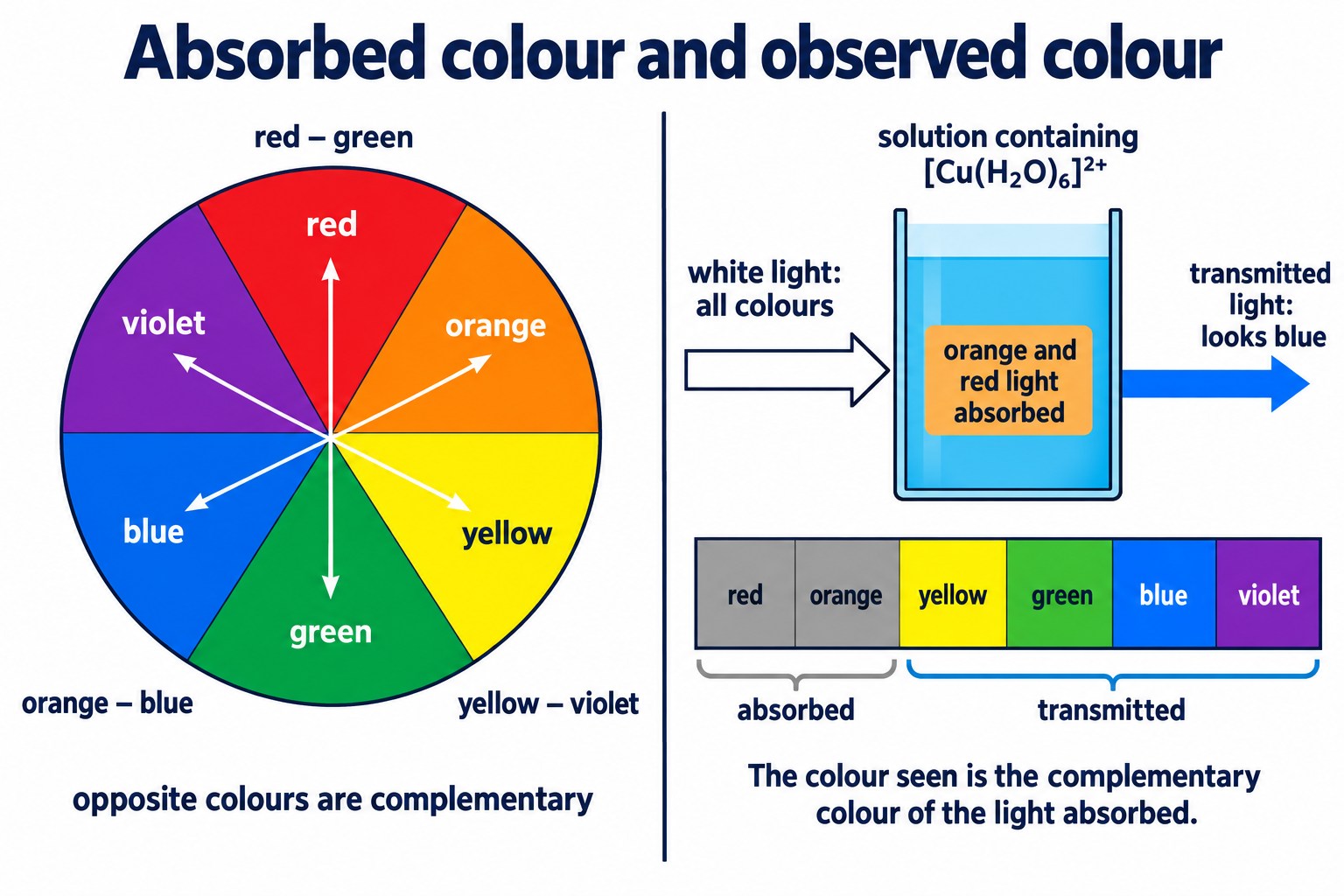
Complementary colours sit opposite each other on the colour wheel. A solution of [Cu(H₂O)₆]²⁺ absorbs orange and red light, so it looks blue.
- A solution transmits the colours it does not absorb. A solid reflects them.
- A blue solution is not absorbing blue light. It is absorbing light from the orange and red part of the spectrum.
- A substance that absorbs no visible light looks colourless in solution, or white as a solid.
Common mistake: Do not write that a blue solution “absorbs blue light” or “emits blue light”. It absorbs the complementary colour and transmits blue.
Splitting of the d Orbitals
In an isolated transition element ion, the five 3d orbitals all have the same energy: they are degenerate. Ligands change this.
- Ligands bond to the metal ion, and their lone pairs repel the electrons in the 3d orbitals.
- Some 3d orbitals point more directly at the ligands than others, so they are raised in energy by different amounts.
- The five 3d orbitals split into two sets with different energies: the two sets are non-degenerate.
- The energy gap between the two sets is called ΔE.
| Complex | Lower set | Higher set |
|---|---|---|
| octahedral | three 3d orbitals | two 3d orbitals |
| tetrahedral | two 3d orbitals | three 3d orbitals |
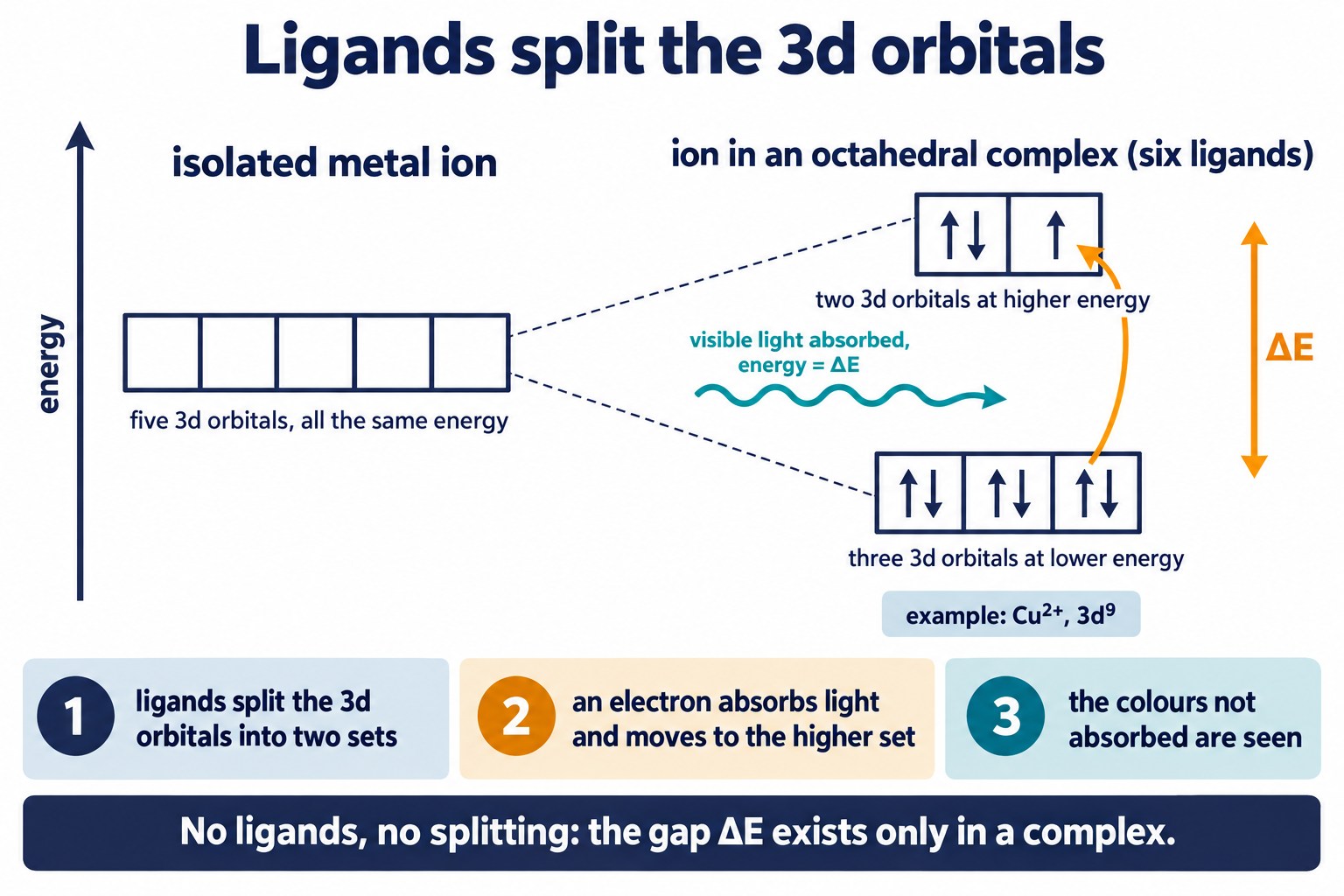
Five 3d orbitals at one energy in the isolated ion split into three lower and two higher in an octahedral complex. The gap is ΔE.
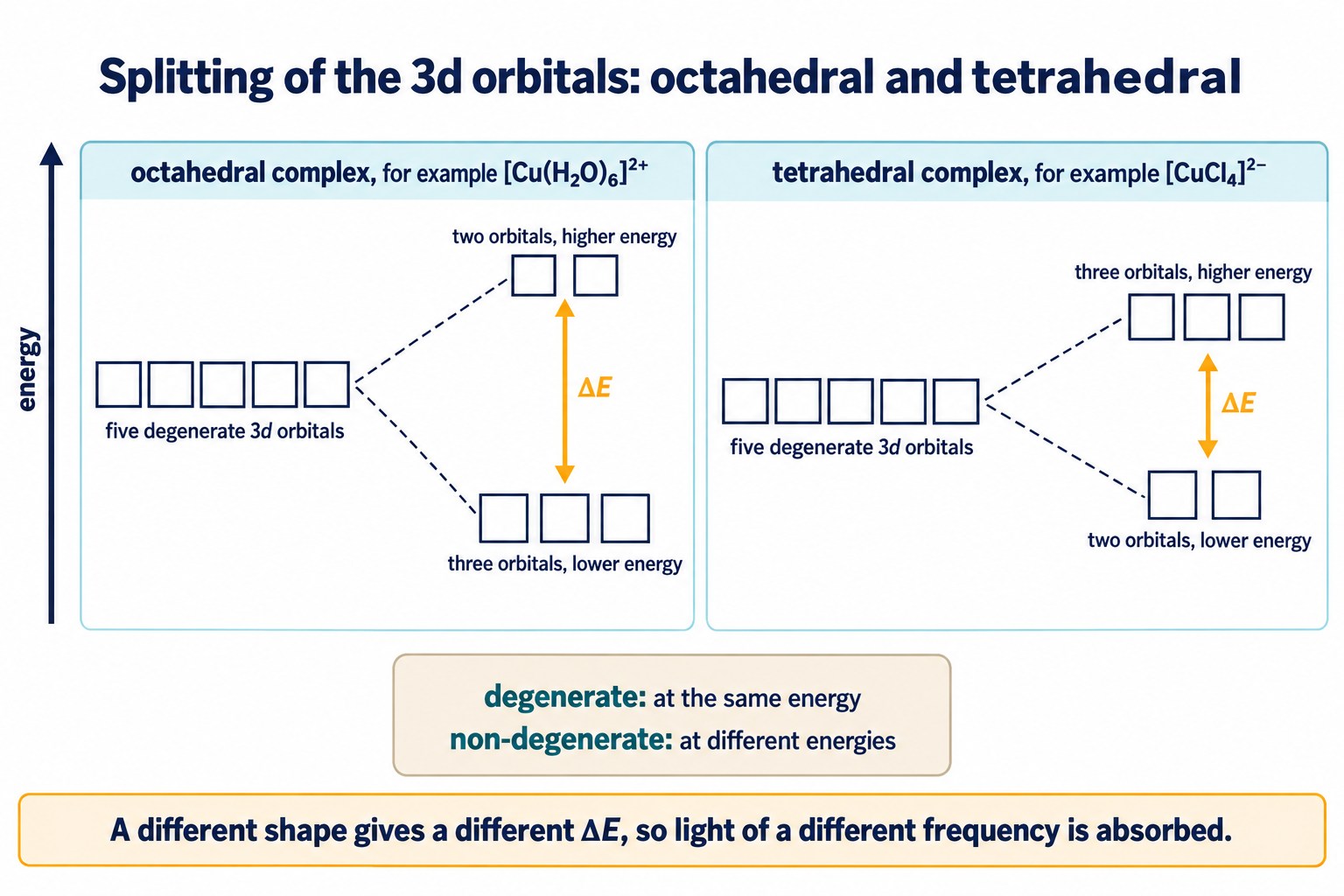
Octahedral and tetrahedral splitting compared. The pattern is reversed in a tetrahedral complex, and ΔE is smaller.
Definition: Degenerate orbitals have the same energy. Non-degenerate orbitals have different energies. Ligands split the five degenerate 3d orbitals into two non-degenerate sets.
Remember: The splitting is caused by the ligands. Without ligands there is no energy gap, so the explanation of colour always starts with the ligands splitting the 3d sub-shell.
Check: Splitting and Complementary Colours
Link the colour absorbed to the colour seen, and describe what ligands do to the 3d orbitals.
How Absorbing Light Gives Colour
The gap ΔE between the two sets of 3d orbitals matches the energy of visible light. The full explanation has four steps.
- The ligands split the 3d sub-shell into two sets of orbitals with different energies.
- An electron in the lower set absorbs visible light of energy ΔE and is promoted to the higher set.
- Light of one frequency is therefore removed from the white light.
- The remaining light is transmitted or reflected, and the complementary colour is seen.
Example: [Cu(H₂O)₆]²⁺
- Cu²⁺ is [Ar]3d⁹, so there is one space in the higher set of orbitals.
- An electron from the lower set is promoted into that space.
- The energy needed corresponds to orange and red light.
- The rest of the spectrum is transmitted, so the solution looks blue.
Exam focus: A full-mark answer has three ideas: the 3d orbitals are split by the ligands, electrons absorb visible light to move to the higher level, and the light that is not absorbed is the colour seen.
Quick Check: What Really Happens to the Light?
Pick the one accurate statement in each set, using complexes and solids that are new to this page.
The Energy Gap: ΔE = hν
The energy gap is linked to the frequency of the light absorbed.
Equation: ΔE = hν = (hc) / (λ), where h is the Planck constant (6.63 × 10⁻³⁴ J s), ν is the frequency in Hz (s⁻¹), c is the speed of light (3.00 × 10⁸ m s⁻¹) and λ is the wavelength in m.
- A larger ΔE means light of higher frequency and shorter wavelength is absorbed.
- Convert a wavelength in nm to m before using it: 1 nm = 1 × 10⁻⁹ m.
Worked example: ΔE from a wavelength
A complex absorbs light of wavelength 600 nm. Calculate ΔE in J, and in kJ mol⁻¹.
Step 1. λ = 600 nm = 6.00 × 10⁻⁷ m.
Step 2. ν = (c) / (λ) = (3.00 × 10⁸) / (6.00 × 10⁻⁷) = 5.00 × 10¹⁴ Hz.
Step 3. ΔE = hν = 6.63 × 10⁻³⁴ × 5.00 × 10¹⁴ = 3.32 × 10⁻¹⁹ J.
Worked example: a wavelength from ΔE
In another complex, ΔE = 3.98 × 10⁻¹⁹ J. Calculate the wavelength of the light absorbed.
Step 1. Rearrange ΔE = (hc) / (λ) to give λ = (hc) / (ΔE).
Step 2. λ = (6.63 × 10⁻³⁴ × 3.00 × 10⁸) / (3.98 × 10⁻¹⁹) = 5.00 × 10⁻⁷ m.
Remember: ΔE from the equation is the energy for one ion. Multiply by the Avogadro constant, 6.02 × 10²³ mol⁻¹, and divide by 1000 to give kJ mol⁻¹.
Quick Check: Calculate the Energy Gap
Work each step on paper, then flip the card to check your working.
Why Some Ions Are Colourless
Colour needs an electron that can move from the lower set of 3d orbitals to the higher set. That requires a partly filled 3d sub-shell.
| Ion | 3d electrons | Why it is colourless |
|---|---|---|
| Sc³⁺ | 3d⁰ | there are no 3d electrons to promote |
| Zn²⁺ | 3d¹⁰ | the higher set is full, so no electron can be promoted |
| Cu⁺ | 3d¹⁰ | the higher set is full, so no electron can be promoted |
- In each case no visible light is absorbed, so all of it is transmitted.
- Other 3d⁰ ions, such as Ti⁴⁺, are colourless for the same reason.
- Copper(II), 3d⁹, is coloured but copper(I), 3d¹⁰, is not: the same element, with a different number of 3d electrons.
Exam focus: Give the configuration and its consequence: Zn²⁺ is 3d¹⁰, a full sub-shell, so no electron can move between the split 3d orbitals and no visible light is absorbed.
Check: Explaining Colour and Lack of Colour
Put the steps of the explanation in order and decide from their configurations which ions are colourless.
What Changes the Colour
The size of ΔE decides which colour is absorbed. Anything that alters ΔE alters the colour. Three changes do this.
| Change | Example | Colour change |
|---|---|---|
| Oxidation state of the metal | [Fe(H₂O)₆]²⁺ → [Fe(H₂O)₆]³⁺ | pale green → yellow |
| Ligand | [Cu(H₂O)₆]²⁺ → [Cu(NH₃)₄(H₂O)₂]²⁺ | blue → deep blue |
| Coordination number (and shape) | [Cu(H₂O)₆]²⁺ → [CuCl₄]²⁻ | blue → yellow |
| Coordination number (and shape) | [Co(H₂O)₆]²⁺ → [CoCl₄]²⁻ | pink → blue |
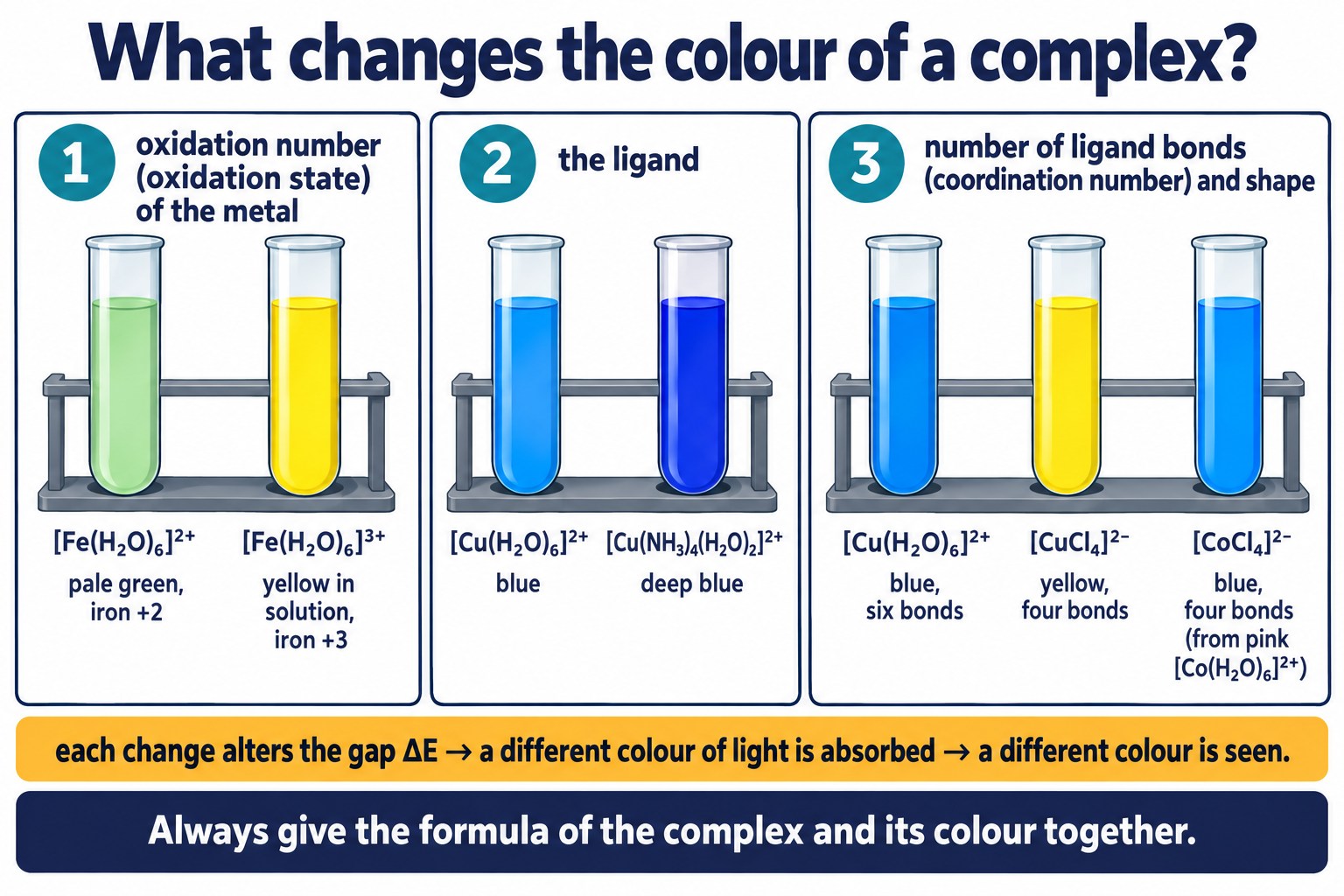
Test tubes showing the three changes: iron(II) and iron(III), copper(II) with water and with ammonia, and aqua ions against chloride complexes.
- A change in oxidation state changes the number of 3d electrons and the attraction between the ion and the ligands.
- Different ligands split the 3d orbitals by different amounts.
- A change in coordination number changes the shape, and so the pattern and size of the splitting.
- Pure [Fe(H₂O)₆]³⁺ is pale violet. Its solutions look yellow because some of the ions react with water.
- The reactions that swap the ligands are covered in Ligand exchange and the Stability of Complexes.
Remember: Colour depends on the metal, its oxidation state, the ligands and the coordination number. Change any one of these and ΔE changes, so a different colour of light is absorbed.
Ligands, ΔE and the Colour Observed
When one ligand is exchanged for another, ΔE changes. Light of a different frequency is absorbed, so a different complementary colour is seen.
| Metal ion | Ligands | Complex | Colour |
|---|---|---|---|
| copper(II) | water | [Cu(H₂O)₆]²⁺ | blue solution |
| copper(II) | hydroxide and water | Cu(OH)₂(H₂O)₄ | pale blue precipitate |
| copper(II) | ammonia and water | [Cu(NH₃)₄(H₂O)₂]²⁺ | deep blue solution |
| copper(II) | chloride | [CuCl₄]²⁻ | yellow solution |
| cobalt(II) | water | [Co(H₂O)₆]²⁺ | pink solution |
| cobalt(II) | hydroxide and water | Co(OH)₂(H₂O)₄ | blue precipitate |
| cobalt(II) | ammonia | [Co(NH₃)₆]²⁺ | yellow-brown solution |
| cobalt(II) | chloride | [CoCl₄]²⁻ | blue solution |
- A ligand that causes a larger ΔE makes the complex absorb light of higher frequency.
- Ammonia causes a larger splitting than water. The copper(II) complex with ammonia absorbs at a higher frequency and looks a deeper blue.
- A tetrahedral complex has a smaller ΔE than an octahedral one, so the chloride complexes absorb light of lower frequency.
Check: What Changes the Colour
Explain colour changes in terms of oxidation state, ligand and coordination number, using complexes whose colours are given in the question.
Common Exam Points
- Start every colour explanation with the ligands splitting the 3d orbitals into two energy levels.
- Electrons are promoted by absorbing visible light. Never write that light is emitted.
- The colour seen is the complementary colour: it is the light transmitted or reflected, not the light absorbed.
- Sc³⁺ (3d⁰), Zn²⁺ and Cu⁺ (both 3d¹⁰) are colourless because no electron can move between the split orbitals.
- Colour changes when the oxidation state, the ligand or the coordination number changes, because ΔE changes.
- Quote the formula and the colour together: [CuCl₄]²⁻ is yellow and [CoCl₄]²⁻ is blue.
- In ΔE = (hc) / (λ), convert nm to m, and remember that ΔE is for one ion, not one mole.
- Octahedral: three lower, two higher. Tetrahedral: two lower, three higher.
FAQs
Use these quick answers to check why transition element ions are coloured and what changes the colour.
Why are transition element complexes coloured?
Ligands split the 3d orbitals into two sets with an energy gap, ΔE. An electron absorbs visible light of energy ΔE and moves to the higher set. The light that is not absorbed is transmitted, so the complementary colour is seen.
Why does [Cu(H₂O)₆]²⁺ look blue?
It absorbs orange and red light, which promotes a 3d electron to the higher set of orbitals. The remaining wavelengths pass through the solution, and together they look blue. Blue is the complementary colour of orange.
Why are Sc³⁺ and Zn²⁺ compounds colourless?
Colour needs a partly filled 3d sub-shell. Sc³⁺ is 3d⁰, so it has no d electron to promote. Zn²⁺ and Cu⁺ are 3d¹⁰, so the higher orbitals are already full. No visible light is absorbed, so the ions are colourless.
What changes the colour of a complex?
Changing the oxidation state of the metal, the ligand or the coordination number changes ΔE, so light of a different frequency is absorbed. [Cu(H₂O)₆]²⁺ is blue, [Cu(NH₃)₄(H₂O)₂]²⁺ is deep blue and [CuCl₄]²⁻ is yellow.
How do I calculate ΔE from a wavelength?
Use ΔE = hν = (hc) / (λ), with λ in metres. For 600 nm, ΔE = (6.63 × 10⁻³⁴ × 3.00 × 10⁸) / (6.00 × 10⁻⁷) = 3.32 × 10⁻¹⁹ J. Multiplying by the Avogadro constant gives 200 kJ mol⁻¹.

Copyright notice: This OLS revision content, including the explanations, layout, diagrams, tables and embedded learning structure, is authored for Online Learning System by Dr. Mohammed Al-Fatah. It may not be copied, reproduced, redistributed or adapted without written permission.
Keep this note — free
Save your progress across every Cambridge topic. A free account remembers which topics you have covered, saves your question scores, and syncs across your phone and laptop.
- Track every topic you have finished
- Keep your practice-question scores
- No payment, no card, free forever
Already registered? Log in