Redox Titrations with Transition element Ions
A concise revision guide to redox titrations: manganate(VII) with iron(II) and with ethanedioate, copper(II) with iodide and thiosulfate, the mole ratios, the end points and worked calculations.
- 28.2.9(a)-i
- 28.2.9(a)-ii
- 28.2.9(b)-i
- 28.2.9(b)-ii
- 28.2.9(c)-i
- 28.2.9(c)-ii
- 28.2.10
What these spec points say
- 28.2.9(a)-i describe the reactions of MnO4–/C2O42– in acid solution
- 28.2.9(a)-ii perform calculations involving MnO4–/C2O42– in acid solution given suitable data
- 28.2.9(b)-i describe the reactions of MnO4–/Fe2+ in acid solution
- 28.2.9(b)-ii perform calculations involving MnO4–/Fe2+ in acid solution given suitable data
- 28.2.9(c)-i describe the reactions of Cu2+/I–
- 28.2.9(c)-ii perform calculations involving Cu2+/I– given suitable data
- 28.2.10 perform calculations involving other redox systems given suitable data
Before You Start
This page brings together redox equations and titration calculations. Half-equations and E⦵ values are covered in Topic 24 Electrochemistry. The redox reactions of the transition elements are covered in the redox chemistry page.
- Amount in moles = concentration × volume in dm³, or n = cV.
- Divide a volume in cm³ by 1000 to convert it to dm³.
- A mean titre uses concordant titres only: titres within 0.10 cm³ of each other.
- An oxidising agent gains electrons. A reducing agent loses electrons.
- The electrons lost must equal the electrons gained. This fixes the mole ratio.
GCSE Recap: Titrations and Electron Transfer
Three quick questions on the GCSE ideas this page builds on.
Manganate(VII) and Iron(II)
Potassium manganate(VII), KMnO₄, is a strong oxidising agent in acidic solution. It oxidises iron(II) ions to iron(III) ions and is reduced to manganese(II) ions.
| Change | Half-equation | Change in oxidation state |
|---|---|---|
| Reduction | MnO₄⁻(aq) + 8H⁺(aq) + 5e⁻ → Mn²⁺(aq) + 4H₂O(l) | Mn: +7 to +2 |
| Oxidation | Fe²⁺(aq) → Fe³⁺(aq) + e⁻ | Fe: +2 to +3 |
Combining the half-equations
- MnO₄⁻ gains 5 electrons. Each Fe²⁺ loses 1 electron.
- Multiply the iron(II) half-equation by 5, so that both involve 5 electrons.
- Add the two half-equations and cancel the electrons.
MnO₄⁻(aq) + 8H⁺(aq) + 5Fe²⁺(aq) → Mn²⁺(aq) + 5Fe³⁺(aq) + 4H₂O(l)
Key idea: 1 mol of MnO₄⁻ reacts with 5 mol of Fe²⁺. Moles of Fe²⁺ = 5 × moles of MnO₄⁻.
A Self-Indicating Titration
No indicator is added. The manganate(VII) solution acts as its own indicator, so the titration is self-indicating.
| Ion | Colour in dilute solution |
|---|---|
| MnO₄⁻ | deep purple |
| Mn²⁺ | very pale pink: looks colourless |
| Fe²⁺ | very pale green: looks almost colourless |
| Fe³⁺ | very pale yellow: looks almost colourless |
- The MnO₄⁻ solution goes in the burette. The reducing agent and the acid go in the conical flask.
- Each purple drop is decolourised as MnO₄⁻ is reduced to Mn²⁺.
- Once all the reducing agent has reacted, the next drop of MnO₄⁻ stays in the flask.
- The end point is the first permanent pale pink colour.
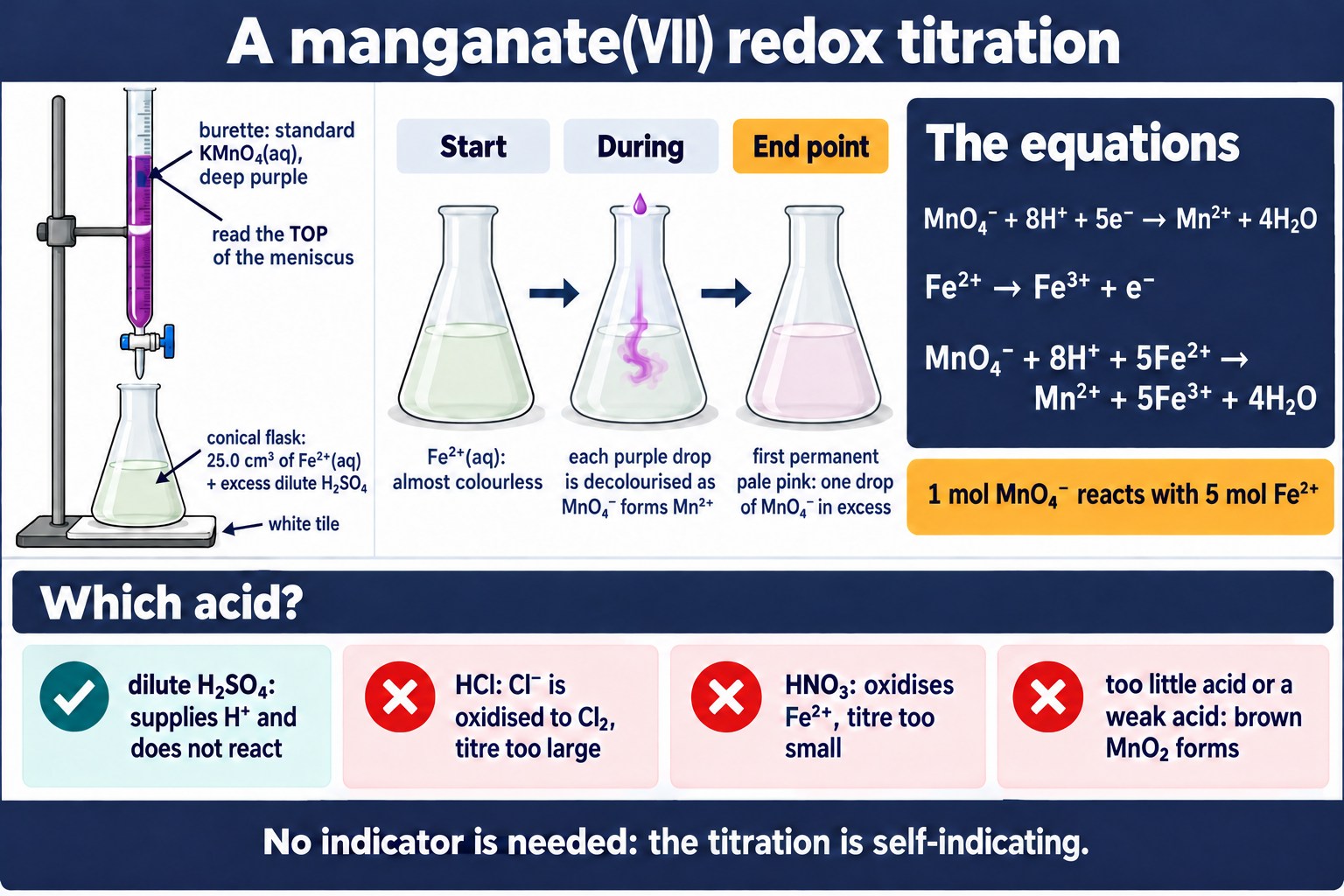
A manganate(VII) titration: purple MnO₄⁻ from the burette is decolourised in the flask until one drop in excess gives the first permanent pale pink colour.
Practical points
- The deep purple colour hides the bottom of the meniscus. Read the top of the meniscus for both readings.
- Oxygen in the air slowly oxidises Fe²⁺ to Fe³⁺. Titrate iron(II) solutions soon after making them.
- Stand the flask on a white tile and add the MnO₄⁻ drop by drop near the end point.
- Titration technique is part of the assessed practical work: see Practical skills.
Exam wording: “The colour change at the end point is from colourless to the first permanent pale pink, caused by a slight excess of MnO₄⁻ ions.”
Quick Check: Reasoning About the End Point
Pick the one accurate statement in each set.
Why Dilute Sulfuric Acid Is Used
The reduction of MnO₄⁻ to Mn²⁺ needs 8 mol of H⁺ for each mole of MnO₄⁻. An excess of dilute sulfuric acid in the flask supplies them.
| Acid | Suitable? | Reason | Effect on the titre |
|---|---|---|---|
| Dilute sulfuric acid | Yes | supplies H⁺; SO₄²⁻ is not oxidised or reduced | correct |
| Hydrochloric acid | No | MnO₄⁻ oxidises Cl⁻ to toxic Cl₂ | too large |
| Nitric acid | No | it is an oxidising agent and oxidises some Fe²⁺ | too small |
| Ethanoic acid | No | a weak acid: it cannot supply enough H⁺ | too large |
E⦵ values explain the problem with chloride ions. E⦵ for MnO₄⁻/Mn²⁺ is +1.52 V and E⦵ for Cl₂/Cl⁻ is +1.36 V, so MnO₄⁻ can oxidise Cl⁻ to Cl₂.
Too little acid
MnO₄⁻(aq) + 4H⁺(aq) + 3e⁻ → MnO₂(s) + 2H₂O(l)
- With too little acid, or a weak acid, MnO₄⁻ is only reduced as far as manganese(IV) oxide, MnO₂.
- MnO₂ is a brown solid. The mixture turns brown and cloudy, which hides the end point.
- Each MnO₄⁻ now gains 3 electrons, not 5, so more MnO₄⁻ is needed and the titre is too large.
Check: Equations, Acid and End Point
Build the equation, explain the choice of acid and describe the end point of a manganate(VII) titration, in questions that do not repeat the examples on this page.
Worked Example: Percentage of Iron in a Salt
A 3.36 g sample of an iron(II) salt was dissolved in dilute sulfuric acid and made up to 250 cm³. A 25.0 cm³ portion needed a mean titre of 24.10 cm³ of 0.0100 mol dm⁻³ KMnO₄.
Calculate the percentage by mass of iron in the salt. (Ar of Fe = 55.8)
Step 1. Moles of MnO₄⁻ = (0.0100 × 24.10) / (1000) = 2.41 × 10⁻⁴ mol.
Step 2. Moles of Fe²⁺ in 25.0 cm³ = 5 × 2.41 × 10⁻⁴ = 1.205 × 10⁻³ mol.
Step 3. Moles of Fe²⁺ in 250 cm³ = 10 × 1.205 × 10⁻³ = 1.205 × 10⁻² mol.
Step 4. Mass of iron = 1.205 × 10⁻² × 55.8 = 0.67239 g, which is 0.672 g to 3 significant figures.
Answer. Percentage of iron = (0.67239) / (3.36) × 100 = 20.0%
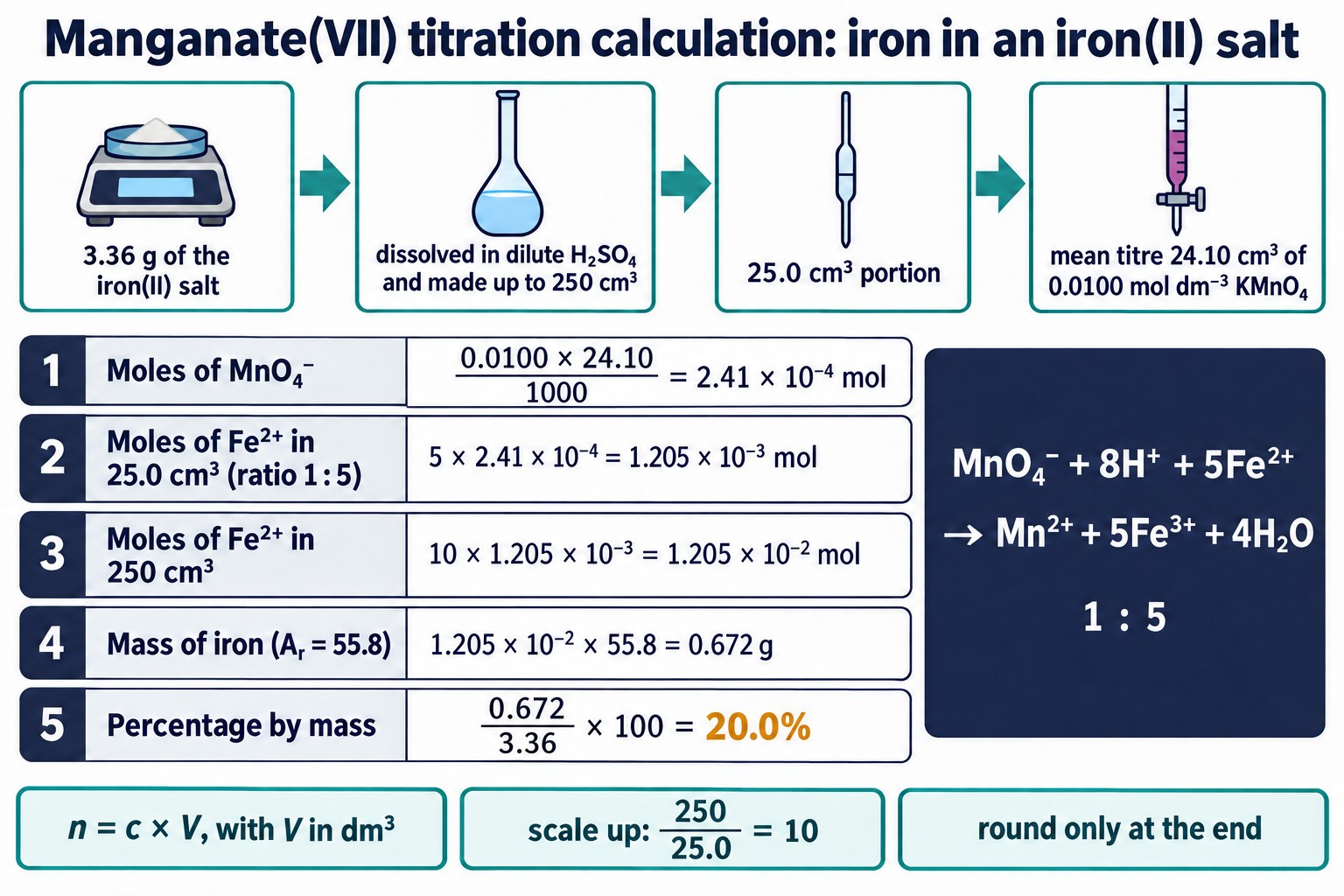
The iron(II) salt calculation in five steps: moles of MnO₄⁻, moles of Fe²⁺ in the portion, moles in the whole flask, mass of iron and percentage by mass.
The same route answers other questions
- Percentage purity: convert the moles in the whole flask into a mass of the pure compound, then divide by the mass of the sample.
- Molar mass: divide the mass of the sample by the moles of Fe²⁺ in the whole flask.
- Concentration: divide the moles in the portion by the volume of the portion in dm³.
Exam focus: Keep the unrounded value in the calculator between steps. Round only the final answer, to the smallest number of significant figures in the data.
Manganate(VII) and Ethanedioate
Ethanedioate ions, C₂O₄²⁻, are oxidised to carbon dioxide by acidified MnO₄⁻. Each C₂O₄²⁻ ion loses 2 electrons.
| Change | Half-equation | Change in oxidation state |
|---|---|---|
| Reduction | MnO₄⁻ + 8H⁺ + 5e⁻ → Mn²⁺ + 4H₂O | Mn: +7 to +2 |
| Oxidation | C₂O₄²⁻ → 2CO₂ + 2e⁻ | C: +3 to +4 |
- Multiply the MnO₄⁻ half-equation by 2 and the C₂O₄²⁻ half-equation by 5, so that both involve 10 electrons.
- Add the half-equations and cancel the electrons.
2MnO₄⁻(aq) + 16H⁺(aq) + 5C₂O₄²⁻(aq) → 2Mn²⁺(aq) + 10CO₂(g) + 8H₂O(l)
Key idea: 2 mol of MnO₄⁻ react with 5 mol of C₂O₄²⁻. Moles of C₂O₄²⁻ = (5) / (2) × moles of MnO₄⁻.
What is different in this titration
- The reaction is slow at room temperature, because MnO₄⁻ and C₂O₄²⁻ are both negative ions and repel each other.
- The flask is warmed to about 60 °C before the titration, to speed up the reaction.
- The first drops of MnO₄⁻ are decolourised slowly. Later drops are decolourised quickly.
- The Mn²⁺ ions formed catalyse the reaction. This is autocatalysis: a product of the reaction acts as its catalyst.
- Bubbles of carbon dioxide are seen. The end point is still the first permanent pale pink colour.
- Ethanedioic acid, H₂C₂O₄, and its salts react in the same 2 : 5 ratio.
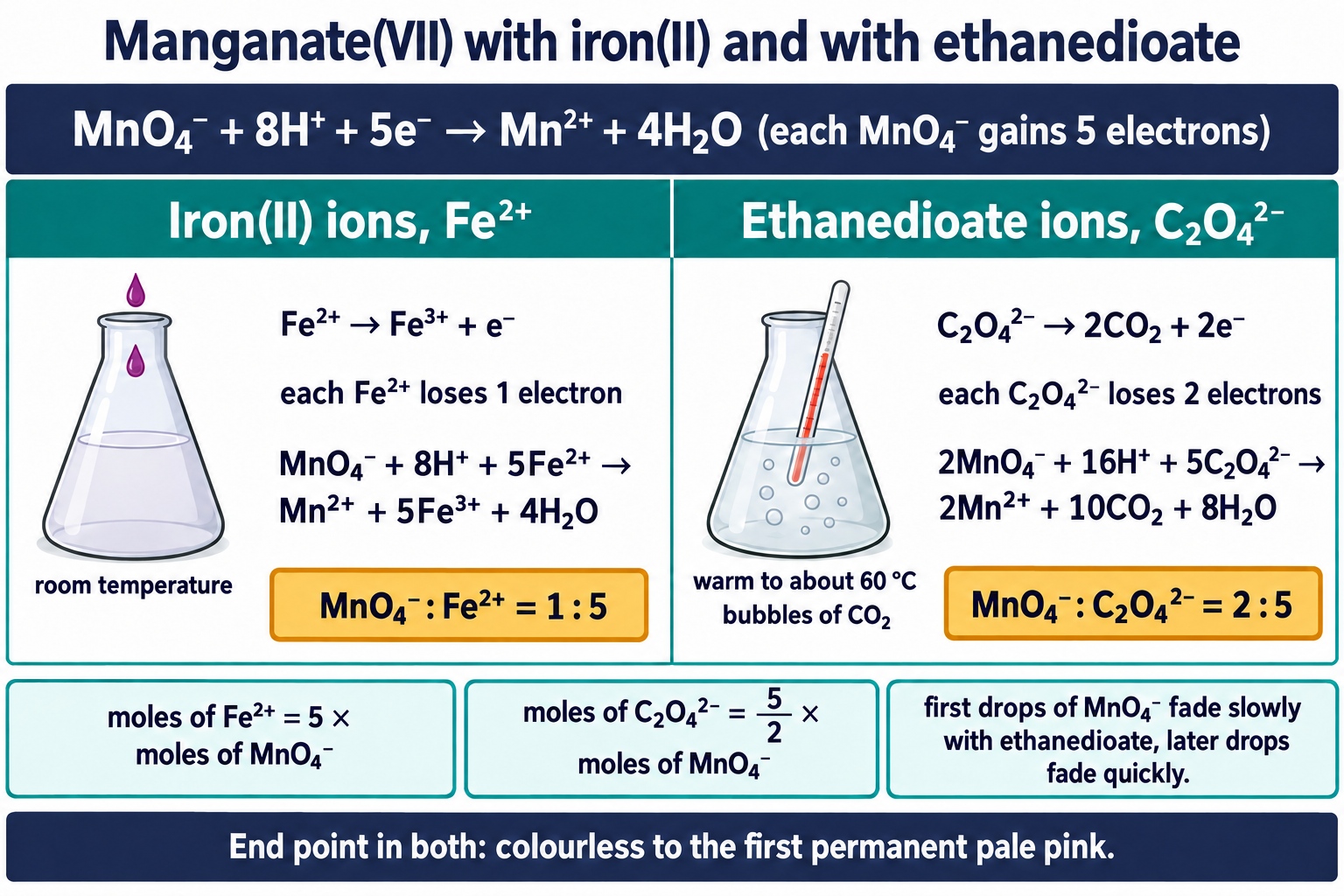
The two manganate(VII) titrations compared: iron(II) at room temperature in a 1 : 5 ratio, and ethanedioate at about 60 °C in a 2 : 5 ratio.
Worked Example: Water of Crystallisation in Ethanedioic Acid
1.56 g of hydrated ethanedioic acid, H₂C₂O₄·xH₂O, was dissolved in water and made up to 250 cm³. A 25.0 cm³ portion, acidified and warmed to 60 °C, needed 19.80 cm³ of 0.0250 mol dm⁻³ KMnO₄. Find x.
Step 1. Moles of MnO₄⁻ = (0.0250 × 19.80) / (1000) = 4.95 × 10⁻⁴ mol.
Step 2. Moles of H₂C₂O₄ in 25.0 cm³ = (5) / (2) × 4.95 × 10⁻⁴ = 1.2375 × 10⁻³ mol.
Step 3. Moles in 250 cm³ = 10 × 1.2375 × 10⁻³ = 1.2375 × 10⁻² mol.
Step 4. Molar mass of the hydrated acid = (1.56) / (1.2375 × 10⁻²) = 126.1 g mol⁻¹.
Answer. x = (36.1) / (18.0) = 2.01, so x = 2 and the formula is H₂C₂O₄·2H₂O.
Check: Manganate(VII) Titration Calculations
Work through calculations for manganate(VII) with iron(II) and with ethanedioate, using data that is not used on this page.
Copper(II) and Iodide
Copper(II) ions are found in two stages. The Cu²⁺ ions are not titrated directly. They are used to make iodine, and the iodine is then titrated.
Stage 1: add excess potassium iodide
2Cu²⁺(aq) + 4I⁻(aq) → 2CuI(s) + I₂(aq)
- Cu²⁺ is reduced to copper(I): the oxidation state of copper falls from +2 to +1.
- Some of the I⁻ ions are oxidised to iodine: the oxidation state of iodine rises from −1 to 0.
- The blue solution changes to a white precipitate of copper(I) iodide, CuI, in a brown solution of iodine.
- The KI is in excess, so the amount of I₂ formed depends only on the amount of Cu²⁺.
Stage 2: titrate the iodine with thiosulfate
I₂(aq) + 2S₂O₃²⁻(aq) → 2I⁻(aq) + S₄O₆²⁻(aq)
- Add standard sodium thiosulfate solution from a burette until the brown colour fades to pale straw.
- Add a few drops of starch solution. The mixture turns blue-black.
- Add thiosulfate drop by drop until the blue-black colour just disappears. An off-white precipitate of CuI remains.
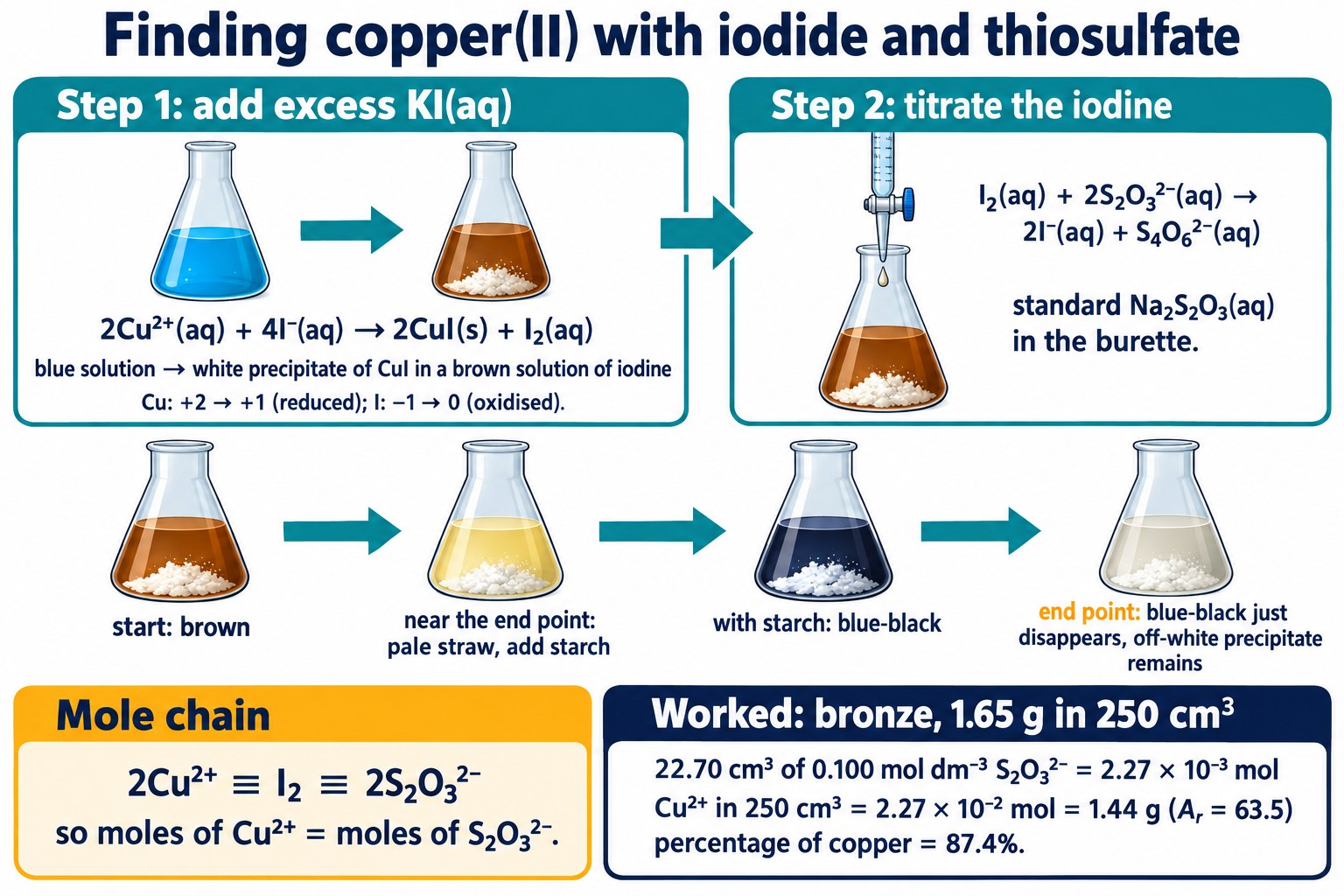
Finding copper(II): excess iodide gives a white precipitate of copper(I) iodide and brown iodine, and the iodine is titrated with thiosulfate using starch.
Key idea: The mole chain is 2Cu²⁺ ≡ I₂ ≡ 2S₂O₃²⁻. So moles of Cu²⁺ = moles of S₂O₃²⁻.
Why the starch is added late
- Starch is added only when very little iodine is left, at the pale straw stage.
- Added early, the starch holds a lot of iodine strongly and releases it slowly, so the end point is not sharp.
Quick Check: A Two-Stage Titration in a New Setting
Build the mole chain for a different oxidising agent that also makes iodine.
Worked Example: Percentage of Copper in an Alloy
1.65 g of bronze was dissolved in concentrated nitric acid. The solution was neutralised and made up to 250 cm³. Excess KI was added to a 25.0 cm³ portion. The iodine needed 22.70 cm³ of 0.100 mol dm⁻³ Na₂S₂O₃.
Calculate the percentage by mass of copper in the bronze. (Ar of Cu = 63.5)
Step 1. Moles of S₂O₃²⁻ = (0.100 × 22.70) / (1000) = 2.27 × 10⁻³ mol.
Step 2. Moles of I₂ = (2.27 × 10⁻³) / (2) = 1.135 × 10⁻³ mol.
Step 3. Moles of Cu²⁺ in 25.0 cm³ = 2 × 1.135 × 10⁻³ = 2.27 × 10⁻³ mol.
Step 4. Moles of Cu²⁺ in 250 cm³ = 10 × 2.27 × 10⁻³ = 2.27 × 10⁻² mol.
Step 5. Mass of copper = 2.27 × 10⁻² × 63.5 = 1.44145 g, which is 1.44 g to 3 significant figures.
Answer. Percentage of copper = (1.44145) / (1.65) × 100 = 87.4%
- The nitric acid oxidises the copper in the alloy to Cu²⁺(aq).
- The excess acid must be neutralised, because nitric acid would also oxidise I⁻ ions to iodine.
Other Redox Systems
A question may use a redox system that is not on this page. The half-equations, or the overall equation, are given. The method does not change.
- Balance the electrons in the two half-equations to find the mole ratio.
- Calculate the moles of the solution with the known concentration.
- Use the mole ratio to find the moles of the other reactant.
- Answer the question asked: a concentration, a mass, a percentage or a formula.
| Oxidising agent | Reducing agent | Electrons | Mole ratio |
|---|---|---|---|
| MnO₄⁻ (gains 5e⁻) | Fe²⁺ (loses 1e⁻) | 5 | 1 : 5 |
| MnO₄⁻ (gains 5e⁻) | C₂O₄²⁻ (loses 2e⁻) | 10 | 2 : 5 |
| MnO₄⁻ (gains 5e⁻) | H₂O₂ (loses 2e⁻) | 10 | 2 : 5 |
| Cr₂O₇²⁻ (gains 6e⁻) | Fe²⁺ (loses 1e⁻) | 6 | 1 : 6 |
Worked example: dichromate(VI) and iron(II)
A 25.0 cm³ portion of an iron(II) solution, acidified with dilute sulfuric acid, needed 16.90 cm³ of 0.0200 mol dm⁻³ K₂Cr₂O₇. Find the concentration of Fe²⁺.
Cr₂O₇²⁻ + 14H⁺ + 6e⁻ → 2Cr³⁺ + 7H₂O
Cr₂O₇²⁻ + 14H⁺ + 6Fe²⁺ → 2Cr³⁺ + 6Fe³⁺ + 7H₂O
Step 2. Moles of Cr₂O₇²⁻ = (0.0200 × 16.90) / (1000) = 3.38 × 10⁻⁴ mol.
Step 3. Moles of Fe²⁺ = 6 × 3.38 × 10⁻⁴ = 2.028 × 10⁻³ mol.
Answer. Concentration of Fe²⁺ = (2.028 × 10⁻³) / (0.0250) = 0.0811 mol dm⁻³
Remember: Orange Cr₂O₇²⁻ is reduced to green Cr³⁺. This colour change is not sharp, so a redox indicator is added. The titration is not self-indicating.
Quick Check: Finding the Vanadium in an Ore
Work out each stage yourself, then flip the card to compare.
Common Exam Points
Say
- “The end point is the first permanent pale pink colour.”
- “Dilute sulfuric acid is added in excess to provide the H⁺ ions needed to reduce MnO₄⁻ to Mn²⁺.”
- “Moles of Fe²⁺ = 5 × moles of MnO₄⁻” and “moles of C₂O₄²⁻ = (5) / (2) × moles of MnO₄⁻”.
- “Moles of Cu²⁺ = moles of S₂O₃²⁻, because 2Cu²⁺ ≡ I₂ ≡ 2S₂O₃²⁻.”
Do not say
- “The end point is purple” (a purple flask means the end point has been overshot).
- “Hydrochloric acid is used to acidify” (chloride ions are oxidised by MnO₄⁻).
- “An indicator is added” to a manganate(VII) titration (it is self-indicating).
- “Copper(II) iodide is formed” (the white precipitate is copper(I) iodide, CuI).
Watch for
- Scaling up: a 25.0 cm³ portion from a 250 cm³ flask is one tenth of the sample.
- The 2 : 5 ratio for ethanedioate, not 1 : 5.
- Whether the question wants the mass of iron, of Fe²⁺ ions or of the whole compound.
- Warming the flask for ethanedioate, but not for iron(II).
- Titres recorded to 2 decimal places, ending in 0 or 5.
Check: Redox Titrations
Bring the whole page together: method, choice of acid, sources of error and calculations for manganate(VII) with iron(II) and ethanedioate, in contexts not used on this page.
FAQs
Use these quick answers to check redox titrations with manganate(VII) and the titration of copper(II) with iodide and thiosulfate.
Why is no indicator needed in a manganate(VII) titration?
MnO₄⁻ is purple and the Mn²⁺ formed is almost colourless, so the titration is self-indicating. Each drop is decolourised while some reducing agent remains. The end point is the first permanent pale pink colour in the flask.
Why is dilute sulfuric acid used to supply the H⁺ ions?
Sulfate ions are neither oxidised nor reduced. Chloride ions from hydrochloric acid are oxidised to chlorine by MnO₄⁻, nitric acid is itself an oxidising agent, and ethanoic acid is too weak. Too little acid gives brown MnO₂.
What is the mole ratio of manganate(VII) to ethanedioate?
It is 2 : 5. Each MnO₄⁻ gains five electrons and each C₂O₄²⁻ loses two: 2MnO₄⁻ + 16H⁺ + 5C₂O₄²⁻ → 2Mn²⁺ + 10CO₂ + 8H₂O. With Fe²⁺, which loses one electron, the ratio is 1 : 5.
Why is the ethanedioate titration warmed to about 60 °C?
The reaction between MnO₄⁻ and C₂O₄²⁻ is slow at room temperature, so the flask is warmed to speed it up. The Mn²⁺ ions formed then catalyse the reaction, so later drops of manganate(VII) are decolourised much more quickly.
How is copper(II) found by titration?
Add excess potassium iodide: 2Cu²⁺ + 4I⁻ → 2CuI + I₂. Titrate the iodine with thiosulfate, I₂ + 2S₂O₃²⁻ → 2I⁻ + S₄O₆²⁻, adding starch near the end point. The moles of Cu²⁺ equal the moles of S₂O₃²⁻.

Copyright notice: This OLS revision content, including the explanations, layout, diagrams, tables and embedded learning structure, is authored for Online Learning System by Dr. Mohammed Al-Fatah. It may not be copied, reproduced, redistributed or adapted without written permission.
Keep this note — free
Save your progress across every Cambridge topic. A free account remembers which topics you have covered, saves your question scores, and syncs across your phone and laptop.
- Track every topic you have finished
- Keep your practice-question scores
- No payment, no card, free forever
Already registered? Log in