Transition elements as Catalysts
A concise revision guide to transition element catalysts: why variable oxidation states and d orbitals make them good catalysts, and heterogeneous and homogeneous examples, iron in the Haber process.
- 28.1.3(b)
- 28.1.5-a
- 28.1.5-b
What these spec points say
- 28.1.3(b) understand that transition elements behave as catalysts
- 28.1.5-a explain why transition elements behave as catalysts in terms of having more than one stable oxidation state
- 28.1.5-b explain why transition elements behave as catalysts in terms of vacant d orbitals that are energetically accessible and can form dative bonds with ligands
Catalysis at a Surface
Choose a step to watch carbon monoxide and nitrogen monoxide being adsorbed onto a metal surface, reacting there and leaving as products.
© Dr. Mohammed Al-Fatah – onlinelearningsystem.net
Before You Start
Catalysts were first met in Topic 26 Reaction kinetics. This page explains why the transition elements and their compounds are such good catalysts.
- A catalyst increases the rate of a reaction and is chemically unchanged at the end.
- It provides an alternative reaction route with a lower activation energy.
- More particles then have at least the activation energy, so more collisions are successful.
- A catalyst does not change the position of equilibrium or the amount of product.
GCSE Recap: What a Catalyst Changes
Three quick questions on the GCSE ideas this page builds on.
Why Transition elements Are Good Catalysts
Transition elements and their compounds are used as catalysts throughout the chemical industry. Two features of their chemistry explain this.
| Feature | How it helps |
|---|---|
| More than one stable oxidation state | the element can accept electrons from one species and pass them to another, then return to its original state |
| Vacant d orbitals that are energetically accessible | the atom or ion can form dative covalent bonds with ligands, so reactant species can bond to it |
- The 3d and 4s sub-shells are close in energy, so changing oxidation state needs little energy. See the properties of the transition elements.
- Bonding a reactant to the metal as a ligand is the same idea as complex formation.
Two types of catalyst
| Type | Meaning | Typical example |
|---|---|---|
| Heterogeneous | the catalyst is in a different phase from the reactants | a solid catalyst with gaseous reactants |
| Homogeneous | the catalyst is in the same phase as the reactants | aqueous ions catalysing a reaction between other aqueous ions |
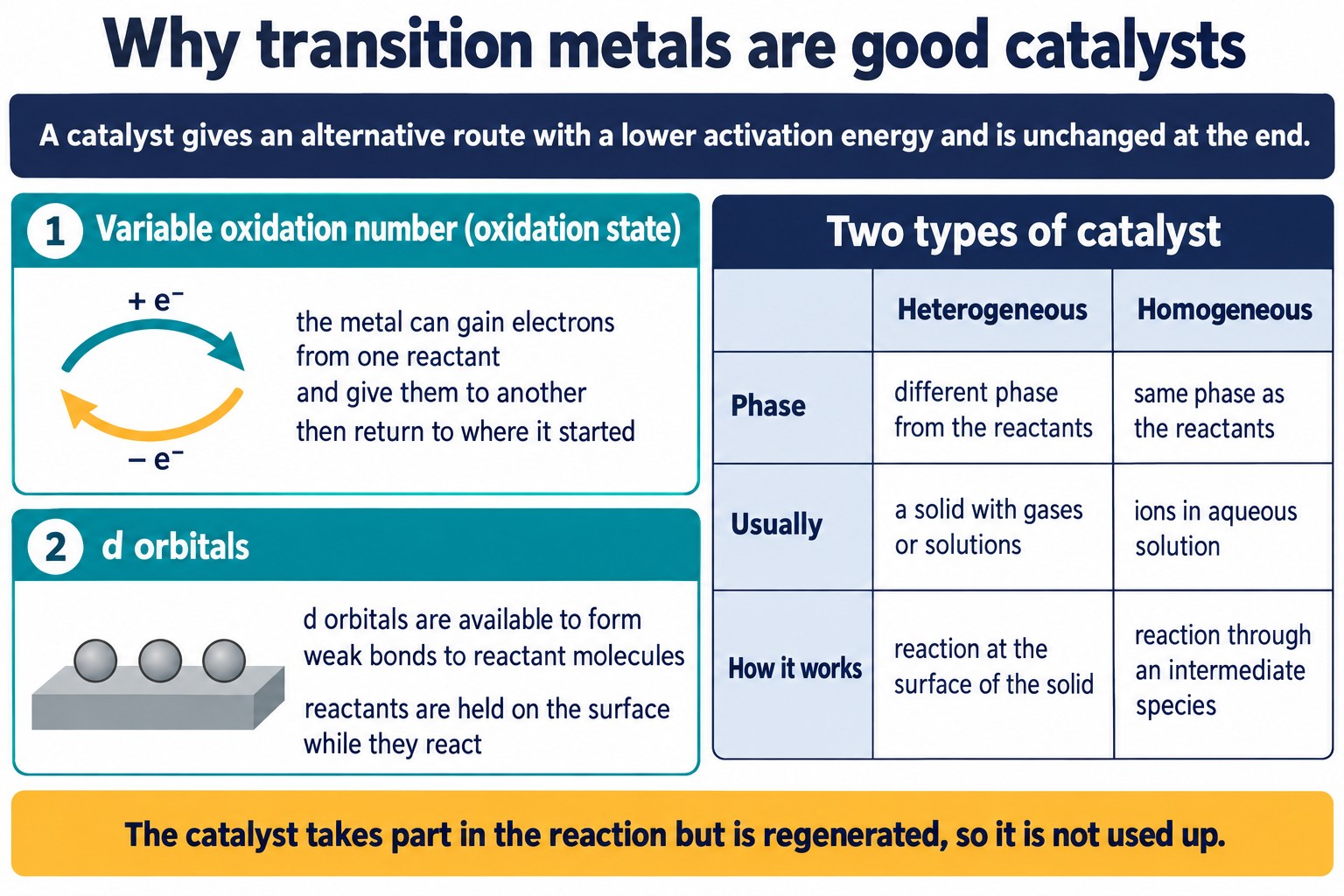
Two features make these elements good catalysts: more than one stable oxidation state, and d orbitals that bond to reactants. A catalyst is heterogeneous or homogeneous.
Remember: A phase is not quite the same as a state. Two liquids that do not mix are two phases. For most exam examples, a solid catalyst with gases is heterogeneous.
Quick Check: Would It Work as a Catalyst?
Pick the one accurate statement in each set, using metals and mixtures that are new to this page.
How a Heterogeneous Catalyst Works
A heterogeneous catalyst is usually a solid, and the reactants are gases or in solution. The reaction takes place at the surface of the catalyst.
- Adsorption: reactant molecules form weak bonds to atoms on the surface.
- Bonds inside the reactant molecules are weakened. The molecules are also held close together, in a favourable position.
- Reaction: new bonds form between the particles held on the surface.
- Desorption: the product molecules leave the surface, which is then free to adsorb more reactant.
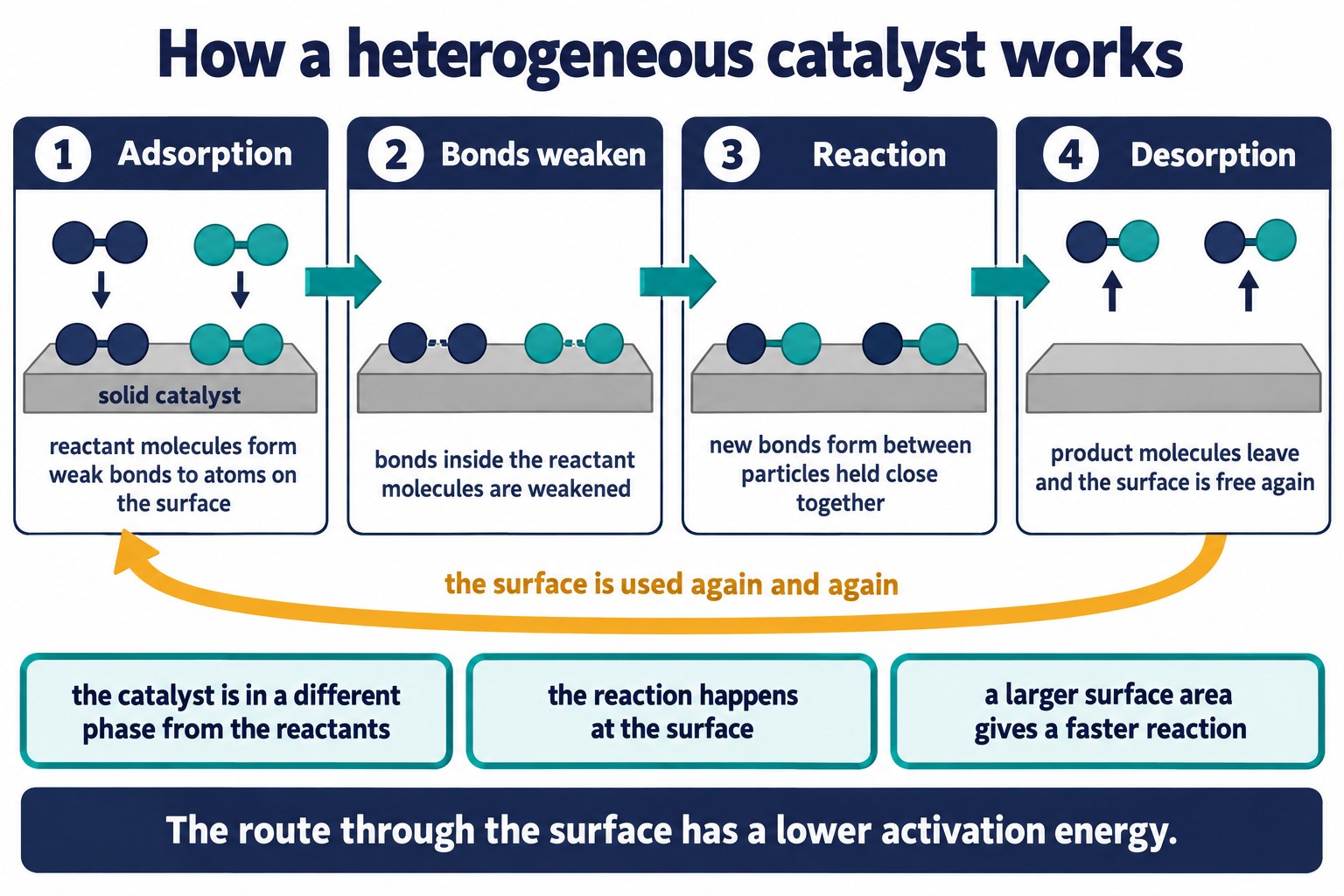
The four stages of heterogeneous catalysis: adsorption of the reactants, weakening of their bonds, reaction on the surface and desorption of the products.
Why the surface matters
- Adsorption means bonding onto a surface. It is not absorption, which means soaking into the bulk.
- Weakened bonds break more easily, so the activation energy is lower.
- A larger surface area gives more places for the reaction, so the rate is higher. Catalysts are used as powders, pellets, gauzes or thin coatings.
- The catalyst is unchanged at the end, so a small amount converts a large amount of reactant.
Key idea: The bonds to the surface must be strong enough to hold and weaken the reactants, but weak enough to let the products leave.
Check: Catalysts and Surfaces
Explain why transition elements make good catalysts and put the stages of surface catalysis in order, in questions that do not repeat the examples on this page.
Heterogeneous Catalysts to Know
| Catalyst | Process | Equation |
|---|---|---|
| Iron, Fe | the Haber process, which makes ammonia | N₂(g) + 3H₂(g) ⇌ 2NH₃(g) |
| Vanadium(V) oxide, V₂O₅ | the Contact process, which makes SO₃ for sulfuric acid | 2SO₂(g) + O₂(g) ⇌ 2SO₃(g) |
- In each case the catalyst is a solid and the reactants are gases or in solution: a different phase.
- Iron is a metal used as the element. V₂O₅ is a compound. Both the elements and their compounds can be catalysts.
- In the Haber process, N₂ and H₂ molecules are adsorbed onto the iron, where the strong N≡N bond is weakened.
- In the Contact process the vanadium changes oxidation state, from +5 to +4 and back to +5, as it passes oxygen to SO₂.
Quick Check: Follow a New Catalytic Cycle
Follow the electrons round a surface catalyst that is new to this page.
Homogeneous Catalysis in Outline
A homogeneous catalyst is in the same phase as the reactants. Often all the species are ions in aqueous solution.
- The catalyst reacts with one reactant to form an intermediate.
- The transition element ion changes oxidation state in this step.
- The intermediate reacts with the other reactant. The catalyst is regenerated in its original oxidation state.
Example: iron(II) ions with peroxodisulfate and iodide
S₂O₈²⁻(aq) + 2I⁻(aq) → 2SO₄²⁻(aq) + I₂(aq)
Without a catalyst this reaction is slow. Both reactants are negative ions, so they repel each other and the activation energy is high.
| Step | Equation | Change to iron |
|---|---|---|
| 1 | S₂O₈²⁻ + 2Fe²⁺ → 2SO₄²⁻ + 2Fe³⁺ | Fe²⁺ oxidised to Fe³⁺ |
| 2 | 2Fe³⁺ + 2I⁻ → 2Fe²⁺ + I₂ | Fe³⁺ reduced back to Fe²⁺ |
- Each step is between a positive ion and a negative ion, which attract. Both steps have a lower activation energy.
- Fe²⁺ is used in step 1 and regenerated in step 2. Adding the two steps gives the overall equation.
- Fe³⁺ ions also catalyse the reaction: step 2 then happens first.
Key idea: Heterogeneous catalysts work at a surface. Homogeneous catalysts work through an intermediate. Both depend on the transition element changing oxidation state easily.
Common Exam Points
Say
- “A heterogeneous catalyst is in a different phase from the reactants, and the reaction occurs at its surface.”
- “Reactants are adsorbed, bonds are weakened, the reaction occurs and the products are desorbed.”
- “Transition elements can change oxidation state easily, so they can transfer electrons between reactants.”
Do not say
- “The reactants are absorbed” (the word is adsorbed: onto the surface, not into the solid).
- “The catalyst does not take part in the reaction” (it takes part and is regenerated).
- “The catalyst gives the particles more energy” (it lowers the activation energy).
- “The catalyst increases the yield” (the position of equilibrium does not change).
Watch for
- State symbols: they show whether the catalyst is in a different phase from the reactants.
- Desorption: an answer that stops at “the reaction occurs” is incomplete.
Check: Heterogeneous Catalysis
Bring the page together: phases, adsorption and desorption, surface area and the role of the catalyst, in contexts that are not used on this page.
FAQs
Use these quick answers to check why transition elements are good catalysts and how heterogeneous and homogeneous catalysts work.
What is a heterogeneous catalyst?
It is a catalyst in a different phase from the reactants, usually a solid with gaseous reactants. The reaction takes place at the surface of the solid. A homogeneous catalyst is in the same phase as the reactants.
Why are transition elements good catalysts?
They have more than one stable oxidation state, so they can accept electrons from one species and pass them to another. They also have vacant d orbitals that are energetically accessible, which form dative covalent bonds with ligands.
What is the difference between adsorption and absorption?
Adsorption means bonding onto the surface of the catalyst. Absorption means soaking into the bulk of a material. In surface catalysis the reactants are adsorbed, their bonds are weakened, they react, and the products are then desorbed.
How does a homogeneous catalyst work?
It reacts with one reactant to form an intermediate, and the transition element ion changes oxidation state in this step. The intermediate then reacts with the other reactant, which regenerates the catalyst in its original oxidation state.
Which heterogeneous catalysts should I know?
Iron in the Haber process, N₂ + 3H₂ ⇌ 2NH₃, and vanadium(V) oxide in the Contact process, 2SO₂ + O₂ ⇌ 2SO₃. Both are solids with gaseous reactants. On iron, the strong N≡N bond of adsorbed nitrogen is weakened.

Copyright notice: This OLS revision content, including the explanations, layout, diagrams, tables and embedded learning structure, is authored for Online Learning System by Dr. Mohammed Al-Fatah. It may not be copied, reproduced, redistributed or adapted without written permission.
Keep this note — free
Save your progress across every Cambridge topic. A free account remembers which topics you have covered, saves your question scores, and syncs across your phone and laptop.
- Track every topic you have finished
- Keep your practice-question scores
- No payment, no card, free forever
Already registered? Log in