Ligands, Complex Ions and Their Shapes
A concise revision guide to complex ions: ligands and the dative covalent bond, coordination number, monodentate, bidentate and polydentate ligands, and the octahedral, tetrahedral, square planar and linear shapes.
- 28.2.2
- 28.2.3(a)-i
- 28.2.3(a)-ii
- 28.2.3(a)-iii
- 28.2.3(b)-i
- 28.2.3(b)-ii
- 28.2.3(c)
- 28.2.4
- 28.2.5-a
- 28.2.5-b
- 28.2.5-c
- 28.2.5-d
- 28.2.6(a)
- 28.2.6(b)
What these spec points say
- 28.2.2 define the term ligand as a species that contains a lone pair of electrons that forms a dative covalent bond to a central metal atom/ion
- 28.2.3(a)-i understand and use the term monodentate ligand including as an example H2O
- 28.2.3(a)-ii understand and use the term monodentate ligand including as an example NH3
- 28.2.3(a)-iii understand and use the term monodentate ligand including as an example Cl–
- 28.2.3(b)-i understand and use the term bidentate ligand including as an example 1,2-diaminoethane, en, H2NCH2CH2NH2
- 28.2.3(b)-ii understand and use the term bidentate ligand including as an example the ethanedioate ion, C2O42–
- 28.2.3(c) understand and use the term polydentate ligand including as an example EDTA4–
- 28.2.4 define the term complex as a molecule or ion formed by a central metal atom/ion surrounded by one or more ligands
- 28.2.5-a describe the geometry (shape and bond angles) of transition element complexes which are linear
- 28.2.5-b describe the geometry (shape and bond angles) of transition element complexes which are square planar
- 28.2.5-c describe the geometry (shape and bond angles) of transition element complexes which are tetrahedral
- 28.2.5-d describe the geometry (shape and bond angles) of transition element complexes which are octahedral
- 28.2.6(a) state what is meant by coordination number
- 28.2.6(b) predict the formula and charge of a complex ion, given the metal ion, its charge or oxidation state, the ligand and its coordination number or geometry
Shapes of Complex Ions
Choose a step to watch each ligand travel in and form a dative bond, and the bonds spread out as far apart as they can.
© Dr. Mohammed Al-Fatah – onlinelearningsystem.net
Before You Start
This page builds on bonding and shapes of molecules from your earlier course.
- A lone pair is a pair of outer electrons not used in bonding. Water has two on its oxygen atom and ammonia has one on its nitrogen atom.
- In a dative covalent bond, both shared electrons come from the same atom.
- Electron pairs around a central atom repel each other and move as far apart as possible, which fixes the shape.
- The ions used here are those of the d-block: see Electron Configurations and Properties of Transition elements.
Ligands and Complex Ions
A transition element ion is small and highly charged, and it has vacant orbitals. It attracts species that have lone pairs and accepts those lone pairs into its vacant orbitals.
Definition: A ligand is a molecule or ion with a lone pair of electrons that it donates to a central metal atom or ion, forming a dative covalent bond.
- A complex is a central metal atom or ion surrounded by one or more ligands. If it carries a charge it is a complex ion.
- Every bond between a ligand and the metal ion is a dative covalent bond.
- The formula is written in square brackets with the overall charge outside: [Cu(H₂O)₆]²⁺.
- In water, a metal ion written as Cu²⁺(aq) is really the complex ion [Cu(H₂O)₆]²⁺.
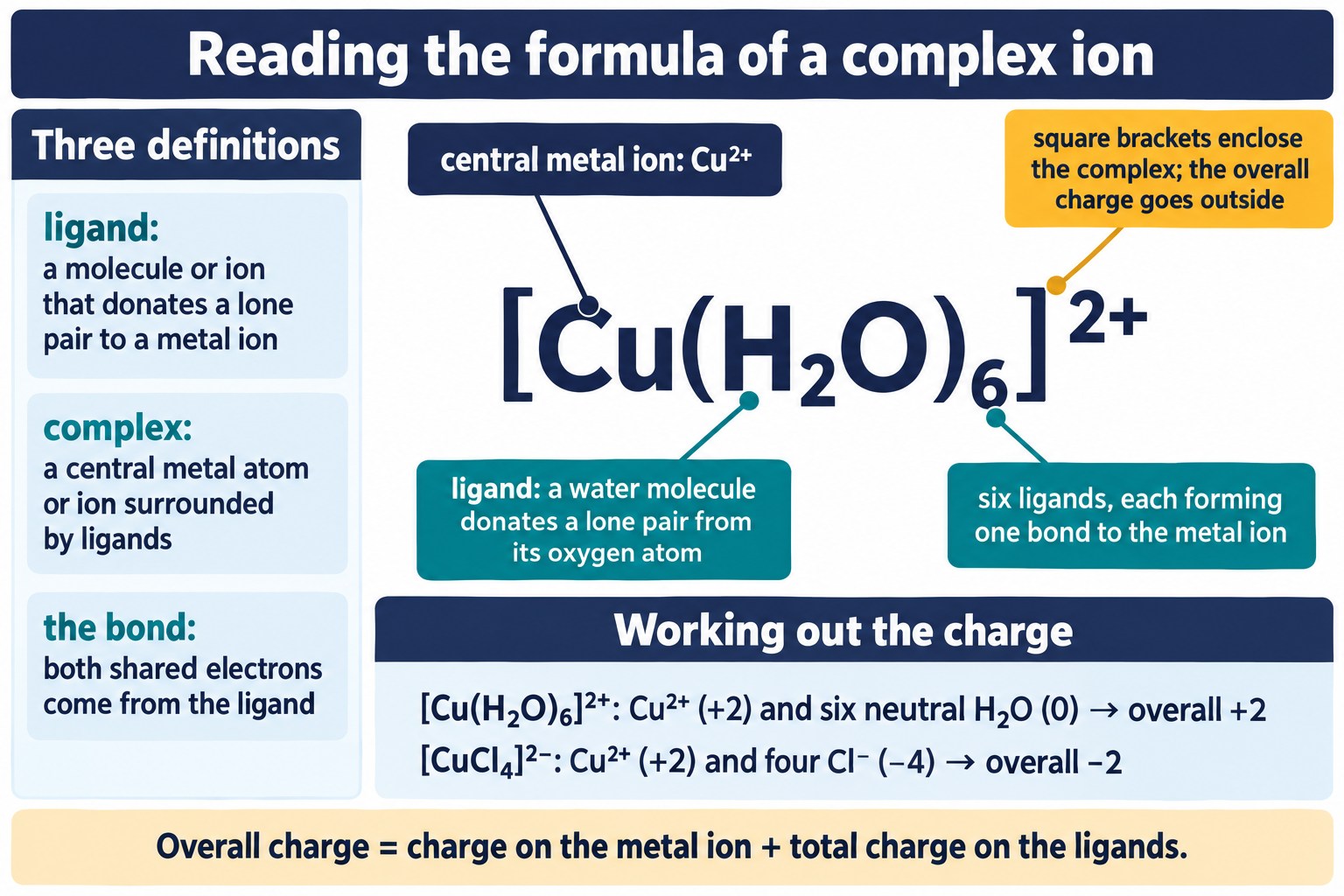
The formula of a complex ion taken apart: the central metal ion, the ligands, the square brackets and the overall charge.
Exam focus: State where the electrons come from: the ligand donates a lone pair to the metal ion. A dative covalent bond is drawn as a line or as an arrow pointing from the ligand to the metal.
Coordination number
Definition: The coordination number is the number of dative covalent bonds to the central metal atom or ion.
The coordination number counts bonds, not ligands. The two are equal only when every ligand forms one bond.
| Complex | Number of ligands | Bonds per ligand | Coordination number |
|---|---|---|---|
| [Cu(H₂O)₆]²⁺ | 6 | 1 | 6 |
| [CuCl₄]²⁻ | 4 | 1 | 4 |
| [Ni(H₂NCH₂CH₂NH₂)₃]²⁺ | 3 | 2 | 6 |
| [Cu(EDTA)]²⁻ | 1 | 6 | 6 |
| [Ag(NH₃)₂]⁺ | 2 | 1 | 2 |
- The most common coordination numbers are 6 and 4.
- A coordination number of 6 does not always mean six ligands.
Monodentate, Bidentate and Polydentate Ligands
Ligands are classified by the number of lone pairs that one ligand donates to the same metal ion.
| Type | Bonds per ligand | Examples |
|---|---|---|
| monodentate | 1 | H₂O, NH₃, OH⁻, Cl⁻, CN⁻ |
| bidentate | 2 | 1,2-diaminoethane, H₂NCH₂CH₂NH₂ (“en”); ethanedioate ion, C₂O₄²⁻ |
| polydentate | more than 2 | EDTA⁴⁻, which forms six bonds |
- Water has two lone pairs but is monodentate: both are on the same small oxygen atom, so only one can reach the metal ion.
- Ammonia has only one lone pair. A hydroxide ion, like water, has all its lone pairs on one oxygen atom, so it also forms one bond.
- In “en”, each nitrogen atom donates one lone pair. The two nitrogen atoms are far enough apart to bond to the same ion.
- In the ethanedioate ion, one lone pair is donated from each of the two negatively charged oxygen atoms.
- The cyanide ion, CN⁻, bonds through the lone pair on its carbon atom.
- EDTA⁴⁻ donates six lone pairs: two from nitrogen atoms and four from oxygen atoms. One EDTA⁴⁻ ion wraps around one metal ion.
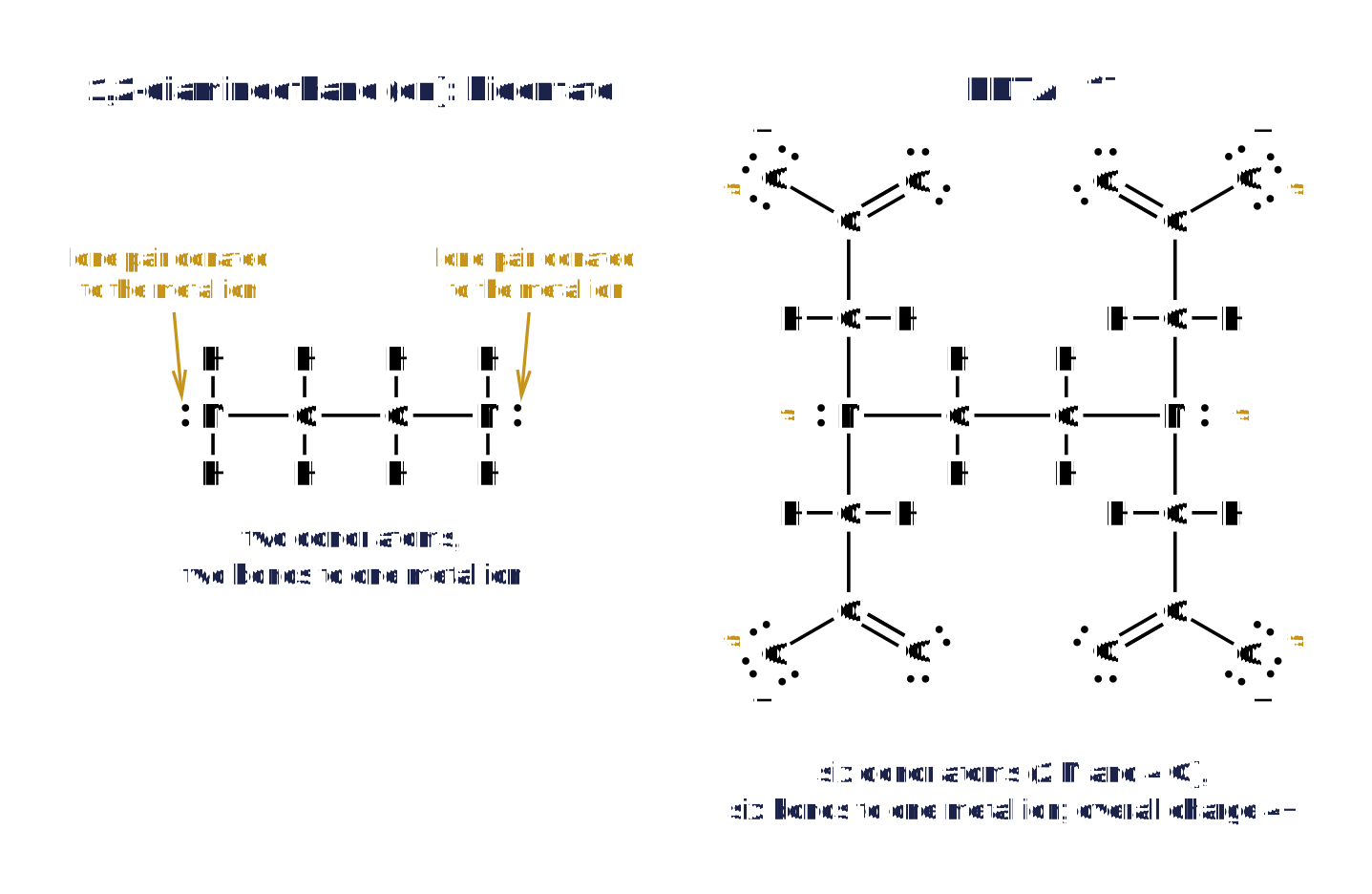
1,2-Diaminoethane has two donor nitrogen atoms. EDTA⁴⁻ has six donor atoms: two nitrogen and four oxygen.
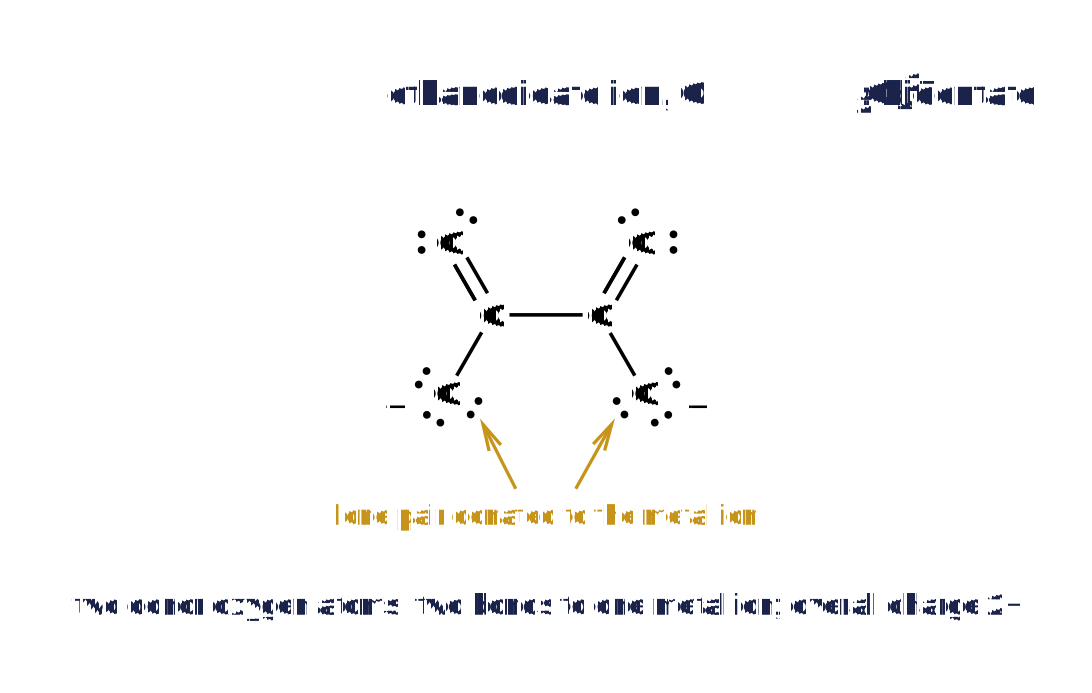
The ethanedioate ion bonds through one lone pair on each of its two negatively charged oxygen atoms.
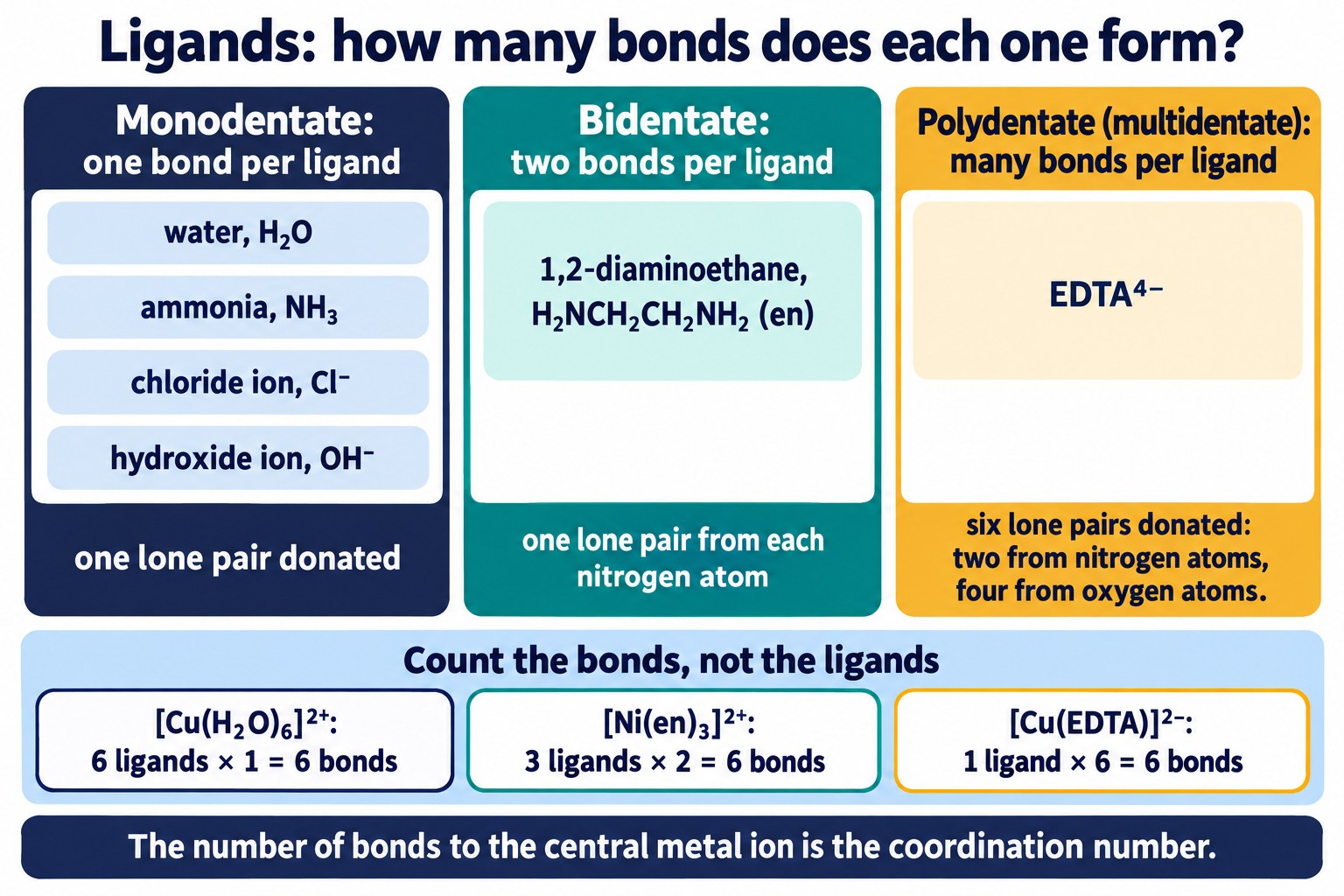
Ligands sorted by the number of bonds each one forms to a single metal ion, with the bonds counted in three complexes.
Remember: Three bidentate ligands or one EDTA⁴⁻ ion fill all six positions around a metal ion: [Ni(en)₃]²⁺ and [Cu(EDTA)]²⁻ both have a coordination number of 6.
Check: Ligands and Complex Ions
Use the terms ligand, complex ion, dative covalent bond and coordination number with complexes not shown above.
Quick Check: Count the Bonds, Not the Ligands
Work out how many bonds each new complex has to its metal ion, where en is the bidentate molecule H₂NCH₂CH₂NH₂, each EDTA⁴⁻ forms six bonds and CN⁻ is monodentate.
Charges and Oxidation states in Complexes
The overall charge on a complex is the charge on the metal ion plus the total charge on the ligands. The same sum, run backwards, gives the oxidation state of the metal.
| Ligand | Charge |
|---|---|
| H₂O, NH₃, H₂NCH₂CH₂NH₂ | 0 |
| Cl⁻, OH⁻, CN⁻ | −1 |
| C₂O₄²⁻ | −2 |
| EDTA⁴⁻ | −4 |
Worked example: the charge on a complex
Worked example: the oxidation state of the metal
Step 1. In [CoCl₄]²⁻, four chloride ligands contribute 4 × (−1) = −4.
Answer. Co + (−4) = −2, so cobalt is +2.
Step 1. In [Cr(NH₃)₆]³⁺, the six ammonia ligands are neutral.
Answer. Chromium is +3, the same as the overall charge.
Answer. Pt + (−2) = 0, so platinum is +2.
Step 1. In [Fe(CN)₆]⁴⁻, six cyanide ligands contribute −6.
Answer. Fe + (−6) = −4, so iron is +2.
Step 1. In [Cr(C₂O₄)₃]³⁻, three ethanedioate ligands contribute 3 × (−2) = −6.
Predicting the formula and charge of a complex
Given the metal ion, the ligand and the coordination number or shape, work out how many ligands are needed, then add up the charges.
| Metal ion | Ligand | Coordination number or shape | Ligands needed | Formula |
|---|---|---|---|---|
| Co³⁺ | NH₃ | 6 | 6 | [Co(NH₃)₆]³⁺ |
| Fe³⁺ | CN⁻ | 6 | 6 | [Fe(CN)₆]³⁻ |
| Ni²⁺ | en (bidentate) | 6 | 3 | [Ni(en)₃]²⁺ |
| Zn²⁺ | Cl⁻ | tetrahedral | 4 | [ZnCl₄]²⁻ |
| Ag⁺ | NH₃ | linear | 2 | [Ag(NH₃)₂]⁺ |
- Number of ligands = (coordination number) / (bonds per ligand).
- For Fe³⁺ with six CN⁻: +3 + 6 × (−1) = −3.
Exam focus: Check a formula by adding the charges. For [CuCl₄]²⁻: +2 + 4 × (−1) = −2. If the sum does not match the charge outside the brackets, the oxidation state is wrong.
Check: Coordination number, Charge and Oxidation state
Work out the coordination number, the overall charge and the oxidation state of the metal in complexes not used above.
Shapes of Complex Ions
The shape depends on the coordination number and on the size of the ligands. The bonding pairs repel each other and take up positions as far apart as possible.
| Shape | Coordination number | Bond angle | Typical ligands | Examples |
|---|---|---|---|---|
| octahedral | 6 | 90° | small: H₂O, NH₃ | [Cu(H₂O)₆]²⁺, [Fe(H₂O)₆]²⁺, [Cr(NH₃)₆]³⁺ |
| tetrahedral | 4 | 109.5° | large: Cl⁻ | [CuCl₄]²⁻, [CoCl₄]²⁻ |
| square planar | 4 | 90° | mostly complexes of platinum(II) | [Pt(NH₃)₂Cl₂], cis-platin |
| linear | 2 | 180° | NH₃ with silver(I) | [Ag(NH₃)₂]⁺ |
Why six bonds give an octahedron
- Six bonding pairs of electrons surround the metal ion.
- They repel each other equally and move as far apart as possible.
- The position of minimum repulsion puts the six ligands at the corners of an octahedron, with all bond angles 90°.
Why chloride gives a tetrahedron
- A chloride ion is much larger than a water or ammonia molecule.
- Only four chloride ions fit around the metal ion, and they repel each other strongly.
- Four bonding pairs spread out to 109.5°, so [CuCl₄]²⁻ is tetrahedral and the coordination number falls from 6 to 4.
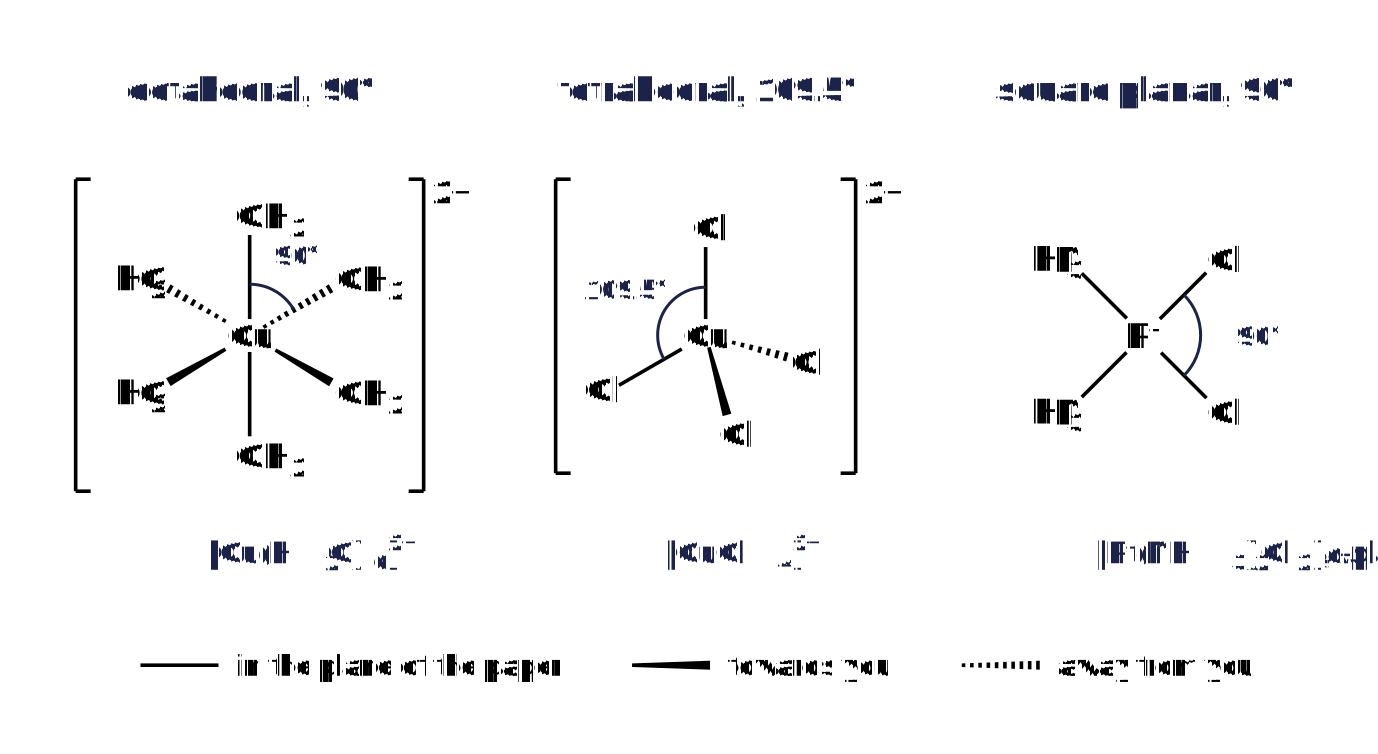
Octahedral [Cu(H₂O)₆]²⁺, tetrahedral [CuCl₄]²⁻ and square planar cis-platin, drawn with wedges and hashed bonds.
Drawing tip: Draw an octahedral complex with two plain bonds, two wedges and two hashed bonds. Bond each ligand through its donor atom, and put square brackets and the charge around the whole ion.
Linear Complexes
Silver(I) ions form a complex with only two ligands. Two bonding pairs repel to opposite sides of the ion, giving a linear shape with a bond angle of 180°.
- [Ag(NH₃)₂]⁺ has a coordination number of 2.
- It forms when aqueous ammonia is added to a solution containing silver ions.
- The solution is colourless: Ag⁺ is 4d¹⁰, with a full d set.
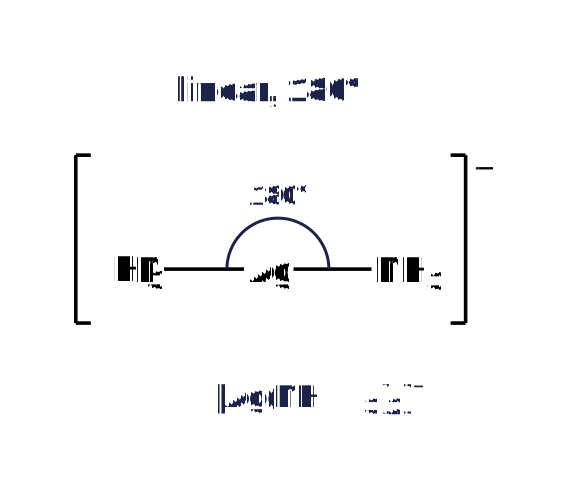
The linear complex ion [Ag(NH₃)₂]⁺: both ammonia ligands bond through nitrogen and the N–Ag–N angle is 180°.
Cis-platin
Cis-platin, [Pt(NH₃)₂Cl₂], is a square planar complex of platinum(II). It is neutral: the +2 of the platinum is balanced by two chloride ligands.
- The four ligands lie in one plane at 90° to each other.
- “cis” means that the two chloride ligands are next to each other, on the same side of the complex.
- In the other isomer, the trans form, the two chloride ligands are opposite each other.
- Cis-platin is used in cancer treatment.
The two isomers, and how to draw them, are covered in Stereoisomerism in Complex Ions.
Remember: Cis-platin has the same coordination number as [CuCl₄]²⁻ but a different shape: square planar with 90° angles, not tetrahedral with 109.5° angles.
Check: Shapes and Bond Angles
Predict the shape and bond angle of complexes from their ligands and coordination number.
Common Exam Points
- A ligand donates a lone pair to the metal ion. Say “lone pair” and name the bond as a dative covalent bond.
- The coordination number is the number of dative covalent bonds to the metal, not the number of ligands.
- [Ni(en)₃]²⁺ has three ligands but a coordination number of 6.
- Small ligands (H₂O, NH₃) give octahedral complexes with 90° angles. The larger Cl⁻ gives tetrahedral complexes with 109.5° angles.
- Cis-platin is square planar, 90°, and has no overall charge.
- [Ag(NH₃)₂]⁺ is linear with a bond angle of 180°.
- Bond water through O and ammonia through N in any drawing.
- To find the oxidation state of the metal, subtract the total ligand charge from the overall charge.
- To predict a formula, divide the coordination number by the bonds per ligand, then add up the charges.
FAQs
Use these quick answers to check ligands, the coordination number and the shapes of complex ions.
What is a ligand?
A ligand is a molecule or ion that donates a lone pair of electrons to a central metal ion, forming a dative covalent bond. Water, ammonia, cyanide ions and chloride ions are monodentate: each one forms a single bond to the metal ion.
Is the coordination number the same as the number of ligands?
No. The coordination number is the number of dative covalent bonds to the central metal ion. In [Ni(en)₃]²⁺ three bidentate ligands form six bonds, so the coordination number is 6. In [Cu(EDTA)]²⁻ one ligand forms all six.
Why is [CuCl₄]²⁻ tetrahedral when [Cu(H₂O)₆]²⁺ is octahedral?
Chloride ions are larger than water molecules, so only four fit round the Cu²⁺ ion. Four ligands give a tetrahedral shape with bond angles of 109.5°. Six small ligands, such as H₂O or NH₃, give an octahedral shape with 90° angles.
How do I work out the oxidation state of the metal in a complex?
The charge on the complex equals the oxidation state of the metal plus the total charge of the ligands. In [CoCl₄]²⁻ four Cl⁻ ligands total 4−, so cobalt is +2. In [Cr(NH₃)₆]³⁺ ammonia is neutral, so chromium is +3.
Which complex ions are linear?
Silver(I) forms the linear complex [Ag(NH₃)₂]⁺, with a coordination number of 2 and a bond angle of 180°. It forms when aqueous ammonia is added to a solution containing silver ions.

Copyright notice: This OLS revision content, including the explanations, layout, diagrams, tables and embedded learning structure, is authored for Online Learning System by Dr. Mohammed Al-Fatah. It may not be copied, reproduced, redistributed or adapted without written permission.
Keep this note — free
Save your progress across every Cambridge topic. A free account remembers which topics you have covered, saves your question scores, and syncs across your phone and laptop.
- Track every topic you have finished
- Keep your practice-question scores
- No payment, no card, free forever
Already registered? Log in