Stereoisomerism in Complex Ions
A concise revision guide to stereoisomerism in complexes: cis–trans isomerism in square planar and octahedral complexes, optical isomerism with bidentate ligands, and the polarity of the isomers.
- 28.4.1(a)-i
- 28.4.1(a)-ii
- 28.4.1(b)
- 28.4.2
What these spec points say
- 28.4.1(a)-i describe geometrical (cis/trans) isomerism shown by complexes, e.g. square planar such as [Pt(NH3)2Cl2]
- 28.4.1(a)-ii describe geometrical (cis/trans) isomerism shown by complexes, including those associated with bidentate ligands, e.g. octahedral such as [Co(NH3)4(H2O)2]2+ and [Ni(H2NCH2CH2NH2)2(H2O)2]2+
- 28.4.1(b) describe optical isomerism shown by complexes, including those associated with bidentate ligands, e.g. [Ni(H2NCH2CH2NH2)3]2+ and [Ni(H2NCH2CH2NH2)2(H2O)2]2+
- 28.4.2 deduce the overall polarity of complexes such as those described in 28.4.1(a) and 28.4.1(b)
Isomers of Complexes
Choose a step to compare the cis and trans forms of a square planar complex, then try to fit an octahedral complex onto its mirror image.
© Dr. Mohammed Al-Fatah – onlinelearningsystem.net
Before You Start
Stereoisomerism was introduced in organic chemistry. The same two types are found in complexes.
- Stereoisomers have the same structural formula but a different arrangement of atoms in space.
- E/Z (geometrical or cis–trans) isomerism in alkenes: groups are fixed on the same side or on opposite sides of a C=C bond.
- Optical isomerism: a molecule and its mirror image cannot be superimposed.
- The shapes needed here, octahedral and square planar, are covered in Ligands, Complex Ions and Their Shapes.
Stereoisomers of Complexes
In a complex, the ligands are held in fixed positions around the metal ion. If the same ligands can be arranged in more than one way in space, the complex has stereoisomers.
| Type | Found in | Example |
|---|---|---|
| geometrical (cis–trans) isomerism | square planar complexes with two ligands of one kind and two of another | [Pt(NH₃)₂Cl₂] |
| geometrical (cis–trans) isomerism | octahedral complexes with four ligands of one kind and two of another | [Co(NH₃)₄(H₂O)₂]²⁺ |
| optical isomerism | octahedral complexes with bidentate ligands | [Ni(H₂NCH₂CH₂NH₂)₃]²⁺ |
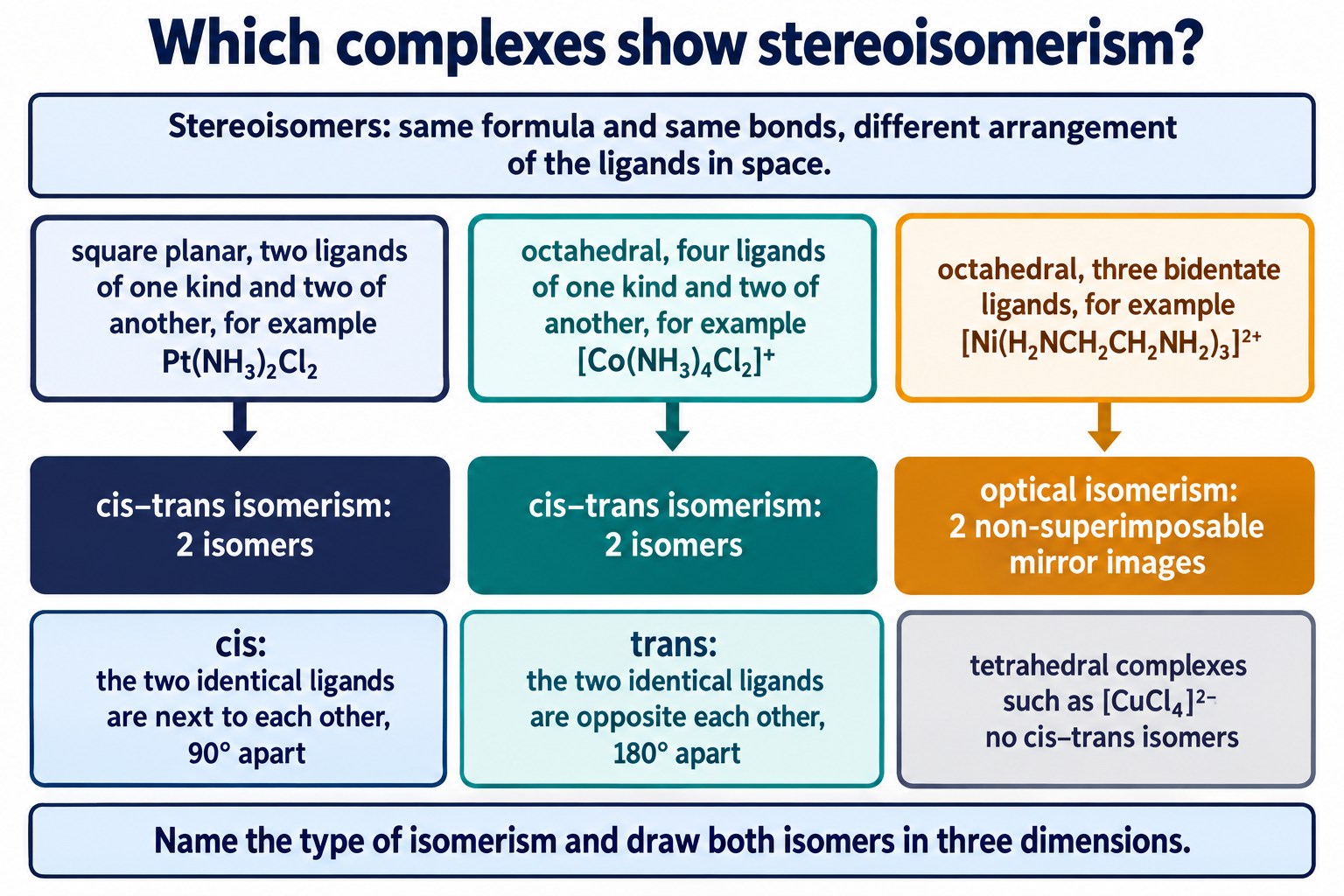
A flow chart for deciding which type of stereoisomerism a complex can show, from its shape and its ligands.
- Tetrahedral complexes such as [CuCl₄]²⁻ do not show cis–trans isomerism: every position is next to every other.
- A complex with six identical monodentate ligands, such as [Cu(H₂O)₆]²⁺, has no stereoisomers.
Quick Check: Which Type of Stereoisomerism?
Use the shape and the ligands to classify each new complex. In these complexes, Pt(II) is square planar and C₂O₄²⁻ is a bidentate ligand.
Cis–Trans Isomerism in Square Planar Complexes
In [Pt(NH₃)₂Cl₂], the four ligands sit at the corners of a square around the platinum(II) ion. There are two ways to arrange them.
| cis isomer | trans isomer | |
|---|---|---|
| Identical ligands | next to each other | opposite each other |
| Cl–Pt–Cl angle | 90° | 180° |
| Name | cis-[Pt(NH₃)₂Cl₂], cis-platin | trans-[Pt(NH₃)₂Cl₂] |
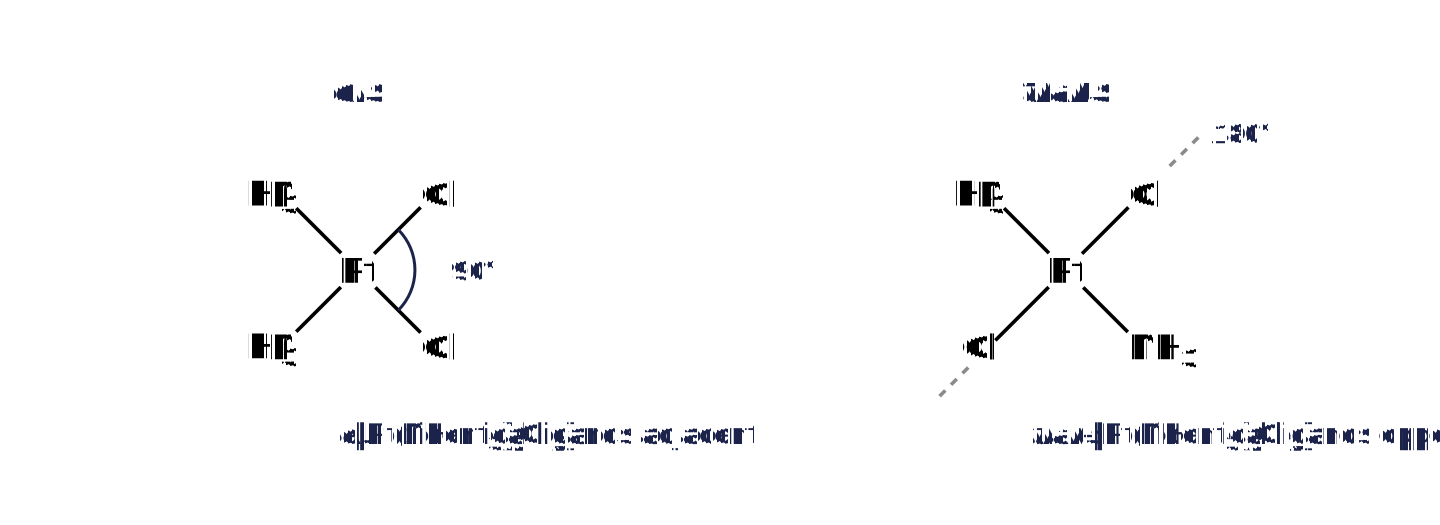
The cis and trans isomers of [Pt(NH₃)₂Cl₂]. In the cis isomer the two chloride ligands are 90° apart. In the trans isomer they are 180° apart.
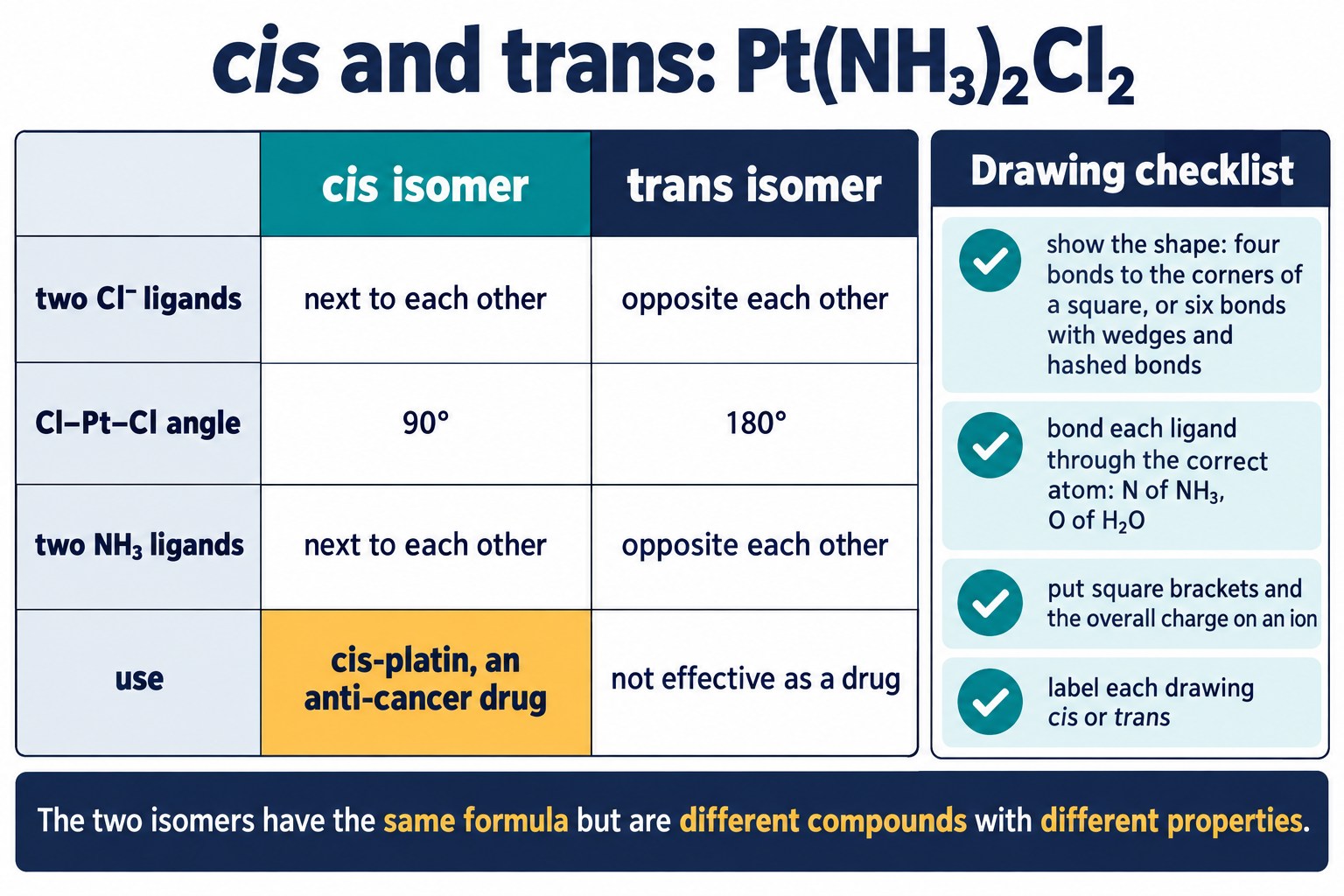
The cis and trans isomers compared in words, with a checklist for drawing the isomers of any complex.
Remember: cis means the two identical ligands are adjacent, at 90°. trans means they are opposite, at 180°. The two isomers are different compounds with different properties.
Cis–Trans Isomerism in Octahedral Complexes
An octahedral complex with four ligands of one kind and two of another also has two isomers. The pair of matching ligands is either adjacent or opposite.
| Isomer | Positions of the two matching ligands | Angle between them |
|---|---|---|
| cis | next to each other | 90° |
| trans | opposite each other, on a straight line through the metal | 180° |
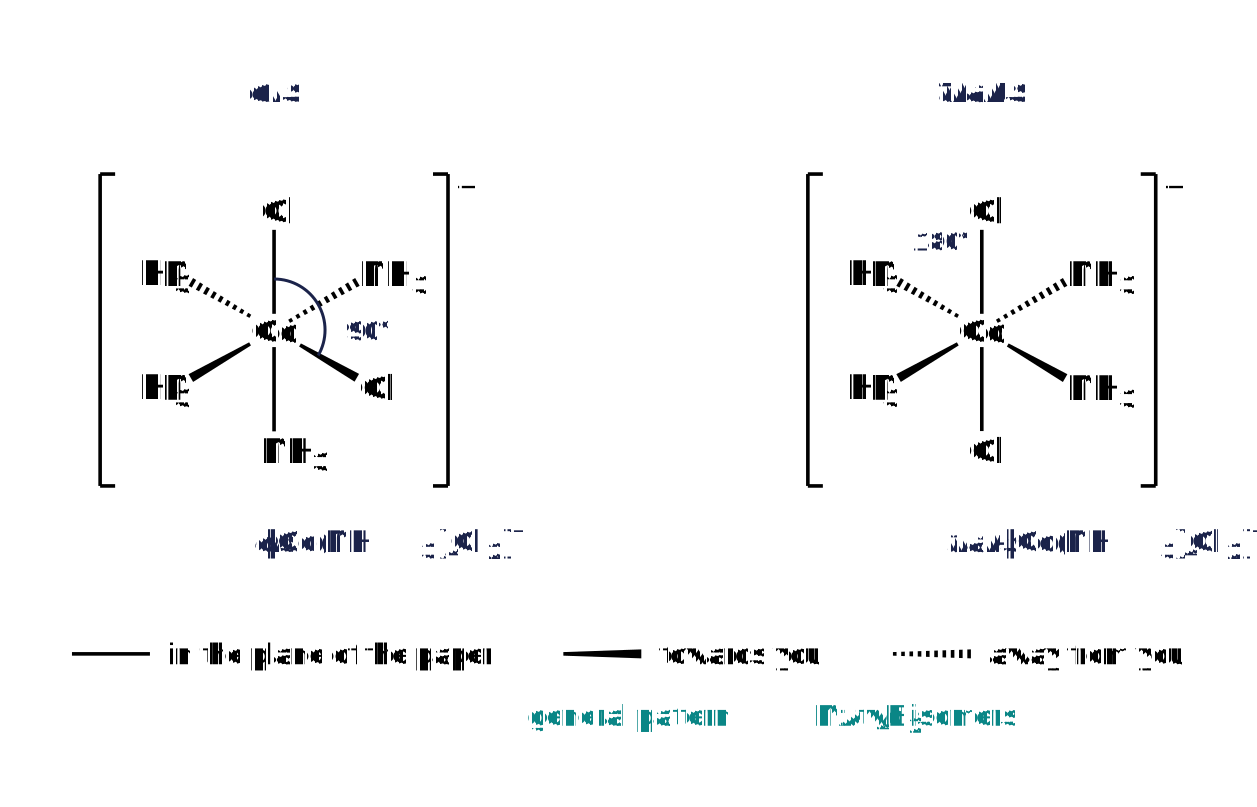
The cis and trans isomers of [Co(NH₃)₄Cl₂]⁺. Compare the positions of the two chloride ligands.
- In cis-[Co(NH₃)₄Cl₂]⁺, the two chloride ligands are 90° apart.
- In trans-[Co(NH₃)₄Cl₂]⁺, the two chloride ligands are 180° apart.
- [Co(NH₃)₄(H₂O)₂]²⁺ follows the same pattern: the two water ligands are adjacent in the cis isomer and opposite in the trans isomer.
- There are only two isomers. Any other drawing is one of these two, rotated.
With bidentate ligands
[Ni(H₂NCH₂CH₂NH₂)₂(H₂O)₂]²⁺ has two bidentate “en” ligands and two water ligands. The two water ligands can be adjacent (cis) or opposite (trans).
- Each “en” ligand must join two neighbouring positions. It cannot stretch across the metal ion to the opposite side.
- In the trans isomer, the two “en” ligands lie in one plane with the water ligands above and below.
Drawing tip: Keep the same octahedral skeleton for both drawings: two plain bonds, two wedges, two hashed bonds. For trans, put the matching ligands on the two plain vertical bonds.
Check: Cis–Trans Isomers of Complexes
Identify cis and trans isomers and decide which complexes can show this type of isomerism.
Optical Isomerism in Octahedral Complexes
An octahedral complex with three bidentate ligands exists as two optical isomers. They are mirror images of each other that cannot be superimposed.
- In [Ni(H₂NCH₂CH₂NH₂)₃]²⁺, each “en” ligand bridges two neighbouring positions.
- The three ligands are arranged like the blades of a propeller, which can twist to the left or to the right.
- The two forms rotate the plane of plane-polarised light in opposite directions.
- [Cr(C₂O₄)₃]³⁻, with three bidentate ethanedioate ligands, shows optical isomerism in the same way.
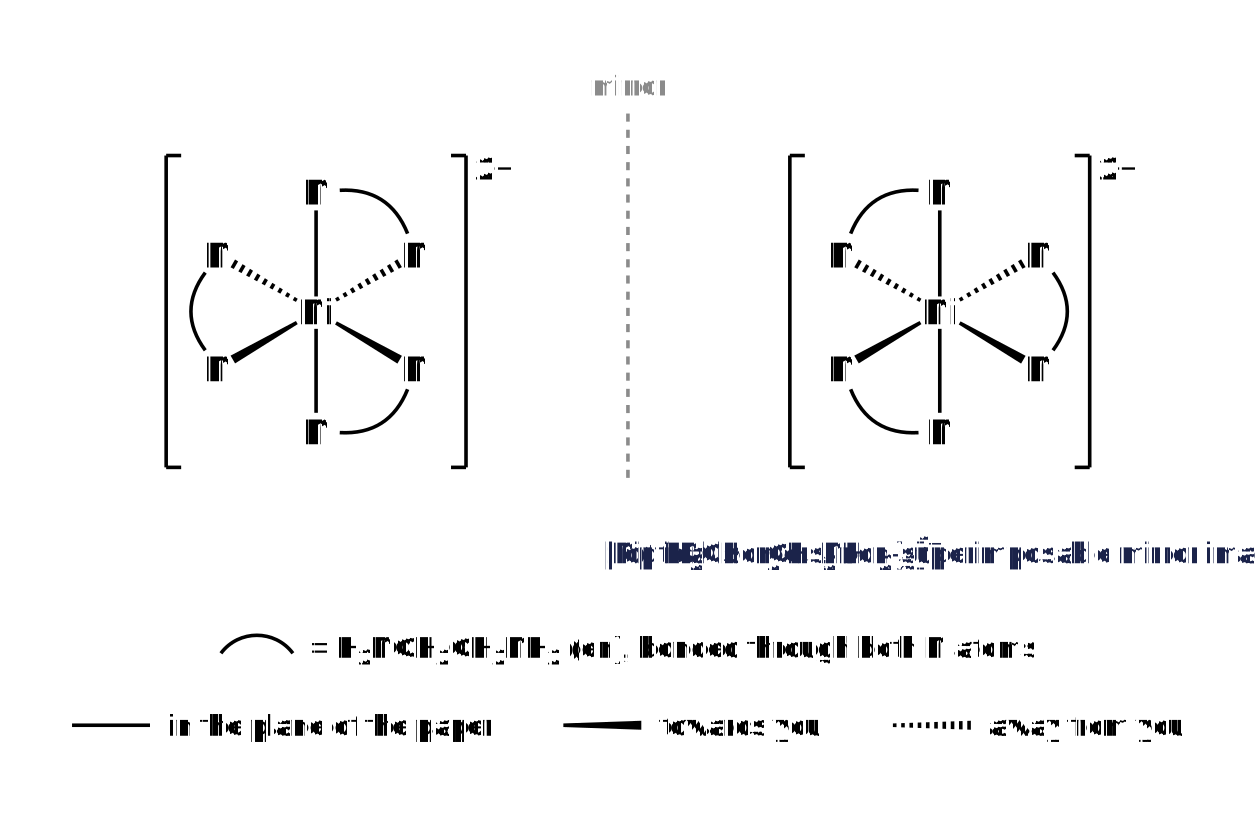
The two optical isomers of [Ni(H₂NCH₂CH₂NH₂)₃]²⁺ either side of a mirror line. Each curved line stands for one “en” ligand.
Cis–trans and optical isomerism together
[Ni(H₂NCH₂CH₂NH₂)₂(H₂O)₂]²⁺ has three stereoisomers in total.
- The cis isomer has no plane of symmetry. It exists as a pair of optical isomers.
- The trans isomer has a plane of symmetry. Its mirror image is identical to it, so it is not optically active.
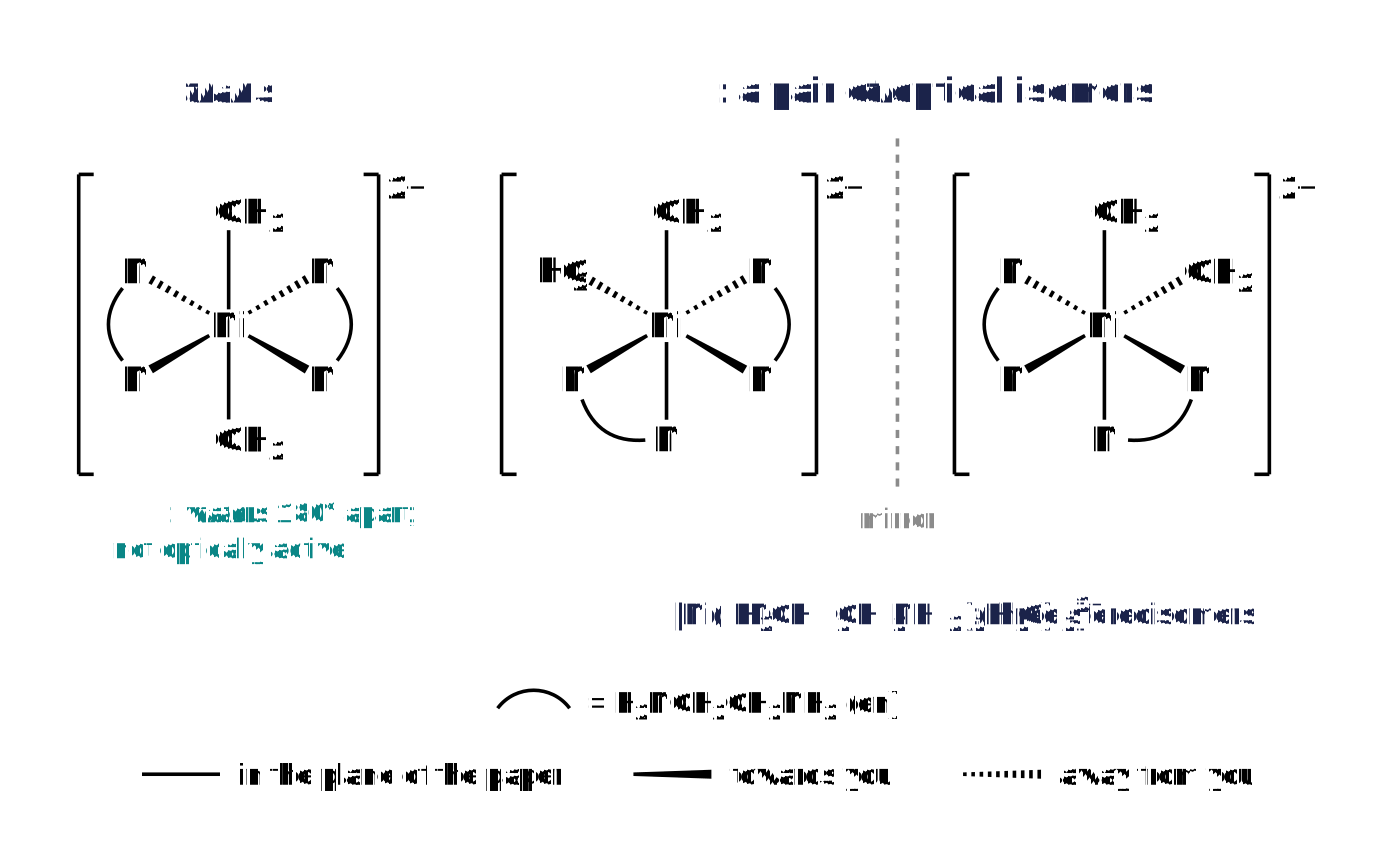
The three stereoisomers of [Ni(H₂NCH₂CH₂NH₂)₂(H₂O)₂]²⁺: one trans isomer and a pair of cis optical isomers.
Drawing tip: Draw the first isomer, then draw a vertical dashed mirror line and reflect every ligand across it. Show each bidentate ligand as a curved line joining two neighbouring donor atoms.
Quick Check: Counting the Stereoisomers
Combine cis–trans and optical isomerism for a complex that is new to this page.
Quick Check: Spot the Optical Isomers
Decide which of these new complexes exist as a pair of optical isomers.
Polarity of Complexes
Each bond between the metal and a ligand has a dipole. The overall polarity depends on whether these dipoles cancel, which depends on the symmetry of the complex.
| Complex | Arrangement | Overall polarity |
|---|---|---|
| cis-[Pt(NH₃)₂Cl₂] | both Pt–Cl dipoles on the same side | polar: the dipoles do not cancel |
| trans-[Pt(NH₃)₂Cl₂] | equal dipoles point in opposite directions | non-polar: the dipoles cancel |
| cis-[Co(NH₃)₄(H₂O)₂]²⁺ | two water ligands on the same side | polar |
| trans-[Co(NH₃)₄(H₂O)₂]²⁺ | two water ligands opposite each other | non-polar |
| cis-[Ni(en)₂(H₂O)₂]²⁺ | two water ligands on the same side | polar |
| trans-[Ni(en)₂(H₂O)₂]²⁺ | two water ligands opposite each other | non-polar |
| [Ni(en)₃]²⁺ | three identical ligands arranged symmetrically | non-polar: both optical isomers |
- Trans isomers are symmetrical, so equal and opposite dipoles cancel.
- Cis isomers have the matching ligands on one side, so there is an overall dipole.
- A complex with identical ligands in every position, such as [Cu(H₂O)₆]²⁺ or [CuCl₄]²⁻, has no overall dipole.
Exam focus: To deduce polarity, draw the complex in three dimensions, mark the dipole on each different bond, and decide whether the dipoles cancel. State the reason, not only the answer.
Check: Optical Isomers of Complexes
Decide which complexes have optical isomers and describe how the two isomers are related.
Common Exam Points
- Name the type of isomerism in full: cis–trans isomerism or optical isomerism.
- cis: identical ligands adjacent, 90°. trans: identical ligands opposite, 180°.
- Square planar [Pt(NH₃)₂Cl₂] and octahedral [Co(NH₃)₄Cl₂]⁺ each have one cis and one trans isomer.
- Optical isomers are non-superimposable mirror images. Three bidentate ligands on an octahedral ion always give two.
- Draw optical isomers either side of a mirror line, with wedges and hashed bonds.
- A bidentate ligand always spans two neighbouring positions, never two opposite positions.
- [Ni(en)₂(H₂O)₂]²⁺ has three stereoisomers: trans, and two cis optical isomers.
- Cis isomers are polar because the dipoles do not cancel. Trans isomers are non-polar.
FAQs
Use these quick answers to check cis-trans and optical isomerism in complexes and the polarity of the isomers.
What is the difference between cis and trans isomers?
In the cis isomer the two identical ligands are next to each other, 90° apart. In the trans isomer they are opposite each other, 180° apart. Square planar [Pt(NH₃)₂Cl₂] and octahedral [Co(NH₃)₄Cl₂]⁺ both have a cis and a trans form.
Can a tetrahedral complex show cis-trans isomerism?
No. In a tetrahedral complex such as [CuCl₄]²⁻ every position is next to every other, so there is only one arrangement. Look for cis-trans isomers in square planar complexes and in octahedral complexes with two ligands that differ from the rest.
Which complexes show optical isomerism?
Octahedral complexes with bidentate ligands, such as [Ni(en)₃]²⁺, where en is H₂NCH₂CH₂NH₂. The three ligands can be arranged in two ways that are mirror images of each other and cannot be superimposed. These are the two optical isomers.
What is cis-platin?
It is the cis isomer of [Pt(NH₃)₂Cl₂], a square planar complex of platinum(II) in which the two chloride ligands are next to each other. It is used in cancer treatment. The trans isomer is not effective.
How do I decide whether an isomer is polar?
Check whether the bond dipoles cancel. In cis-[Pt(NH₃)₂Cl₂] the two Pt-Cl dipoles lie on the same side, so they do not cancel and the molecule is polar. In the trans isomer they are opposite and cancel, so it is non-polar.

Copyright notice: This OLS revision content, including the explanations, layout, diagrams, tables and embedded learning structure, is authored for Online Learning System by Dr. Mohammed Al-Fatah. It may not be copied, reproduced, redistributed or adapted without written permission.
Keep this note — free
Save your progress across every Cambridge topic. A free account remembers which topics you have covered, saves your question scores, and syncs across your phone and laptop.
- Track every topic you have finished
- Keep your practice-question scores
- No payment, no card, free forever
Already registered? Log in