Amines, Amides and Amino Acids: Structure and Naming
A concise revision guide to the nitrogen-containing functional groups: primary, secondary and tertiary amines, aliphatic and aromatic amines such as butylamine and phenylamine, primary and N-substituted amides, and 2-amino acids, with their names, structural, displayed and skeletal formulae, hydrogen bonding and solubility.
Recap: Ammonia, Halogenoalkanes and Acyl Chlorides
Five quick questions on what you already know: the nucleophilic substitution of a halogenoalkane by ammonia from Nucleophilic Substitution Reactions, and the reactions of acyl chlorides with ammonia and amines from Acyl Chlorides.
Amines: Derivatives of Ammonia
An amine is ammonia, NH₃, with one or more hydrogen atoms replaced by carbon groups. The amine group, –NH₂, keeps the lone pair of electrons on nitrogen.
| Class | Carbon groups on N | Example |
|---|---|---|
| primary amine | one | butylamine, CH₃CH₂CH₂CH₂NH₂; ethylamine, CH₃CH₂NH₂ |
| secondary amine | two | diethylamine, (CH₃CH₂)₂NH |
| tertiary amine | three | triethylamine, (CH₃CH₂)₃N |
| quaternary ammonium ion | four (positive ion, no lone pair) | tetramethylammonium ion, (CH₃)₄N⁺ |
- Primary, secondary and tertiary count the carbon groups bonded to the nitrogen.
- Alcohols are classed differently: by the carbons bonded to the carbon that holds the OH group.
- So (CH₃)₃CNH₂ is a primary amine, but (CH₃)₃COH is a tertiary alcohol.
- A quaternary ammonium salt such as (CH₃)₄N⁺Cl⁻ has four carbon groups on a positive nitrogen (one line here; it is met again in Amines as Nucleophiles).
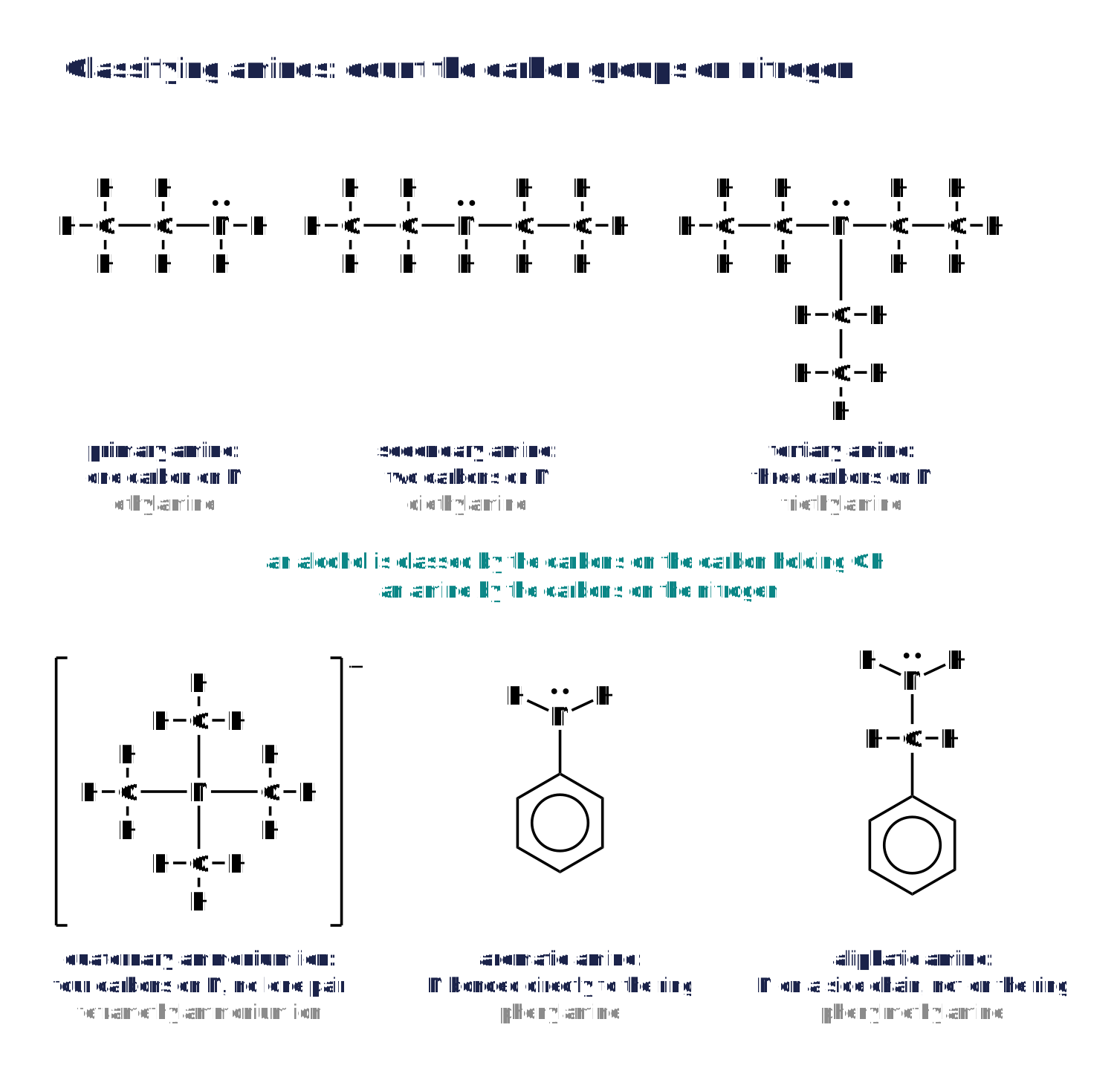
The six structures that fix the vocabulary: primary, secondary, tertiary and quaternary by the groups on nitrogen, then aromatic phenylamine against aliphatic phenylmethylamine.
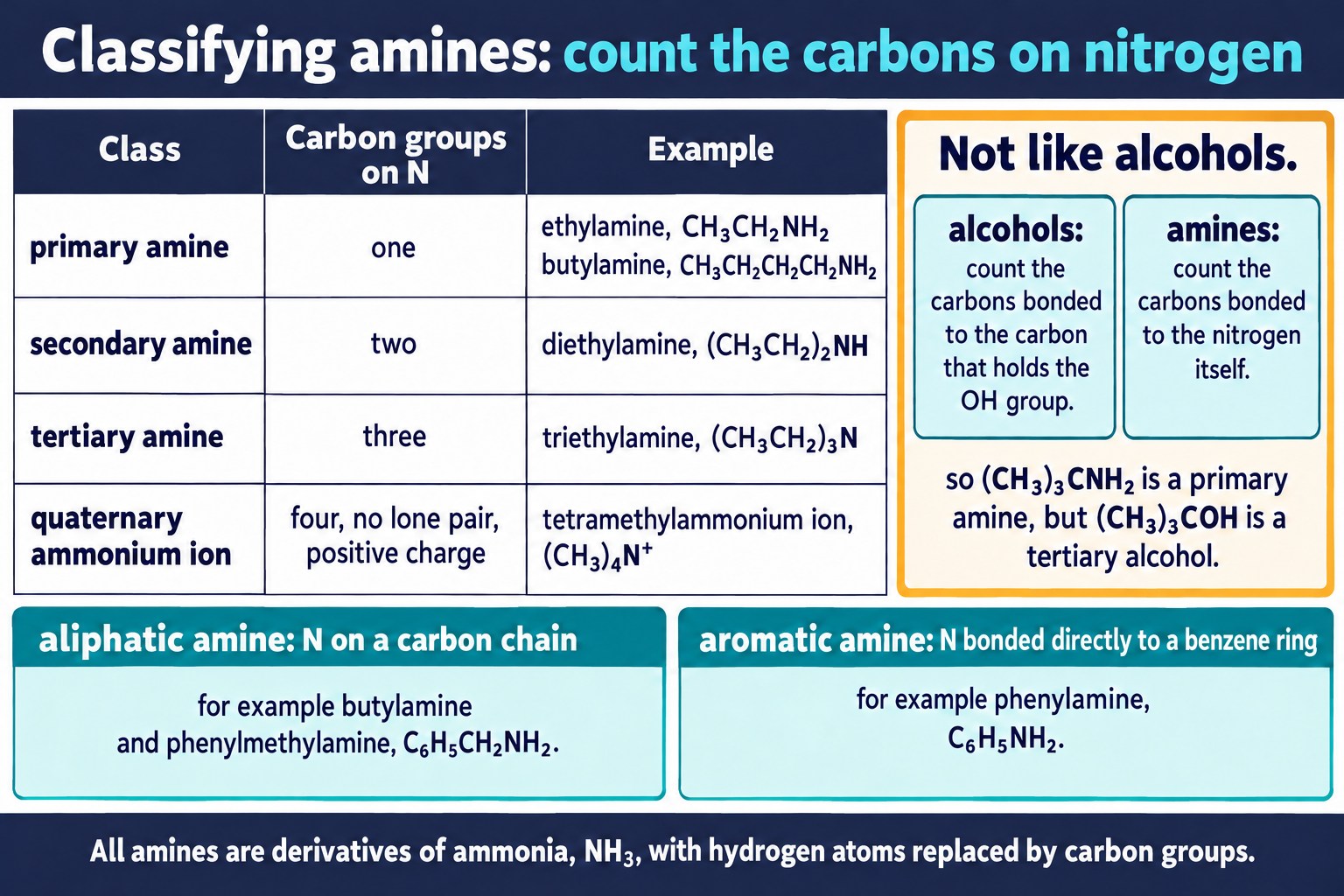
The classification in one table, with the alcohol comparison that catches many students out.
Remember: A primary amine has one carbon on the nitrogen, however branched that carbon is. Count groups on N, not on C.
Aliphatic and Aromatic Amines
In an aliphatic amine the nitrogen is bonded to a carbon chain, as in butylamine and ethylamine. In an aromatic amine the nitrogen is bonded directly to a benzene ring.
| Compound | Formula | Type | Why |
|---|---|---|---|
| butylamine | CH₃CH₂CH₂CH₂NH₂ | aliphatic, primary | N on a carbon chain |
| phenylamine | C₆H₅NH₂ | aromatic, primary | N bonded directly to the ring |
| phenylmethylamine | C₆H₅CH₂NH₂ | aliphatic, primary | a CH₂ sits between the ring and the N |
- Phenylamine is the headline aromatic amine in this topic: its ring changes how the lone pair behaves (Amines as Bases).
- Phenylmethylamine looks aromatic but is aliphatic: the nitrogen is on a side chain, not on the ring.
Naming Amines
Simple amines are named as alkylamines: the alkyl group followed by amine. Questions also use the aminoalkane and alkan-1-amine styles.
| Formula | Name | Also seen as |
|---|---|---|
| CH₃NH₂ | methylamine | aminomethane |
| CH₃CH₂NH₂ | ethylamine | aminoethane, ethanamine |
| CH₃CH₂CH₂NH₂ | propylamine | 1-aminopropane, propan-1-amine |
| CH₃CH₂CH₂CH₂NH₂ | butylamine | 1-aminobutane, butan-1-amine |
| CH₃CH(NH₂)CH₂CH₃ | 2-aminobutane | butan-2-amine |
| H₂N(CH₂)₆NH₂ | hexane-1,6-diamine | the monomer of nylon-6,6 |
| C₆H₅NH₂ | phenylamine | an aromatic amine |
Groups on the nitrogen: the N- prefix
- A carbon group bonded to nitrogen is named with the locant N, not a number.
- CH₃CH₂NHCH₃ is N-methylethylamine: the longer group, ethyl, is the parent amine.
- CH₃CH₂N(CH₃)₂ is N,N-dimethylethylamine, a tertiary amine.
- (CH₃CH₂)₂NH is diethylamine and (CH₃CH₂)₃N is triethylamine: identical groups take di- and tri-.
Exam focus: If a question gives 1-aminobutane, butan-1-amine or butylamine, all three mean CH₃CH₂CH₂CH₂NH₂. Use whichever the question uses.
Check: Classifying and Naming Amines
Class amines as primary, secondary, tertiary or quaternary, tell aromatic from aliphatic, and name or draw amines from their names.
Amides
An amide has a nitrogen bonded to a carbonyl carbon: the amide group, –CONH₂. Amides are named from the parent carboxylic acid, with the ending -amide.
| Formula | Name | Class |
|---|---|---|
| CH₃CONH₂ | ethanamide | primary amide, RCONH₂ |
| CH₃CH₂CONH₂ | propanamide | primary amide |
| CH₃CONHCH₃ | N-methylethanamide | N-substituted amide |
| CH₃CONHC₆H₅ | N-phenylethanamide | N-substituted amide |
- A group on the nitrogen takes the N- prefix, exactly as in amines: these are N-substituted amides, RCONHR′.
- The amide link, –CONH–, joins the repeat units of polyamides such as nylon (Condensation Polymers: Polyamides and Polyesters).
- The same link between amino acids is called the peptide link in proteins (Peptides and Proteins).
- Amides are made from acyl chlorides: Amides.
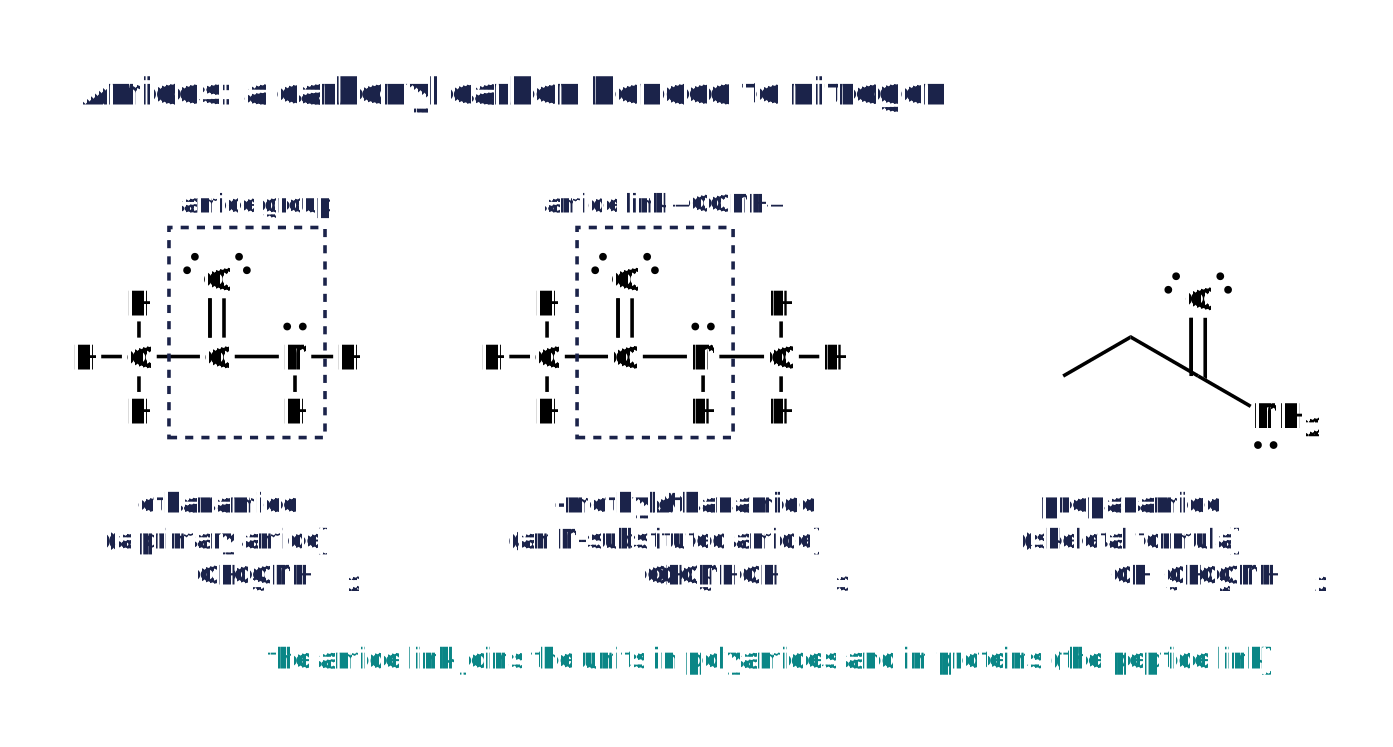
Ethanamide, N-methylethanamide and propanamide. The dashed box picks out the amide group: a C=O carbon bonded to N.
Common mistake: An amide is not an amine with a C=O nearby. The nitrogen must be bonded to the carbonyl carbon itself: R–C(=O)–N.
Amino Acids
An amino acid has both an amine group and a carboxylic acid group. In a 2-amino acid (an α-amino acid) both groups are on the same carbon: carbon 2 of the acid chain.
- General formula RCH(NH₂)COOH. R is a hydrogen atom or a side chain.
- Named as 2-aminoalkanoic acids: the NH₂ is a prefix on carbon 2, the COOH carbon being carbon 1.
- The 20 amino acids found in proteins are 2-amino acids, each with a common name.
| Systematic name | Common name | R group | Formula |
|---|---|---|---|
| 2-aminoethanoic acid | glycine | H | H₂NCH₂COOH |
| 2-aminopropanoic acid | alanine | CH₃ | CH₃CH(NH₂)COOH |
| 2-amino-3-hydroxypropanoic acid | serine | CH₂OH | HOCH₂CH(NH₂)COOH |
| 2-amino-3-sulfanylpropanoic acid | cysteine | CH₂SH | HSCH₂CH(NH₂)COOH |
- Carbon 2 carries four different groups (H, R, NH₂, COOH) in every 2-amino acid except glycine, so it is a chiral centre: see Optical Isomerism and Chirality.
- Glycine has two hydrogens on carbon 2, so it is the one common amino acid that is not chiral.
- Their acid-base behaviour and zwitterions are covered in Amino Acids and Zwitterions.
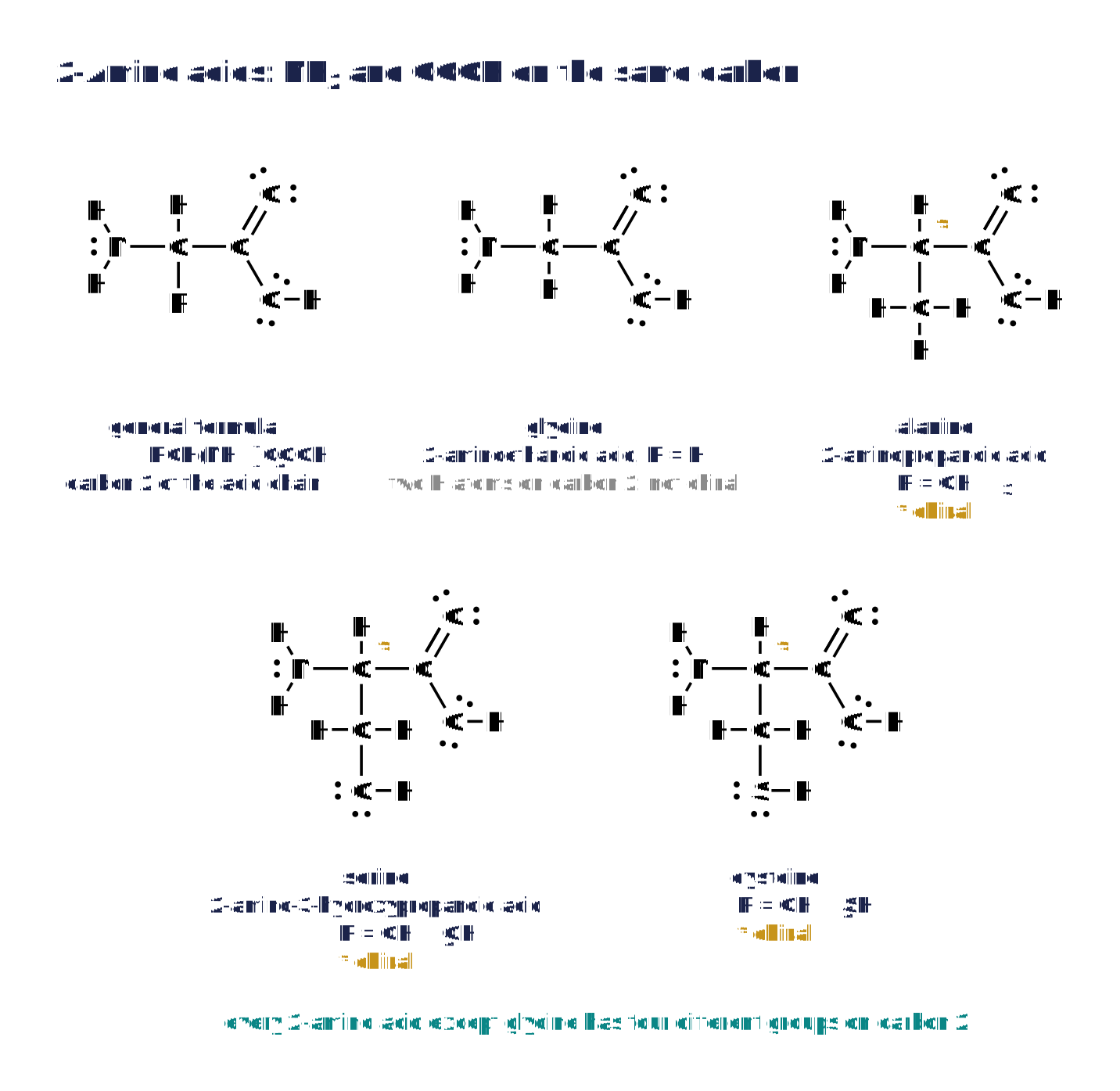
Glycine, alanine, serine and cysteine drawn displayed. The amber star marks the chiral carbon; glycine has none.
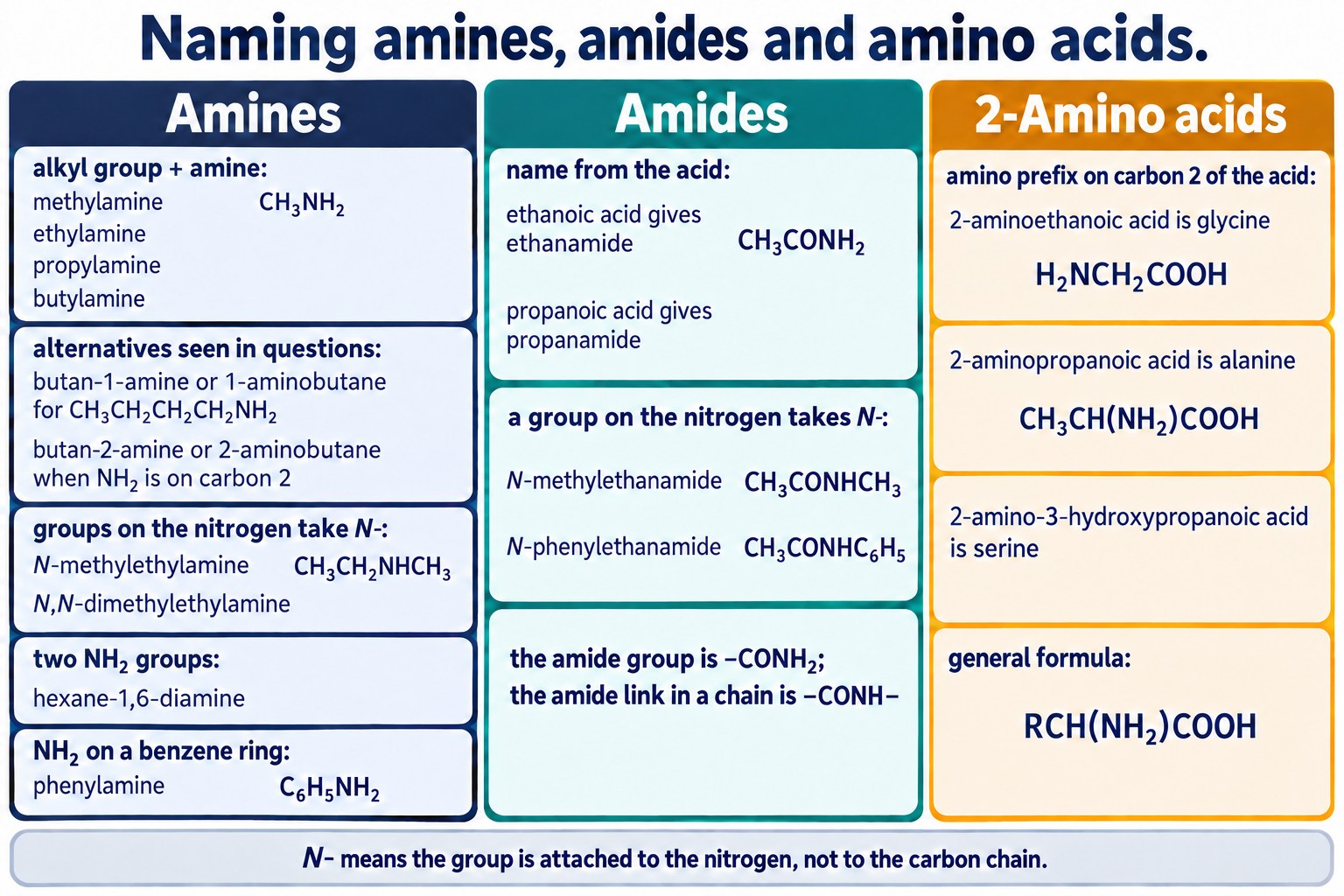
The naming rules for all three classes side by side, with the N- prefix rule that they share.
Quick Check: Spotting Chiral 2-Amino Acids
Two tests apply to every formula, so read each one with care.
Worked Example: Three Formulae for One Compound
Questions ask for the structural, displayed or skeletal formula of an amine, amide or amino acid. Take butylamine.
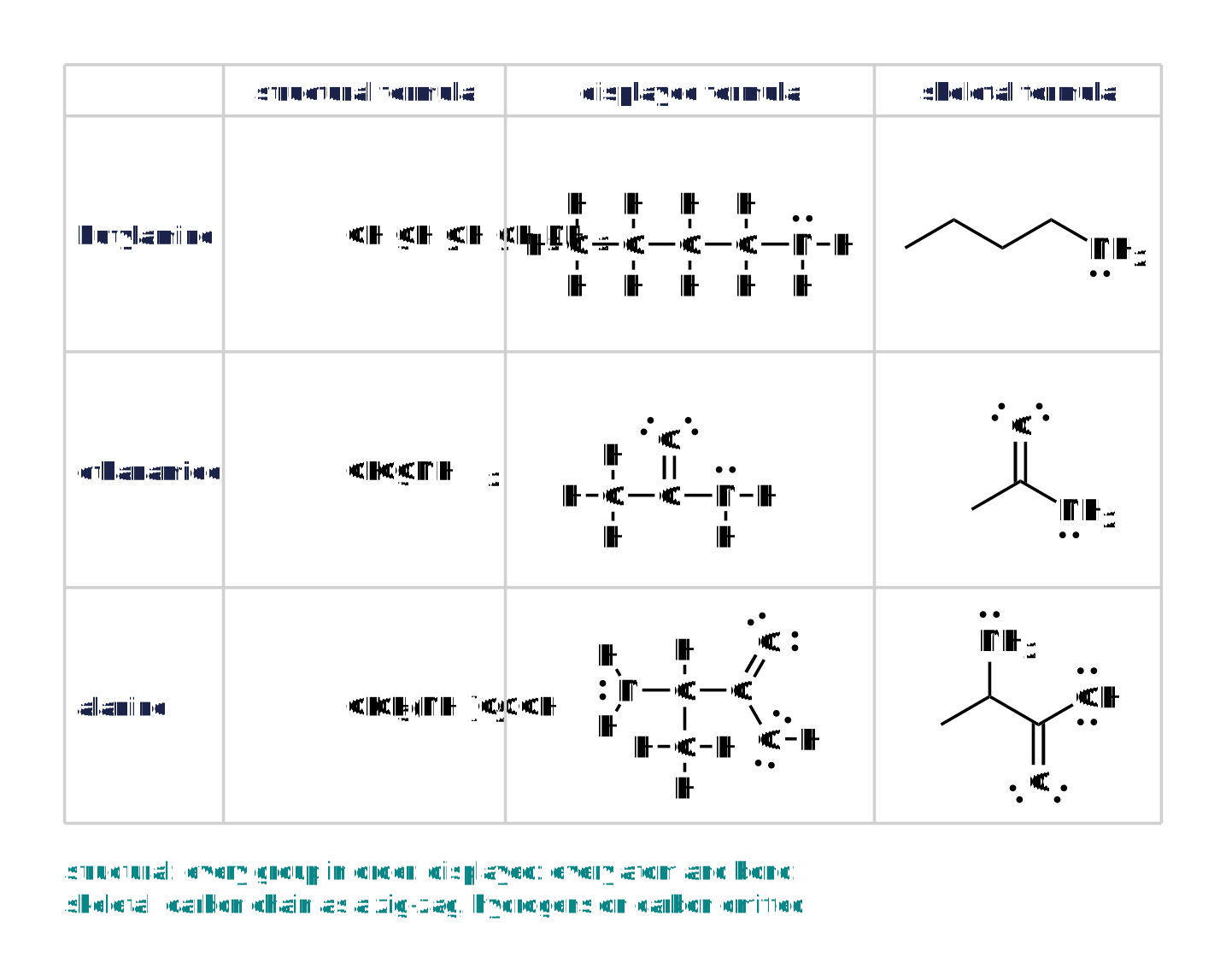
Butylamine, ethanamide and alanine each written as a structural, a displayed and a skeletal formula. Note how the C=O and NH₂ are always drawn out.
- In a skeletal formula the functional groups (NH₂, CONH₂, COOH) are written in full at the end of the zig-zag.
- In a displayed formula of an amide the C=O double bond must be drawn, with N bonded to that carbon.
- For an amino acid the displayed formula shows carbon 2 with H, R, NH₂ and COOH all drawn out.
Physical Properties: Hydrogen Bonding
Amines have polar N–H bonds, so hydrogen bonds form between molecules (N–H···N) and with water. Nitrogen is less electronegative than oxygen, so these are weaker than the O–H···O bonds in alcohols.
| Compound | Mr | Boiling point | Intermolecular forces |
|---|---|---|---|
| propane, CH₃CH₂CH₃ | 44 | −42 °C | London forces only |
| ethylamine, CH₃CH₂NH₂ | 45 | 17 °C | hydrogen bonds N–H···N |
| ethanol, CH₃CH₂OH | 46 | 78 °C | hydrogen bonds O–H···O |
- Small amines are gases or volatile liquids with a fishy smell. Methylamine and ethylamine are gases at room temperature.
- Short-chain amines such as butylamine are miscible with water: the N–H and the lone pair hydrogen bond to water molecules.
- Solubility falls as the hydrocarbon chain grows. Phenylamine is only slightly soluble in water.
- Amides have two N–H bonds and a C=O, so they hydrogen bond strongly: ethanamide is a solid that dissolves in water.
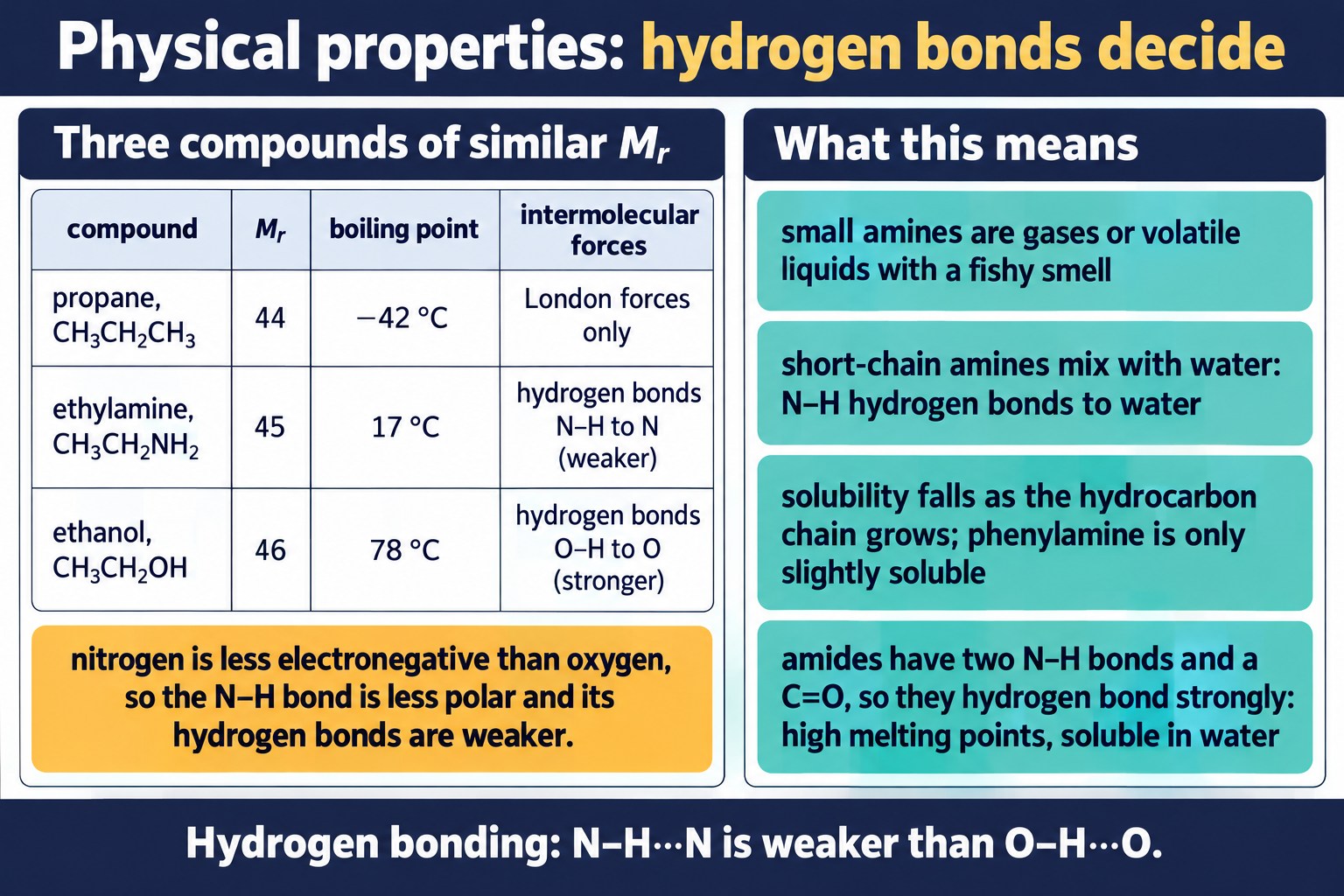
Boiling points of three compounds of almost equal Mr, and what the N–H hydrogen bond does for solubility and smell.
Exam focus: Explain a boiling point with three steps: name the force (hydrogen bonding), say what forms it (N–H and a lone pair on N), and compare its strength with O–H···O.
Check: Amides, Amino Acids and Formulae
Name amides and 2-amino acids, pick out the chiral carbon, choose the right formula type and explain a solubility or boiling point trend.
Quick Check: Ranking Boiling Points
These four compounds have almost equal Mr, so the order depends on the forces between the molecules.
Common Exam Points
- Primary, secondary and tertiary amines are classed by the carbon groups on nitrogen; alcohols by the groups on the carbon holding OH.
- Phenylamine is aromatic because N is bonded to the ring; phenylmethylamine, C₆H₅CH₂NH₂, is aliphatic.
- Butylamine, 1-aminobutane and butan-1-amine are the same compound. N-methyl means the methyl group is on the nitrogen.
- An amide has N bonded to a carbonyl carbon: ethanamide CH₃CONH₂; N-methylethanamide CH₃CONHCH₃ is N-substituted.
- 2-Amino acids have NH₂ and COOH on carbon 2: RCH(NH₂)COOH. Every one except glycine is chiral.
- Skeletal formulae show the chain as a zig-zag with NH₂, CONH₂ or COOH written out at the end.
- Hydrogen bonding between N–H and N is weaker than between O–H and O: ethylamine boils at 17 °C, ethanol at 78 °C.
- Short-chain amines mix with water because they hydrogen bond to it; solubility falls as the chain lengthens.
FAQs
Use these quick answers to check how amines, amides and amino acids are classified and named, and why butylamine and ethanamide have the physical properties they do.
What makes an amine primary, secondary or tertiary?
Count the carbon groups bonded to the nitrogen. CH₃CH₂NH₂ has one, so it is primary; (CH₃CH₂)₂NH has two, secondary; (CH₃CH₂)₃N has three, tertiary.
This differs from alcohols, where you count the carbons attached to the carbon carrying the OH group.
Is phenylmethylamine an aromatic amine?
No. In an aromatic amine such as phenylamine, C₆H₅NH₂, the nitrogen is bonded directly to the benzene ring. In phenylmethylamine, C₆H₅CH₂NH₂, a CH₂ group sits between the ring and the nitrogen, so it behaves as an aliphatic amine.
Why are 2-amino acids also called α-amino acids?
The amine group is on carbon 2 of the acid, the carbon next to the COOH group, which older naming calls the α-carbon. Glycine, H₂NCH₂COOH, is 2-aminoethanoic acid and alanine, CH₃CH(NH₂)COOH, is 2-aminopropanoic acid.
Why does butylamine boil below an alcohol of similar Mr?
Amines form hydrogen bonds through N–H, but nitrogen is less electronegative than oxygen, so N–H···N hydrogen bonds are weaker than O–H···O. Less energy is needed to separate the molecules. Ethylamine boils at 17 °C, ethanol at 78 °C.
How do I name an amide?
Take the acid name, drop -oic acid and add -amide: CH₃CONH₂ from ethanoic acid is ethanamide. If an alkyl group replaces a hydrogen on the nitrogen, add an N- prefix: CH₃CONHCH₃ is N-methylethanamide, an N-substituted (secondary) amide.

Copyright notice: This OLS revision content, including the explanations, layout, diagrams, tables and embedded learning structure, is authored for Online Learning System by Dr. Mohammed Al-Fatah. It may not be copied, reproduced, redistributed or adapted without written permission.
Keep this note — free
Save your progress across every Edexcel IAL topic. A free account remembers which topics you have covered, saves your question scores, and syncs across your phone and laptop.
- Track every topic you have finished
- Keep your practice-question scores
- No payment, no card, free forever
Already registered? Log in