Diazonium Salts and Azo Dyes
A concise revision guide to the reactions of phenylamine with nitrous acid below 10 °C to form the benzenediazonium ion, and its coupling with phenol in alkaline solution to form an azo dye.
Before You Start
This page builds on the preparation of phenylamine and the chemistry of phenol.
- Phenylamine is made by reducing nitrobenzene with tin and concentrated hydrochloric acid, then adding sodium hydroxide: Preparing Amines.
- Nitrobenzene comes from benzene with concentrated nitric and sulfuric acids: Nitration of Benzene.
- Phenol is activated towards electrophilic substitution at the 2, 4 and 6 positions, and in alkali it forms the phenoxide ion: Phenol.
- An aromatic amine has the –NH₂ group bonded directly to the ring; the nitrogen lone pair is partly delocalised into the ring.
Nitrous Acid
Nitrous acid, HNO₂ (nitric(III) acid), is too unstable to store. It is made in the reaction flask from sodium nitrite and dilute hydrochloric acid, in ice.
- NaNO₂ + HCl → HNO₂ + NaCl: sodium nitrite solution is added slowly to the cold acid.
- The mixture is kept below 10 °C in an ice bath, because nitrous acid decomposes if it warms up.
- The acid is used at once, in the same flask, with the phenylamine already dissolved in the hydrochloric acid.
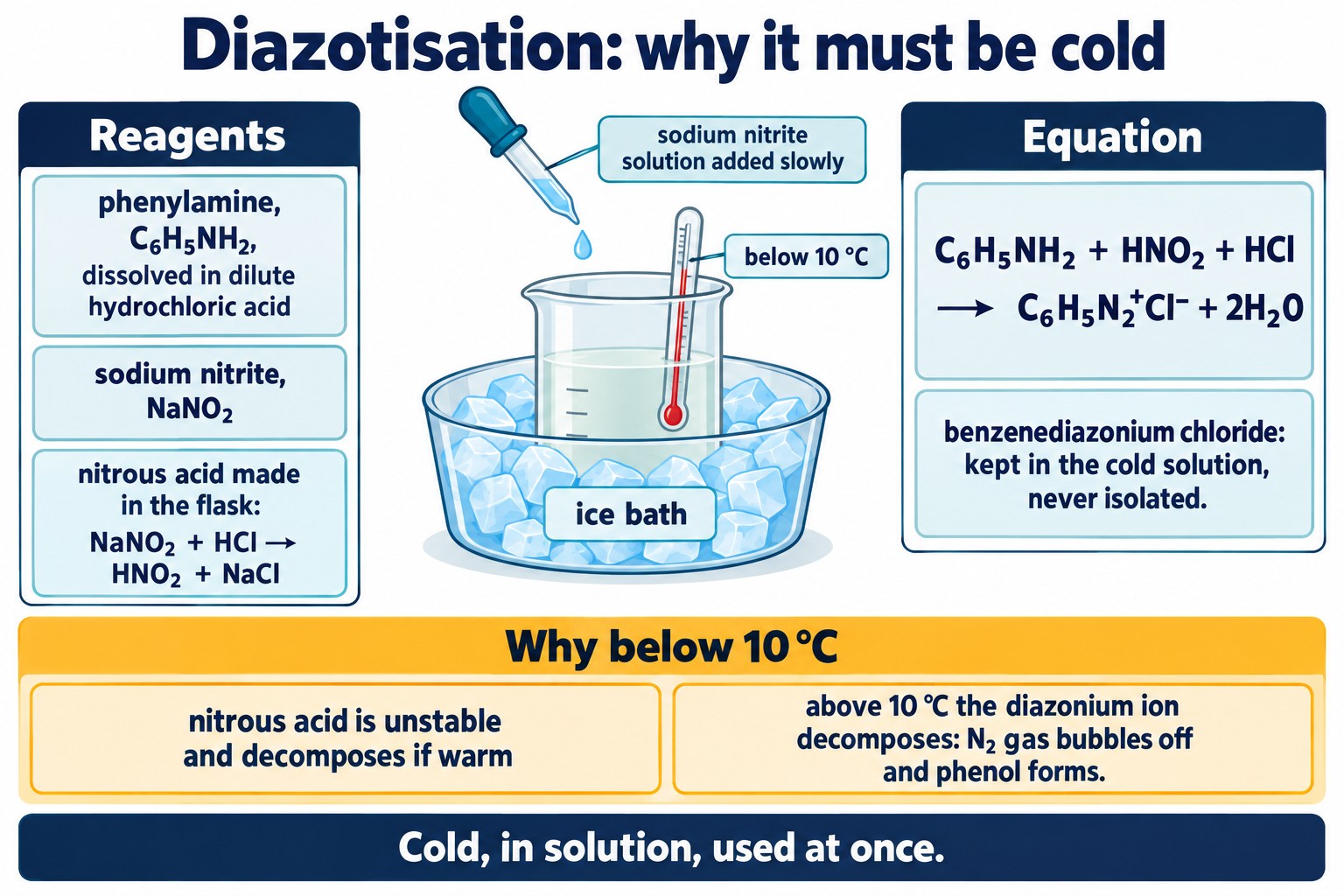
The cold conditions: an ice bath below 10 °C, sodium nitrite and dilute hydrochloric acid making nitrous acid in the flask, and why warming spoils the product.
Diazotisation: Making the Benzenediazonium Ion
Phenylamine reacts with nitrous acid and hydrochloric acid below 10 °C to form benzenediazonium chloride. The reaction is called diazotisation.
- C₆H₅NH₂ + HNO₂ + HCl → C₆H₅N₂⁺Cl⁻ + 2H₂O
- The benzenediazonium ion, C₆H₅N₂⁺, carries the group –N⁺≡N bonded to the ring; the positive charge is on the inner nitrogen.
- The ion is stabilised by the ring, but only in cold solution. It is never isolated as a dry solid.
- Aliphatic diazonium ions (from alkylamines) are far too unstable to keep: they lose nitrogen at once.
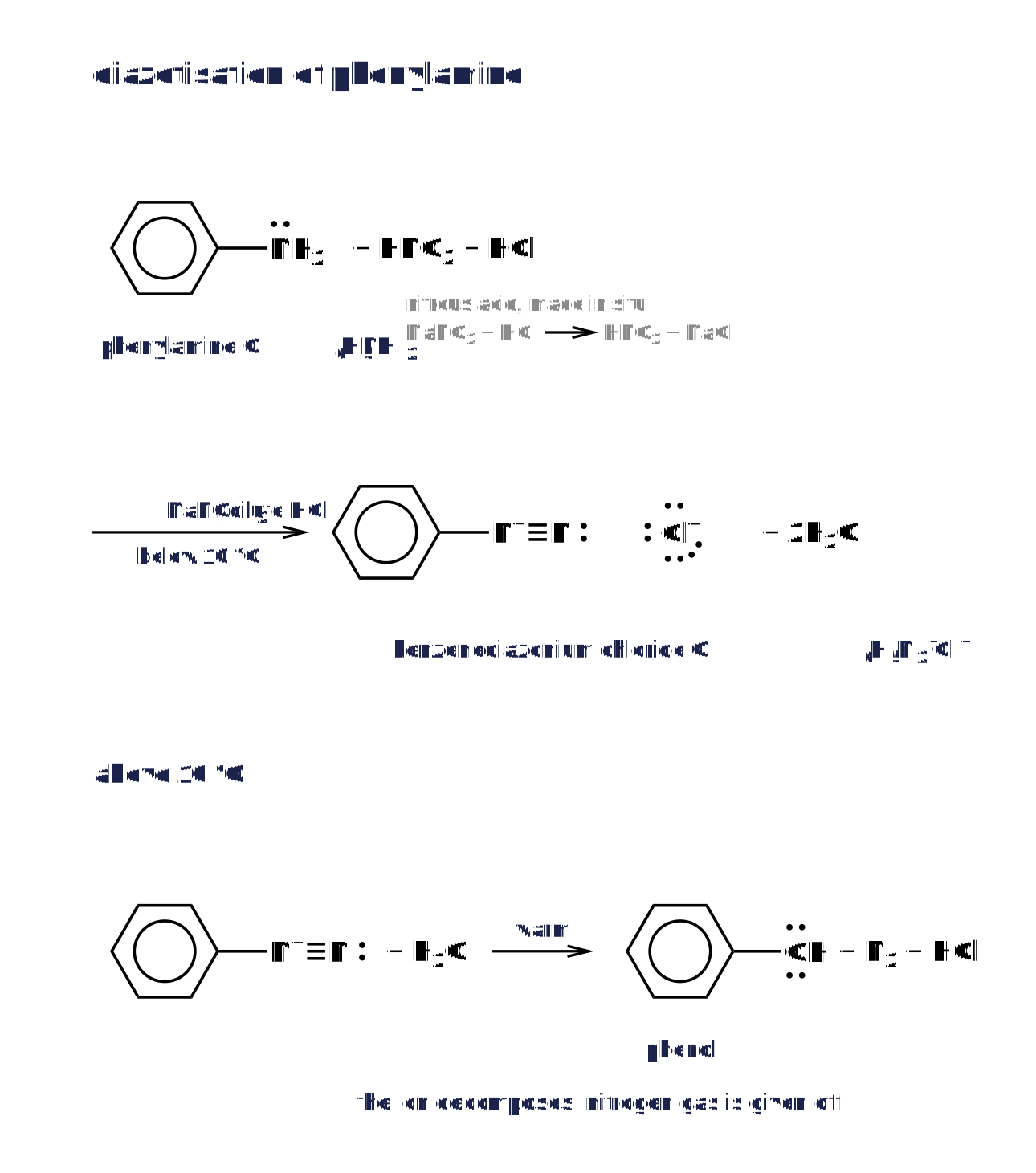
Phenylamine with nitrous acid and hydrochloric acid below 10 °C giving benzenediazonium chloride, and what happens to the ion above 10 °C.
Above 10 °C: decomposition
- The diazonium ion decomposes above about 10 °C and nitrogen gas bubbles off: the N≡N unit is lost as N₂.
- With water the product of decomposition is phenol, C₆H₅OH, plus N₂ and HCl, so the dye yield falls if the mixture warms.
- Keeping the temperature below 10 °C is the condition examiners ask for most often.
Exam focus: Three things go with every diazotisation answer: sodium nitrite and dilute hydrochloric acid (nitrous acid made in situ), below 10 °C, and the product named as benzenediazonium chloride.
Check: Diazotisation
Give the reagents, the temperature and the product for the reaction of an aromatic amine with nitrous acid, and explain why the mixture must be kept cold.
Coupling with Phenol: an Azo Dye
The cold diazonium solution is added to phenol dissolved in sodium hydroxide solution. A yellow-orange solid, an azo compound, precipitates at once.
- Phenol in alkali is present as the phenoxide ion, C₆H₅O⁻, whose ring is even more activated than phenol itself.
- The diazonium ion is a weak electrophile: it attacks carbon 4 of the phenoxide ring, opposite the O⁻, in an electrophilic substitution.
- C₆H₅N₂⁺Cl⁻ + C₆H₅OH → C₆H₅N=NC₆H₄OH + HCl (the HCl is neutralised by the NaOH present).
- The product is 4-hydroxyazobenzene: two benzene rings joined by the azo group, –N=N–.
- Conditions: alkaline (NaOH), below 10 °C, so the diazonium ion survives long enough to couple.
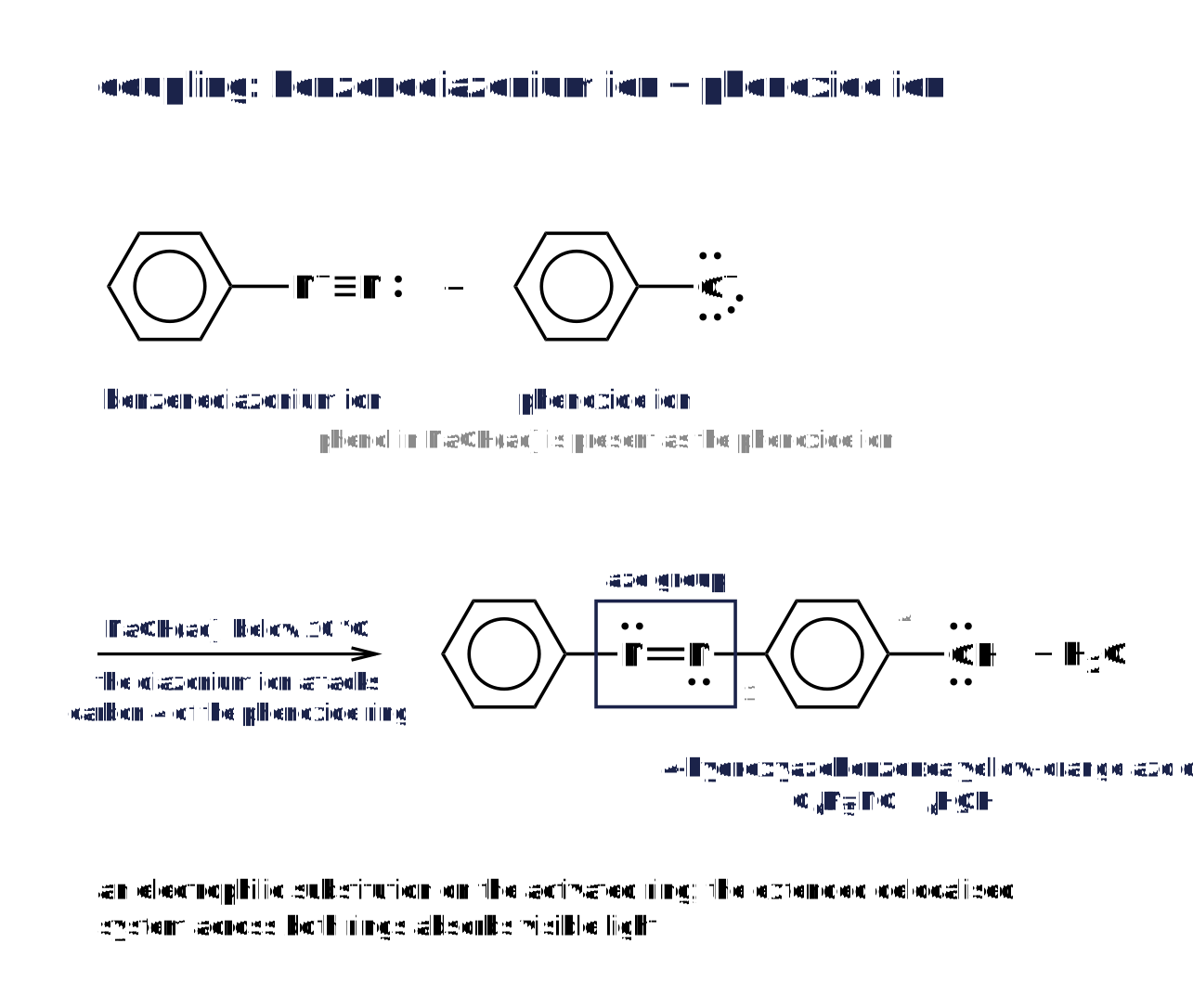
The benzenediazonium ion coupling with the phenoxide ion in cold sodium hydroxide solution to give 4-hydroxyazobenzene, with the azo group boxed.
| Coupling partner | Colour of the azo compound |
|---|---|
| phenol (as phenoxide, in NaOH) | yellow-orange |
| naphthalen-2-ol (in NaOH) | red |
| phenylamine (in acid) | yellow |
Remember: Coupling is an electrophilic substitution. The diazonium ion is the electrophile; the activated ring of the phenoxide ion is the nucleophile.
Quick Check: Choosing the Coupling Partners
Work backwards from a dye that is new to this page.
Why Azo Compounds Are Coloured
The azo group links the delocalised π systems of both rings into one extended delocalised system. This absorbs light in the visible region, so the compound is coloured.
- Benzene and phenol absorb in the ultraviolet and are colourless; joining two rings through –N=N– shifts the absorption into the visible range.
- The colour seen is the light that is not absorbed: 4-hydroxyazobenzene absorbs blue-violet and looks yellow-orange.
- Azo compounds are stable and bond well to fibres, so they are used as dyes for textiles, in inks and in food colourings.
- Methyl orange is an azo compound used as an acid-base indicator: red in acid, yellow in alkali.
- Changing the amine or the coupling partner changes the length of the delocalised system and so the colour.
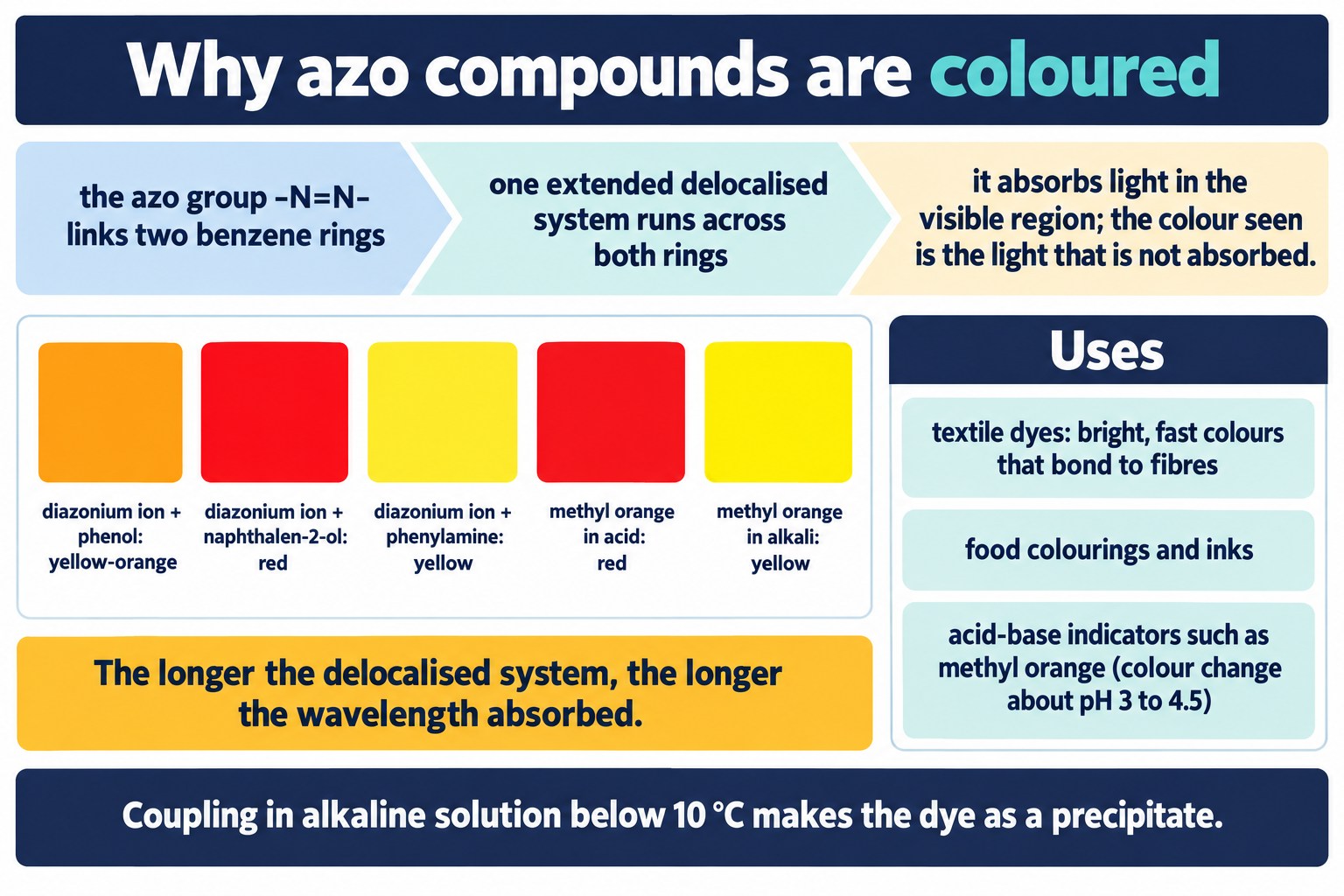
Why azo compounds are coloured: the extended delocalised system across both rings, a strip of dye colours by coupling partner, and uses in textiles and indicators.
Quick Check: Explaining Colour in Azo Dyes
Pick the one accurate statement in each set.
The Synthesis Chain: Benzene to Dye
Dye manufacture puts together four reactions from this and earlier topics. Each step keeps the benzene ring and changes the group on it.
| Step | Reagents and conditions | Product |
|---|---|---|
| 1 nitration | concentrated HNO₃ and concentrated H₂SO₄, about 50 °C | nitrobenzene, C₆H₅NO₂ |
| 2 reduction | tin and concentrated HCl, heat under reflux; then NaOH(aq) | phenylamine, C₆H₅NH₂ |
| 3 diazotisation | NaNO₂ and dilute HCl, below 10 °C | benzenediazonium chloride, C₆H₅N₂⁺Cl⁻ |
| 4 coupling | phenol in NaOH(aq), below 10 °C | 4-hydroxyazobenzene, the azo dye |
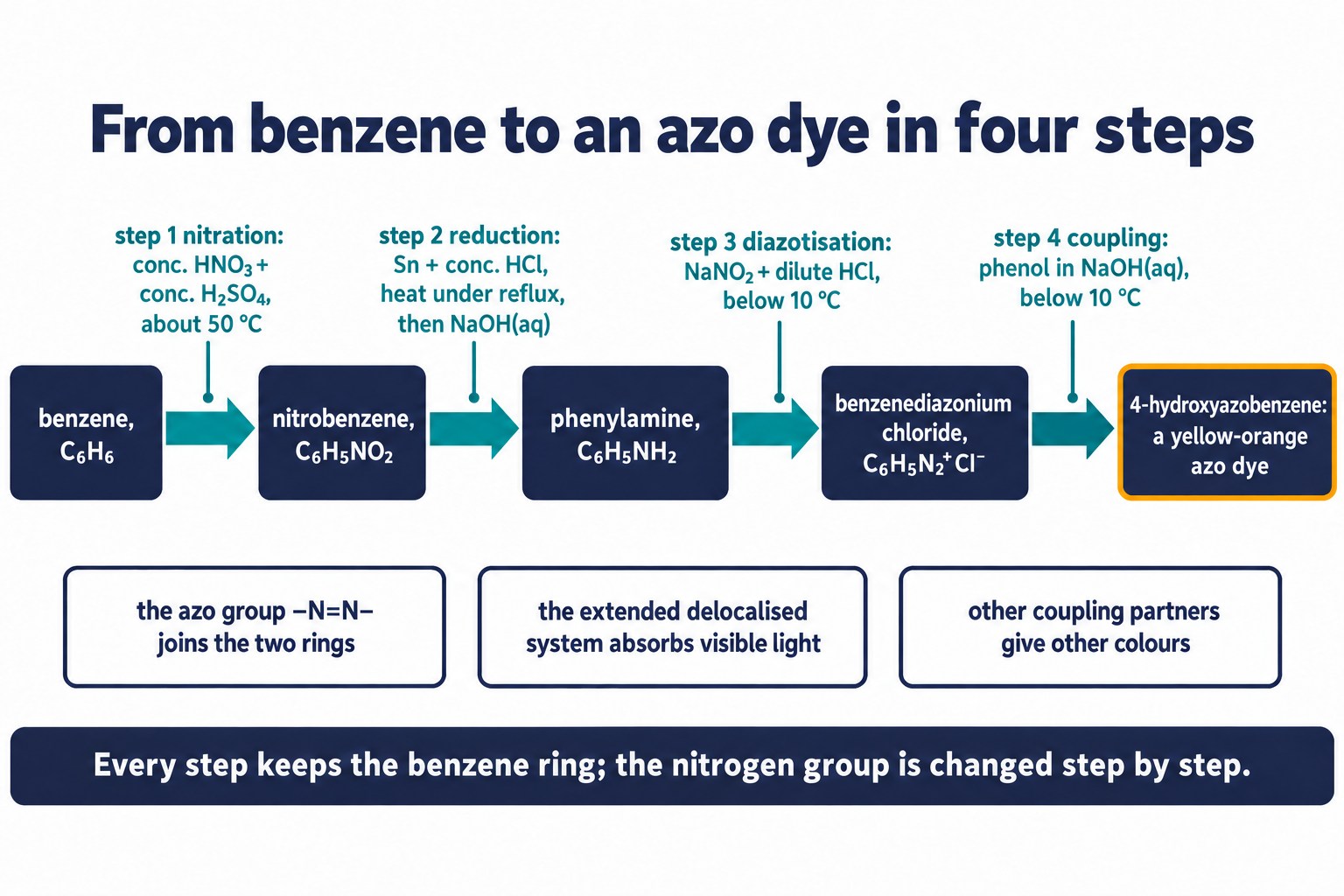
The whole chain from benzene to an azo dye as named boxes with the reagents and conditions at each arrow.
Worked example: planning the synthesis
Check: Coupling and Azo Dyes
Name the azo group and the conditions for coupling, explain why azo compounds are coloured, and set out the steps from benzene to a dye.
Common Exam Points
- Nitrous acid is made in situ from sodium nitrite: NaNO₂ + HCl → HNO₂ + NaCl, in an ice bath.
- Diazotisation: C₆H₅NH₂ + HNO₂ + HCl → C₆H₅N₂⁺Cl⁻ + 2H₂O, below 10 °C; above 10 °C the ion decomposes and nitrogen gas is given off.
- Coupling: add the cold diazonium solution to phenol in sodium hydroxide solution, below 10 °C; the yellow-orange azo compound precipitates.
- The azo group is –N=N–; it joins the two rings into one extended delocalised system that absorbs visible light.
- Other coupling partners (naphthalen-2-ol, phenylamine) give other colours; azo compounds are used as dyes and indicators.
- The chain benzene → nitrobenzene → phenylamine → benzenediazonium chloride → azo dye, with reagents and conditions at each step.
FAQs
Use these quick answers to check the conditions for diazotisation, the coupling reaction with phenol, why azo compounds are coloured and the full synthesis from benzene.
Why must the diazotisation be kept below 10 °C?
The benzenediazonium ion decomposes above about 10 °C, losing nitrogen gas. The mixture is kept in ice, and the nitrous acid is made in situ from sodium nitrite and dilute hydrochloric acid because HNO₂ is itself unstable.
What is the equation for making benzenediazonium chloride?
C₆H₅NH₂ + HNO₂ + HCl → C₆H₅N₂⁺Cl⁻ + 2H₂O, below 10 °C, with the nitrous acid formed from NaNO₂ + HCl → HNO₂ + NaCl. The –N≡N⁺ group is stabilised by the benzene ring; aliphatic diazonium ions are too unstable to isolate.
Why is the phenol dissolved in sodium hydroxide for the coupling reaction?
In alkali the phenol forms the phenoxide ion, whose ring is even more electron rich, so it attacks the diazonium ion readily. The cold diazonium solution is added below 10 °C and 4-hydroxyazobenzene, a yellow-orange azo compound, precipitates; the azo group –N=N– joins the rings.
Why are azo compounds coloured?
The –N=N– azo group links two benzene rings, so the delocalised π system extends across the whole molecule. This lowers the energy gap between electron levels so that visible light is absorbed and the compound shows the complementary colour. Methyl orange is an azo dye.
What is the full synthesis from benzene to an azo dye?
Nitrate benzene with concentrated HNO₃ and H₂SO₄ to nitrobenzene; reduce with tin and concentrated HCl, then NaOH, to phenylamine; diazotise with NaNO₂ and HCl below 10 °C; add to phenol in NaOH(aq).
Each step keeps the ring and changes only the group attached to it.

Copyright notice: This OLS revision content, including the explanations, layout, diagrams, tables and embedded learning structure, is authored for Online Learning System by Dr. Mohammed Al-Fatah. It may not be copied, reproduced, redistributed or adapted without written permission.
Keep this note — free
Save your progress across every Edexcel IAL topic. A free account remembers which topics you have covered, saves your question scores, and syncs across your phone and laptop.
- Track every topic you have finished
- Keep your practice-question scores
- No payment, no card, free forever
Already registered? Log in