Peptides and Proteins
A concise revision guide to peptides and proteins: the formation of the peptide (amide) link by condensation between amino acids, drawing dipeptides and tripeptides, the hydrolysis of proteins to their amino acids.
Forming a Peptide Link
Choose a step to watch two amino acids lose water, form a peptide link, grow into a chain and split apart again on hydrolysis.
© Dr. Mohammed Al-Fatah – onlinelearningsystem.net
Before You Start
A peptide is a chain of amino acids joined by amide links. Check these ideas first.
- The general formula RCH(NH₂)COOH, the R groups of glycine, alanine and serine, and the zwitterion: Amino Acids and Zwitterions.
- The amide group –CONH– and how an acyl chloride and an amine form it with loss of a small molecule: Amides.
- A condensation reaction joins two molecules and releases a small molecule, here water.
- A condensation polymer forms when every monomer has two reactive groups: Condensation Polymers: Polyamides and Polyesters.
GCSE Recap: Polymers and Their Monomers
Three quick questions on the GCSE ideas this page builds on.
The Peptide Link
The –COOH group of one amino acid and the –NH₂ group of another join with the loss of water. The new –CONH– group is an amide link, called the peptide link in peptides and proteins.
- Glycine + alanine → a dipeptide + H₂O: two amino acids, one peptide link.
- Two different dipeptides are possible. In Gly-Ala the glycine provides the C=O and the alanine the N–H; in Ala-Gly it is the other way round.
- H₂NCH₂COOH + H₂NCH(CH₃)COOH → H₂NCH₂CONHCH(CH₃)COOH + H₂O (Gly-Ala).
- Every dipeptide still has a free –NH₂ at one end and a free –COOH at the other, so the chain can keep growing.
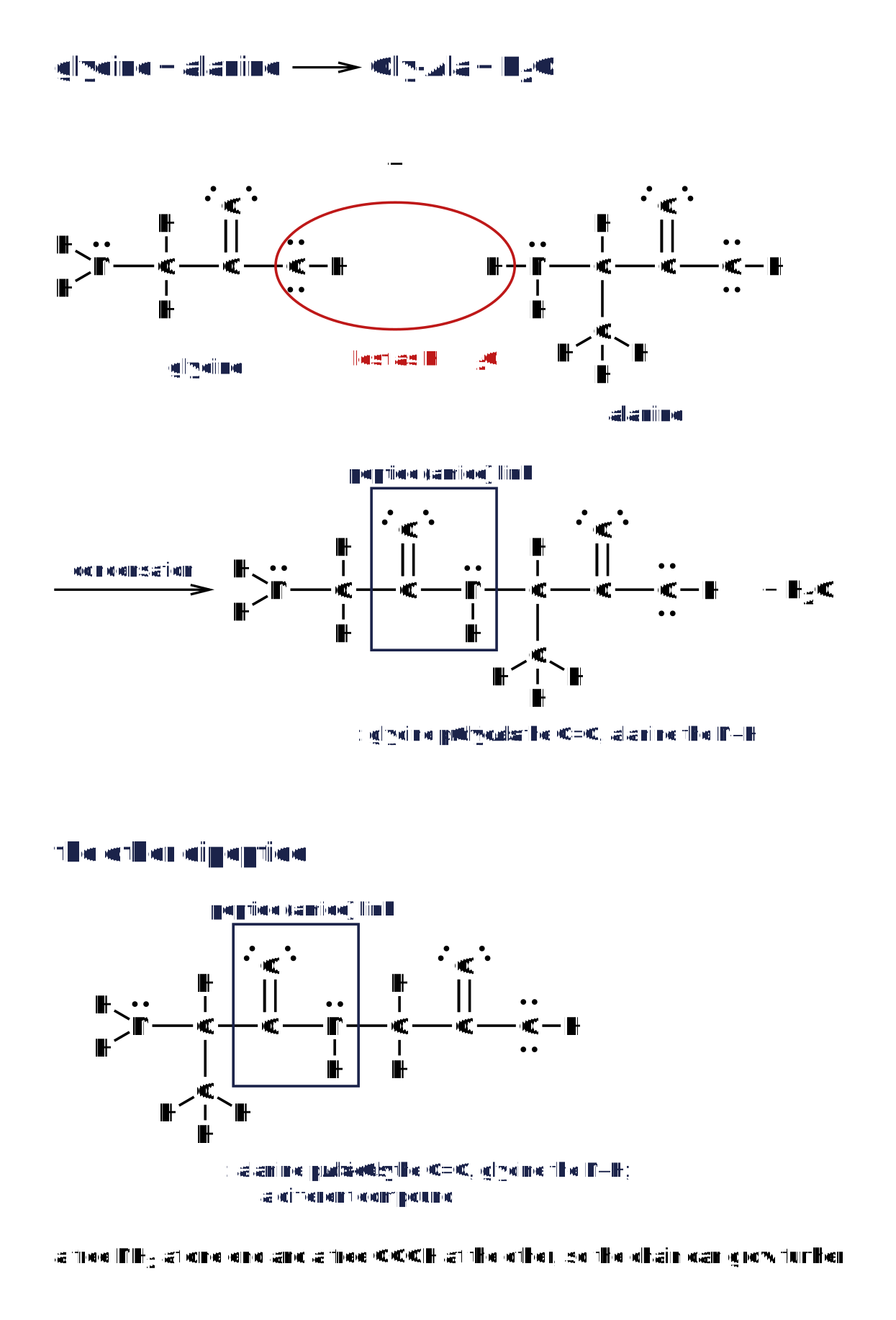
Glycine and alanine condensing to the Gly-Ala dipeptide with the peptide link boxed, and the isomeric Ala-Gly dipeptide underneath.
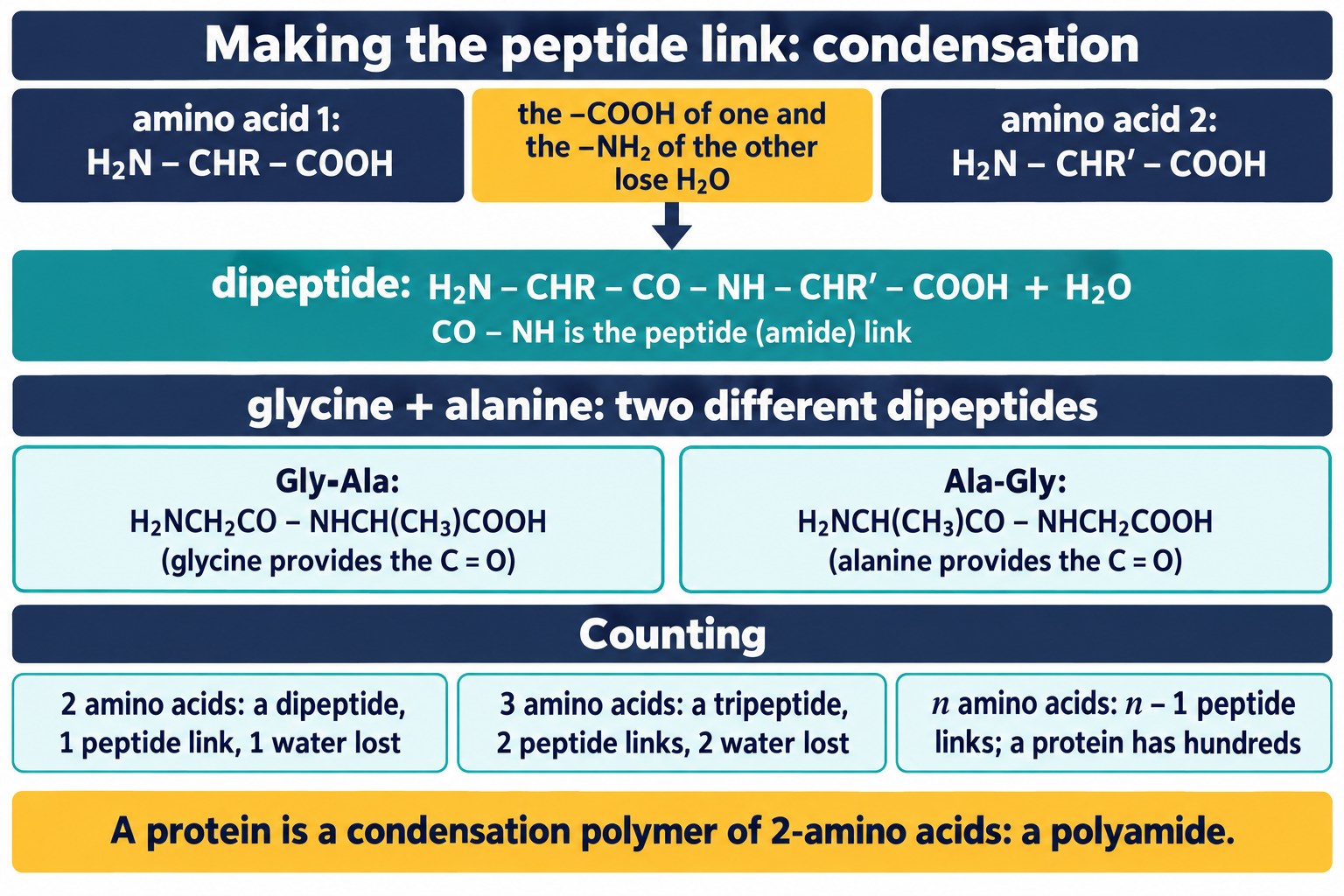
Making the peptide link: the acid of one amino acid and the amine of another lose water, the two dipeptides from glycine and alanine, and how to count the links in a chain.
Exam focus: When two different amino acids are given, say that two dipeptides can form and draw both. The order matters: Gly-Ala and Ala-Gly are different compounds.
Tripeptides and Longer Chains
Three amino acids give a tripeptide with two peptide links; n amino acids give n − 1 links and lose n − 1 water molecules.
Worked example: drawing a tripeptide
Step 1. Draw glycine, alanine and serine in order, each with the –NH₂ on the left and the –COOH on the right: H₂NCH₂COOH, H₂NCH(CH₃)COOH, H₂NCH(CH₂OH)COOH.
Answer. Gly-Ala-Ser: H₂NCH₂CONHCH(CH₃)CONHCH(CH₂OH)COOH, two peptide links, two water molecules lost.
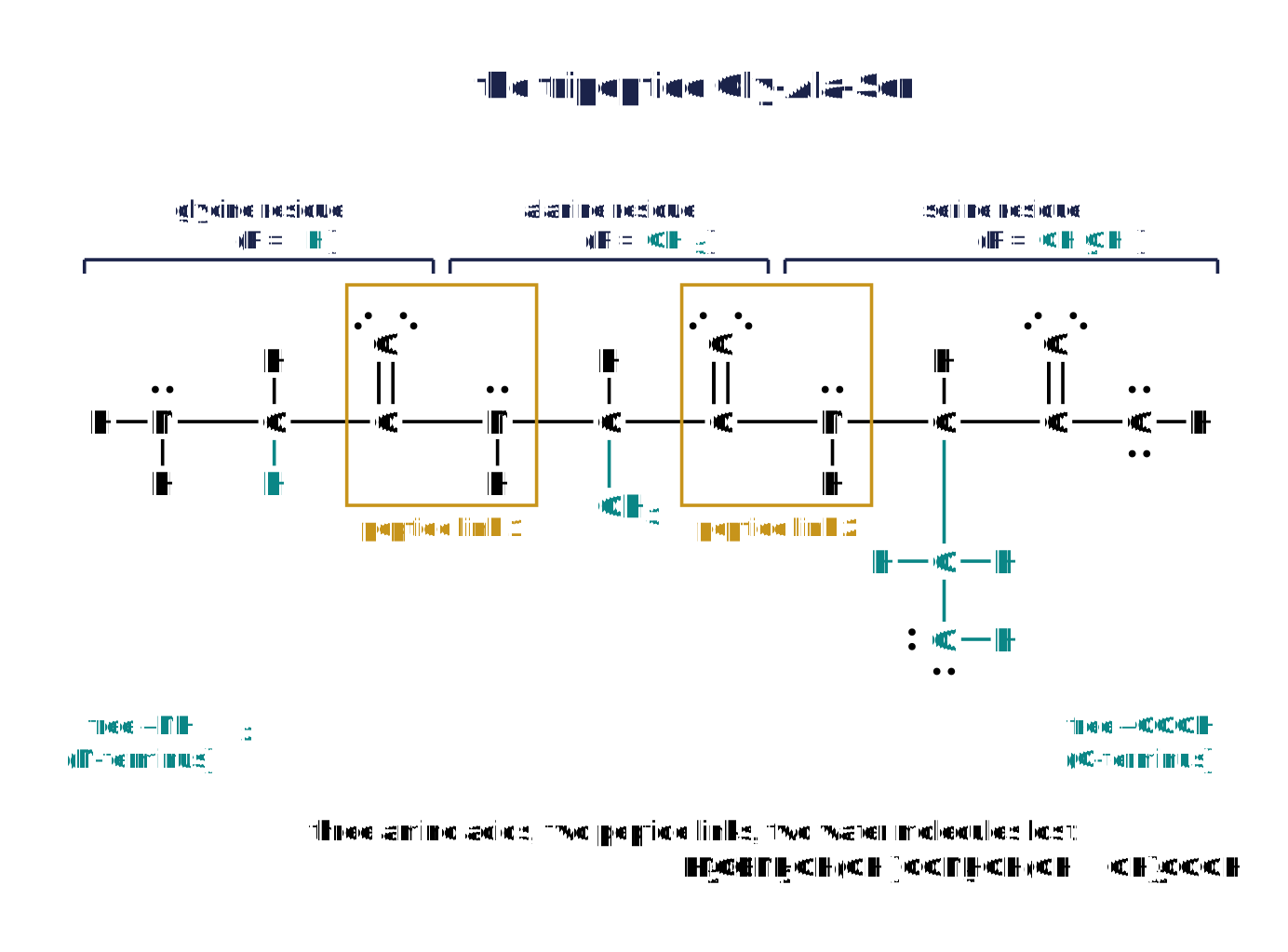
The Gly-Ala-Ser tripeptide drawn displayed with both peptide links boxed and the three residues bracketed and named.
Worked example: reading a peptide
Answer. The R groups are CH₂SH, H and CH₃: cysteine, glycine and alanine, in that order from the –NH₂ end.
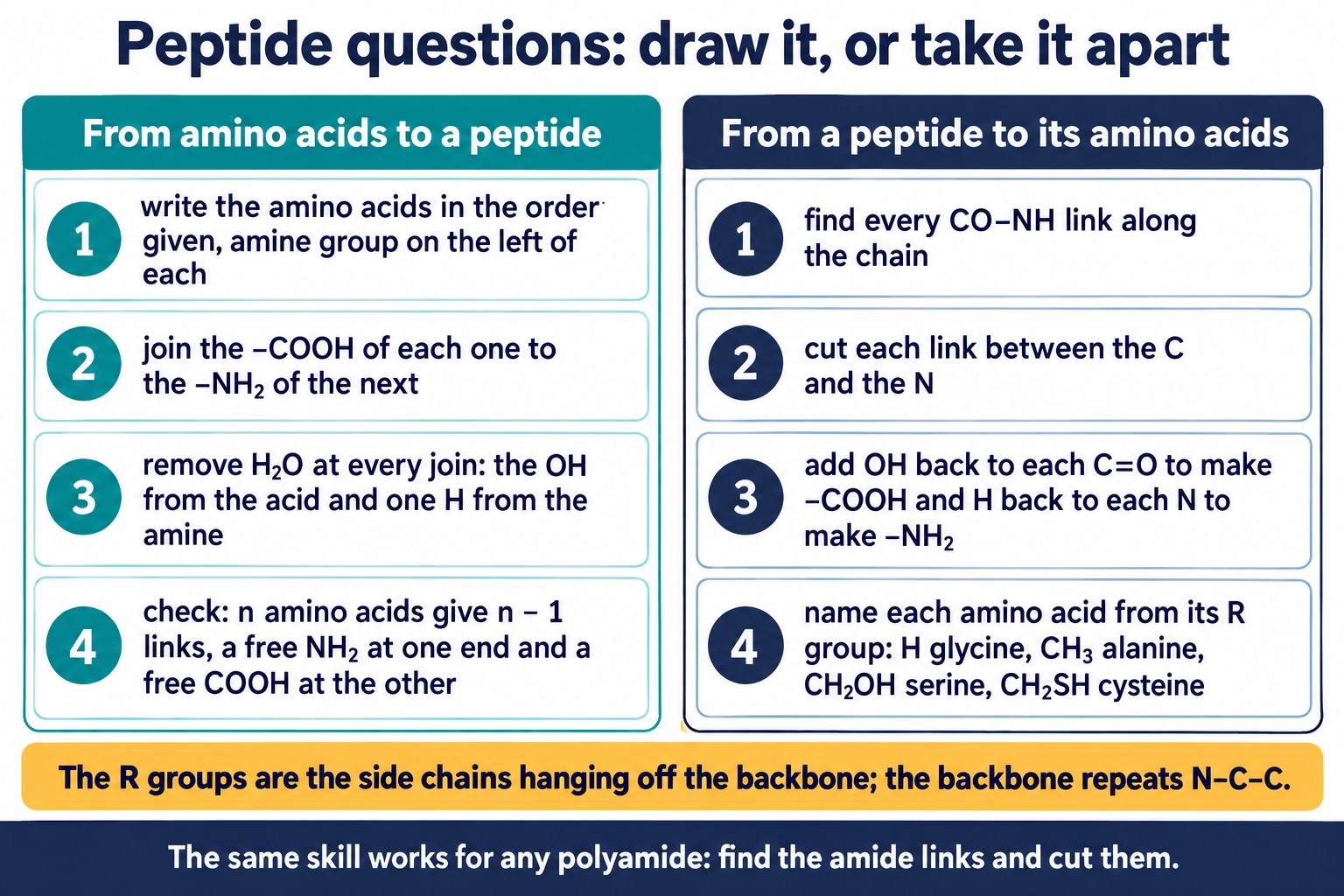
Peptide questions both ways: building a peptide from named amino acids, and taking a peptide apart to recover and name its amino acids.
Quick Check: Counting Sequences, Links and Mr
Type a whole number for each one.
Polypeptides and Proteins
A chain of many amino acids is a polypeptide; a protein is one or more long polypeptide chains. Proteins are condensation polymers of 2-amino acids.
- Each monomer has two reactive groups (–NH₂ and –COOH), so the chain grows by repeated condensation with loss of water at every link.
- A protein is therefore a polyamide, like nylon, with the repeating backbone –NH–CHR–CO–: Condensation Polymers: Polyamides and Polyesters.
- The order of the amino acids along the chain decides the protein; hydrogen bonds between the C=O and N–H groups of different parts of the chain hold its shape.
- About twenty different amino acids, in chains hundreds long, give an almost unlimited number of proteins.
Remember: Dipeptide: two amino acids, one link. Tripeptide: three, two links. Polypeptide and protein: many amino acids, a condensation polymer, a polyamide.
Check: Peptides
Draw the dipeptides from two given amino acids, count the peptide links in a chain, and identify the amino acids in a given peptide.
Breaking the Peptide Link: Hydrolysis
Heating a protein with acid or alkali breaks every peptide link by hydrolysis: water is added back across the C–N bond and the amino acids are released.
- Conditions: heat under reflux with 6 mol dm⁻³ hydrochloric acid for about 24 hours.
- In acid the amino acids are present as their ammonium salts, H₃N⁺CHRCOOH Cl⁻; neutralising gives the free amino acids.
- Alkaline hydrolysis with hot sodium hydroxide gives the carboxylate salts, H₂NCHRCOO⁻ Na⁺, instead.
- Gly-Ala + H₂O → glycine + alanine: one water molecule is added back for every link broken.
- Identifying the amino acids in the mixture tells you which amino acids made up the protein.
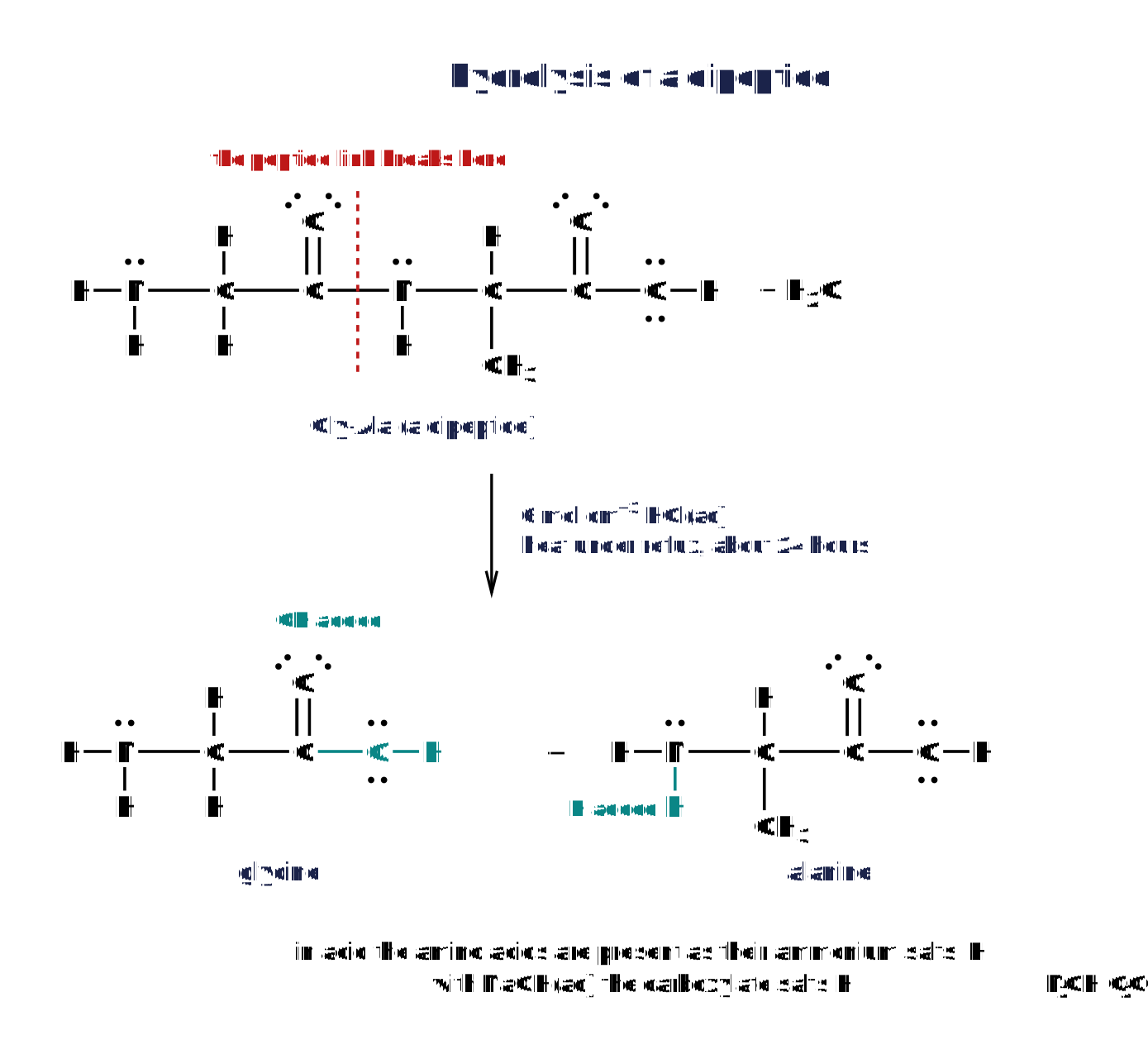
The Gly-Ala dipeptide hydrolysed under reflux with hydrochloric acid to glycine and alanine, with the bond that breaks marked.
Exam focus: Hydrolysis is the reverse of condensation: add H₂O across each CO–NH link, giving a –COOH and an –NH₂. State the acid (or alkali) and heat under reflux.
Check: Hydrolysis of Peptides
Give the conditions for hydrolysing a peptide and work out which amino acids are formed.
Quick Check: Hydrolysing a New Peptide
Pick the one accurate statement about each hydrolysis.
Common Exam Points
- The peptide link is an amide link, –CONH–, formed by condensation between the –COOH of one amino acid and the –NH₂ of another with loss of H₂O.
- Two different amino acids give two dipeptides (Gly-Ala and Ala-Gly); n amino acids give n − 1 peptide links.
- To draw a peptide, line up the amino acids and remove H₂O at every join; to recover them, cut each CO–NH link and add back OH and H.
- Proteins are condensation polymers of 2-amino acids: polyamides with the backbone –NH–CHR–CO–.
- Hydrolysis: heat under reflux with 6 mol dm⁻³ hydrochloric acid for about 24 hours; in acid the amino acids form as their ammonium salts.
FAQs
Use these quick answers to check the peptide link, the two dipeptides from a pair of amino acids, counting links, the hydrolysis of proteins and proteins as polyamides.
What is a peptide link?
It is the amide link, –CONH–, formed when the COOH group of one amino acid condenses with the NH₂ group of another, losing a water molecule. The C=O comes from the acid group and the N–H from the amine group of the other.
Why can glycine and alanine form two different dipeptides?
It depends on which amino acid provides the C=O of the link. If the COOH of glycine reacts with the NH₂ of alanine, the dipeptide is Gly-Ala, H₂NCH₂CONHCH(CH₃)COOH.
If the COOH of alanine reacts with the NH₂ of glycine, it is Ala-Gly, a different compound.
How many peptide links are in a tripeptide?
Two. Three amino acids are joined by two condensation reactions, each forming one –CONH– link and releasing water. A chain of n amino acids has n − 1 peptide links, with a free NH₂ at one end and a free COOH at the other.
How is a protein broken down into its amino acids?
Heat the protein under reflux with 6 mol dm⁻³ hydrochloric acid for about 24 hours. Water, catalysed by the acid, breaks every peptide link (hydrolysis) and the amino acids are released as their ammonium salts. Hot sodium hydroxide gives the carboxylate salts instead.
What is the difference between a polypeptide and a protein?
Both are condensation polymers of 2-amino acids joined by peptide links. A polypeptide is a shorter chain; a protein is one or more long polypeptide chains folded into a specific shape, held by hydrogen bonding between C=O and N–H groups along the chains.

Copyright notice: This OLS revision content, including the explanations, layout, diagrams, tables and embedded learning structure, is authored for Online Learning System by Dr. Mohammed Al-Fatah. It may not be copied, reproduced, redistributed or adapted without written permission.
Keep this note — free
Save your progress across every Edexcel IAL topic. A free account remembers which topics you have covered, saves your question scores, and syncs across your phone and laptop.
- Track every topic you have finished
- Keep your practice-question scores
- No payment, no card, free forever
Already registered? Log in