Polymer Properties: Polyamides, Poly(propenamide) and Poly(ethenol)
A concise revision guide to the properties of nitrogen-containing and hydroxyl-containing polymers: hydrogen bonding between polyamide chains, the addition polymers poly(propenamide) and poly(ethenol), why poly(ethenol) dissolves in water, and its uses in soluble laundry bags and liquid-detergent capsules.
Before You Start
This page looks at how the groups along a polymer chain decide its properties, from the strength of nylon to a polymer that dissolves in the wash.
- Polyamides, their repeat units and the hydrogen bonds between their chains: Condensation Polymers: Polyamides and Polyesters.
- Addition polymerisation of alkenes and drawing the repeat unit of an addition polymer: Polymerisation Reactions.
- A hydrogen bond forms between an H atom bonded to N or O and a lone pair on another N or O atom.
- An ester group, –COO–, can exchange its alcohol part for another alcohol; this page uses that reaction to make a polymer. Ester chemistry is on the esters page.
GCSE Recap: Monomers and Plastics
Three quick questions on the GCSE ideas this page builds on.
Polyamides: Properties from Hydrogen Bonding
In a polyamide every repeat unit carries amide links, –CONH–. The N–H of one chain hydrogen bonds to the C=O of the next, and this one interaction explains the physical properties of nylon.
| Property | Explanation |
|---|---|
| high tensile strength | many hydrogen bonds along the chains must be broken to pull the chains apart |
| high melting temperature (about 265 °C for nylon-6,6) | the hydrogen bonds and London forces between chains need a lot of energy to overcome |
| forms fibres that can be cold-drawn | stretching lines the chains up, so more hydrogen bonds form between them |
| elastic | hydrogen bonds re-form when the stretched chains relax |
| absorbs a little water | water molecules hydrogen bond to the N–H and C=O groups on the chain |
- Polyesters have C=O groups but no N–H, so their chains are held by weaker permanent dipole-dipole forces.
- Polyalkenes have only London forces between chains: lower melting temperatures and no water absorbed.
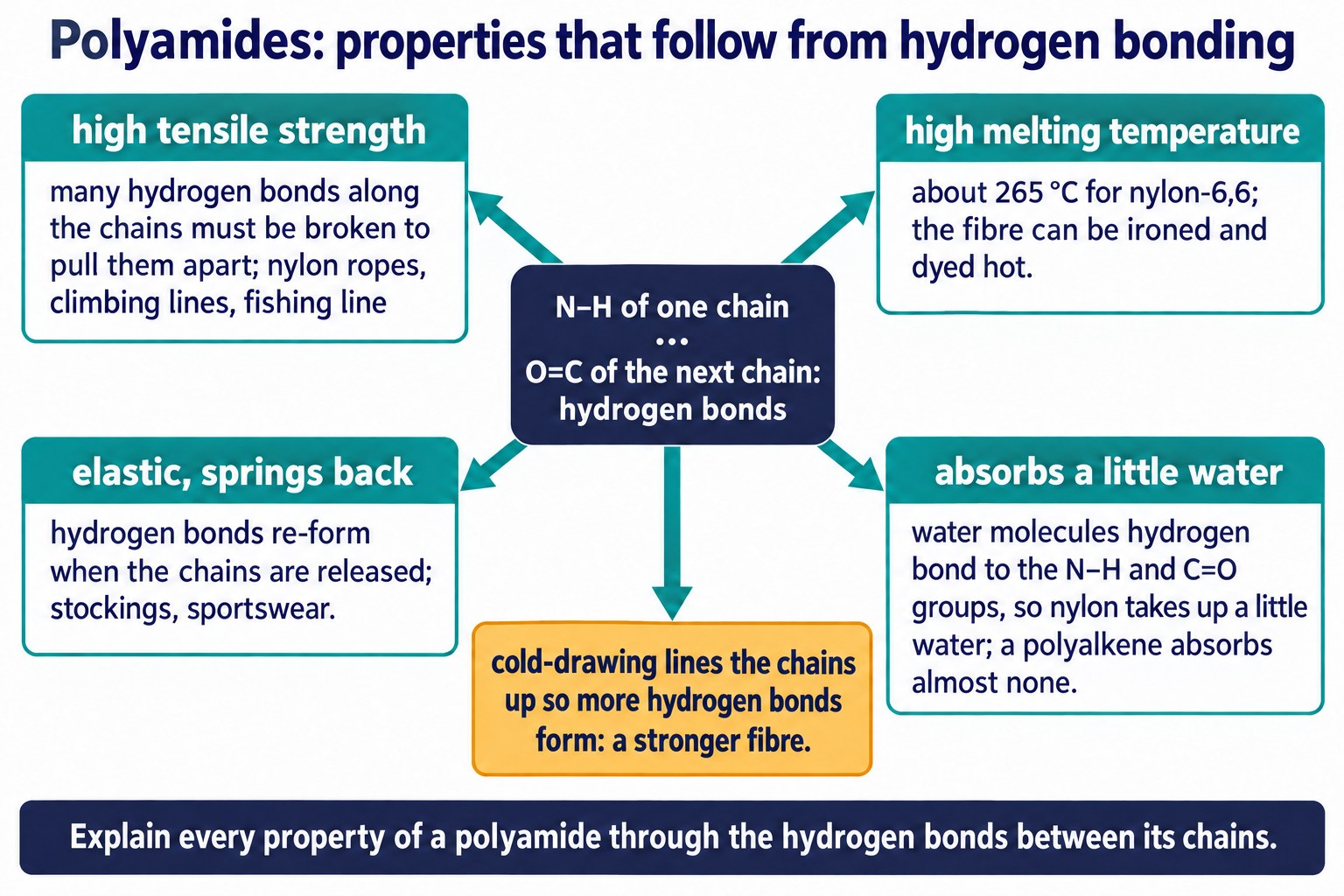
Strength, melting temperature, elasticity and water absorption all follow from hydrogen bonds between the N–H and C=O groups of neighbouring chains.
Exam focus: Always name the atoms: hydrogen bonds between the N–H hydrogen of one chain and the C=O oxygen of a neighbouring chain. “Strong intermolecular forces” alone earns nothing.
Quick Check: Amide Links and Melting Temperature
Use the number of amide links along a chain to rank these polymers.
Poly(propenamide): an Addition Polymer with Nitrogen
Not every nitrogen-containing polymer is a polyamide. Poly(propenamide) is an addition polymer made from propenamide, CH₂=CHCONH₂, an alkene that carries an amide group.
- The C=C bond opens and the monomers join through carbon: n CH₂=CHCONH₂ → –[CH₂–CH(CONH₂)]–ₙ.
- Repeat unit: –CH₂–CH(CONH₂)–. The amide group hangs off the chain, not in the backbone, so this is not a polyamide.
- Nothing is lost: the repeat unit has the same atoms as the monomer.
- The CONH₂ groups hydrogen bond to each other and to water, so the polymer absorbs water strongly.
- Uses: super-absorbent gels, water treatment and the gels used to separate charged molecules in biochemistry.
Worked example: drawing the repeat unit of an addition polymer
Step 2. Change the double bond to a single bond and draw a bond out of each carbon to the left and to the right.
| Poly(propenamide) | Nylon-6,6 | |
|---|---|---|
| type of polymerisation | addition | condensation |
| monomer | propenamide, CH₂=CHCONH₂ | hexane-1,6-diamine + hexanedioic acid |
| where the amide group is | a side group on the chain | in the backbone as –CONH– links |
| small molecule lost | none | water |
Common mistake: Poly(propenamide) is not a polyamide: its amide group is a side group and the backbone is all carbon. Polyamides have –CONH– links in the chain itself.
Check: Hydrogen Bonds Between Chains
Explain the properties of polymers whose chains carry N–H, C=O or O–H groups through the hydrogen bonds between them and with water.
Poly(ethenol): a Polymer Whose Monomer Does Not Exist
Poly(ethenol) has the repeat unit –CH₂–CH(OH)–. It looks like the addition polymer of “ethenol”, CH₂=CHOH, but that molecule cannot be isolated: it rearranges at once to ethanal, CH₃CHO.
- Instead, ethenyl ethanoate, CH₂=CHOOCCH₃, is polymerised by addition to poly(ethenyl ethanoate), repeat unit –CH₂–CH(OOCCH₃)–.
- The polymer is then treated with methanol. Each ethanoate ester group is swapped for an OH group: an ester exchange (transesterification).
- Equation: –[CH₂–CH(OOCCH₃)]–ₙ + n CH₃OH → –[CH₂–CH(OH)]–ₙ + n CH₃COOCH₃.
- The by-product is methyl ethanoate. The carbon chain is untouched; only the side groups change.
- The reaction need not go to completion: the fraction of ethanoate groups replaced can be controlled.
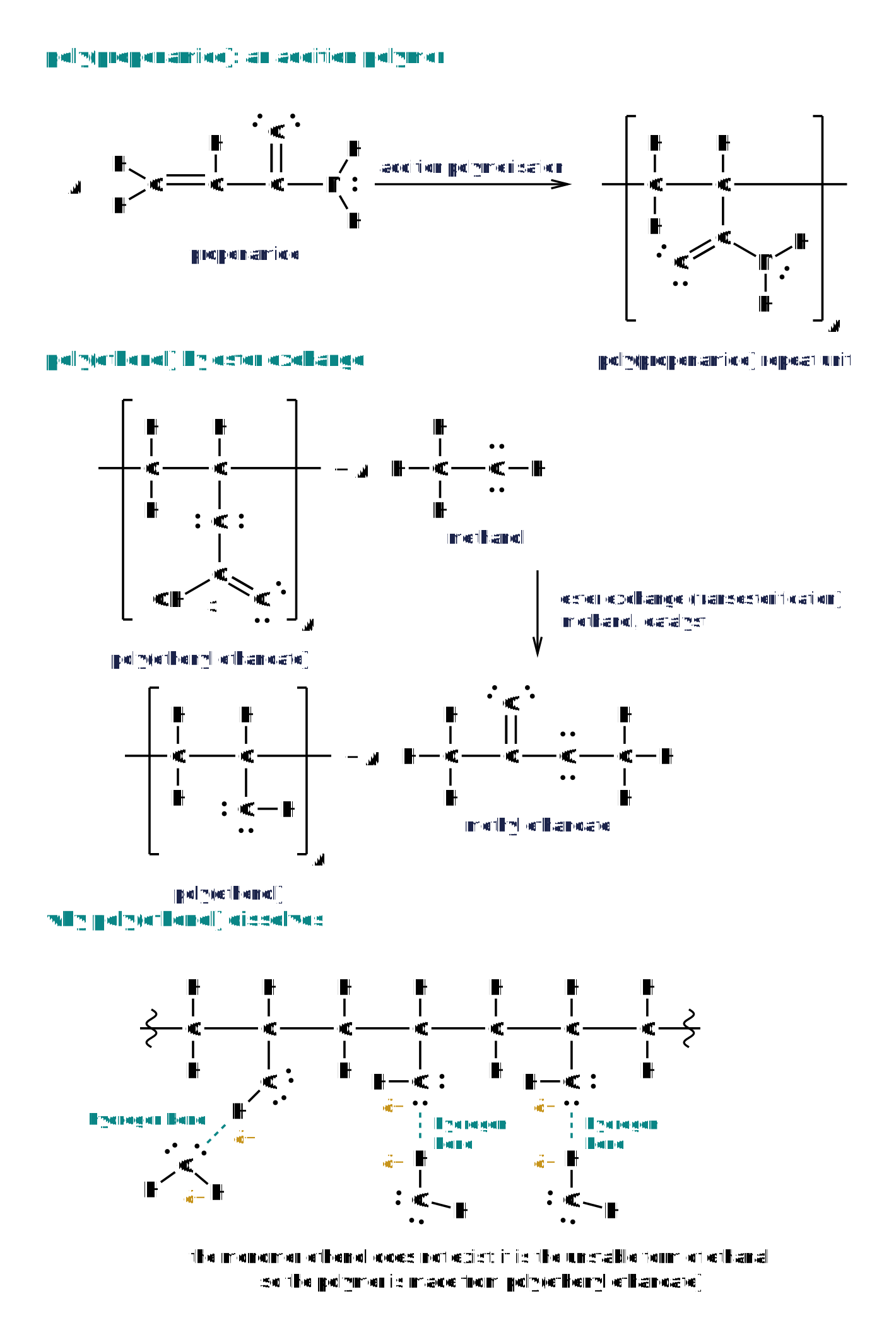
Propenamide to poly(propenamide); poly(ethenyl ethanoate) to poly(ethenol) by ester exchange with methanol; and poly(ethenol) hydrogen bonded to water.
Remember: Poly(ethenol) is made from poly(ethenyl ethanoate) by ester exchange with methanol, not from ethenol, which does not exist as a stable compound.
Quick Check: Tracking an Ester Exchange
Work out each answer on paper, then flip the card to check your working.
Why Poly(ethenol) Dissolves in Water
Most polymers are insoluble in water. Poly(ethenol) dissolves because every repeat unit carries an OH group that can hydrogen bond to water.
- Water molecules hydrogen bond to the many OH groups along the chain, releasing enough energy to separate the chains.
- The OH groups also hydrogen bond strongly to each other between chains. When every group is OH, only hot water can break these bonds.
- Leaving some ethanoate groups in place breaks up the regular hydrogen bonding between chains, so water gets in more easily.
- The solubility is therefore tuned by how far the ester exchange is taken.
| Ethanoate groups replaced by OH | Dissolves in |
|---|---|
| 98 to 99 % (almost all) | hot water only, above about 70 °C |
| about 88 % | cold water |
| below about 70 % | does not dissolve: too few OH groups |
Exam focus: Two hydrogen-bonding ideas: OH groups on the chain hydrogen bond to water, so it dissolves; OH groups on neighbouring chains hydrogen bond to each other, so a fully converted polymer needs hot water.
Quick Check: Reasoning With Water-Soluble Polymers
Pick the one accurate statement in each set.
Uses of Poly(ethenol)
A polymer that dissolves on demand has uses wherever the contents must be released in water without being handled.
- Soluble laundry bags in hospitals: infected linen is sealed in the bag, which goes straight into the washing machine and dissolves in the wash. Nobody touches the linen.
- Liquid-detergent capsules for washing machines and dishwashers: the film holds a measured dose and dissolves when wet. No measuring, no spills.
- The bags use a grade that dissolves in hot water; capsules use a grade that dissolves in cold water.
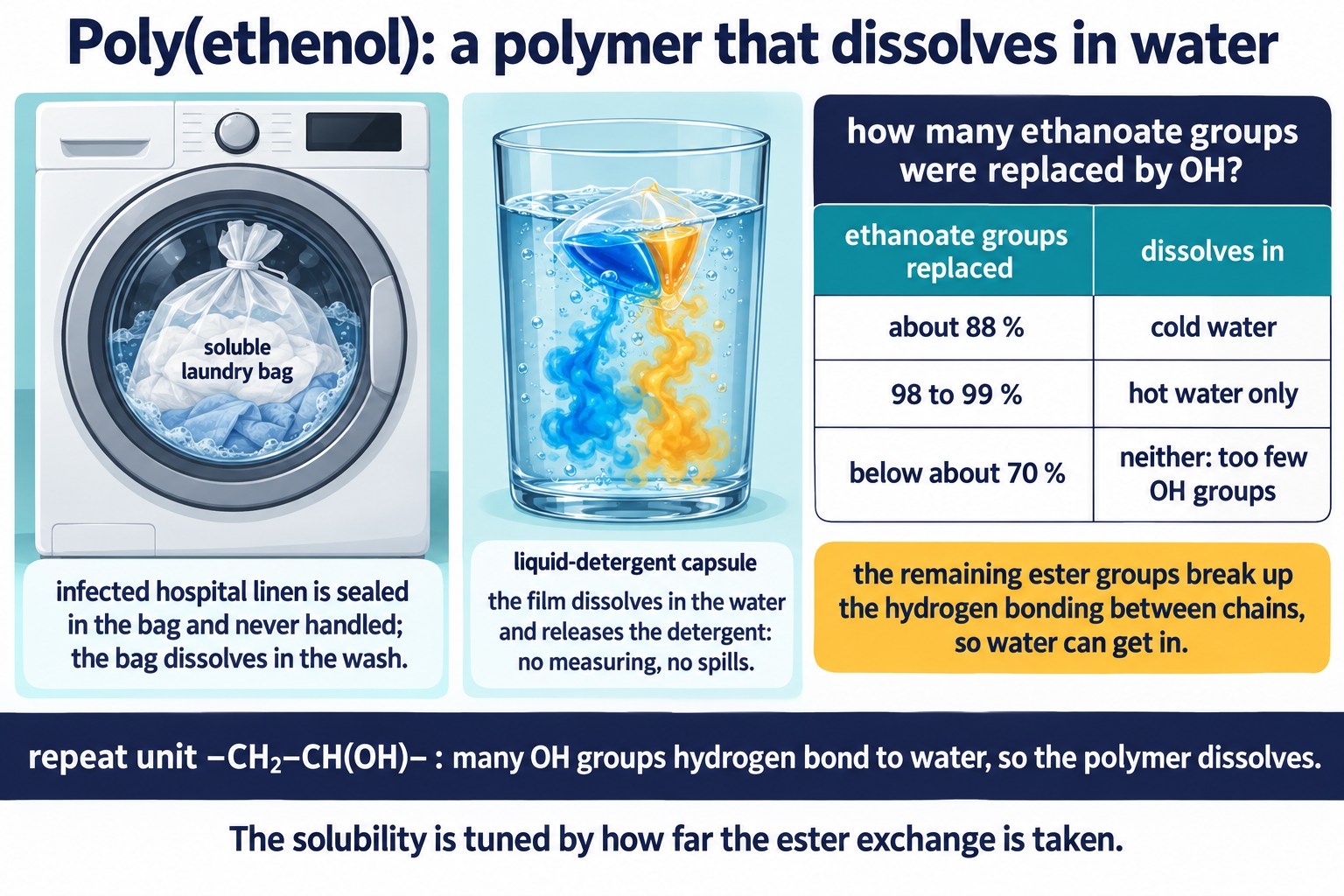
A laundry bag that dissolves in the wash and a detergent capsule that dissolves in water, with the solubility grades set by the fraction of ethanoate groups replaced.
Remember: Laundry bags: no handling of infected linen. Detergent capsules: a measured dose released in the wash. Both depend on hydrogen bonding between the OH groups and water.
Check: Polymers and Water
Predict from the groups on a polymer chain whether it absorbs or dissolves in water, and explain the answer with hydrogen bonding.
Common Exam Points
- Polyamide properties come from hydrogen bonds between the N–H of one chain and the C=O of the next: strength, high melting temperature, fibres.
- Poly(propenamide) is an addition polymer of CH₂=CHCONH₂, repeat unit –CH₂–CH(CONH₂)–; the amide group is a side group.
- Draw an addition repeat unit by opening the C=C: same atoms as the monomer, a bond out of each end.
- Ethenol does not exist, so poly(ethenol) is made from poly(ethenyl ethanoate) by ester exchange with methanol.
- Poly(ethenol) dissolves because its OH groups hydrogen bond to water; the more ethanoate groups are left, the colder the water it dissolves in.
- Uses: soluble laundry bags for infected linen and liquid-detergent capsules.
- Repeat unit of poly(ethenol): –CH₂–CH(OH)–. Repeat unit of poly(ethenyl ethanoate): –CH₂–CH(OOCCH₃)–.
FAQs
Use these quick answers to check why poly(ethenol) dissolves in water, how it is made by ester exchange, the degree of hydrolysis, its uses, and poly(propenamide).
Why does poly(ethenol) dissolve in water?
Every repeat unit, –CH₂–CH(OH)–, carries an OH group, so the chains form many hydrogen bonds to water molecules, enough to pull the chains apart and into solution.
Most addition polymers have only C–H and C–C bonds and cannot hydrogen bond, so they are insoluble.
Why is poly(ethenol) not made from ethenol?
Ethenol, CH₂=CHOH, does not exist as a stable monomer: it rearranges to ethanal. Instead poly(ethenyl ethanoate) is made first and then treated with methanol in an ester exchange (transesterification), which replaces the ethanoate groups with OH groups and releases methyl ethanoate.
What does the degree of hydrolysis mean for solubility?
It is the percentage of ethanoate groups replaced by OH. A fully (98 to 99%) hydrolysed polymer forms strong hydrogen bonds between its own chains and dissolves only in hot water. At 88% the remaining ester groups disrupt that bonding, so it dissolves cold.
What are the uses of poly(ethenol)?
Hospital laundry bags: infected linen is sealed in the bag, which dissolves in the hot wash so nobody handles it. Liquid-detergent and dishwasher capsules: the film dissolves in water, releasing the measured dose. Both uses depend on the polymer dissolving at a chosen temperature.
What is poly(propenamide) and why is it useful?
It is the addition polymer of propenamide, CH₂=CHCONH₂, with repeat unit –CH₂–CH(CONH₂)–. The amide groups hydrogen bond strongly to water, so the polymer absorbs large amounts of it; it is used as a super-absorbent material and in the gels used in laboratories.

Copyright notice: This OLS revision content, including the explanations, layout, diagrams, tables and embedded learning structure, is authored for Online Learning System by Dr. Mohammed Al-Fatah. It may not be copied, reproduced, redistributed or adapted without written permission.
Keep this note — free
Save your progress across every Edexcel IAL topic. A free account remembers which topics you have covered, saves your question scores, and syncs across your phone and laptop.
- Track every topic you have finished
- Keep your practice-question scores
- No payment, no card, free forever
Already registered? Log in