Qualitative Analysis of Inorganic and Organic Unknowns
Practical Skills: Qualitative Analysis identifies unknown organic liquids and inorganic solids from a fixed menu of test-tube reactions: bromine water, warm acidified dichromate(VI), Fehling’s solution, hydrolysis then silver nitrate, and the acid, barium chloride, limewater and chlorine water tests, with every observation written in the words an examiner credits.
GCSE Recap: Testing for Ions
Four quick questions on the GCSE tests this practical builds on: flame colours, the carbonate test with limewater, the sulfate test and the silver nitrate colours.
What This Practical Is Testing
Practical Skills: Qualitative Analysis asks you to identify several unknown substances, typically colourless organic liquids (here A, B and C) and white inorganic solids (here X, Y and Z), from a fixed menu of test-tube reactions.
Nothing here needs new theory: the tests come from the Group 17 chemistry, the tests for alkenes, alcohols, aldehydes and halogenoalkanes, and the ion tests you first met at GCSE.
What is new is the discipline: a small portion of the unknown for each test, the correct reagent in the correct order, and the right conditions (warming when the test needs it).
The last part of that discipline is an observation written in words an examiner will credit before any inference is made.
The logic is an evidence trail: unknown → test → observation → inference → identity. Negative results are part of the trail.
A liquid that turns acidified dichromate(VI) green but leaves Fehling’s solution blue is a primary or secondary alcohol; the negative Fehling’s result is what rules out an aldehyde, which dichromate(VI) would also have oxidised.
A solid that fizzes with acid is not shown to be a carbonate until the gas has turned limewater cloudy.
Students lose marks by jumping from one positive test to an identity and by describing a solution with no colour as “clear”.
Paper 3, a timed laboratory examination that assesses manipulation, observation, presentation of data, analysis and evaluation.
For this practical that means naming reagents and conditions precisely (warm in a water bath, dilute nitric acid before silver nitrate), giving observations in full (colour before and after, precipitate colour, gas test), and writing ionic equations with state symbols.
It also means explaining why a step is there: why the acid, why the warming, why the solid is dissolved first, why a second reagent is needed to confirm.
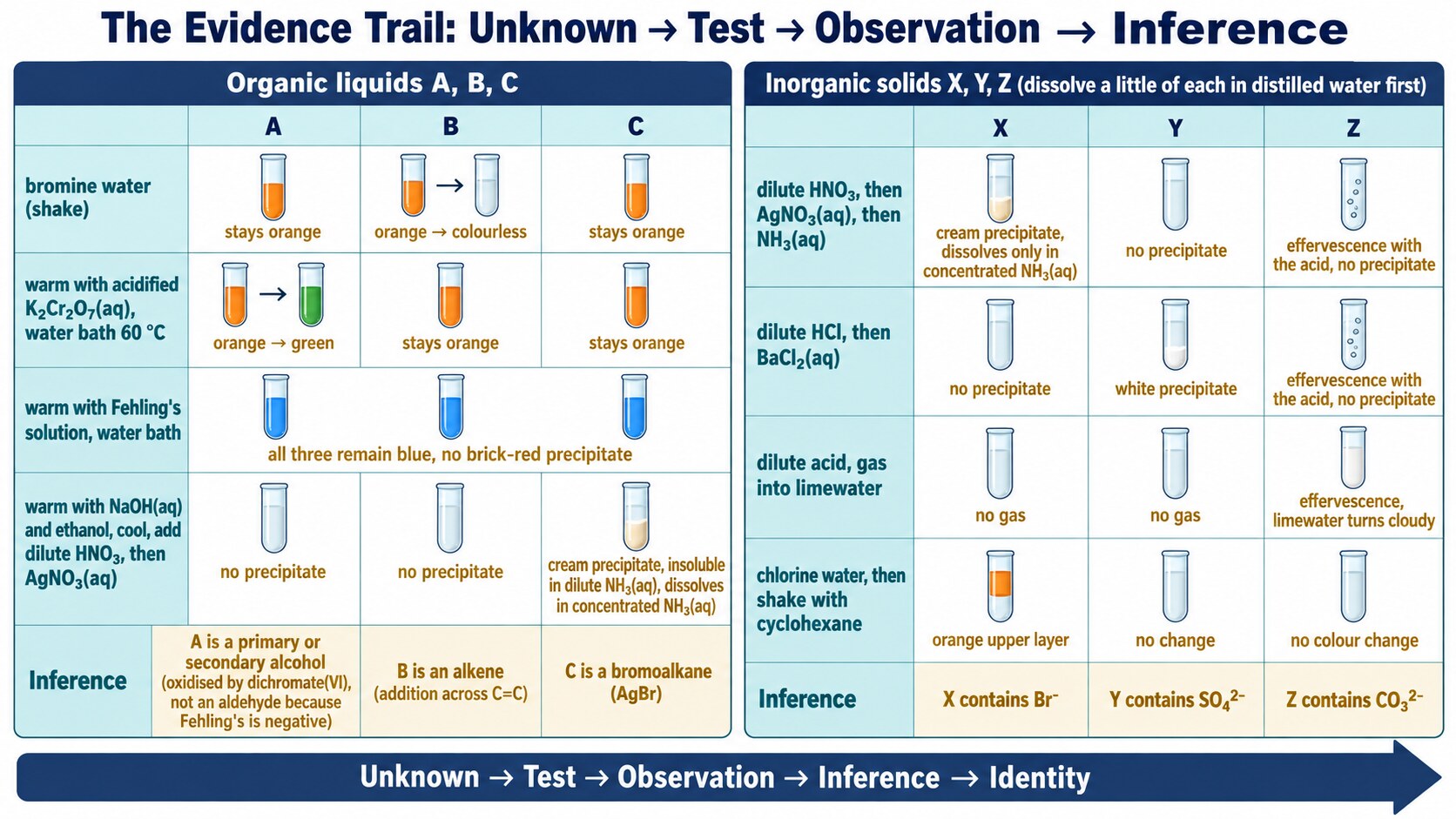
The evidence trail for the six unknowns on this page: every test, every observation and the inference each one supports.
Key idea: An observation is what you see (orange to colourless, cream precipitate, effervescence). An inference is what it means (C=C present, bromide ions, carbonate ions). Write them separately and never skip the observation.
Safety and Apparatus
Everything is done on a test-tube scale: a few drops of the liquid or a spatula tip of the solid. Small quantities are a safety measure and a practical one, because a tube crowded with solid gives a cloudy mixture in which a precipitate cannot be seen.
| Apparatus | What it is for | Note |
|---|---|---|
| Test tubes and rack | one clean tube per test | a dirty tube contaminates the next test |
| Boiling tube, bung and delivery tube | carbonate test: gas led into limewater | fit the bung immediately after adding the acid |
| Water bath (250 cm³ beaker on a hotplate) and thermometer | warming the dichromate(VI), Fehling’s and hydrolysis tubes at about 60 °C | no naked flame near ethanol |
| Dropping pipettes | adding reagents a few drops at a time | one pipette per reagent |
| Spatula and distilled water | dissolving a small portion of each solid | tap water contains chloride ions |
| Limewater in a test tube | confirming carbon dioxide | fresh limewater turns cloudy quickly |
| Teat pipette and watch glass | transferring and viewing small samples | view precipitates against a dark background |
Hazards and precautions: Bromine water and chlorine water: toxic and corrosive, use small volumes in a fume cupboard or a well-ventilated room, wear gloves.
Acidified potassium dichromate(VI): toxic and a suspected carcinogen, wear gloves, use small volumes and pour residues into the labelled waste bottle.
Sodium hydroxide solution: corrosive, eye protection throughout. Ethanol: flammable, so the hydrolysis tube is warmed in a water bath, never over a flame.
Silver nitrate: stains skin and clothing. Concentrated hydrochloric acid: corrosive, use a few drops only. Fehling’s solution is alkaline and contains copper: gloves and eye protection.
Method: Step by Step
The method below follows the sample set on this page: three colourless liquids A, B and C and three white solids X, Y and Z. Each test uses a fresh portion of the unknown, and every “why” is a mark-scheme point.
| Step | What you do | Why |
|---|---|---|
| 1 | Put about 1 cm³ of each liquid A, B and C into three separate test tubes and add bromine water dropwise with shaking. | An alkene decolourises bromine water (orange to colourless) by electrophilic addition across the C=C bond; the other liquids leave it orange. |
| 2 | To fresh portions add acidified potassium dichromate(VI) solution and warm the tubes in a water bath at about 60 °C for a few minutes. | Primary and secondary alcohols and aldehydes are oxidised only on warming; the orange Cr₂O₇²⁻(aq) is reduced to green Cr³⁺(aq). Without warming a negative result means nothing. |
| 3 | To fresh portions add Fehling’s solution and warm in the water bath. | Only an aldehyde reduces the blue Cu²⁺ complex to a brick-red precipitate of Cu₂O; a liquid that is oxidised by dichromate(VI) but leaves Fehling’s solution blue is an alcohol, not an aldehyde. |
| 4 | To fresh portions add sodium hydroxide solution and a little ethanol, warm in the water bath, then cool. | The C–X bond in a ${w.halo} is covalent, so there are no free halide ions until hydrolysis: R–X + OH⁻ → R–OH + X⁻. Ethanol dissolves the organic liquid; the water bath avoids a flame near it. |
| 5 | Acidify the cooled mixture with dilute nitric acid, then add silver nitrate solution. Test any precipitate with dilute, then concentrated, ammonia solution. | The acid neutralises the excess hydroxide ions, which would otherwise give a brown precipitate of Ag₂O with Ag⁺. Nitric acid is used because HCl would add Cl⁻. White, cream or yellow AgX identifies the halogen; ammonia confirms it. |
| 6 | Dissolve a spatula tip of each solid X, Y and Z in about 2 cm³ of distilled water in separate tubes. | The ion tests need free ions in solution; a dry solid cannot react with AgNO₃(aq) or BaCl₂(aq). Distilled water adds no chloride ions. |
| 7 | To one portion of each solution add dilute nitric acid, then silver nitrate solution; test any precipitate with dilute and concentrated ammonia solution. | The acid removes carbonate ions, which would give a white precipitate of Ag₂CO₃. AgCl white (dissolves in dilute NH₃), AgBr cream (dissolves only in concentrated NH₃), AgI yellow (insoluble in both). |
| 8 | To a second portion add dilute hydrochloric acid, then barium chloride solution. | The acid removes carbonate ions, which would give white BaCO₃; a white precipitate that forms after acidifying is BaSO₄. Never acidify with sulfuric acid, which adds sulfate ions. |
| 9 | Add dilute acid to a little of the solid in a boiling tube, fit the bung at once and lead the gas into limewater. | Effervescence suggests a carbonate; limewater turning cloudy (a white precipitate of CaCO₃) identifies the gas as carbon dioxide and completes the test. |
| 10 | To a third portion add chlorine water, then shake with a little cyclohexane and let the layers settle. | Chlorine oxidises bromide ions to bromine (orange) and iodide ions to iodine (brown); the halogen dissolves in the upper cyclohexane layer, orange for bromine and purple for iodine, which makes the colour unmistakable. |
| 11 | Identify the cation with the scheme described on the cation card below (sodium hydroxide and ammonia solutions, or the solubility of the hydroxide and sulfate), and test a portion for ammonium ions. | The anion tests give only half the identity; the cation must be shown separately, and an ammonium salt looks exactly like a metal salt. |
| 12 | Record every observation in a results table at the time, then write the inference beside it. | Examiners credit “orange to colourless”, “cream precipitate”, “effervescence, limewater turns cloudy”; they do not credit “positive”, “reacted” or “clear”. |
Exam wording: “Warm with acidified potassium dichromate(VI) in a water bath: orange to green.” “Add dilute nitric acid, then silver nitrate solution: cream precipitate, insoluble in dilute ammonia, soluble in concentrated ammonia.” Reagent, condition, observation.
Test Bench: Identify the Unknowns
Watch three colourless liquids and three white solids meet their test-tube reagents, then follow every observation to an inference and an identity.
© Dr. Mohammed Al-Fatah – onlinelearningsystem.net
Organic Unknowns A, B and C
Four tests separate the organic liquids: bromine water for a C=C bond, warm acidified dichromate(VI) for anything oxidisable, warm Fehling’s solution (Fehling’s solution or Tollens’ reagent are accepted) for an aldehyde, and hydrolysis followed by silver nitrate for a halogenoalkane.
The table gives the sample observations and the inference each one allows. Notice that the inference column uses the negative results as much as the positive ones.
| Test | A | B | C | Inference |
|---|---|---|---|---|
| Bromine water, shaken | stays orange | orange to colourless (decolourised) | stays orange | B contains a C=C bond, so B is an alkene; the product is a 1,2-dibromoalkane (accepted). A and C are saturated. |
| Acidified K₂Cr₂O₇(aq), warmed in a water bath | orange to green | stays orange | stays orange | A is oxidised: orange Cr₂O₇²⁻(aq) is reduced to green Cr³⁺(aq). A is a primary or secondary alcohol or an aldehyde; B and C are not oxidised (not a tertiary alcohol test on its own). |
| Fehling’s solution, warmed in a water bath | remains blue, no precipitate | remains blue, no precipitate | remains blue, no precipitate | No aldehyde is present. Combined with the dichromate(VI) result, A is a primary or secondary alcohol, not an aldehyde. |
| Warm with NaOH(aq) and ethanol, cool, acidify with dilute HNO₃, add AgNO₃(aq), then NH₃(aq) | no precipitate | no precipitate | cream precipitate, insoluble in dilute NH₃(aq), dissolves in concentrated NH₃(aq) | C releases Br⁻ ions on hydrolysis, so C is a bromoalkane. The ammonia result rules out AgCl (dissolves in dilute) and AgI (insoluble in both). |
Three details carry marks. The dichromate(VI) and Fehling’s tubes are warmed in a water bath at about 60 °C; at room temperature both stay unchanged and the negative result is worthless.
Bromine water is decolourised, from orange to colourless, never “goes clear”.
The dichromate(VI) result alone does not identify A: dichromate(VI) would also oxidise an aldehyde, which is exactly why the negative Fehling’s result must be quoted in the inference.
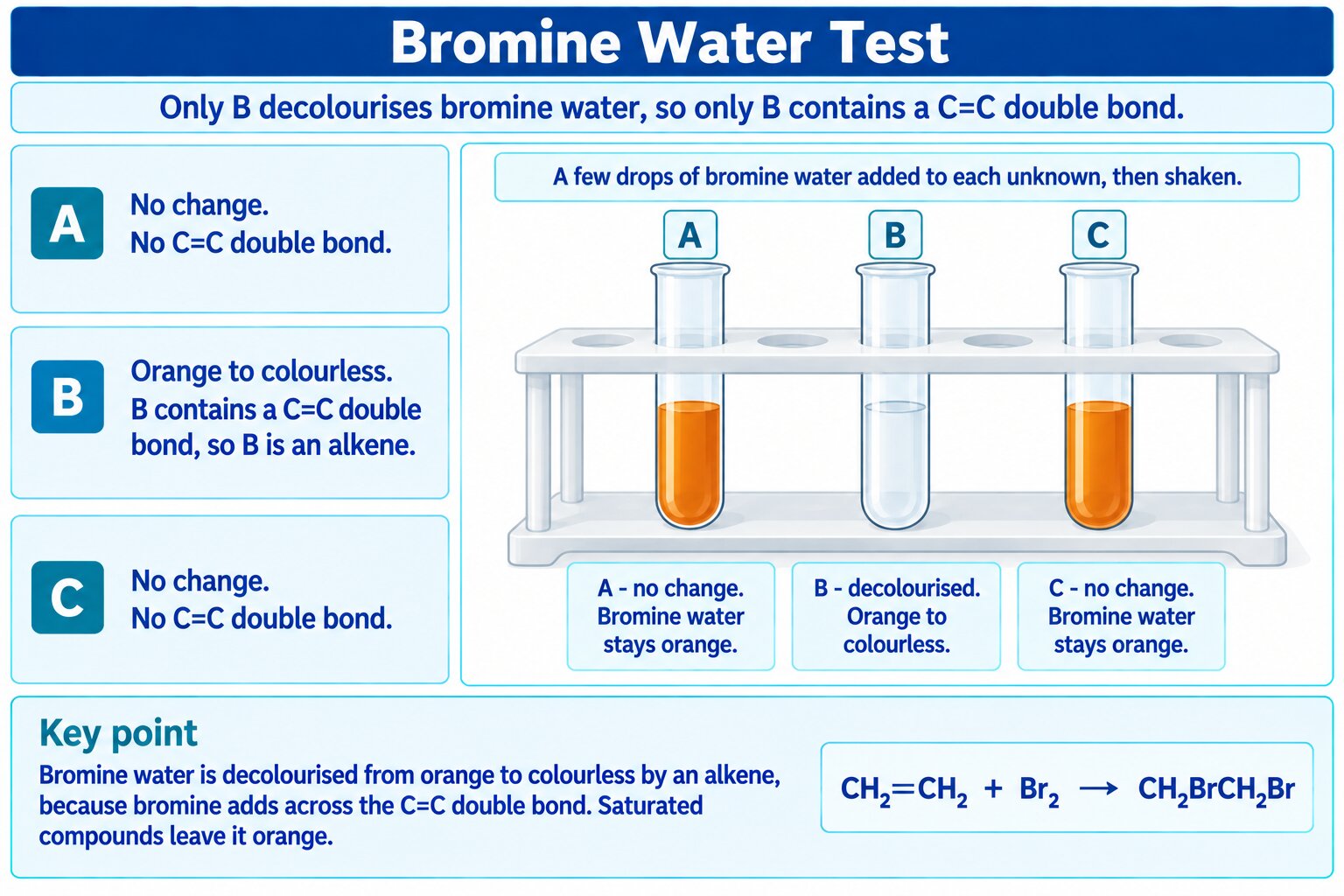
Bromine water added to A, B and C: only B decolourises it, from orange to colourless, which is the evidence for a C=C bond.
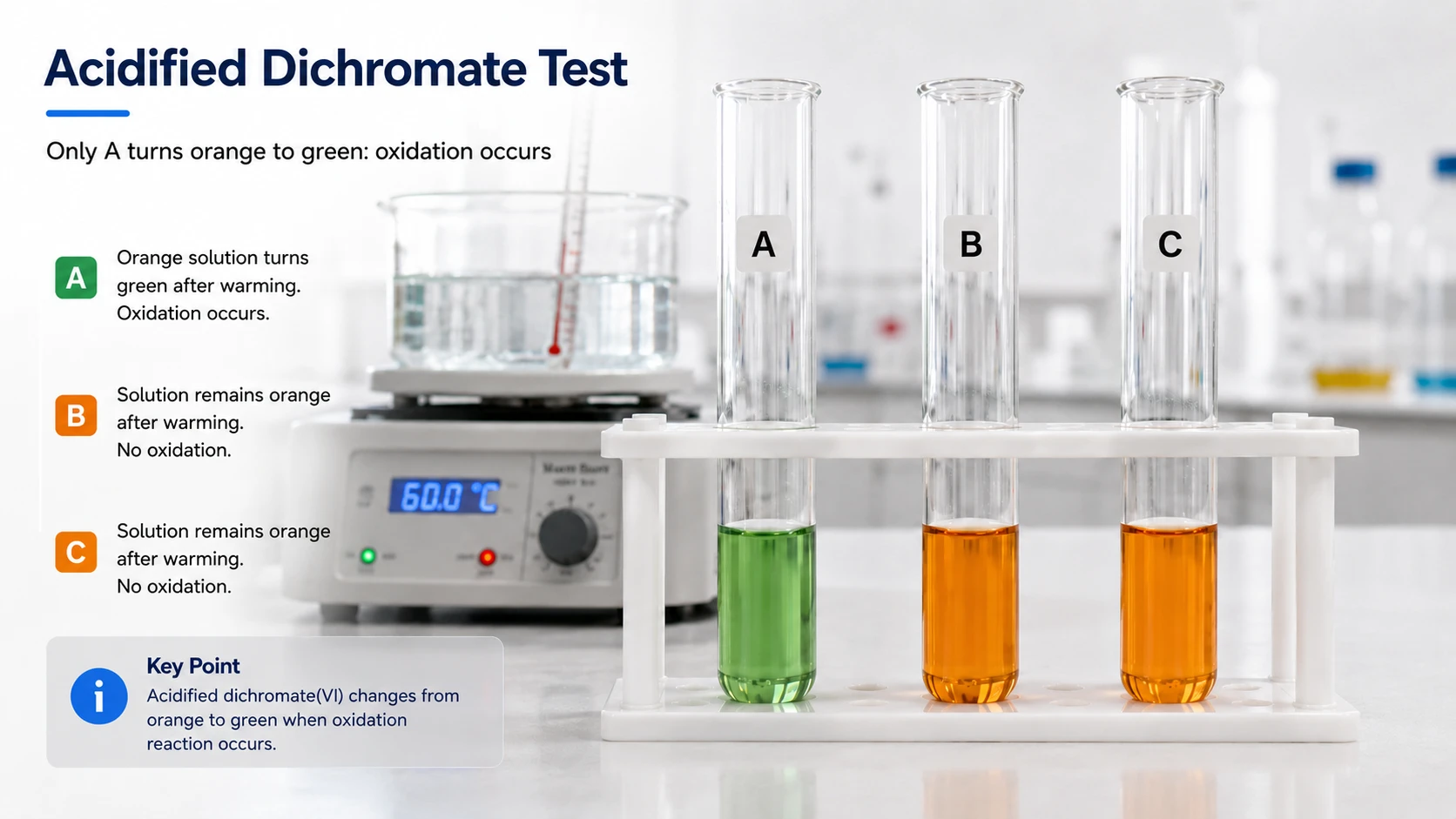
After warming in a water bath, only tube A has changed from orange to green: Cr₂O₇²⁻(aq) reduced to Cr³⁺(aq) as A is oxidised.
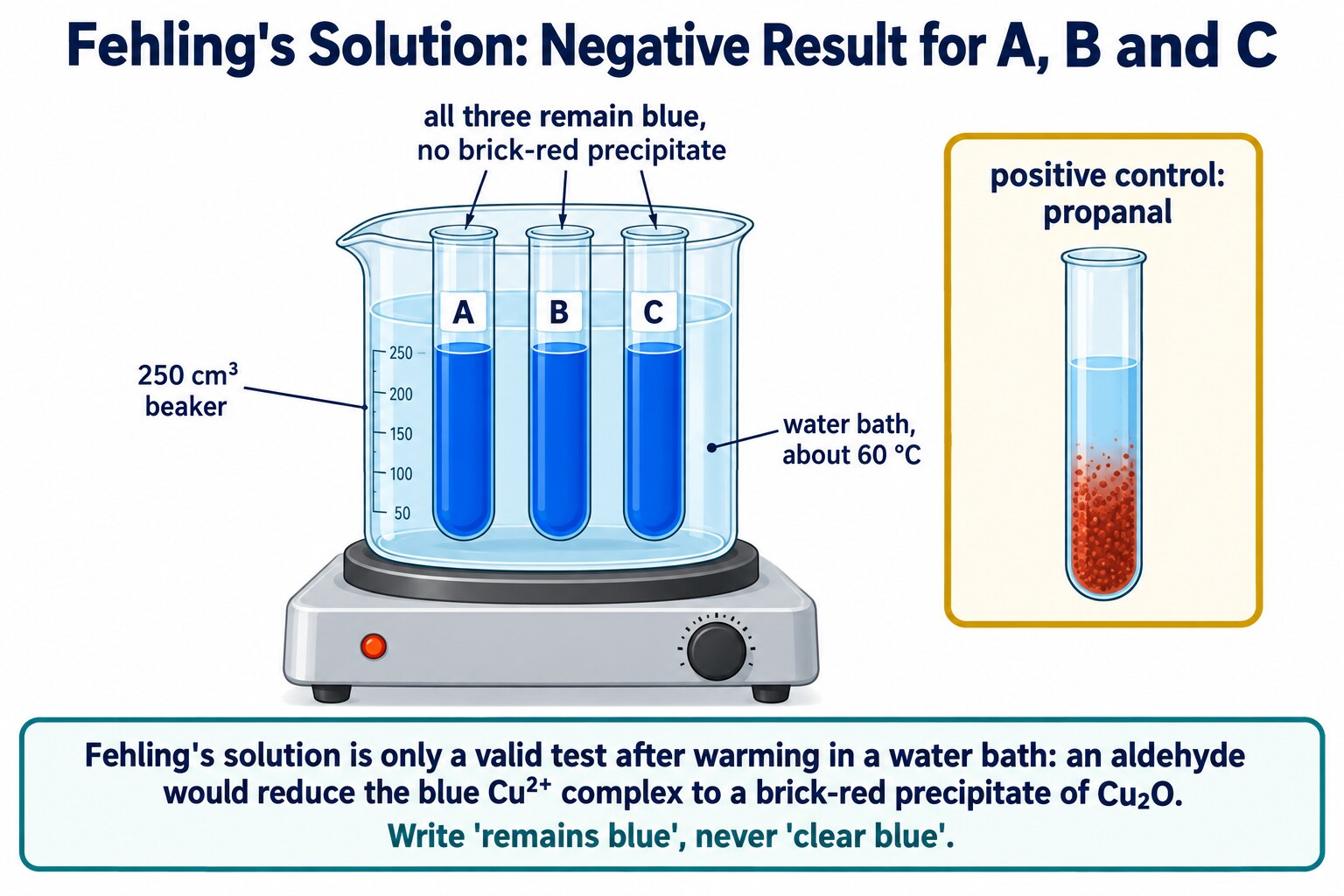
Fehling’s solution warmed with A, B and C: all three remain blue with no precipitate, so none of them is an aldehyde.
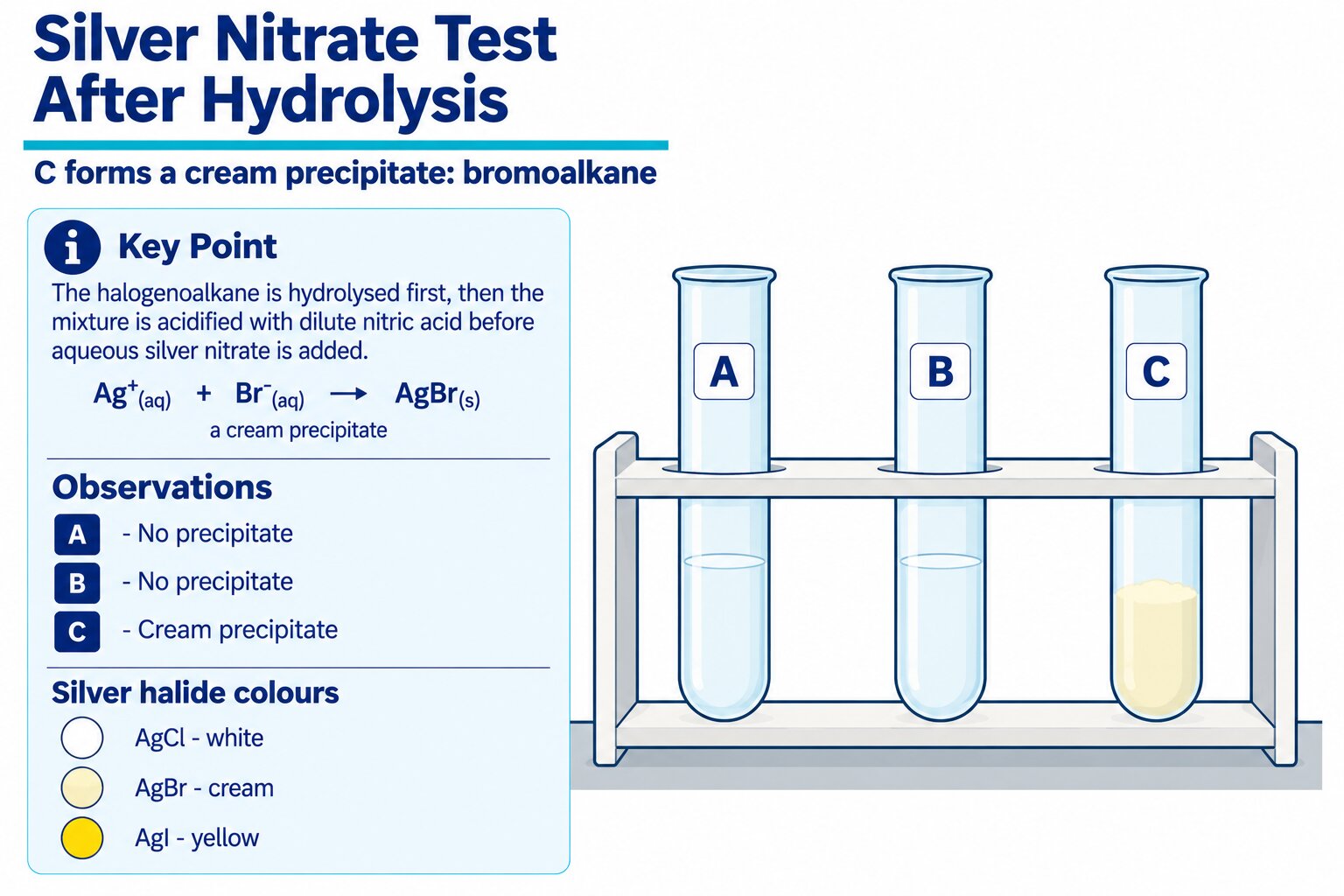
Hydrolysis, acidification with dilute nitric acid and then silver nitrate: only C gives a cream precipitate of silver bromide.
Exam focus: Final identities: A is a primary or secondary alcohol (never “an oxidisable alcohol”), B is an alkene, C is a bromoalkane. Each identity must quote the test that supports it and the negative test that rules out the alternative.
Check: Three New Liquids
Propanal, propanone and but-1-ene meet the same three reagents. Predict every observation and decide which liquid is which.
Testing for an Aldehyde and the Rest of the Organic Menu
The sample set gives no positive Fehling’s result, so you must still know what one looks like.
On warming in a water bath an aldehyde reduces the deep blue copper(II) complex in Fehling’s solution to a brick-red precipitate of copper(I) oxide, Cu₂O.
Cu²⁺ is reduced to Cu⁺ while the aldehyde is oxidised to a carboxylic acid: RCHO + 2Cu²⁺ + 4OH⁻ → RCOOH + Cu₂O + 2H₂O.
A ketone has no hydrogen on its carbonyl carbon, so it cannot be oxidised under these conditions and the solution stays blue.
Tollens’ reagent (ammoniacal silver nitrate) is the accepted alternative: warmed with an aldehyde it gives a silver mirror on the inside of the tube as Ag⁺ is reduced to Ag.
The full organic test menu is longer than the four tests used on A, B and C, and any of it can appear in a question.
A carbonyl group (aldehyde or ketone) gives an orange precipitate with 2,4-dinitrophenylhydrazine (2,4-DNPH); Fehling’s or Tollens’ then decides between the two.
A carboxylic acid effervesces with sodium carbonate or sodium hydrogencarbonate solution, and the gas turns limewater cloudy; alcohols and phenols do not.
A tertiary alcohol is the one that leaves warm acidified dichromate(VI) orange but is still an alcohol, so it is identified by elimination once the other tests are negative.
The oxidation chemistry behind the dichromate(VI) test is the subject of Practical Skills: Distillation and Reflux (oxidation of an alcohol).
| Functional group | Reagent and conditions | Positive observation |
|---|---|---|
| Alkene, C=C | bromine water, shake at room temperature | orange to colourless |
| Primary or secondary alcohol, or aldehyde | acidified K₂Cr₂O₇(aq), warm in a water bath | orange to green |
| Aldehyde | Fehling’s solution, warm in a water bath | brick-red precipitate of Cu₂O |
| Aldehyde (alternative) | Tollens’ reagent, warm gently in a water bath | silver mirror |
| Aldehyde or ketone | 2,4-DNPH solution | orange precipitate |
| Carboxylic acid | Na₂CO₃(aq) or NaHCO₃(aq) | effervescence; gas turns limewater cloudy |
| Halogenoalkane | warm with NaOH(aq) and ethanol, cool, dilute HNO₃, AgNO₃(aq), then NH₃(aq) | white, cream or yellow precipitate; solubility in NH₃(aq) confirms |
| CH₃CO– or CH₃CH(OH)– group | alkaline aqueous iodine (I₂(aq) and NaOH(aq)), warm gently | yellow precipitate of tri-iodomethane, CHI₃ |
| Compound that can be oxidised | acidified KMnO₄(aq) | purple to colourless |
Two more organic tests from the notes
The tri-iodomethane test picks out one structural feature: a methyl group next to a carbonyl group, CH₃CO–, or next to a carbon carrying an OH group, CH₃CH(OH)–.
Warm the compound gently with iodine solution and sodium hydroxide solution: a pale yellow precipitate of CHI₃ with an antiseptic smell is a positive result, CH₃COR + 3I₂ + 4OH⁻ → RCOO⁻ + CHI₃(s) + 3I⁻ + 3H₂O(l).
Ethanol, ethanal, propan-2-ol and propanone give it; propan-1-ol, propanal and methanol do not, because the alkaline iodine first oxidises CH₃CH(OH)– to CH₃CO–.
Acidified potassium manganate(VII) turns from purple to colourless with any compound it can oxidise, including primary and secondary alcohols, aldehydes and alkenes, so it says only “can be oxidised”. Follow it with a more selective test to decide which group is present.
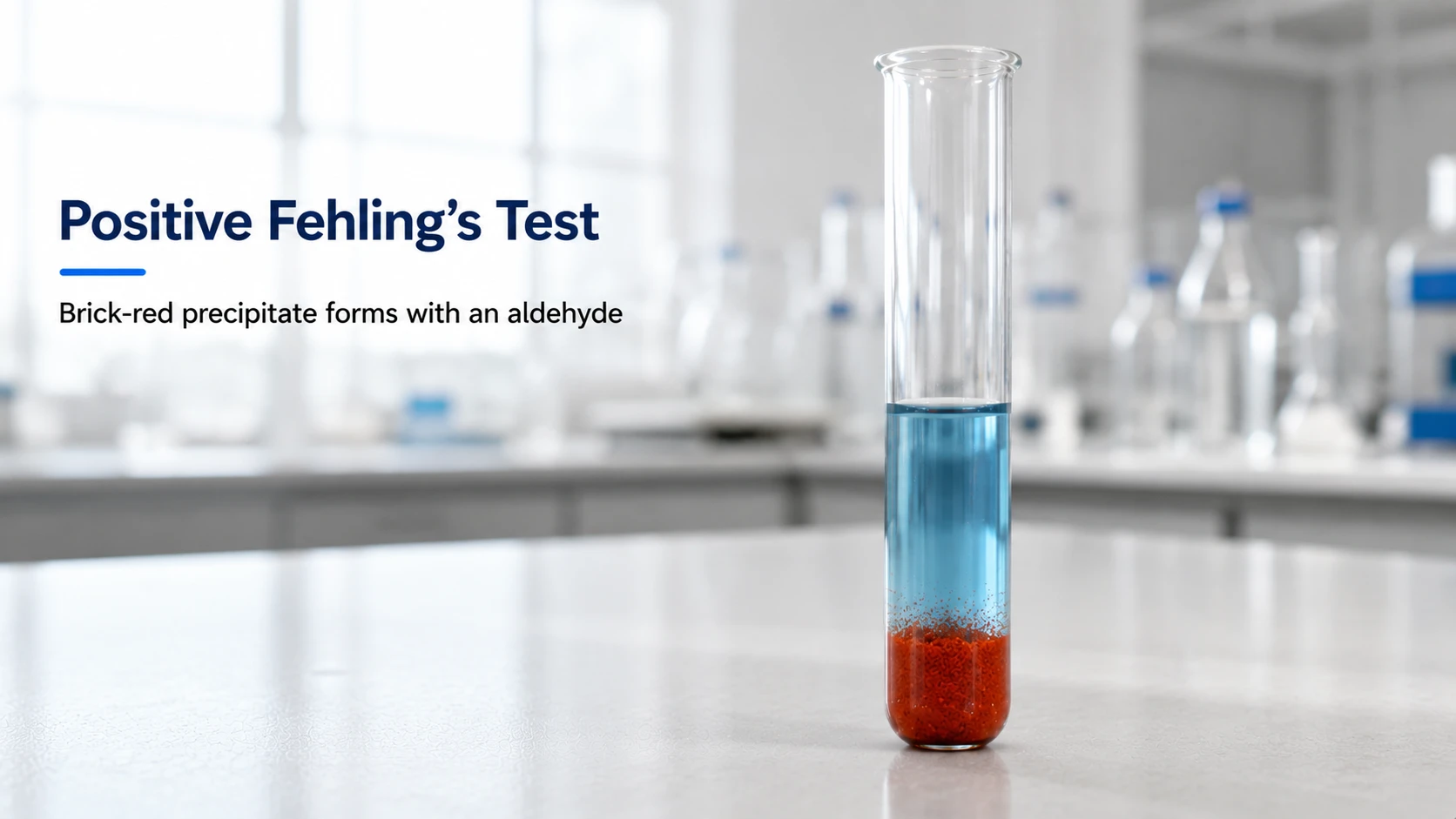
A positive Fehling’s result for reference: brick-red copper(I) oxide settles under the pale blue liquid after warming with an aldehyde. Not part of the sample data.
Key idea: Dichromate(VI) says “oxidisable”; Fehling’s or Tollens’ says “aldehyde”. You need both results to name a primary alcohol with confidence.
Check: Tri-iodomethane and Manganate(VII) Tests
Apply the alkaline iodine and acidified manganate(VII) tests to compounds that are not on this page.
Check: Aldehyde or Not?
Two questions on using a positive and a negative result together for liquids that are not on this page.
Testing C for the Halogen
The halogenoalkane test has five steps and every one of them is examined. First, warm a few drops of C with sodium hydroxide solution and a little ethanol in a water bath.
The C–Br bond is covalent, so there are no bromide ions in the liquid until it has been hydrolysed: CH₃CH₂CH₂Br + OH⁻ → CH₃CH₂CH₂OH + Br⁻ (1-bromopropane is used as the example).
Ethanol is the co-solvent that lets the organic liquid mix with the aqueous alkali, and it is flammable, so the tube is warmed in a water bath and never over a flame.
Second, cool the tube and acidify with dilute nitric acid. The alkali was added in excess, and Ag⁺ reacts with OH⁻ to give a brown precipitate of silver oxide, Ag₂O, which would hide the halide result: 2Ag⁺(aq) + 2OH⁻(aq) → Ag₂O(s) + H₂O(l).
Nitric acid is chosen because hydrochloric acid would add chloride ions and give a white precipitate of AgCl whatever the unknown, and sulfuric acid would add sulfate ions.
Third, add silver nitrate solution: Ag⁺(aq) + Br⁻(aq) → AgBr(s), a cream precipitate.
Fourth and fifth, add dilute ammonia solution (the cream precipitate stays) and then concentrated ammonia solution (it dissolves): AgBr(s) + 2NH₃(aq) → [Ag(NH₃)₂]⁺(aq) + Br⁻(aq).
Exam focus: Without the ammonia step an examiner can only accept “AgBr or AgI”, because cream and pale yellow are hard to tell apart in a small tube.
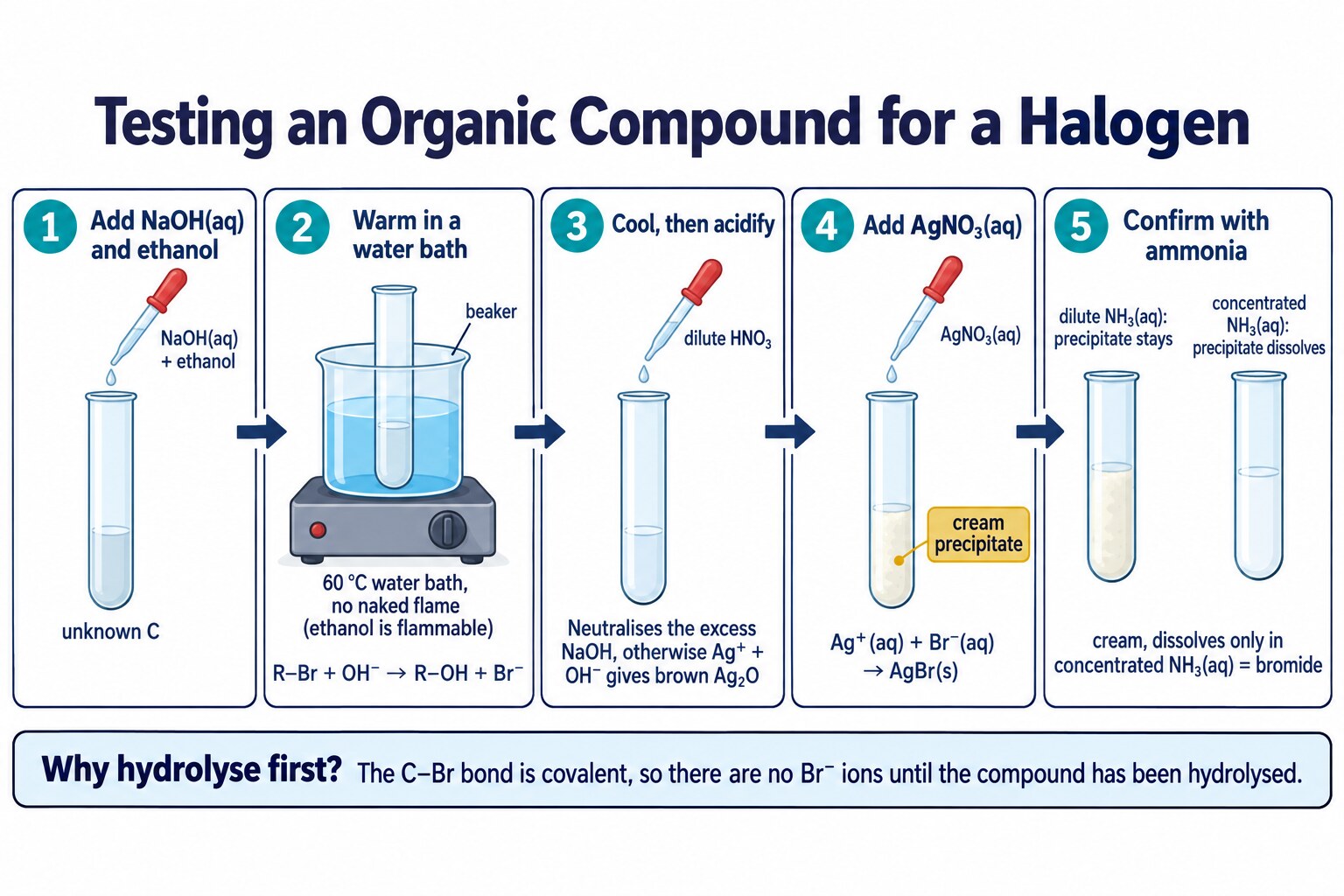
The five steps for testing an organic liquid for a halogen: hydrolyse with NaOH(aq) and ethanol in a water bath, cool, acidify with dilute nitric acid, add silver nitrate, confirm with dilute then concentrated ammonia.
The same silver nitrate chemistry is used to compare the rates of hydrolysis of chloro-, bromo- and iodoalkanes in Practical Skills: Rates of Hydrolysis (hydrolysis of halogenoalkanes), where the time taken for the precipitate to appear is the measurement.
Here the precipitate is only the evidence for which halogen is present.
Exam trap: Adding silver nitrate straight to the organic liquid gives no precipitate and proves nothing: the halogen is covalently bonded. Hydrolyse, acidify with nitric acid, then test.
Inorganic Unknowns X, Y and Z
The three white solids are tested for their anions in solution, so the first step is to dissolve a spatula tip of each in a little distilled water.
A dry solid cannot react with silver nitrate or barium chloride solution, and tap water would add chloride ions.
On this board the cation is identified separately, by the scheme in the cation card below; in this sample set X is a calcium salt, Y a sodium salt and Z a potassium salt.
The table gives the anion evidence with the inference beside each observation.
| Test | X | Y | Z | Inference |
|---|---|---|---|---|
| Dissolve in distilled water | colourless solution | colourless solution | colourless solution | All three are soluble salts; the ion tests can now be done on portions of each solution. |
| Dilute HNO₃, then AgNO₃(aq), then NH₃(aq) | cream precipitate; does not dissolve in dilute NH₃(aq), dissolves in concentrated NH₃(aq) | no precipitate | effervescence with the acid, then no precipitate | X contains Br⁻ (AgBr). Y and Z contain no halide. Z reacts with the acid itself. |
| Dilute HCl, then BaCl₂(aq) | no precipitate | white precipitate | effervescence with the acid, then no precipitate | Y contains SO₄²⁻ (BaSO₄). The acid first removes any carbonate, which would give white BaCO₃. |
| Dilute acid on the solid, gas into limewater | no gas | no gas | effervescence; limewater turns cloudy | Z contains CO₃²⁻: the gas is CO₂, shown by the white precipitate of CaCO₃ in the limewater. |
| Chlorine water, then shake with cyclohexane | orange solution; orange upper (cyclohexane) layer | no change | no colour change (slight fizzing from the acidic chlorine water) | X contains Br⁻: chlorine oxidises bromide ions to bromine. Consistent with the cream AgBr. |
Identities: X is calcium bromide, CaBr₂; Y is sodium sulfate, Na₂SO₄; Z is potassium carbonate, K₂CO₃.
Each anion has one primary test and one confirmation: silver nitrate then ammonia for the halide, acid then barium chloride for the sulfate, acid then limewater for the carbonate.
The chlorine water result for X is a second, independent line of evidence for bromide, which is what makes the identification secure.
The acid before each precipitation test is not decoration. Carbonate ions give a white precipitate with silver ions (Ag₂CO₃) and with barium ions (BaCO₃), so a carbonate would give a false positive in both tests.
Dilute acid converts the carbonate to carbon dioxide and removes the problem.
The acid must add nothing that is being tested for: nitric acid before silver nitrate (hydrochloric acid would add Cl⁻), hydrochloric or nitric acid before barium chloride (sulfuric acid would add SO₄²⁻).
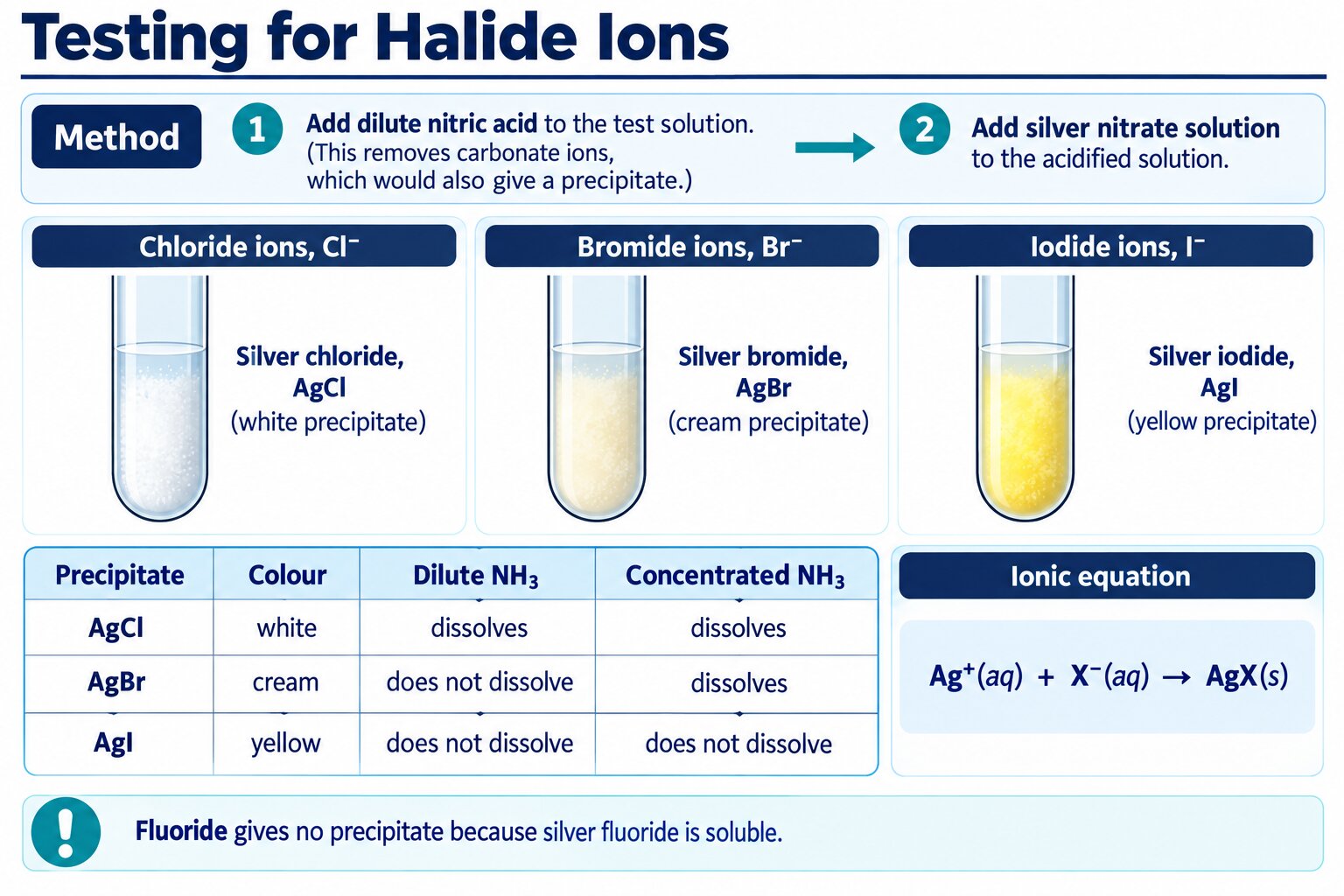
The silver halide test: acidify with dilute nitric acid, add silver nitrate, then use dilute and concentrated ammonia to tell white AgCl, cream AgBr and yellow AgI apart.
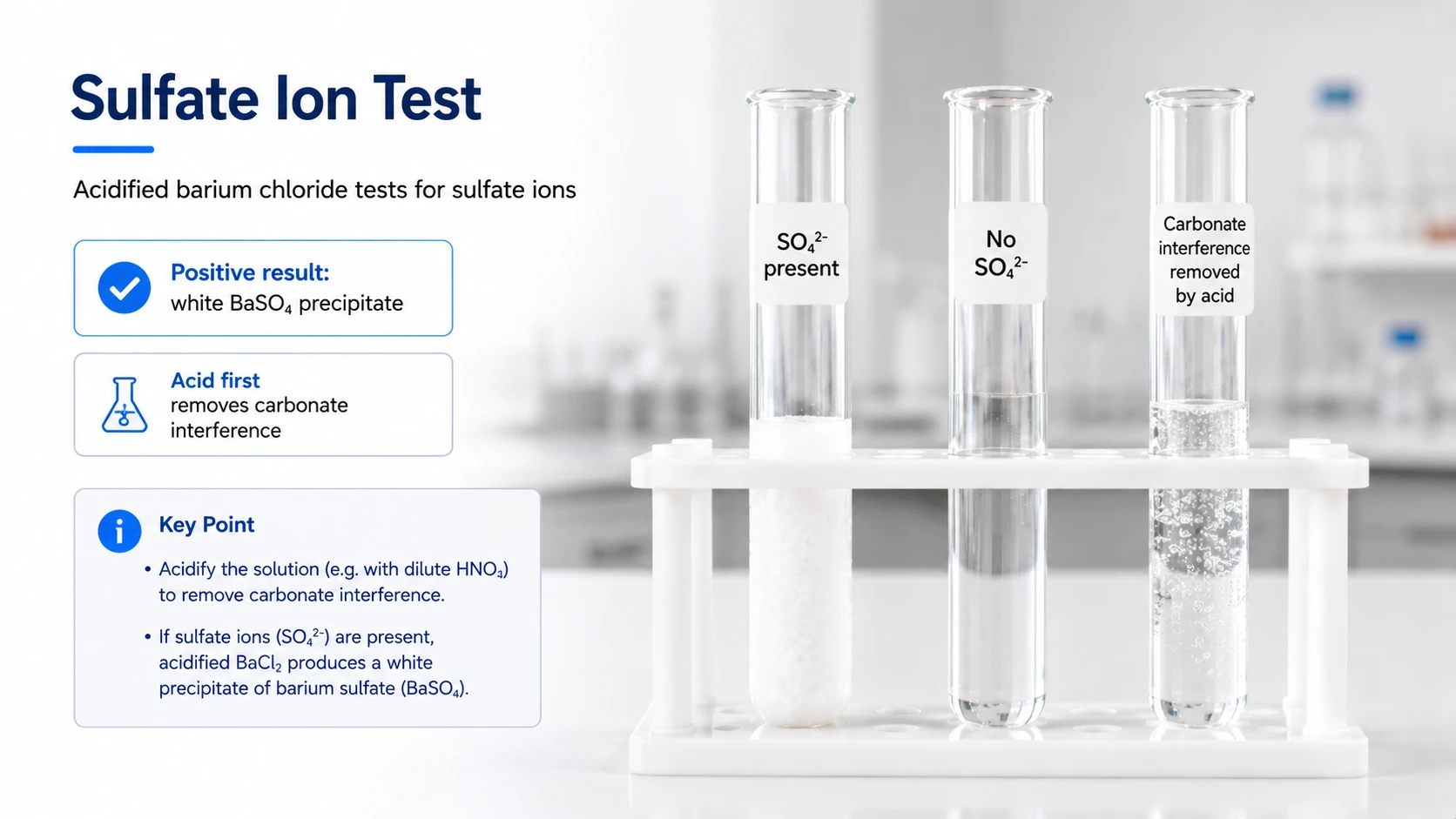
The sulfate test: acidify with dilute hydrochloric acid, then add barium chloride solution. A white precipitate of BaSO₄ shows sulfate; a carbonate fizzes with the acid instead.
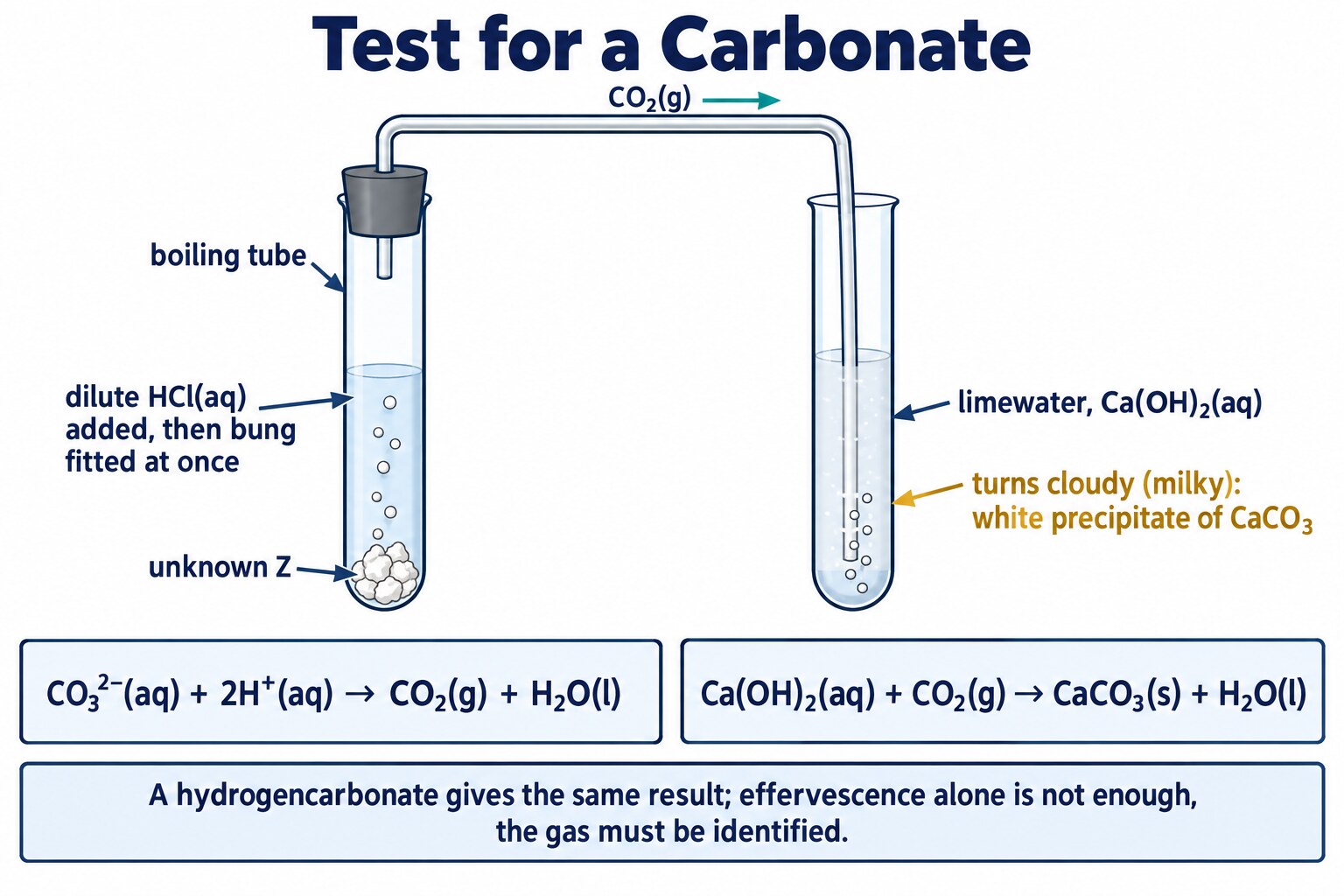
The carbonate test done properly: acid added to the solid in a boiling tube, bung fitted at once, and the gas bubbled through limewater, which turns cloudy.
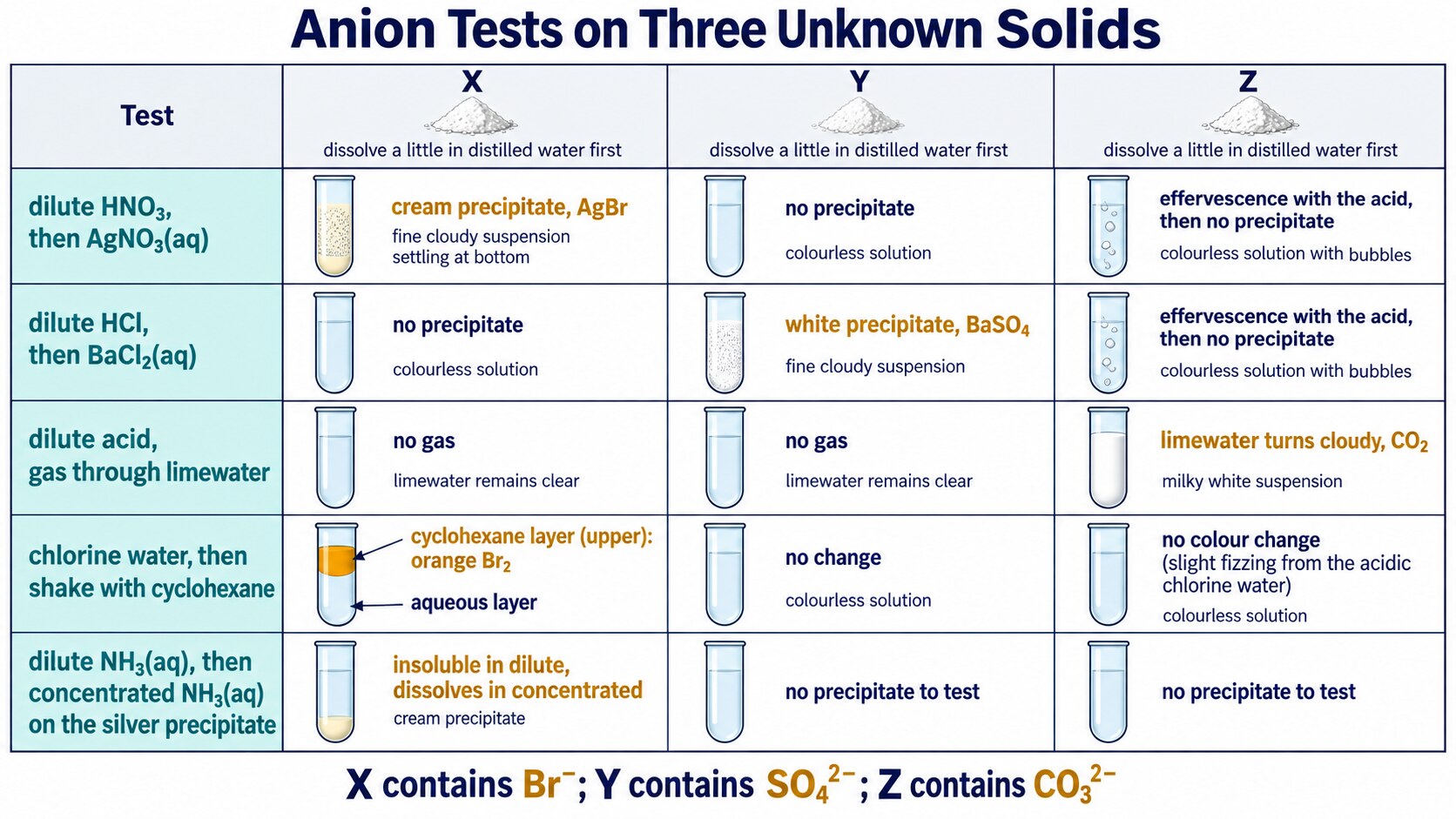
The anion tests on X, Y and Z side by side, with the orange bromine in the upper cyclohexane layer of the chlorine water tube for X.
Exam wording: “Add dilute hydrochloric acid, then barium chloride solution: a white precipitate shows sulfate ions. The acid removes carbonate ions, which would also give a white precipitate.” Reagent, observation, inference and the reason for the acid.
Check: A New Solid, W
Follow the evidence trail for a solid that is not on this page: a yellow silver precipitate, a purple cyclohexane layer and a white precipitate with dilute sulfuric acid.
Identifying the Cation: Sodium Hydroxide and Ammonia Solutions
On this board the metal ion is identified from the precipitate formed with sodium hydroxide solution and with ammonia solution, first with a few drops and then in excess.
The observations must be written in the standard wording: the colour of the precipitate, then whether it is “soluble in excess” or “insoluble in excess”, then the colour of any solution formed.
The table below is the one you need to know; the same table is printed in the practical paper, but you will answer faster and more accurately if you understand it.
| Cation | NaOH(aq) | NH₃(aq) |
|---|---|---|
| Al³⁺ | white ppt, soluble in excess giving a colourless solution | white ppt, insoluble in excess |
| Ba²⁺ | faint white ppt. is observed unless [Ba²⁺(aq)] is very low | no ppt |
| Ca²⁺ | white ppt. unless [Ca²⁺(aq)] is very low | no ppt |
| Cr³⁺ | grey-green ppt, soluble in excess giving a dark green solution | grey-green ppt, insoluble in excess |
| Cu²⁺ | pale blue ppt, insoluble in excess | pale blue ppt, soluble in excess giving a dark blue solution |
| Fe²⁺ | green ppt, turns brown near the surface on standing, insoluble in excess | green ppt, turning brown on contact with air, insoluble in excess |
| Fe³⁺ | red-brown ppt, insoluble in excess | red-brown ppt, insoluble in excess |
| Mg²⁺ | white ppt, insoluble in excess | white ppt, insoluble in excess |
| Mn²⁺ | off-white ppt, rapidly turning brown on contact with air, insoluble in excess | off-white ppt, rapidly turning brown on contact with air, insoluble in excess |
| Zn²⁺ | white ppt, soluble in excess giving a colourless solution | white ppt, soluble in excess giving a colourless solution |
| NH₄⁺ | ammonia given off on warming (damp red litmus turns blue) | no reaction |
Three white precipitates cause most of the lost marks. Zinc hydroxide dissolves in excess of both reagents; aluminium hydroxide dissolves in excess sodium hydroxide only; magnesium hydroxide dissolves in neither.
Calcium gives a white precipitate with sodium hydroxide unless its concentration is very low, barium gives a faint one unless its concentration is very low, and neither gives a precipitate with ammonia.
They are identified by the sulfate test on the anion side (barium sulfate is insoluble, calcium sulfate slightly soluble) or by a flame colour where the paper allows it.
For iron(II), the change to brown on standing is a mark point: Fe(OH)₂ is oxidised by air to Fe(OH)₃.
Two coloured hydroxides complete the table. Chromium(III) gives a grey-green precipitate that, like aluminium hydroxide, is amphoteric and dissolves in excess sodium hydroxide to give a dark green solution, but not in excess ammonia.
Cr³⁺(aq) + 3OH⁻(aq) → Cr(OH)₃(s), then Cr(OH)₃(s) + 3OH⁻(aq) → [Cr(OH)₆]³⁻(aq).
Manganese(II) gives an off-white precipitate of Mn(OH)₂ with either reagent, insoluble in excess, which turns brown rapidly as oxygen in the air oxidises it.
Iron(II) behaves in the same way but starts green, so the colour before it browns is what tells the two apart.
Equations with state symbols: Cu²⁺(aq) + 2OH⁻(aq) → Cu(OH)₂(s); Zn(OH)₂(s) + 2OH⁻(aq) → [Zn(OH)₄]²⁻(aq); Cu(OH)₂(s) + 4NH₃(aq) → [Cu(NH₃)₄]²⁺(aq) + 2OH⁻(aq).
Gas tests are also marked: carbon dioxide turns limewater cloudy, ammonia turns damp red litmus blue, chlorine bleaches damp litmus, and sulfur dioxide turns acidified potassium dichromate(VI) paper from orange to green.
The ammonium ion
Ammonium salts look like any other white solid, so the ammonium test is part of every scheme.
Warm a little of the solid (or its solution) with sodium hydroxide solution and hold a piece of damp red litmus paper at the mouth of the tube without letting it touch the liquid.
Ammonia gas is given off and the paper turns blue: NH₄⁺(aq) + OH⁻(aq) → NH₃(g) + H₂O(l).
Students lose marks by writing “litmus turns blue” without saying the paper was damp and red, and by forgetting that the alkali itself would turn the paper blue if it splashed on it.
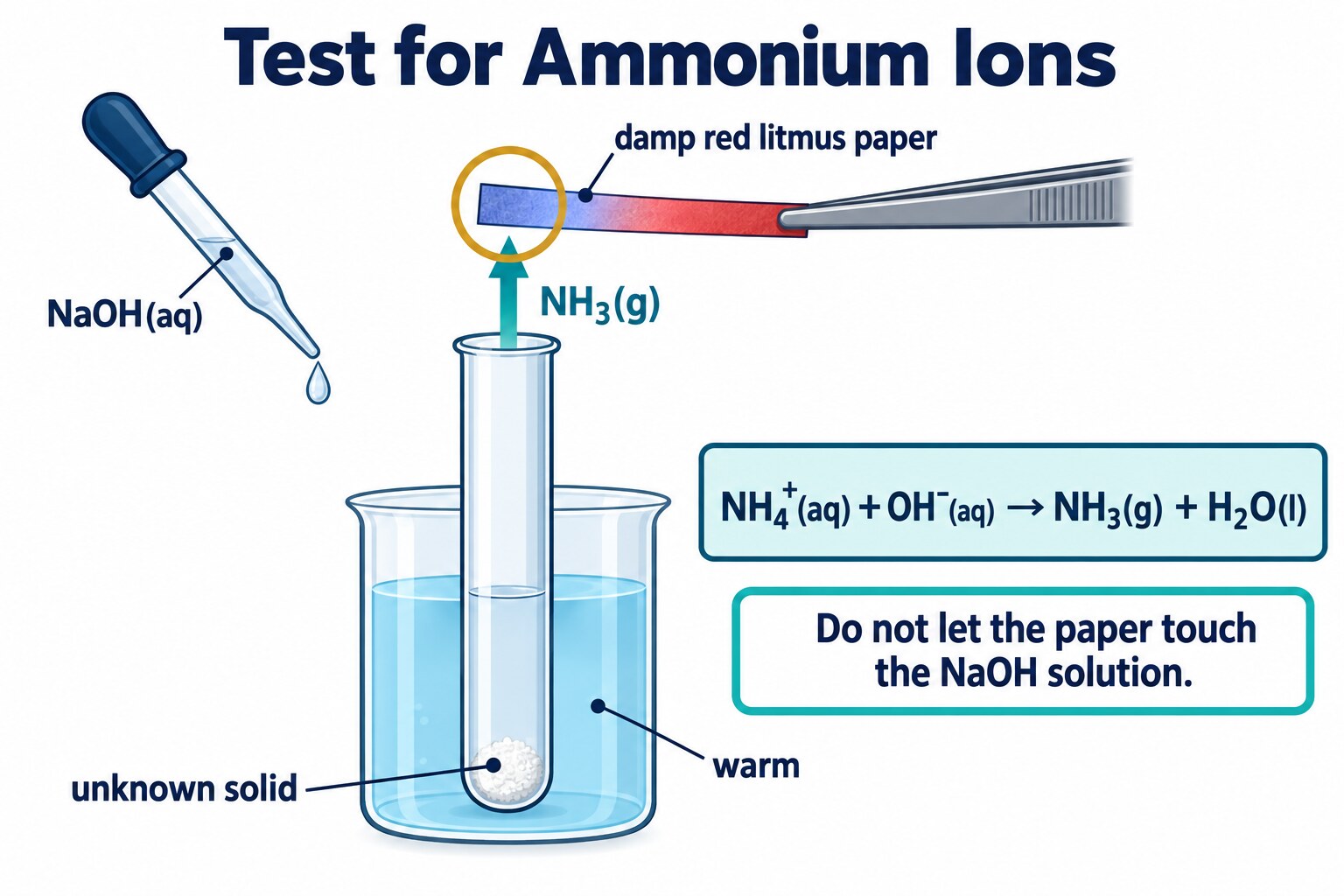
The ammonium ion test: warm the solid with sodium hydroxide solution and test the gas with damp red litmus paper, which turns blue.
Exam wording: Always three parts: “white ppt, soluble in excess, colourless solution”. A precipitate that dissolves has not “disappeared”: it has formed a soluble complex.
More Anion Tests, Gas Tests and the Iodine Test
The qualitative analysis notes printed in the practical paper list more anions than the three in the sample set, and each has its own test.
Nitrate and nitrite are found by reduction to ammonia: warm the solution with sodium hydroxide solution and a small piece of aluminium foil, and test the gas with damp red litmus paper.
Because the test detects ammonia, warm the solution with sodium hydroxide alone first: if ammonia is given off before the foil is added, ammonium ions are present and must be driven off by boiling before the nitrate test means anything.
| Anion | Reaction (as in the qualitative analysis notes) |
|---|---|
| nitrate, NO₃⁻(aq) | NH₃ liberated on heating with OH⁻(aq) and Al foil |
| nitrite, NO₂⁻(aq) | NH₃ liberated on heating with OH⁻(aq) and Al foil; decolourises acidified aqueous KMnO₄ |
| sulfate, SO₄²⁻(aq) | gives white ppt with Ba²⁺(aq) (insoluble in excess dilute strong acids); gives white ppt with high [Ca²⁺(aq)] |
| sulfite, SO₃²⁻(aq) | gives white ppt with Ba²⁺(aq) (soluble in excess dilute strong acids); decolourises acidified aqueous KMnO₄ |
| thiosulfate, S₂O₃²⁻(aq) | gives off-white/pale yellow ppt slowly with H⁺ |
3NO₃⁻(aq) + 8Al(s) + 5OH⁻(aq) + 18H₂O(l) → 3NH₃(g) + 8[Al(OH)₄]⁻(aq)
Nitrate and nitrite give the same aluminium foil result, so a second test separates them.
Nitrite is a reducing agent: it is oxidised to nitrate and turns acidified potassium manganate(VII) from purple to colourless, 2MnO₄⁻(aq) + 5NO₂⁻(aq) + 6H⁺(aq) → 2Mn²⁺(aq) + 5NO₃⁻(aq) + 3H₂O(l).
Nitrate cannot be oxidised further, so it leaves the purple colour.
Sulfate and sulfite both give a white precipitate with barium ions, and the acid decides between them. Barium sulfate is insoluble in excess dilute strong acid; barium sulfite dissolves, BaSO₃(s) + 2H⁺(aq) → Ba²⁺(aq) + SO₂(g) + H₂O(l).
Sulfite is also a reducing agent and decolourises acidified manganate(VII), 2MnO₄⁻(aq) + 5SO₃²⁻(aq) + 6H⁺(aq) → 2Mn²⁺(aq) + 5SO₄²⁻(aq) + 3H₂O(l).
Calcium sulfate is only slightly soluble, which is why a solution with a high concentration of calcium ions also gives a white precipitate with sulfate.
Thiosulfate is recognised by the slow appearance of an off-white or pale yellow precipitate of sulfur when acid is added, S₂O₃²⁻(aq) + 2H⁺(aq) → S(s) + SO₂(g) + H₂O(l), the reaction timed in Practical Skills: Rates of Reaction.
Tests for gases and for iodine
| Gas or element | Test and test result |
|---|---|
| ammonia, NH₃ | turns damp red litmus paper blue |
| carbon dioxide, CO₂ | gives a white ppt with limewater |
| hydrogen, H₂ | “pops” with a lighted splint |
| oxygen, O₂ | relights a glowing splint |
| iodine, I₂ | gives blue-black colour on addition of starch solution |
Effervescence on its own is only an observation: the notes expect you to identify the gas with its test.
Hydrogen burns with a squeaky pop because it mixes with air in the tube, 2H₂(g) + O₂(g) → 2H₂O(l), and is given off when a reactive metal such as magnesium or zinc is added to dilute acid.
Oxygen relights a glowing splint because it supports combustion; it comes from decomposing hydrogen peroxide with a catalyst.
Starch is a very sensitive test for iodine, so a blue-black colour after an oxidising agent is added to iodide ions shows that iodine has been formed.
Exam wording: Nitrate and nitrite: “ammonia given off on warming with NaOH(aq) and Al foil turns damp red litmus paper blue”. Only nitrite, and sulfite, decolourise acidified KMnO₄(aq), because they are reducing agents.
Check: Ions and Gases From the Notes
Use the qualitative analysis notes to identify ions and gases in new unknowns.
Chlorine Water: a Stronger Oxidising Agent
Chlorine water confirms bromide and iodide ions because chlorine is a stronger oxidising agent than bromine or iodine.
Reactivity falls down Group 17: the atoms get larger, the outer shell is further from the nucleus and more shielded, so the attraction for an extra electron weakens.
Chlorine therefore takes electrons from bromide and iodide ions, oxidising them to the element: 2Br⁻(aq) + Cl₂(aq) → Br₂(aq) + 2Cl⁻(aq) and 2I⁻(aq) + Cl₂(aq) → I₂(aq) + 2Cl⁻(aq).
Exam tip: Say “chlorine oxidises bromide ions to bromine”, never “chlorine displaces bromide”: what is displaced is the element bromine, and the mechanism is a transfer of electrons.
The colours in water are orange for bromine and brown for iodine, and dilute solutions of the two can look alike.
Shaking with a few drops of cyclohexane (or hexane) settles it: the halogen dissolves in the non-polar solvent, which is less dense than water and forms the upper layer, orange for bromine and purple (violet) for iodine, above a colourless aqueous layer.
Chloride ions give no change, because chlorine cannot oxidise chloride. With X the orange upper layer agrees with the cream AgBr precipitate: two independent tests, one inference.
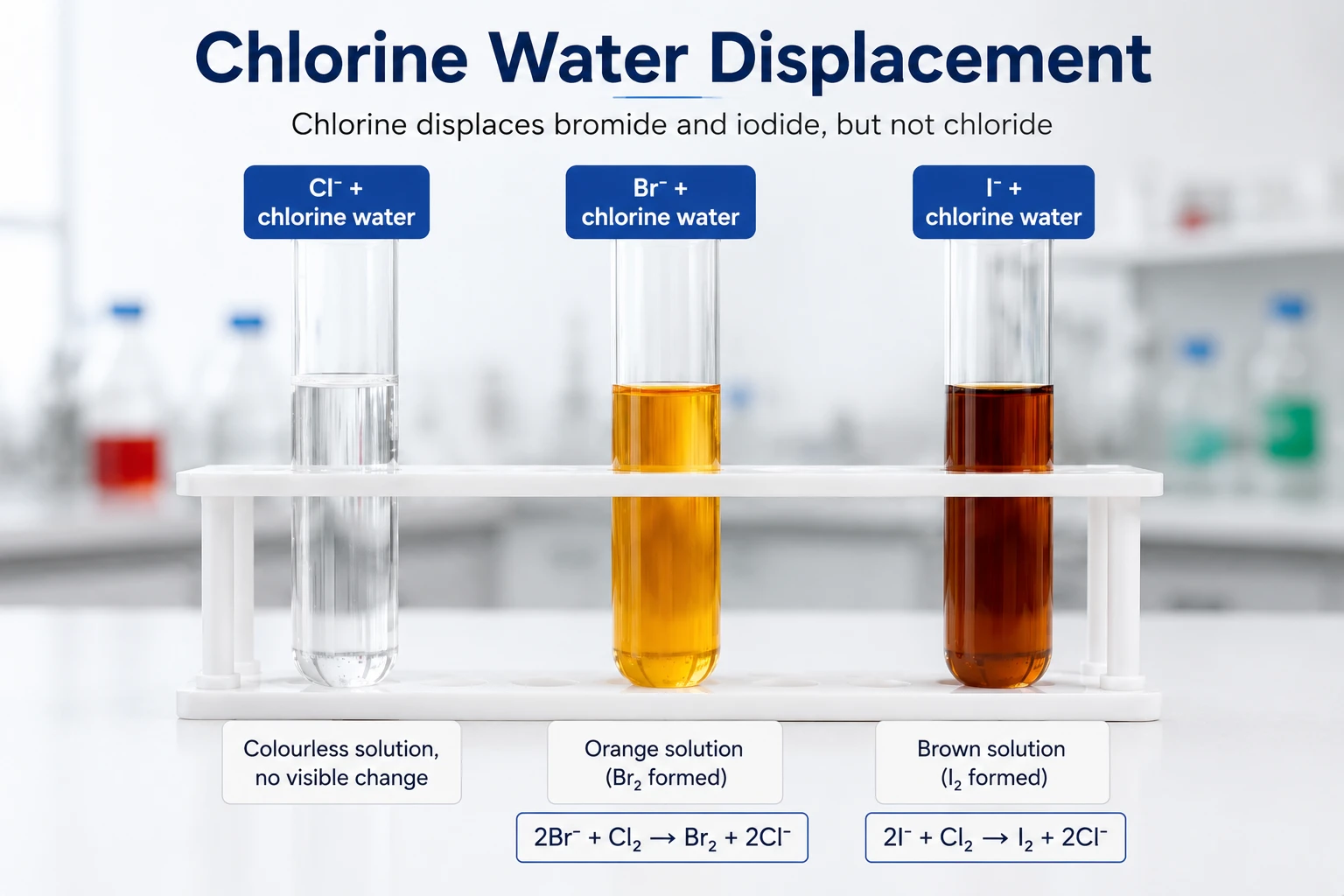
Chlorine water added to chloride, bromide and iodide solutions: no change, orange bromine, brown iodine (purple when shaken with cyclohexane).
Key idea: Oxidising power falls down ${w.g7}. Chlorine oxidises Br⁻ and I⁻; bromine oxidises I⁻ only; iodine oxidises neither. The cyclohexane layer sits on top and shows the halogen colour clearly.
Check: Chlorine Water and Iodide Ions
Complete the ionic equation for chlorine water and potassium iodide solution, give the colours in water and in cyclohexane, and name what is oxidised.
Ionic Equations and Reagent Roles
Every precipitation and gas equation in this practical is expected as an ionic equation with state symbols; an equation without them loses the mark. The full set for the sample unknowns is below, together with the equations for the confirmatory and organic steps.
| Reaction | Equation |
|---|---|
| Carbonate with acid | CO₃²⁻(aq) + 2H⁺(aq) → CO₂(g) + H₂O(l) |
| Carbon dioxide with limewater | Ca(OH)₂(aq) + CO₂(g) → CaCO₃(s) + H₂O(l) |
| Silver bromide precipitate | Ag⁺(aq) + Br⁻(aq) → AgBr(s) |
| Silver bromide in concentrated ammonia | AgBr(s) + 2NH₃(aq) → [Ag(NH₃)₂]⁺(aq) + Br⁻(aq) |
| Barium sulfate precipitate | Ba²⁺(aq) + SO₄²⁻(aq) → BaSO₄(s) |
| Barium carbonate (the false positive the acid prevents) | Ba²⁺(aq) + CO₃²⁻(aq) → BaCO₃(s) |
| Silver oxide (what forms if excess NaOH is not neutralised) | 2Ag⁺(aq) + 2OH⁻(aq) → Ag₂O(s) + H₂O(l) |
| Bromide oxidised by chlorine | 2Br⁻(aq) + Cl₂(aq) → Br₂(aq) + 2Cl⁻(aq) |
| Hydrolysis of the bromoalkane | CH₃CH₂CH₂Br + OH⁻ → CH₃CH₂CH₂OH + Br⁻ |
| Dichromate(VI) reduced (half-equation) | Cr₂O₇²⁻(aq) + 14H⁺(aq) + 6e⁻ → 2Cr³⁺(aq) + 7H₂O(l) |
| Bromine adding to an alkene | C₂H₄(g) + Br₂(aq) → C₂H₄Br₂(l) |
| Ammonium ion with hydroxide | NH₄⁺(aq) + OH⁻(aq) → NH₃(g) + H₂O(l) |
Three reagent roles are asked about again and again. Dilute nitric acid before silver nitrate has two jobs.
In the inorganic test it removes carbonate ions, which would give a white precipitate of Ag₂CO₃ and mask the halide. In the organic test it neutralises the excess sodium hydroxide from the hydrolysis, which would otherwise give brown Ag₂O.
Why nitric acid and not another acid: hydrochloric acid adds chloride ions (false white AgCl) and sulfuric acid adds sulfate ions (false white BaSO₄ in the sulfate test).
Dilute hydrochloric acid before barium chloride removes carbonate ions, which would give white BaCO₃; sulfuric acid can never be used here.
The ammonia steps are also reagent roles. Dilute ammonia dissolves AgCl by forming the soluble complex [Ag(NH₃)₂]⁺; AgBr is less soluble and needs concentrated ammonia; AgI is too insoluble to dissolve in either.
So the ammonia result is not a second test for the same thing, it is what separates the three halides once a precipitate has been seen.
Exam trap: Two different reasons for the same acid: nitric acid removes carbonate ions in the inorganic test and neutralises excess hydroxide ions in the organic test. Give the reason that fits the question.
Check: Diagnosing Test Results
Explain four results from halogenoalkane tests on compounds that are not on this page.
Exam-Style Data Practice
Two kinds of question follow this practical: an unknown-solution matrix, in which four labelled solutions are mixed pairwise and identified from the pattern, and a composition-and-spectra question that leads from percentage composition to a structure. Both are answered by the evidence-trail habit.
Unknown solution matrix
Four solutions are sodium carbonate, barium chloride, dilute hydrochloric acid and dilute sulfuric acid. The trap is that barium chloride gives a white precipitate with sodium carbonate as well as with sulfuric acid: Ba²⁺(aq) + CO₃²⁻(aq) → BaCO₃(s). A student who forgets this misassigns C and D.
| Letter | Identity | Evidence from the pairwise mixing |
|---|---|---|
| A | sulfuric acid, H₂SO₄ | white precipitate with C (BaSO₄) and effervescence with D; no other change |
| B | hydrochloric acid, HCl | effervescence with D only; no precipitate with anything |
| C | barium chloride, BaCl₂ | white precipitate with A (BaSO₄, insoluble in acid) and with D (BaCO₃, which dissolves with effervescence when A or B is added) |
| D | sodium carbonate, Na₂CO₃ | effervescence with A and B; white precipitate with C |
The distinguishing observations are that A gives both a precipitate and a gas, B gives only a gas, C gives two precipitates and D gives two lots of gas and one precipitate. Adding acid to the C + D precipitate dissolves it with effervescence, which tells BaCO₃ from BaSO₄.
Composition and spectra
An organic compound contains 38.7% carbon, 9.7% hydrogen and 51.6% oxygen by mass (the three values must add to 100%). Its mass spectrum has a molecular ion peak at m/z 62 and a base peak at m/z 31; its infrared spectrum has a broad absorption at about 3400 cm⁻¹ and no absorption near 1700 cm⁻¹.
| Step | Working | Result |
|---|---|---|
| 1. Moles in 100 g | C: 38.7 ÷ 12.0 = 3.23; H: 9.7 ÷ 1.0 = 9.7; O: 51.6 ÷ 16.0 = 3.23 | C : H : O = 3.23 : 9.7 : 3.23 |
| 2. Simplest ratio | divide by 3.23: C 1.00, H 3.00, O 1.00 | empirical formula CH₃O, relative mass 12.0 + 3.0 + 16.0 = 31.0 |
| 3. Molecular formula | Mr from the molecular ion is 62; 62 ÷ 31 = 2 | C₂H₆O₂ |
| 4. Infrared | broad absorption at about 3400 cm⁻¹: O–H, broadened by hydrogen bonding; nothing near 1700 cm⁻¹: no C=O | an alcohol, not an acid or a carbonyl compound |
| 5. Fragment | m/z 31 is CH₂OH⁺ (12 + 2 + 16 + 1), formed when the C–C bond in HOCH₂–CH₂OH breaks | a CH₂OH group is present |
| 6. Structure | two carbons, two OH groups, a CH₂OH fragment | ethane-1,2-diol, HOCH₂CH₂OH |
Two errors are common enough to name. Rounding the ratio to CH₂O gives C₂H₄O₂, which is ethanoic acid, a compound that would show a strong C=O absorption and no m/z 31 fragment; the data rule it out.
CHO⁺ has m/z 29, not 31: check every fragment by adding the atomic masses.
Key idea: Composition gives the empirical formula; the molecular ion gives Mr and so the molecular formula; the infrared spectrum names the functional groups; the fragments place them. Quote each piece of evidence for its own conclusion.
Check: Formula From Composition and Spectra
A different compound, Q: 52.2% carbon, 13.0% hydrogen, 34.8% oxygen, M⁺ at m/z 46, broad absorption at 3300 cm⁻¹ and a base peak at m/z 31. Work through the same steps.
Errors, Uncertainty and Improvements
A qualitative practical has no numerical result to compare with an accepted value, so the evaluation questions ask about false positives, false negatives and the steps that prevent them. The table lists the errors students actually make and what each does to the conclusion.
| Source of error | Effect on the result | Improvement |
|---|---|---|
| Dichromate(VI) or Fehling’s tube not warmed | false negative: an alcohol or aldehyde appears unreactive | warm in a water bath at about 60 °C for several minutes before recording a negative |
| Solid tested directly with AgNO₃(aq) or BaCl₂(aq) | false negative: no ions in solution, no precipitate | dissolve a small portion in distilled water first |
| Hydrochloric acid used before silver nitrate | false positive: white AgCl in every tube | acidify with dilute nitric acid |
| Sulfuric acid used before barium chloride | false positive: white BaSO₄ in every tube | acidify with dilute hydrochloric (or nitric) acid |
| No acid before silver nitrate on the hydrolysed liquid | brown Ag₂O masks the halide colour | neutralise the excess NaOH with dilute nitric acid, testing with litmus |
| Carbonate not removed before the barium or silver test | false positive: white BaCO₃ or Ag₂CO₃ | acidify first and wait until effervescence stops |
| Effervescence recorded as “carbonate” without the gas test | inference not supported | bubble the gas through limewater and record the cloudiness |
| Tap water used to dissolve the solids | false positive for chloride | use distilled or deionised water |
| Same pipette used for two reagents | cross-contamination, unexpected precipitates | one labelled pipette per reagent; rinse tubes between tests |
| Too much solid in the tube | cloudy suspension hides or imitates a precipitate | use a spatula tip only; view against a dark background |
Where a quantity is measured, its percentage uncertainty still follows the usual rule.
If a method asks for “about 0.5 g” of solid and a 2 d.p. balance reads 0.50 g, the uncertainty is ±0.005 g, so the percentage uncertainty is (0.005 ÷ 0.50) × 100 = 1.0%.
Measuring 5 cm³ of water with a 10 cm³ measuring cylinder (±0.5 cm³) gives (0.5 ÷ 5) × 100 = 10%.
Neither matters here, because a precipitate forms or does not form whatever the exact mass or volume, and that is the answer to “why is ‘approximately’ acceptable in this method”: the result is qualitative, so the measurements need only be roughly right.
The composition data in the exam question are different: 38.7% quoted to 1 decimal place has an uncertainty of ±0.05%, about 0.1% of the value.
That is why the mole ratio comes out as 1.00 : 3.00 : 1.00 and not as something that needs rounding.
Exam wording: “Warming the tube in a water bath makes a negative result reliable.” “Dilute nitric acid is used because hydrochloric acid would add chloride ions and give a false positive.” State the error, its effect and the fix.
Common Mistakes
- Writing “clear” for a solution with no colour. Bromine water is decolourised; a solution with no colour is colourless; “clear” only means not cloudy.
- Not warming the dichromate(VI) and Fehling’s tubes, then reporting “no reaction”. A negative result at room temperature proves nothing.
- Calling A “an oxidisable alcohol”. The inference is “a primary or secondary alcohol”; the negative Fehling’s result is what rules out an aldehyde.
- Adding silver nitrate straight to the organic liquid. The halogen is covalently bonded; hydrolyse first, then acidify with nitric acid, then test.
- Testing a solid with silver nitrate or barium chloride solution without dissolving it in distilled water first.
- Giving “fizzes with acid” as proof of a carbonate. The gas must turn limewater cloudy.
- Stopping at “cream precipitate”. Without the dilute and concentrated ammonia results, AgBr has not been distinguished from AgI.
- Writing “chlorine displaces bromide ions”. Chlorine oxidises bromide ions to bromine; the element bromine is what is displaced.
- Ionic equations without state symbols, and minus signs missing from Br⁻ and SO₄²⁻.
- Rounding the mole ratio carelessly (CH₂O instead of CH₃O) and quoting a fragment whose mass does not add up (CHO⁺ is 29, CH₂OH⁺ is 31).
Check: Technique Check
Six sets of statements about the technique of this practical. Pick the accurate one in each set.
Common Exam Points
Say
“Warm with acidified potassium dichromate(VI) in a water bath: orange to green, so the liquid is oxidised.”
“Fehling’s solution remains blue on warming, so it is not an aldehyde; A is a primary or secondary alcohol.”
“Dissolve the solid in distilled water, add dilute nitric acid, then silver nitrate solution: cream precipitate, insoluble in dilute ammonia, soluble in concentrated ammonia, so bromide ions.”
“Effervescence; the gas turns limewater cloudy, so carbonate ions.”
“Chlorine oxidises bromide ions to bromine, which gives an orange upper layer in cyclohexane.”
Do not say
“Goes clear.” “Positive result.” “Oxidisable alcohol.” “Chlorine displaces bromide.” “Add acid” without saying which acid and why. “Fizzes, so carbonate” without the limewater step. Equations without state symbols. “No reaction” when a soluble product has formed.
Watch for
The order of the tests and the reason for it (acid before silver nitrate or barium chloride; carbonate removed first).
Which acid: nitric before silver nitrate, hydrochloric or nitric before barium chloride, never sulfuric. Water bath, not a naked flame, for every warming step.
Percentages in a composition question must add to 100%, and every fragment mass must add up.
FAQs
Quick answers to the questions students ask most about Practical Skills: Qualitative Analysis and the tests for unknown organic liquids and inorganic solids.
Why must the acidified dichromate(VI) and Fehling’s tubes be warmed?
Both oxidations are slow at room temperature.
Warming in a water bath at about 60 °C for a few minutes lets the reaction happen, so a tube that stays orange or blue after warming is a genuine negative result.
Without warming a negative result proves nothing, and the water bath keeps any naked flame away from flammable organic liquids.
Why is nitric acid, and not hydrochloric acid, added before silver nitrate?
Hydrochloric acid would add chloride ions and give a white precipitate of silver chloride in every tube, a false positive. Nitric acid adds only nitrate ions, which form no insoluble silver salt.
The acid removes carbonate ions in the inorganic test and neutralises excess sodium hydroxide after hydrolysing the organic liquid, which would otherwise give brown silver oxide.
How do I tell silver bromide from silver iodide?
Cream and pale yellow are easy to confuse in a small tube, so use ammonia: silver chloride dissolves in dilute ammonia, silver bromide dissolves only in concentrated ammonia, and silver iodide dissolves in neither. Quote the ammonia result as part of the inference.
Does fizzing with acid prove that a solid is a carbonate?
No. Effervescence suggests a carbonate (or hydrogencarbonate) but the gas must be identified: bubble it through limewater, which turns cloudy as a white precipitate of calcium carbonate forms. The observation and its confirmation are separate mark points.
What is the difference between “clear” and “colourless”?
Colourless means the solution has no colour; clear means it is not cloudy. Bromine water that has reacted with an alkene is decolourised, orange to colourless. A blue Fehling’s solution is clear but not colourless. Examiners penalise “goes clear” because it does not describe a colour change.
Why shake the chlorine water mixture with cyclohexane?
Bromine and iodine dissolve much better in the non-polar solvent than in water, and cyclohexane floats as the upper layer, so the colour is concentrated and easy to read: orange for bromine, purple for iodine. Dilute aqueous solutions of the two can look alike.
Copyright and author footprint: This OLS revision page was written for Online Learning System by Dr. Mohammed Al-Fatah. It is designed for A Level Chemistry revision and should not be copied or redistributed without permission.
Keep this note — free
Save your progress across every Cambridge topic. A free account remembers which topics you have covered, saves your question scores, and syncs across your phone and laptop.
- Track every topic you have finished
- Keep your practice-question scores
- No payment, no card, free forever
Already registered? Log in