Comparing the Rates of Hydrolysis of Halogenoalkanes
In Practical Skills: Rates of Hydrolysis you compare how quickly halogenoalkanes are hydrolysed by timing the appearance of a silver halide precipitate after aqueous silver nitrate is added. Relative rate is 1/t, so a shorter time means a faster reaction. Part 1 changes the halogen; Part 2 changes the structure around the carbon bonded to the halogen.
GCSE Recap: Testing for Halide Ions
Three quick questions on the silver nitrate test you met at GCSE: the colours, the reason for the acid and what a precipitate is.
What This Practical Is Testing
In this practical (Practical Skills: Rates of Hydrolysis) you compare how quickly different halogenoalkanes are hydrolysed.
Hydrolysis is a reaction with water: the water molecule acts as a nucleophile, the C–X bond breaks and the products are an alcohol, a hydrogen ion and a halide ion.
The halide ion is detected by aqueous silver nitrate, which gives a precipitate of the silver halide. The rates are compared by timing how long the precipitate takes to appear.
Key idea: relative rate ∝ 1/t, so a shorter time means a faster hydrolysis. The experiment gives relative rates, not a rate in mol dm⁻³ s⁻¹.
The experiment has two linked comparisons. In Part 1 three primary halogenoalkanes with different halogens are compared: 1-chlorobutane, 1-bromobutane and 1-iodobutane.
In Part 2 the halogen is kept the same and the structure is changed: 1-bromobutane (primary), 2-bromobutane (secondary) and 2-bromo-2-methylpropane (tertiary).
The chemistry is examined in Paper 3, a timed laboratory examination that assesses manipulation, observation, presentation of data, analysis and evaluation.
Expect to describe the method, explain the role of each reagent, process the times and explain the order using bond enthalpies from the data booklet.
| Stage | What happens | What you see |
|---|---|---|
| Hydrolyse | Water attacks the halogenoalkane; the C–X bond breaks and X⁻ is released. | Nothing yet: the solution stays clear. |
| Detect | Ag⁺(aq) from the silver nitrate reacts with X⁻(aq) to give AgX(s). | The liquid turns cloudy throughout. |
| Compare | The time to the first cloudiness is recorded and converted to 1/t. | The shortest time is the fastest hydrolysis. |
Key idea: Silver nitrate does not cause the hydrolysis. The water it is dissolved in is the nucleophile, and the Ag⁺ ions detect the halide ion as it is released.
This is why no precipitate can form before the aqueous silver nitrate is added, and why timing starts at that moment.
Safety and Apparatus
The reagents are flammable, volatile and, in the case of silver nitrate, staining. A hazard question expects you to name the hazard and the matching precaution, not just “wear goggles”.
| Apparatus or reagent | What it is for | Note |
|---|---|---|
| 250 cm³ beaker | Water bath, three-quarters full | Filled from a kettle, never heated with a Bunsen |
| Thermometer (0 to 100 °C) | Checks the bath is at 50 °C before and during timing | Reads to ±0.5 °C |
| Test tubes with bungs | Hold 5 cm³ ethanol + 4 drops of halogenoalkane; the bung stops the volatile halogenoalkane escaping while the tube warms | 2-bromo-2-methylpropane boils at 73 °C |
| Dropping pipettes | Deliver the drops of halogenoalkane and the 1 cm³ of silver nitrate | One pipette per liquid to avoid contamination |
| Measuring cylinder or graduated pipette | Measures 5 cm³ ethanol and 1 cm³ silver nitrate solution | 1 cm³ graduated pipette reads to ±0.05 cm³ |
| Stop clock | Times from adding the silver nitrate to the first cloudiness | Reads to 0.01 s; reaction time is the real limit |
| White tile or card | Background against which the first cloudiness is judged | Same background for every tube |
| Reagents | 1-chlorobutane, 1-bromobutane, 1-iodobutane, 2-bromobutane, 2-bromo-2-methylpropane, ethanol, 0.05 mol dm⁻³ silver nitrate solution | Kettle for the hot water |
Hazards and precautions: Ethanol and the halogenoalkanes are highly flammable: no naked flames, so the water bath is prepared from a kettle.
The halogenoalkanes are harmful and volatile: work in a well ventilated laboratory or fume cupboard and keep the tubes stoppered until the silver nitrate is added.
Silver nitrate stains skin and is an irritant: wear gloves and wash spills off at once.
Kettle water scalds: mix it with cold water to reach 50 °C before filling the beaker. Eye protection throughout.
The Five Halogenoalkanes Used
Before you interpret the results you must be able to classify each halogenoalkane.
Find the carbon atom bonded to the halogen and count the carbon atoms bonded to that carbon: one gives a primary halogenoalkane, two a secondary and three a tertiary.
Remember: The length of the chain is irrelevant; only the environment of the C–X carbon counts.
| Halogenoalkane | Classification | Where it is used | Comparison being made |
|---|---|---|---|
| 1-chlorobutane | Primary | Part 1 | Effect of the halogen |
| 1-bromobutane | Primary | Parts 1 and 2 | Control compound in both parts |
| 1-iodobutane | Primary | Part 1 | Effect of the halogen |
| 2-bromobutane | Secondary | Part 2 | Effect of structure |
| 2-bromo-2-methylpropane | Tertiary | Part 2 | Effect of structure |
1-Bromobutane appears in both parts on purpose. In Part 1 it is the middle member of the halogen series; in Part 2 it is the primary compound against which the secondary and tertiary bromoalkanes are judged.
The tertiary compound is the bromo analogue of 2-chloro-2-methylpropane, the product prepared in Practical Skills: Organic Preparation (chlorination of 2-methylpropan-2-ol).
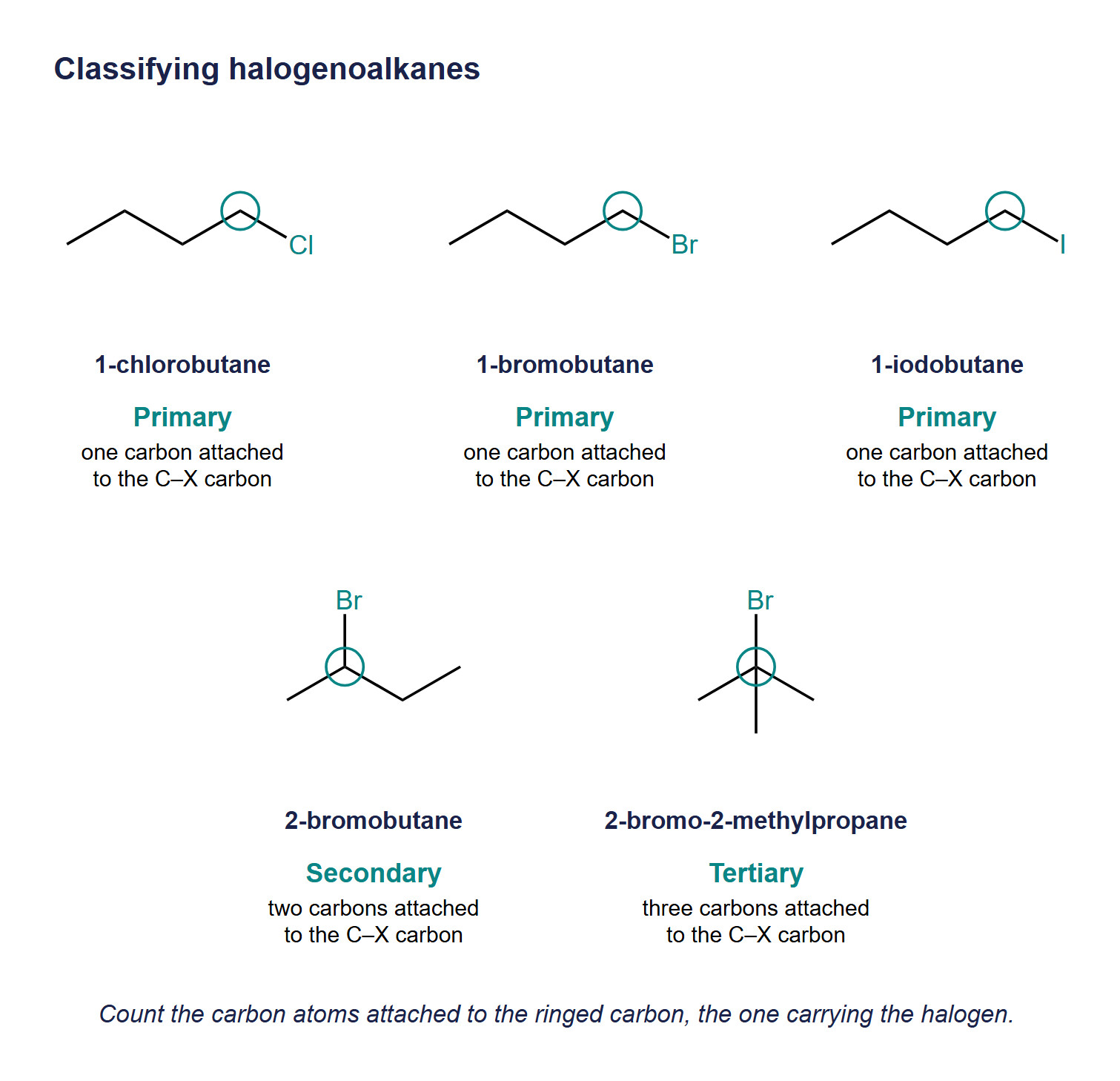
Skeletal formulae of the five halogenoalkanes with the carbon bonded to the halogen circled. Three are primary, one is secondary and one is tertiary.
Exam wording: “The carbon bonded to the bromine is attached to three other carbon atoms, so 2-bromo-2-methylpropane is a tertiary halogenoalkane.” Name the carbon, count its neighbours, state the class.
Check: Classifying by the C–X Carbon
Classify six halogenoalkanes that are not on this page as primary, secondary or tertiary.
Method: Step by Step
The reaction runs in a water bath at about 50 °C. At room temperature 1-chlorobutane takes far too long to give a visible precipitate (the sample time below is already 10 minutes at 50 °C).
A controlled temperature is essential because rate depends on temperature. Every step below carries its reason: the reason is what the mark scheme rewards.
| Step | What you do | Why |
|---|---|---|
| 1 Prepare the bath | Fill a 250 cm³ beaker about three-quarters full with water from a kettle mixed with cold water, and check with a thermometer that it reads 50 °C. | No naked flames near flammable ethanol and halogenoalkanes; the temperature must be known and kept the same for every tube. |
| 2 Add ethanol | Add 5 cm³ of ethanol to each labelled test tube. | Ethanol is a solvent in which both the halogenoalkane and the aqueous silver nitrate mix, giving one phase so that water molecules can reach the halogenoalkane. |
| 3 Add the halogenoalkane | Add four drops of the relevant halogenoalkane to its tube and bung it. | The same number of drops gives approximately equal amounts; the bung stops the volatile halogenoalkane evaporating while the tube warms. |
| 4 Warm both reagents | Stand the halogenoalkane tubes and a tube of 0.05 mol dm⁻³ silver nitrate solution in the same bath for a few minutes. | Both reagents must be at 50 °C when mixed; otherwise the mixture cools on mixing and the temperature is not controlled. |
| 5 Mix and start the clock | Add 1 cm³ (the same volume in every tube) of the warmed silver nitrate solution, bung, shake once and start the stop clock immediately. | The water in the aqueous silver nitrate is the nucleophile, so hydrolysis begins the moment it is added; the same volume keeps the Ag⁺ and water concentrations equal. |
| 6 Judge the first cloudiness | Keep the tube in the bath and watch it against a white tile; stop the clock at the first sign of cloudiness. | The precipitate is a fine suspension, so “first cloudiness” against a fixed background is the endpoint; taking the tube out lets it cool. |
| 7 Repeat and record | Repeat each tube, discard anomalous times and calculate a mean; record the colour of each precipitate. | Judging cloudiness is the main random error; a mean of concordant times reduces it and the colour confirms which halide was released. |
The control variables an examiner expects you to list are: the temperature of the bath, the volume of ethanol, the volume and concentration of the silver nitrate solution, and the amount of halogenoalkane.
Two more are the same observer judging the endpoint against the same background, and the tubes staying in the bath throughout. The only variable that changes is the halogenoalkane.
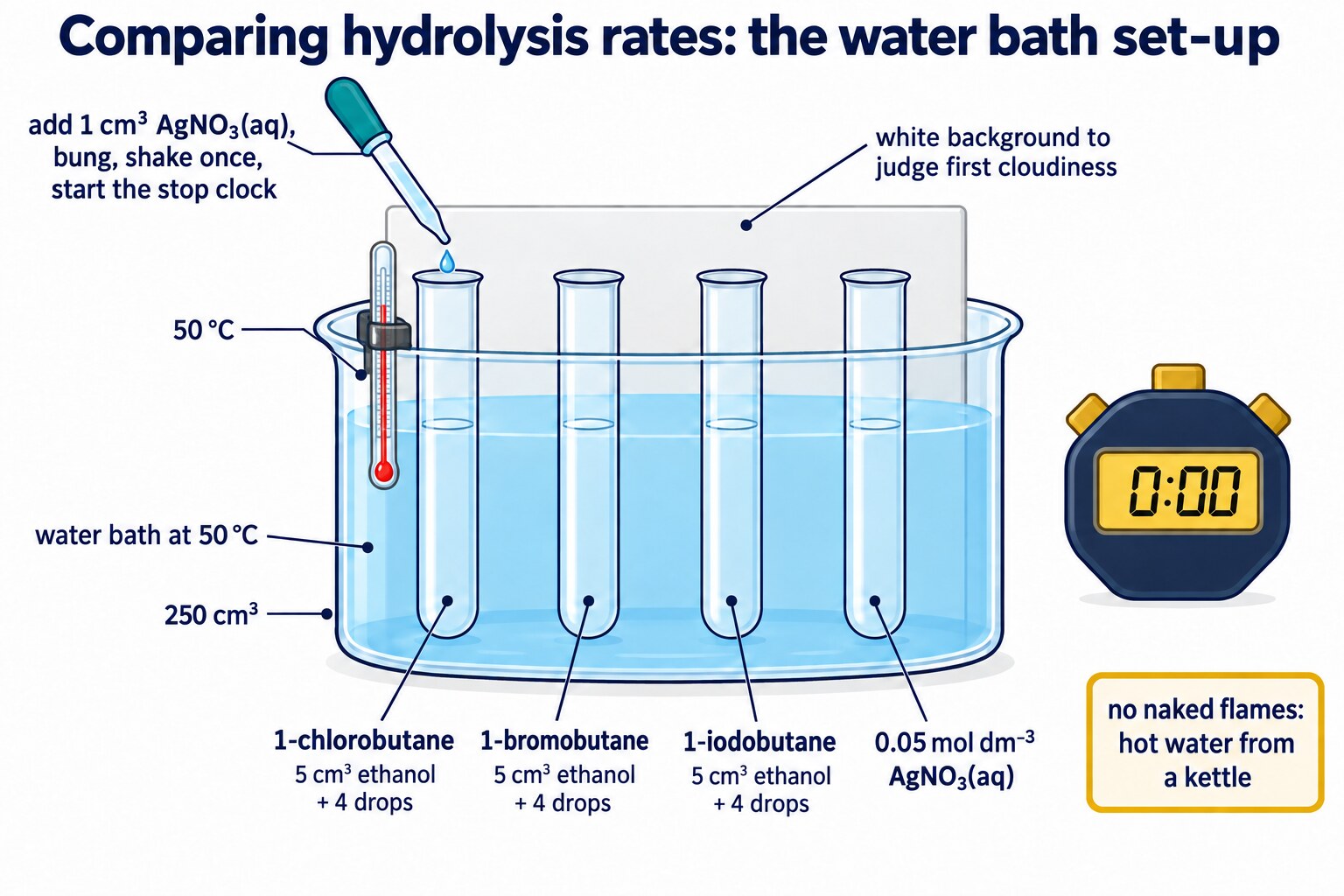
The timing set-up: bath at 50 °C with a thermometer, three reagent tubes and the warmed silver nitrate, a pipette delivering 1 cm³, a stop clock and a white tile behind the tubes.
Evaluation point: Using the same number of drops of each liquid gives approximately, not exactly, equal amounts of substance: the halogenoalkanes have different densities and molar masses. A fairer method measures equal moles by mass or with a graduated pipette.
Hydrolysis Timing Bench
Time how long each halogenoalkane takes to give a precipitate with aqueous silver nitrate at 50 °C, then compare rates using 1/t.
© Dr. Mohammed Al-Fatah – onlinelearningsystem.net
Check: Fair Test
Three things a student did wrong while comparing three different compounds; decide which variable is no longer controlled and which way the time moves.
What Happens During Hydrolysis?
Hydrolysis of a halogenoalkane is a nucleophilic substitution. The halogen is more electronegative than carbon, so the C–X bond is polar and the carbon carries a partial positive charge, δ+.
Water is a nucleophile because its oxygen atom has two lone pairs of electrons.
In the primary halogenoalkanes of Part 1 the oxygen lone pair attacks the δ+ carbon while the C–X bond breaks, the halide ion leaves and the protonated alcohol then loses H⁺.
R–X + H₂O → R–OH + H⁺ + X⁻
CH₃CH₂CH₂CH₂Br(l) + H₂O(l) → CH₃CH₂CH₂CH₂OH(aq) + H⁺(aq) + Br⁻(aq)
Water is a weak nucleophile, much weaker than hydroxide ions, which is why the reaction is slow enough to time with a stop clock. Direct attack on the δ+ carbon is not the only route, and this matters for Part 2.
The two routes have names. A primary halogenoalkane reacts mainly by the Sₙ2 mechanism: water attacks the δ+ carbon and the C–X bond breaks in the same step.
A tertiary halogenoalkane reacts mainly by the Sₙ1 mechanism: the C–X bond breaks first to give a carbocation, and water attacks the carbocation in a second, fast step.
The tertiary carbocation, (CH₃)₃C⁺, is stabilised by the positive inductive effect of three alkyl groups pushing electron density towards the positive carbon, so it forms readily and 2-bromo-2-methylpropane hydrolyses fastest. A secondary halogenoalkane sits between the two.
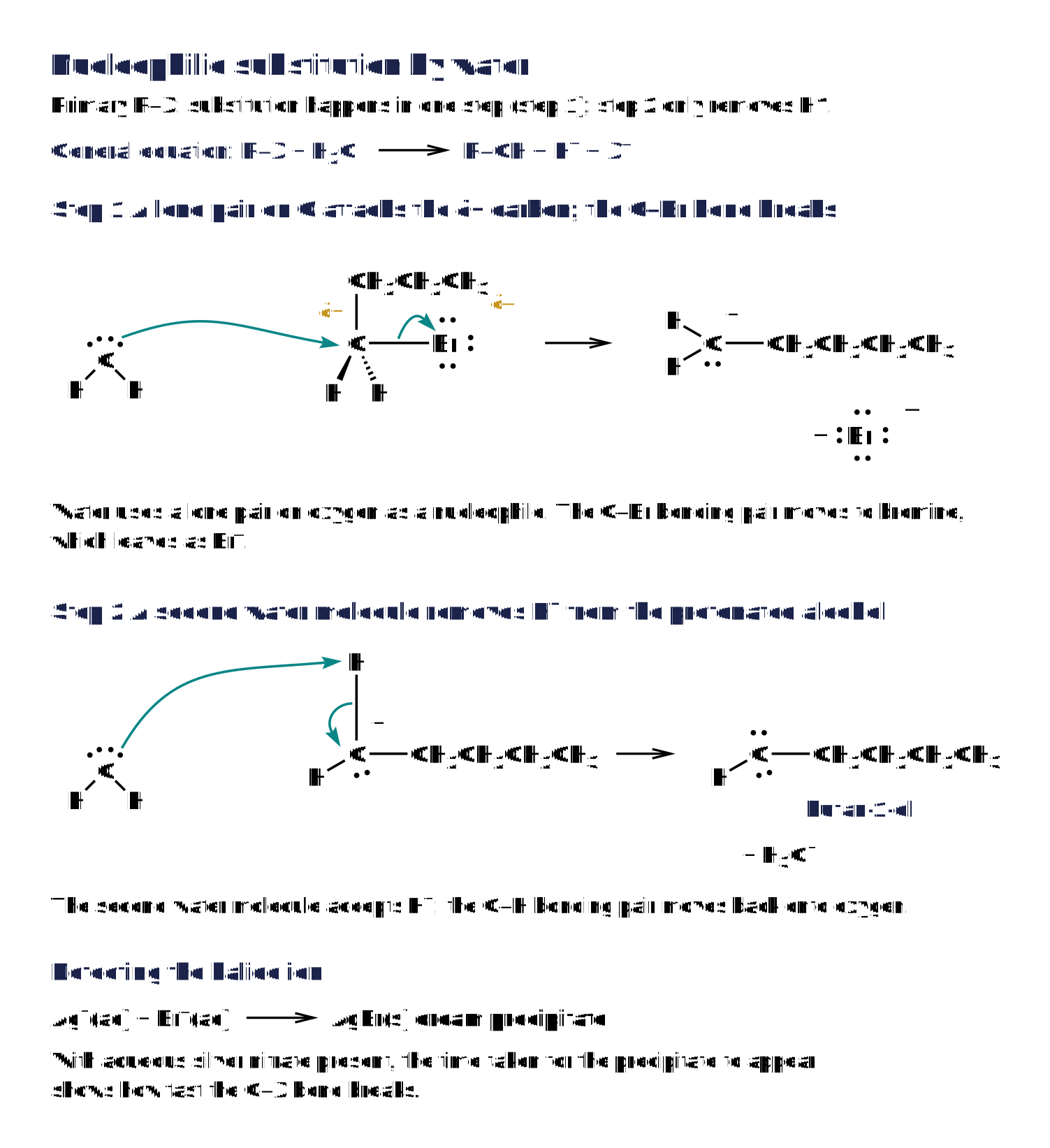
Water attacks the δ+ carbon of a primary halogenoalkane in one step as the C–Br bond breaks; the protonated alcohol then loses H⁺.
Key idea: Whatever the route, the C–X bond must break. In Part 1 the strength of that bond controls the rate; in Part 2 the halogen is the same, so the stability of the carbocation that can form controls the rate.
Why Ethanol, Water and Silver Nitrate Are Used
Each reagent has one job, and students lose marks by swapping them round: the commonest error is calling ethanol the nucleophile.
| Reagent | Role | Why it matters |
|---|---|---|
| Ethanol | Solvent in which both the halogenoalkane and the aqueous silver nitrate dissolve | Halogenoalkanes are almost insoluble in water; without ethanol there would be two layers and the water could not reach the halogenoalkane. |
| Water (in the aqueous silver nitrate) | The nucleophile that attacks the δ+ carbon | It is the only source of water in the tube, so no hydrolysis, and no precipitate, can occur before it is added. |
| Silver nitrate | Supplies Ag⁺(aq) to detect the halide ion as AgX(s) | The precipitate makes an invisible reaction visible; its colour tells you which halide was released. |
Why not use hydroxide ions? Aqueous sodium hydroxide would hydrolyse the halogenoalkane faster, but OH⁻ would give a brown precipitate of silver oxide, Ag₂O, the moment silver nitrate was added: 2Ag⁺(aq) + 2OH⁻(aq) → Ag₂O(s) + H₂O(l).
That masks the halide test. OH⁻ is also a much stronger nucleophile, so the reaction would be over too quickly to time.
Exam wording: “Water, from the aqueous silver nitrate, is the nucleophile. Ethanol is the solvent that allows the halogenoalkane and the aqueous solution to mix.” Never write “ethanol is the nucleophile” or “silver nitrate hydrolyses the halogenoalkane”.
Check: Roles of the Reagents
Fill the gaps for the hydrolysis of a compound not used on this page: nucleophile, solvent, detector and the colour you would see.
How the Silver Halide Precipitate Shows the Rate
The precipitate can only form once hydrolysis has released halide ions, so the time to the first cloudiness measures how quickly the halogenoalkane has hydrolysed.
Because Ag⁺(aq) and X⁻(aq) react instantly, the precipitation step adds nothing to the time.
The solid forms as a fine suspension throughout the liquid, which is why the endpoint is described as cloudiness rather than a lump at the bottom of the tube.
| Halide ion released | Ionic equation | Colour of AgX(s) | What it tells you |
|---|---|---|---|
| Cl⁻ | Ag⁺(aq) + Cl⁻(aq) → AgCl(s) | White | A chloroalkane has hydrolysed |
| Br⁻ | Ag⁺(aq) + Br⁻(aq) → AgBr(s) | Cream | A bromoalkane has hydrolysed |
| I⁻ | Ag⁺(aq) + I⁻(aq) → AgI(s) | Yellow | An iodoalkane has hydrolysed |
White and cream are hard to tell apart in a cloudy tube, and the colour is not what the practical measures: the compounds are known, so the colour is a check, not an identification.
The ammonia confirmation that separates them is given in its own card below and in Practical Skills: Qualitative Analysis (analysis of inorganic and organic unknowns).
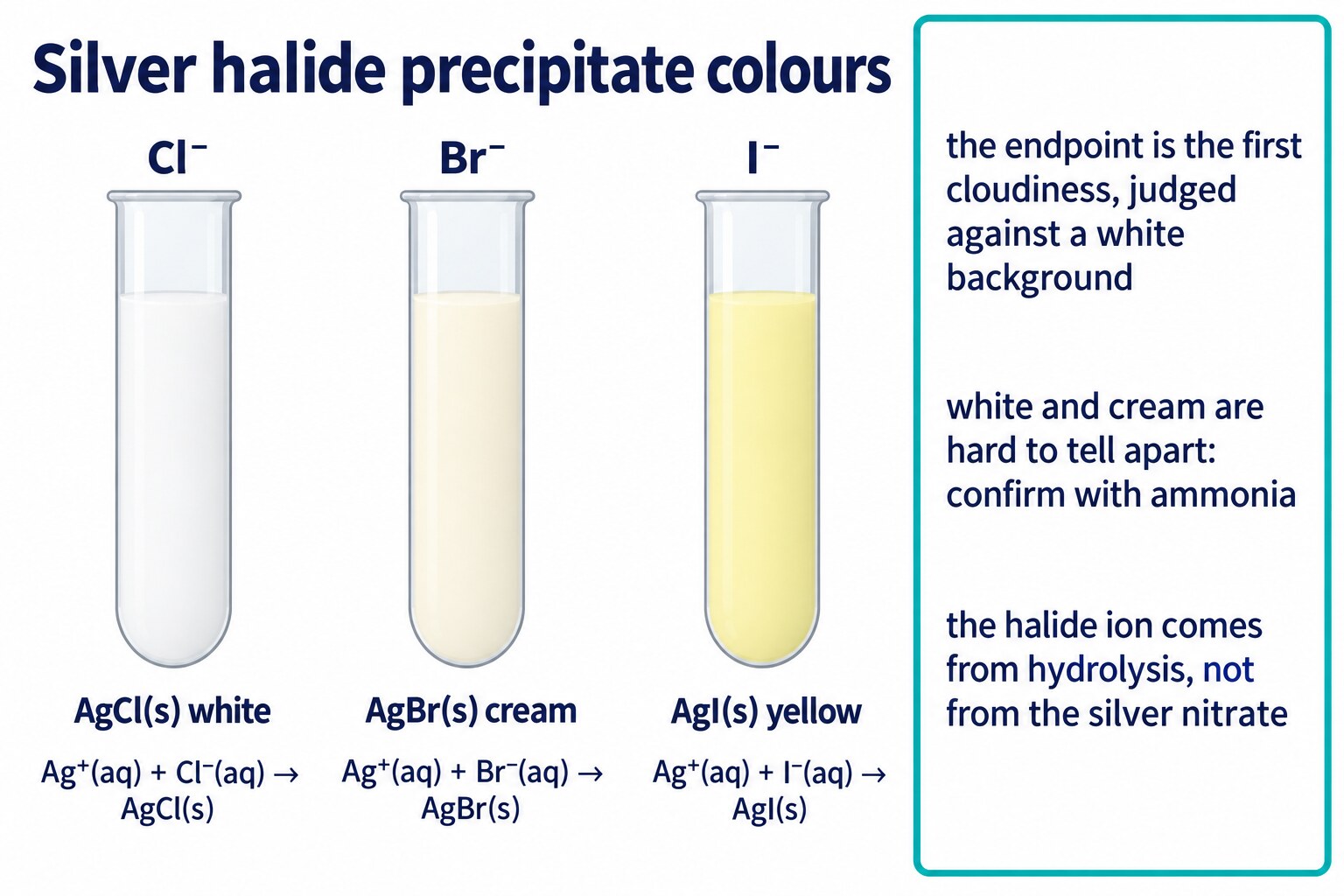
Silver halide precipitate colours: uniform cloudy suspensions of white silver chloride, cream silver bromide and pale yellow silver iodide, with the ionic equations.
Key idea: Yellow AgI means iodide ions were released by hydrolysis, so the original compound was an iodo compound. It does not mean iodine molecules, I₂, are present.
Part 1: Comparing Chloro-, Bromo- and Iodoalkanes
In Part 1 all three halogenoalkanes are primary, so the only variable is the halogen. The sample results below are for one run at 50 °C. The column that examiners look for is 1/t: relative rate is proportional to 1/t, so the largest value is the fastest reaction.
| Halogenoalkane | Bond broken | Time to first cloudiness / s | 1/t / s⁻¹ (2 s.f.) | Mean bond enthalpy / kJ mol⁻¹ | Relative rate |
|---|---|---|---|---|---|
| 1-iodobutane | C–I | 52 | 0.019 | 240 | Fastest |
| 1-bromobutane | C–Br | 87 | 0.011 | 280 | Intermediate |
| 1-chlorobutane | C–Cl | 606 | 0.0017 | 340 | Slowest |
The order is iodo > bromo > chloro. The mean bond enthalpy falls down Group 17: C–Cl 340 kJ mol⁻¹, C–Br 280 kJ mol⁻¹, C–I 240 kJ mol⁻¹ (values from the data booklet).
The C–X bond is broken in the rate-determining step, so the weakest bond, C–I, needs the lowest activation energy and 1-iodobutane hydrolyses fastest.
The ratio of the 1/t values shows the size of the effect: 1-iodobutane reacts about 0.019 / 0.0017 ≈ 11 times faster than 1-chlorobutane at 50 °C.
Bond polarity predicts the opposite. Chlorine is the most electronegative of the three halogens, so the C–Cl bond is the most polar and its carbon the most δ+; if polarity controlled the rate the chloro compound would be fastest.
Key idea: The data show it is slowest, so bond enthalpy, not polarity, controls the rate.
Exam wording: “The C–I bond has the lowest bond enthalpy (240 kJ mol⁻¹), so it breaks most easily in the rate-determining step and 1-iodobutane hydrolyses fastest.” Quote the values, say which step the bond breaks in, and link weak bond to low activation energy.
Check: New Data at 50 °C
Times for three propyl compounds you have not met on this page: convert to 1/t, rank, explain and predict the effect of a cooler bath.
Part 2: Comparing Primary, Secondary and Tertiary Bromoalkanes
In Part 2 the halogen is kept the same, bromine, so the only variable is the structure around the C–Br carbon.
Part 2 was a separate run, which is why 1-bromobutane appears again as the primary control: times are only comparable within one run, so each part carries its own 1-bromobutane reading (87 s in the Part 1 run, 59 s in this one).
Remember: Never compare a Part 1 time with a Part 2 time.
| Halogenoalkane | Classification | Time to first cloudiness / s | 1/t / s⁻¹ (2 s.f.) | Relative rate |
|---|---|---|---|---|
| 2-bromo-2-methylpropane | Tertiary | 3 | 0.33 | Fastest |
| 2-bromobutane | Secondary | 34 | 0.029 | Intermediate |
| 1-bromobutane | Primary | 59 | 0.017 | Slowest |
The order is tertiary > secondary > primary, and it needs an explanation because bond enthalpy cannot give one: every compound here has a C–Br bond of about 280 kJ mol⁻¹.
If water simply attacked the δ+ carbon in every case, the crowded tertiary carbon should be the slowest. It is the fastest because it reacts by a different route.
The C–Br bond breaks first to give the tertiary carbocation (CH₃)₃C⁺, which is stabilised by the positive inductive effect of its three alkyl groups, and water then attacks the carbocation.
Key idea: The more alkyl groups on the C–Br carbon, the more stable the carbocation, the lower the activation energy and the faster the hydrolysis.
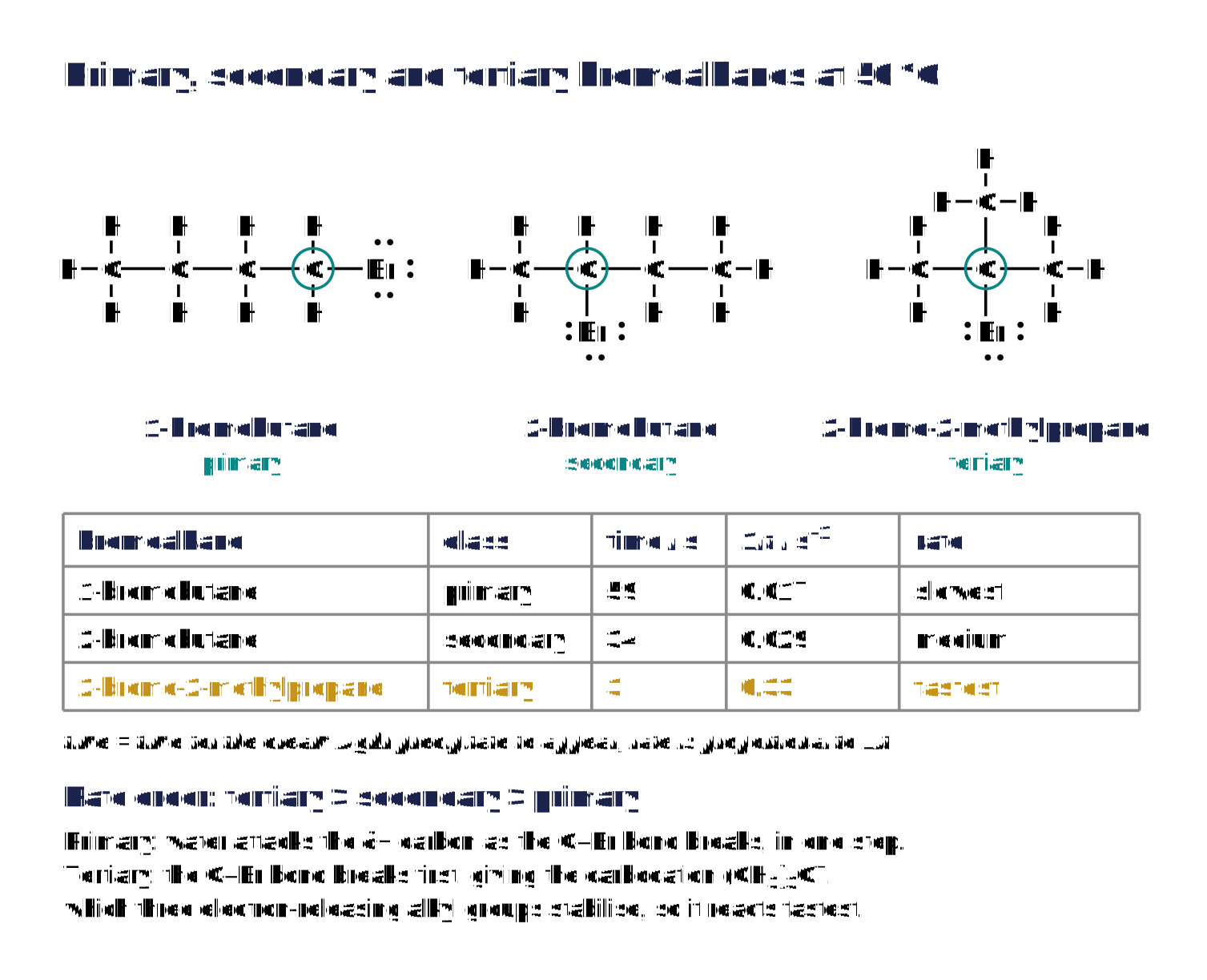
Part 2 at 50 °C: 1-bromobutane, 2-bromobutane and 2-bromo-2-methylpropane with their times and 1/t values, and why the tertiary compound is fastest.
Evaluation point: A time of 3 s is too short to measure reliably: reaction time alone is about ±0.2 s at the start and at the stop.
To improve Part 2, run it at a lower temperature (room temperature is enough for the tertiary compound) or use more dilute reagents so that every time is at least 30 s.
Check: Why the Tertiary Compound Is Fastest
A student explains the tertiary result with a bond enthalpy argument; pick the statement that would earn the marks.
Exam-Style Data Interpretation
A common exam version gives times for equal moles (equal amounts of substance) of 2-chloropropane, 2-bromopropane and 2-iodopropane in the same total volume at 50 °C, together with electronegativities and bond enthalpies, and asks you to explain the trend.
Equal moles in the same total volume gives the same concentration of each halogenoalkane, so concentration cannot be the cause of any difference.
| Halogenoalkane | Time to first cloudiness / s | 1/t / s⁻¹ (2 s.f.) | Electronegativity of the halogen | Mean C–X bond enthalpy / kJ mol⁻¹ |
|---|---|---|---|---|
| 2-iodopropane | 31 | 0.032 | 2.7 | 240 |
| 2-bromopropane | 74 | 0.014 | 3.0 | 280 |
| 2-chloropropane | 241 | 0.0041 | 3.2 | 340 |
Why not electronegativity? Chlorine is the most electronegative, so the C–Cl carbon is the most δ+ and should attract the nucleophile most strongly. If that controlled the rate, 2-chloropropane would be fastest. It is slowest, so the polarity argument fails.
Why does bond enthalpy explain the trend? The C–X bond is broken in the rate-determining step. A stronger bond needs more energy to break, so the activation energy is higher and a smaller fraction of collisions succeed.
C–Cl (340 kJ mol⁻¹) is the strongest and 2-chloropropane is slowest; C–I (240 kJ mol⁻¹) is the weakest and 2-iodopropane is fastest.
Working with 1/t. 1/31 = 0.032 s⁻¹, 1/74 = 0.014 s⁻¹, 1/241 = 0.0041 s⁻¹. The iodo compound reacts about 0.032 / 0.0041 ≈ 8 times faster than the chloro compound. Quote 1/t to 2 significant figures, because the times themselves are only known to the nearest second.
Exam wording: “Equal moles in the same volume gives equal concentrations, so the difference in rate is due to the halogenoalkane. The C–I bond has the lowest bond enthalpy, so it breaks most easily and 2-iodopropane hydrolyses fastest, even though iodine is the least electronegative halogen.”
Check: Describe and Explain
Write a six-mark answer describing how you would compare three pentyl compounds and explaining the expected order; the key terms are marked automatically.
Errors, Uncertainty and Improvements
The stop clock reads to 0.01 s, but the real uncertainty is your reaction time (about ±0.2 s at the start and again at the stop, so ±0.4 s in total) and, far larger, the judgement of “first cloudiness”, which can differ by ±2 s between observers. Percentage uncertainty = (uncertainty / reading) × 100.
Reaction time on 606 s: (0.4 / 606) × 100 = 0.066 %. Reaction time on 52 s: (0.4 / 52) × 100 = 0.77 %. Reaction time on 3 s: (0.4 / 3) × 100 = 13 %. Judgement of the endpoint (±2 s) on 3 s: (2 / 3) × 100 = 67 %. Thermometer (±0.5 °C) on 50 °C: (0.5 / 50) × 100 = 1.0 %. Graduated pipette (±0.05 cm³) on 1 cm³ of silver nitrate: (0.05 / 1) × 100 = 5.0 %. The short Part 2 times, not the apparatus, dominate the uncertainty.
| Source of error | Effect on the result | Improvement |
|---|---|---|
| Tube lifted out of the bath to inspect it | Mixture cools, time too long, comparison unfair | Keep the tube in the bath; view it against a white tile behind the beaker |
| Silver nitrate not warmed | Mixture below 50 °C at the start, all times too long | Stand the silver nitrate tube in the same bath for the same time |
| Different volumes of silver nitrate | Different Ag⁺ and water concentrations, times not comparable | Use a graduated pipette to add exactly 1 cm³ to every tube |
| Drops not equal moles | Different amounts of each halogenoalkane; concentration not truly controlled | Measure equal moles by mass or with a graduated pipette |
| Endpoint judged differently for each tube | Random error of several seconds, worst for short times | Same observer, same white background, repeat and average; or use a light sensor and data logger |
| Clock started late (after shaking) | All times too short; fastest compound most affected | Start the clock as the silver nitrate is added, then shake once |
| Tertiary time of 3 s too short to measure | Percentage uncertainty above 50 % | Lower the bath temperature or dilute the reagents so every time exceeds 30 s |
| Bath temperature drifts during a long run | Later tubes at a different temperature | Monitor with a thermometer and top up with hot water; use a thermostatically controlled bath |
Key idea: The apparatus errors are small (1 % to 5 %); the endpoint judgement and reaction time on very short times are large. An improvement that lengthens the times, or replaces the eye with a sensor, does more than a better pipette.
Confirming the Precipitate with Ammonia
Because white AgCl and cream AgBr look alike in a cloudy tube, the halide test is completed with ammonia solution.
Silver chloride dissolves in dilute NH₃(aq) to give the colourless complex ion [Ag(NH₃)₂]⁺; silver bromide dissolves only in concentrated NH₃(aq); silver iodide dissolves in neither.
Nitric acid is added before the silver nitrate in the general test to remove carbonate and hydroxide ions, but in the hydrolysis experiment it is not needed because the only anion released is the halide.
| Precipitate | Colour | Dilute NH₃(aq) | Concentrated NH₃(aq) |
|---|---|---|---|
| AgCl(s) | White | Dissolves: AgCl(s) + 2NH₃(aq) → [Ag(NH₃)₂]⁺(aq) + Cl⁻(aq) | Dissolves |
| AgBr(s) | Cream | Insoluble | Dissolves: AgBr(s) + 2NH₃(aq) → [Ag(NH₃)₂]⁺(aq) + Br⁻(aq) |
| AgI(s) | Yellow | Insoluble | Insoluble |
In a timed laboratory examination the observations are recorded in a table with columns for the test, the observation and the deduction:
“cloudy cream precipitate after 34 s; insoluble in dilute ammonia, soluble in concentrated ammonia; deduction: Br⁻ released, so the compound is a bromoalkane”.
Write what you see, not what you expect to see, and give the time as well as the colour.
Exam wording: “Add dilute ammonia solution: the white precipitate dissolves, so it was silver chloride. A cream precipitate that dissolves only in concentrated ammonia is silver bromide.”
Recording Observations in a Timed Laboratory Exam
When this experiment appears as an observation exercise, the marks are for the quality of the record as much as for the deductions.
Set out the table before you start, with a row for every tube and columns for the compound, the time to first cloudiness, the colour of the precipitate and the deduction.
Record times to the nearest second, describe colours precisely (white, cream, pale yellow) and note anything unexpected, such as a tube that clouded before the silver nitrate was added (contaminated pipette) or a colour that did not match the compound.
| Test tube | Time to first cloudiness / s | Observation | Deduction |
|---|---|---|---|
| 1-chlorobutane | 606 | Faint white cloudiness, slow to develop | Cl⁻ released slowly; C–Cl is the strongest of the three bonds |
| 1-bromobutane | 87 | Cream cloudiness | Br⁻ released; intermediate rate |
| 1-iodobutane | 52 | Pale yellow cloudiness | I⁻ released fastest; C–I is the weakest bond |
In the evaluation, name the largest source of error (judging the first cloudiness), and say whether it is random or systematic (random, because it varies from tube to tube).
Then give an improvement that reduces it (same observer and background, repeats, or a colorimeter reading the point at which transmitted light falls).
Key idea: Observation, then deduction, in separate columns. “Cream precipitate” is an observation; “bromide ions released” is a deduction. Mixing the two loses marks.
Common Mistakes
- “Silver nitrate causes the hydrolysis.” Water hydrolyses the halogenoalkane; silver ions only detect the halide ion released.
- “Ethanol is the nucleophile.” Ethanol is the solvent. The nucleophile is water from the aqueous silver nitrate.
- “A yellow precipitate shows iodine is present.” Yellow AgI shows iodide ions, released by hydrolysis of an iodo compound.
- “Chlorine is most electronegative, so the chloro compound is fastest.” The data show the opposite: bond enthalpy controls the rate, and C–Cl is the strongest bond.
- “The tertiary compound is fastest because its C–Br bond is weaker.” The bond is the same; the tertiary carbocation is more stable.
- Taking the tube out of the bath to look at it. The temperature drops and the comparison is no longer fair; hold the tube in the bath against a white background.
- Comparing a Part 1 time with a Part 2 time. They are separate runs; compare only within a run.
- Quoting a rate in mol dm⁻³ s⁻¹. The experiment gives relative rates from 1/t, nothing more.
Check: Rates of Hydrolysis Summary
Six rounds; in each pick the one accurate statement about reagents, endpoint, 1/t, bond enthalpy, carbocations and precipitate colours.
Common Exam Points
Say
“Water from the aqueous silver nitrate is the nucleophile; ethanol is the solvent.”
“Relative rate is proportional to 1/t, so the shortest time is the fastest.”
“The C–I bond has the lowest mean bond enthalpy (240 kJ mol⁻¹), so it breaks most easily in the rate-determining step.”
“The tertiary carbocation is stabilised by three alkyl groups, so the C–Br bond breaks first and the tertiary halogenoalkane hydrolyses fastest.”
Do not say
“Silver nitrate hydrolyses the halogenoalkane.” “Ethanol is the nucleophile.” “The chloro compound is fastest because C–Cl is the most polar bond.” “The yellow precipitate is iodine.” “The rate was 52 s.”
Watch for
Every equation needs state symbols: Ag⁺(aq) + Br⁻(aq) → AgBr(s). Give 1/t to 2 significant figures with the unit s⁻¹. In an evaluation, name the variable that was not controlled and say which way the time moves (too long or too short), then give the improvement.
FAQs
Quick answers to the questions students ask most about Practical Skills: Rates of Hydrolysis and the hydrolysis of halogenoalkanes.
How is the rate measured in this practical?
It is not measured directly. The time from adding the aqueous silver nitrate to the first cloudiness is recorded, and relative rate is taken as 1/t. A shorter time means a faster hydrolysis, and the 1/t values can be compared within one run at one temperature.
Why does no precipitate form before the silver nitrate is added?
Because there is no water in the tube. Ethanol and the halogenoalkane do not react; the water that acts as the nucleophile arrives with the aqueous silver nitrate, so hydrolysis and the release of halide ions start at that moment.
Why does 1-iodobutane react faster than 1-chlorobutane?
The C–I bond has a lower mean bond enthalpy (240 kJ mol⁻¹) than C–Cl (340 kJ mol⁻¹), so it breaks more easily in the rate-determining step and the activation energy is lower. Electronegativity would predict the opposite order, so it is not the controlling factor.
Why is 2-bromo-2-methylpropane so much faster than 1-bromobutane?
Both have a C–Br bond, so bond enthalpy cannot explain it.
The tertiary compound loses its bromide first to form the carbocation (CH₃)₃C⁺, stabilised by the positive inductive effect of three alkyl groups. That stable carbocation forms readily, so the reaction is fast.
This is the Sₙ1 route; primary compounds react by the Sₙ2 route in which water attacks the δ+ carbon directly.
Why is it hard to tell silver chloride from silver bromide?
White and cream look alike in a cloudy tube. Add ammonia solution: dilute ammonia dissolves silver chloride, concentrated ammonia dissolves silver bromide and silver iodide dissolves in neither.
Why must there be no naked flames?
Ethanol and the halogenoalkanes are highly flammable and volatile, so the water bath is filled from a kettle and never heated with a Bunsen burner. Bung the tubes while they warm so that the vapour is not lost.
Copyright and author footprint: This OLS revision page was written for Online Learning System by Dr. Mohammed Al-Fatah. It is designed for A Level Chemistry revision and should not be copied or redistributed without permission.
Keep this note — free
Save your progress across every Cambridge topic. A free account remembers which topics you have covered, saves your question scores, and syncs across your phone and laptop.
- Track every topic you have finished
- Keep your practice-question scores
- No payment, no card, free forever
Already registered? Log in