Redox Titrations: Manganate(VII) and Iodine–Thiosulfate
A focused revision guide to redox titrations for Cambridge International A Level Chemistry: potassium manganate(VII) with iron(II), hydrogen peroxide and ethanedioate, the choice of acid, the self-indicating end point, iodine–thiosulfate titrations with starch, and the calculations from half-equations.
Before You Start: Oxidation Numbers and Half-Equations
Three quick questions on the redox ideas this practical builds on: oxidation numbers, balancing a half-equation and naming the oxidising agent.
What This Practical Is Testing
This practical, Practical Skills: Redox Titrations on the Cambridge International course, finds the concentration of a reducing agent or an oxidising agent by titration.
The practical paper names two families. Potassium manganate(VII) is titrated with hydrogen peroxide, iron(II) ions or ethanedioic acid (or its salts), and sodium thiosulfate is titrated with iodine.
The burette technique, the rough titration and the rule for concordant titres (within 0.10 cm³ of each other) are the same as in Practical Skills: Titration (concentration of hcl by titration) and Practical Skills: Standard Solutions (preparation of a standard solution).
What is new is the chemistry of the end point and the mole ratio, which comes from the balanced redox equation.
On the Cambridge International course this practical is examined through Paper 3, a timed laboratory examination that assesses manipulation, observation, presentation of data, analysis and evaluation.
Questions ask you to write or use half-equations (syllabus 6.1, oxidation numbers and balancing by changes in oxidation number), to calculate a concentration or a percentage purity from a mean titre (2.4.1).
They also ask you to describe and explain the end point, and to explain the choice of acid.
Key idea: In a redox titration the mole ratio comes from the balanced redox equation: 1 MnO₄⁻ reacts with 5 Fe²⁺; 2 MnO₄⁻ with 5 H₂O₂ or 5 C₂O₄²⁻; 2 S₂O₃²⁻ with 1 I₂.
Safety and Apparatus
The glassware is the same as for an acid–base titration; the reagents bring their own hazards and handling rules.
| Item | What it is for | Precision or note |
|---|---|---|
| 50 cm³ burette | Delivers the titrant: KMnO₄(aq) or Na₂S₂O₃(aq) | ±0.05 cm³ per reading; KMnO₄ is read at the top of the meniscus |
| 25.0 cm³ pipette and filler | Measures the solution being analysed | ±0.06 cm³ |
| 250 cm³ conical flask and white tile | Holds the mixture; the tile shows the faint pink or the last trace of blue-black | swirl after each addition |
| 10 cm³ measuring cylinder | Adds the excess dilute sulfuric acid, or the excess KI | the amount only has to be in excess, so a cylinder is precise enough |
| Water bath at about 60 °C | Warms ethanedioate solutions before and during the titration | the reaction is too slow at room temperature |
| Starch solution | Indicator for iodine, added near the end point | freshly made |
Safety: Potassium manganate(VII) is an oxidising agent and stains skin and clothes. Dilute sulfuric acid (1 mol dm⁻³) is an irritant. Iodine solution stains and irritates. Wear eye protection, and take care with the hot water bath when titrating ethanedioate.
Method: Step by Step
The method below is for the titration of iron(II) ions, from ammonium iron(II) sulfate, with potassium manganate(VII). The manganate(VII) is in the burette and no indicator is added.
| Step | What you do | Why |
|---|---|---|
| Fill the burette | Rinse the burette with the KMnO₄(aq), fill it and record the initial reading at the top of the meniscus. | The solution is too dark to see the bottom of the meniscus; reading the same point every time keeps the titre correct. |
| Pipette the sample | Pipette 25.0 cm³ of the iron(II) solution into a conical flask. | An accurately known volume of the solution being analysed. |
| Acidify | Add about 10 cm³ of 1 mol dm⁻³ sulfuric acid. | H⁺ is a reactant in the reduction of MnO₄⁻; an excess makes sure Mn²⁺ forms and not brown MnO₂. |
| Rough titration | Add the KMnO₄(aq) with swirling until the first permanent pale pink colour appears. | Shows roughly where the end point is. |
| Accurate titrations | Repeat, adding the KMnO₄(aq) dropwise near the end point, and stop at the first pale pink that lasts about 30 s. | One drop of excess MnO₄⁻ colours the colourless solution; it is self-indicating. |
| Concordant results | Repeat until two titres agree within 0.10 cm³ of each other, and record every burette reading to the nearest 0.05 cm³. | Concordant titres show the end point was judged consistently. |
Redox Titrations: Manganate(VII) and Iodine–Thiosulfate
Titrate iron(II) with self-indicating manganate(VII), watch autocatalysis in the ethanedioate titration, then find copper(II) by iodine and thiosulfate with starch added near the end.
© Dr. Mohammed Al-Fatah – onlinelearningsystem.net
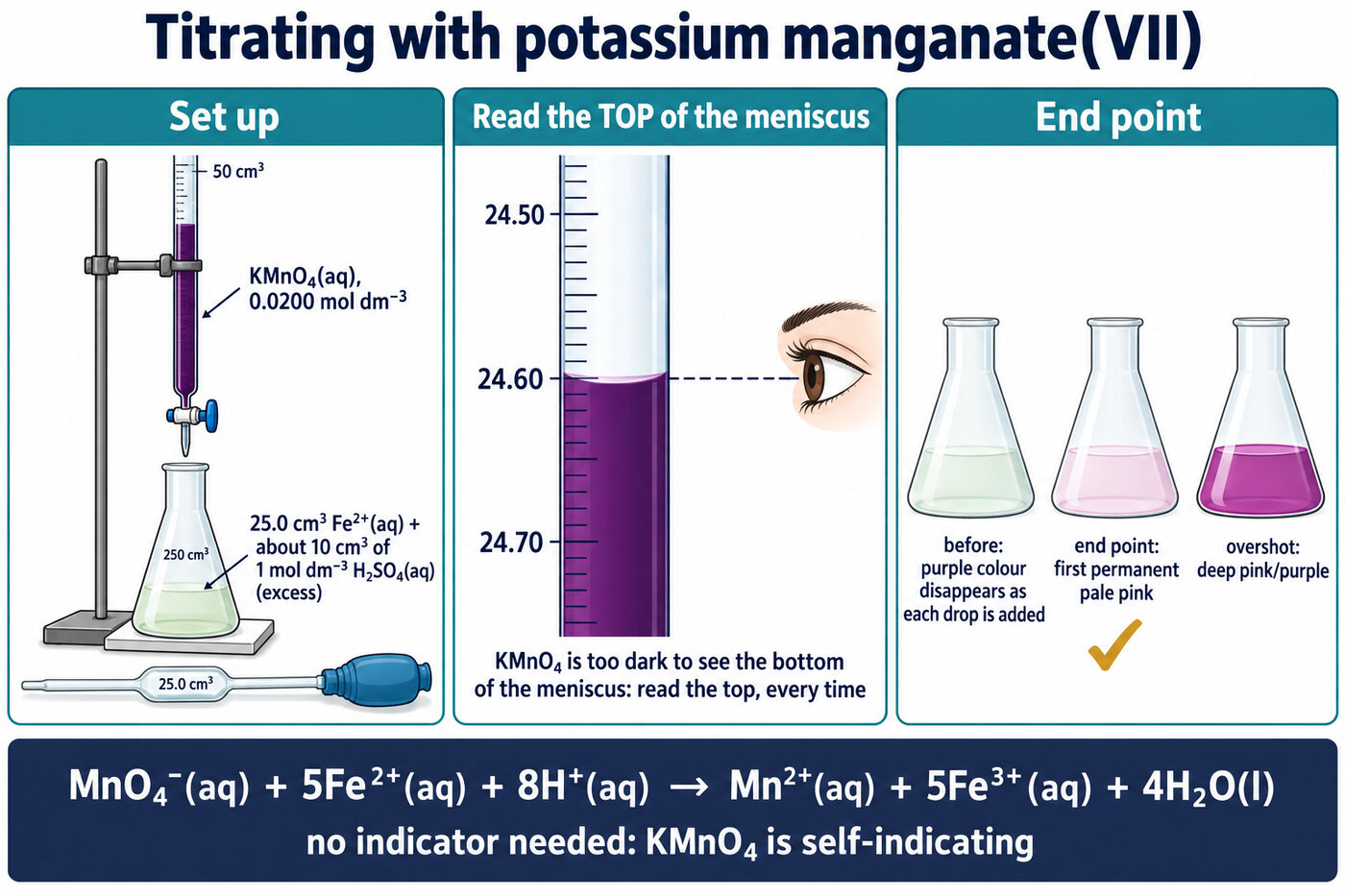
A manganate(VII) titration: read the top of the meniscus of the dark purple solution, and stop at the first permanent pale pink colour.
Technique point: The pale green of iron(II) and the pale yellow of iron(III) are so faint at this dilution that the flask looks colourless until the end point.
Check: Iron in an Iron Tablet
Order the method for a different sample analysed with the same titration.
The Chemistry: Half-Equations and the 1 : 5 Ratio
Manganate(VII) is reduced from +7 to +2 and gains five electrons; each iron(II) ion loses one. Five iron(II) ions are therefore needed for each manganate(VII) ion.
MnO₄⁻(aq) + 8H⁺(aq) + 5e⁻ → Mn²⁺(aq) + 4H₂O(l)
Fe²⁺(aq) → Fe³⁺(aq) + e⁻ (× 5)
MnO₄⁻(aq) + 5Fe²⁺(aq) + 8H⁺(aq) → Mn²⁺(aq) + 5Fe³⁺(aq) + 4H₂O(l)
The titration is self-indicating. MnO₄⁻ is intensely purple and Mn²⁺ is almost colourless at this concentration, so each drop is decolourised while iron(II) remains, and the first drop in excess turns the whole solution pale pink.
Why sulfuric acid, and not another acid
The acid supplies the H⁺ in the half-equation. Hydrochloric acid cannot be used, because manganate(VII) oxidises chloride ions to chlorine; some titrant is used up on the acid, and the titre is too high.
Nitric acid is itself an oxidising agent and could oxidise some iron(II) before the titration, making the titre too low. Ethanoic acid is a weak acid and does not supply enough H⁺.
If there is too little acid, manganate(VII) is reduced only to manganese(IV) oxide, a brown precipitate, and the 1 : 5 ratio no longer holds.
Dilute sulfuric acid is neither oxidised nor an oxidising agent under these conditions, so it is the acid to use.
Exam wording: “Dilute sulfuric acid is used because it provides H⁺ ions but is not oxidised by manganate(VII); hydrochloric acid would be oxidised to chlorine, using up extra manganate(VII).”
Worked Calculation: Iron(II)
The table gives a complete set of results for 25.0 cm³ portions of an iron(II) solution titrated with 0.0200 mol dm⁻³ KMnO₄. Readings are to the nearest 0.05 cm³, taken at the top of the meniscus.
| Titration | Rough | 1 | 2 | 3 |
|---|---|---|---|---|
| Final reading / cm³ | 25.10 | 24.70 | 24.90 | 24.95 |
| Initial reading / cm³ | 0.00 | 0.10 | 0.25 | 0.40 |
| Titre / cm³ | 25.10 | 24.60 | 24.65 | 24.55 |
Titres 1, 2 and 3 are concordant (all within 0.10 cm³), so the mean titre is (24.60 + 24.65 + 24.55) ÷ 3 = 24.60 cm³; the rough titre is not used.
Step 1: moles of MnO₄⁻ = 0.0200 × 24.60 ÷ 1000 = 4.92 × 10⁻⁴ mol
Step 2: moles of Fe²⁺ = 5 × 4.92 × 10⁻⁴ = 2.46 × 10⁻³ mol
Step 3: [Fe²⁺] = 2.46 × 10⁻³ ÷ 0.0250 = 0.0984 mol dm⁻³
Answer: 0.0984 mol dm⁻³. If the solution was made by dissolving 9.80 g of ammonium iron(II) sulfate, (NH₄)₂Fe(SO₄)₂·6H₂O (Mr 392.0), in 250 cm³, the expected concentration is 9.80 ÷ 392.0 ÷ 0.250 = 0.100 mol dm⁻³, so the salt is 0.0984 ÷ 0.100 × 100 = 98.4% pure. The value is given to three significant figures, the precision of the concentration of KMnO₄.
Unit check: cm³ ÷ 1000 = dm³; mol dm⁻³ × dm³ = mol; mol ÷ dm³ = mol dm⁻³. Multiply by 5 for Fe²⁺ because one MnO₄⁻ reacts with five Fe²⁺.
Check: A Nitrite Titration
Apply the same method to a different reducing agent with a different ratio.
Hydrogen Peroxide and Ethanedioate: the 2 : 5 Ratio
Hydrogen peroxide and ethanedioate (oxalate) each lose two electrons, so two manganate(VII) ions (ten electrons) react with five of them.
H₂O₂(aq) → O₂(g) + 2H⁺(aq) + 2e⁻
2MnO₄⁻(aq) + 5H₂O₂(aq) + 6H⁺(aq) → 2Mn²⁺(aq) + 5O₂(g) + 8H₂O(l)
C₂O₄²⁻(aq) → 2CO₂(g) + 2e⁻
2MnO₄⁻(aq) + 5C₂O₄²⁻(aq) + 16H⁺(aq) → 2Mn²⁺(aq) + 10CO₂(g) + 8H₂O(l)
The ethanedioate titration is carried out warm, at about 60 °C, because the reaction is very slow at room temperature: the first drops of manganate(VII) stay purple for several seconds.
The reaction then speeds up as it goes, because the Mn²⁺ ions it produces catalyse it. This is autocatalysis, and it is why the colour of later drops disappears almost at once.
The reaction is slow at first because it needs two negative ions, MnO₄⁻ and C₂O₄²⁻, to react, and they repel each other; the Mn²⁺ catalyst provides a route with a lower activation energy.
Worked Example. Sodium ethanedioate is a primary standard, so it is used to find the exact concentration of a manganate(VII) solution. 25.0 cm³ of 0.0500 mol dm⁻³ Na₂C₂O₄ needs a mean titre of 25.00 cm³ of KMnO₄(aq). Moles of C₂O₄²⁻ = 0.0500 × 25.0 ÷ 1000 = 1.25 × 10⁻³ mol; moles of MnO₄⁻ = 1.25 × 10⁻³ × 2 ÷ 5 = 5.00 × 10⁻⁴ mol; [KMnO₄] = 5.00 × 10⁻⁴ ÷ 0.02500 = 0.0200 mol dm⁻³.
Remember: Fe²⁺: 1 MnO₄⁻ to 5 Fe²⁺. H₂O₂ and C₂O₄²⁻: 2 MnO₄⁻ to 5. Write both half-equations and balance the electrons rather than remembering the ratio.
Check: Choosing the Conditions
Choose the correct statements about acids, indicators, starch and autocatalysis in new situations.
Iodine–Thiosulfate Titrations
Thiosulfate ions reduce iodine to iodide ions and are themselves oxidised to tetrathionate ions. Two thiosulfate ions react with each iodine molecule.
I₂(aq) + 2S₂O₃²⁻(aq) → 2I⁻(aq) + S₄O₆²⁻(aq)
The iodine is usually made in the flask by an oxidising agent that is being analysed, reacting with an excess of potassium iodide. The amount of iodine liberated depends only on the oxidising agent, because the iodide is in excess.
2Cu²⁺(aq) + 4I⁻(aq) → 2CuI(s) + I₂(aq)
IO₃⁻(aq) + 5I⁻(aq) + 6H⁺(aq) → 3I₂(aq) + 3H₂O(l)
The end point uses starch. Thiosulfate is added until the brown iodine colour fades to pale straw (pale yellow).
About 1 cm³ of starch solution is then added, giving a blue-black colour, and thiosulfate is added dropwise until the blue-black colour just disappears.
Starch is added near the end point, not at the start, because a large amount of iodine binds to starch and is released only slowly, so the colour change is late and gradual.
With copper(II), the white precipitate of copper(I) iodide stays in the flask, so the mixture at the end point is off-white rather than colourless; the end point is still the disappearance of the blue-black colour.
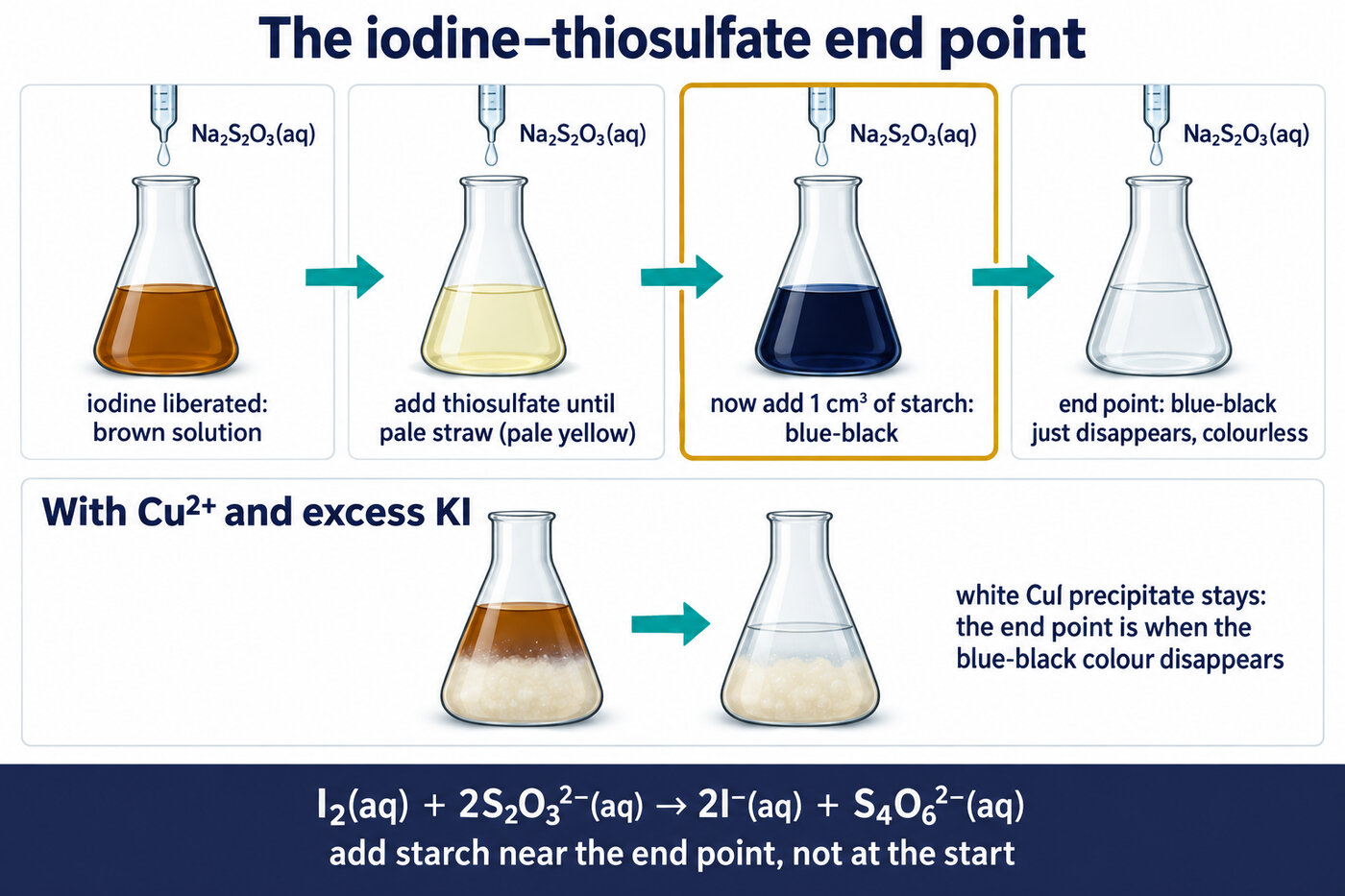
The iodine–thiosulfate end point: brown iodine, pale straw, blue-black once starch is added, then colourless; with copper(II), an off-white precipitate of CuI remains.
Worked Example. 25.0 cm³ of copper(II) sulfate solution is added to excess KI, and the iodine liberated needs a mean titre of 22.40 cm³ of 0.100 mol dm⁻³ Na₂S₂O₃.
Step 1: moles of S₂O₃²⁻ = 0.100 × 22.40 ÷ 1000 = 2.24 × 10⁻³ mol
Step 2: moles of I₂ = 2.24 × 10⁻³ ÷ 2 = 1.12 × 10⁻³ mol
Step 3: moles of Cu²⁺ = 2 × 1.12 × 10⁻³ = 2.24 × 10⁻³ mol, so Cu²⁺ : S₂O₃²⁻ = 1 : 1
Step 4: [Cu²⁺] = 2.24 × 10⁻³ ÷ 0.0250 = 0.0896 mol dm⁻³
Answer: 0.0896 mol dm⁻³. For iodate(V), one IO₃⁻ gives three I₂, which need six S₂O₃²⁻, so IO₃⁻ : S₂O₃²⁻ = 1 : 6.
Exam wording: “Add thiosulfate until the solution is pale straw, then add starch: the blue-black colour disappears at the end point. Starch is added near the end point because iodine bound to starch is released slowly.”
Check: Bleach by Iodine–Thiosulfate
Chain two equations for a different oxidising agent.
Errors, Uncertainty and Improvements
The burette and pipette uncertainties are the same as in any titration; the redox chemistry adds its own sources of error.
| Source of error | Effect on the titre | Improvement |
|---|---|---|
| Iron(II) solution oxidised by air on standing | Less Fe²⁺ left: titre too low | Make the solution fresh, in dilute sulfuric acid, and titrate promptly |
| Too little acid in the flask | Brown MnO₂ forms, the ratio changes and the end point is unclear | Add an excess of dilute sulfuric acid; if brown appears, discard the run |
| Hydrochloric acid used instead of sulfuric acid | Some MnO₄⁻ oxidises Cl⁻: titre too high | Use dilute sulfuric acid only |
| Ethanedioate titrated cold | Slow reaction: the pink persists too early and the end point is overshot | Warm to about 60 °C and add slowly at first |
| Starch added at the start | End point late and gradual: titre too high | Add starch only when the solution is pale straw |
| Iodine lost by evaporation | Less iodine to titrate: titre too low | Titrate as soon as the iodine is liberated; keep the flask cool |
| Reading the top of the meniscus once and the bottom once | Titre wrong by the height of the meniscus | Read the top of the meniscus for every KMnO₄ reading |
Percentage uncertainties. Each burette reading is ±0.05 cm³, so a titre carries ±0.10 cm³: for 24.60 cm³, 0.10 ÷ 24.60 × 100 = 0.41%. The 25.0 cm³ pipette (±0.06 cm³) adds 0.06 ÷ 25.0 × 100 = 0.24%. The total, about 0.65%, is small beside the chemical errors above, which is why the evaluation mark usually goes to one of those.
Exam focus: For every error, say which way the titre moves and why: “the titre is too high because some manganate(VII) is used up oxidising chloride ions”.
Check: Errors in Redox Titrations
Evaluate new situations in redox titrations.
Common Mistakes
The same errors appear in students’ write-ups and exam answers year after year. Each one costs a mark that the corrected version earns.
- Using a 1 : 1 ratio for manganate(VII) and iron(II). The ratio is 1 : 5; for H₂O₂ and ethanedioate it is 2 : 5.
- Describing the manganate(VII) end point as “purple to colourless”. The flask goes from colourless to the first permanent pale pink.
- Adding an indicator to a manganate(VII) titration.
- Choosing hydrochloric acid to acidify, or saying only that sulfuric acid “provides H⁺” without saying why HCl cannot be used.
- Adding starch at the start of an iodine–thiosulfate titration.
- Forgetting the factor of 2 between iodine and thiosulfate, or between Cu²⁺ and I₂.
- Reading the bottom of the meniscus of manganate(VII), which cannot be seen clearly.
Common Exam Points
Say
“Manganate(VII) is self-indicating: the end point is the first permanent pale pink.” “Sulfuric acid is used because hydrochloric acid would be oxidised to chlorine by manganate(VII).” “Starch is added near the end point, when the solution is pale straw; the blue-black colour disappears at the end point.”
Do not say
“The indicator is potassium manganate(VII).” (It is the titrant; no indicator is added.) “The end point is when the solution turns purple.” “MnO₄⁻ reacts with Fe²⁺ in a 1 : 1 ratio.”
Watch for
Half-equations you must combine to get the ratio; percentage purity of a salt or the mass of iron in a tablet; the autocatalysis curve of the ethanedioate titration; two-stage iodine calculations (oxidising agent → I₂ → S₂O₃²⁻); readings recorded to 0.05 cm³ and concordance within 0.10 cm³ of each other.
FAQs
Short answers to the questions students most often ask about redox titrations.
Why is no indicator needed with potassium manganate(VII)?
Because manganate(VII) is intensely purple and its product, Mn²⁺, is almost colourless. While there is still reducing agent in the flask each drop is decolourised; the first drop in excess turns the solution pale pink, which is the end point.
Why do we read the top of the meniscus?
Manganate(VII) solution is so dark that the bottom of the meniscus cannot be seen. Reading the top every time gives the correct titre, because both readings are offset by the same amount.
Why is the ethanedioate titration done warm, and why does it speed up?
The reaction between two negative ions is very slow at room temperature, so it is warmed to about 60 °C. It then speeds up because the Mn²⁺ ions it makes catalyse the reaction, which is called autocatalysis.
When exactly should I add the starch?
When the brown iodine has faded to a pale straw colour. Added earlier, much of the iodine binds to the starch and is released only slowly, so the blue-black colour fades gradually and the end point is late.
How do I get the mole ratio if I cannot remember it?
Write the two half-equations, multiply them so that the electrons lost equal the electrons gained, and add them. The coefficients of the two reactants give the ratio: 1 : 5 for MnO₄⁻ and Fe²⁺, 2 : 5 for MnO₄⁻ and H₂O₂ or C₂O₄²⁻, 1 : 2 for I₂ and S₂O₃²⁻.
Copyright and author footprint: This OLS revision page was written for Online Learning System by Dr. Mohammed Al-Fatah. It is designed for A Level Chemistry revision and should not be copied or redistributed without permission.
Keep this note — free
Save your progress across every Cambridge topic. A free account remembers which topics you have covered, saves your question scores, and syncs across your phone and laptop.
- Track every topic you have finished
- Keep your practice-question scores
- No payment, no card, free forever
Already registered? Log in