Reactions of Alkenes with Hydrogen Halides
A concise revision guide to the addition reaction of alkenes with hydrogen halides, including HBr and HCl, the electrophilic addition mechanism, carbocation formation and why one product may form in greater amount with unsymmetrical alkenes.
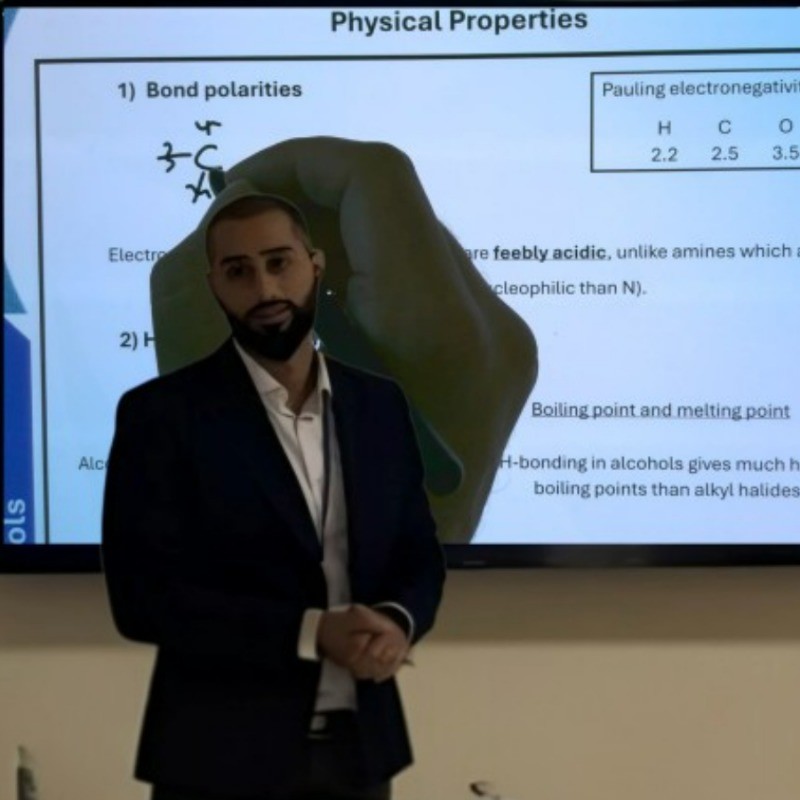
The Overall Reaction
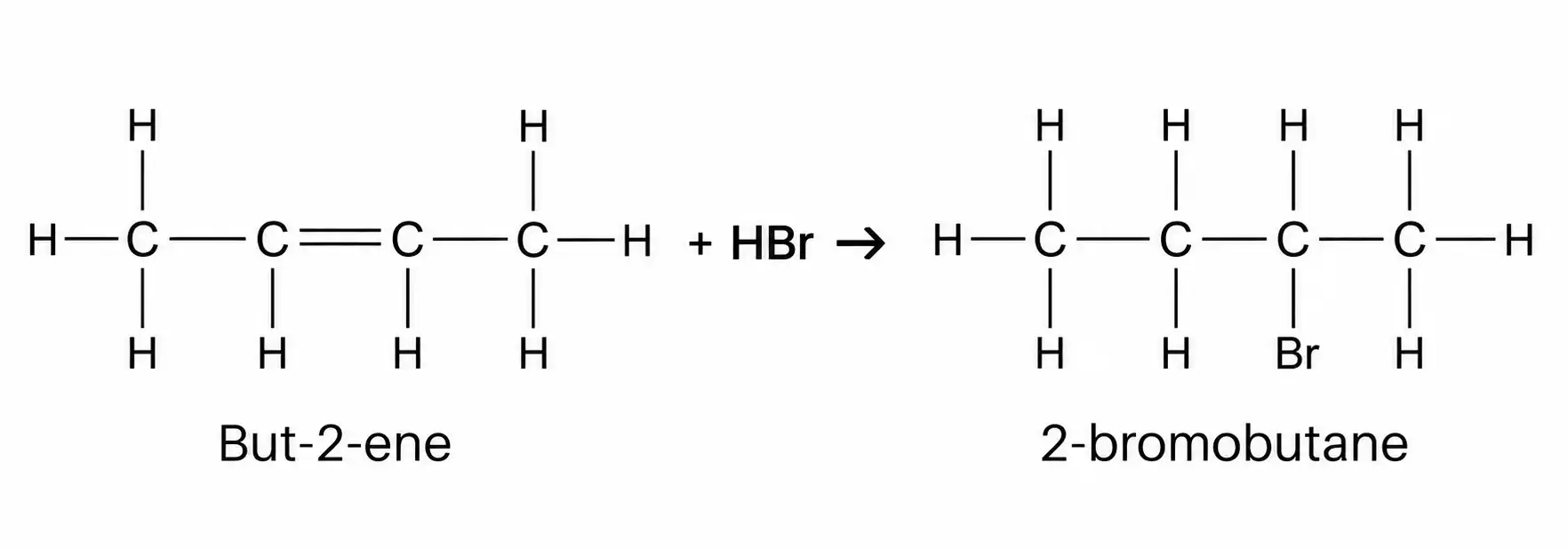
Alkenes react with hydrogen halides such as hydrogen bromide, HBr, or hydrogen chloride, HCl, in an addition reaction.
The C=C double bond opens. The hydrogen atom adds to one carbon atom from the original double bond, and the halogen atom adds to the other carbon atom.
The functional group changes from an alkene to a haloalkane.
Key idea: This is addition because two atoms are added across the C=C double bond and the alkene becomes a saturated haloalkane.
Quick Check: Formula and Reaction Type
Work out the product of an addition that this page does not show.
Why HBr and HCl Act as Electrophiles
In hydrogen bromide, bromine is more electronegative than hydrogen. This means the H-Br bond is polar, with an uneven distribution of electron density.
The hydrogen atom carries a partial positive charge, Hδ+, while the bromine atom carries a partial negative charge, Brδ–.
The electron-rich π bond in the alkene is attracted to Hδ+. The hydrogen atom acts as the electrophile because it accepts electron density from the alkene π bond.
Electrophile: An electron-pair acceptor. In this reaction, Hδ+ is attracted to the electron-rich π bond and begins the electrophilic addition mechanism.
Exam focus: The electrophile is H+, not Br–. The π bond attacks the hydrogen atom first.
Quick Check: Which End Attacks?
Decide whether the statement about hydrogen iodide is true or false.
The Electrophilic Addition Mechanism
The π bond donates electron density to Hδ+, forming a new C-H bond. At the same time, the H-Br bond breaks by heterolytic fission, producing Br–.
After H+ has added, one carbon atom from the original C=C double bond becomes positively charged. This produces a carbocation intermediate.
The bromide ion, Br–, then donates a lone pair to the carbocation, forming the final bromoalkane product.
Step 1: The π bond attacks Hδ+
The alkene π bond is electron-rich, so it is attracted to the partially positive hydrogen atom in HBr.
Step 2: H-Br breaks heterolytically
Both electrons from the H-Br bond move to bromine, forming Br– and leaving a carbocation on the organic molecule.
Step 3: Br– attacks the carbocation
The bromide ion donates a lone pair to the positively charged carbon, forming a new C-Br bond.
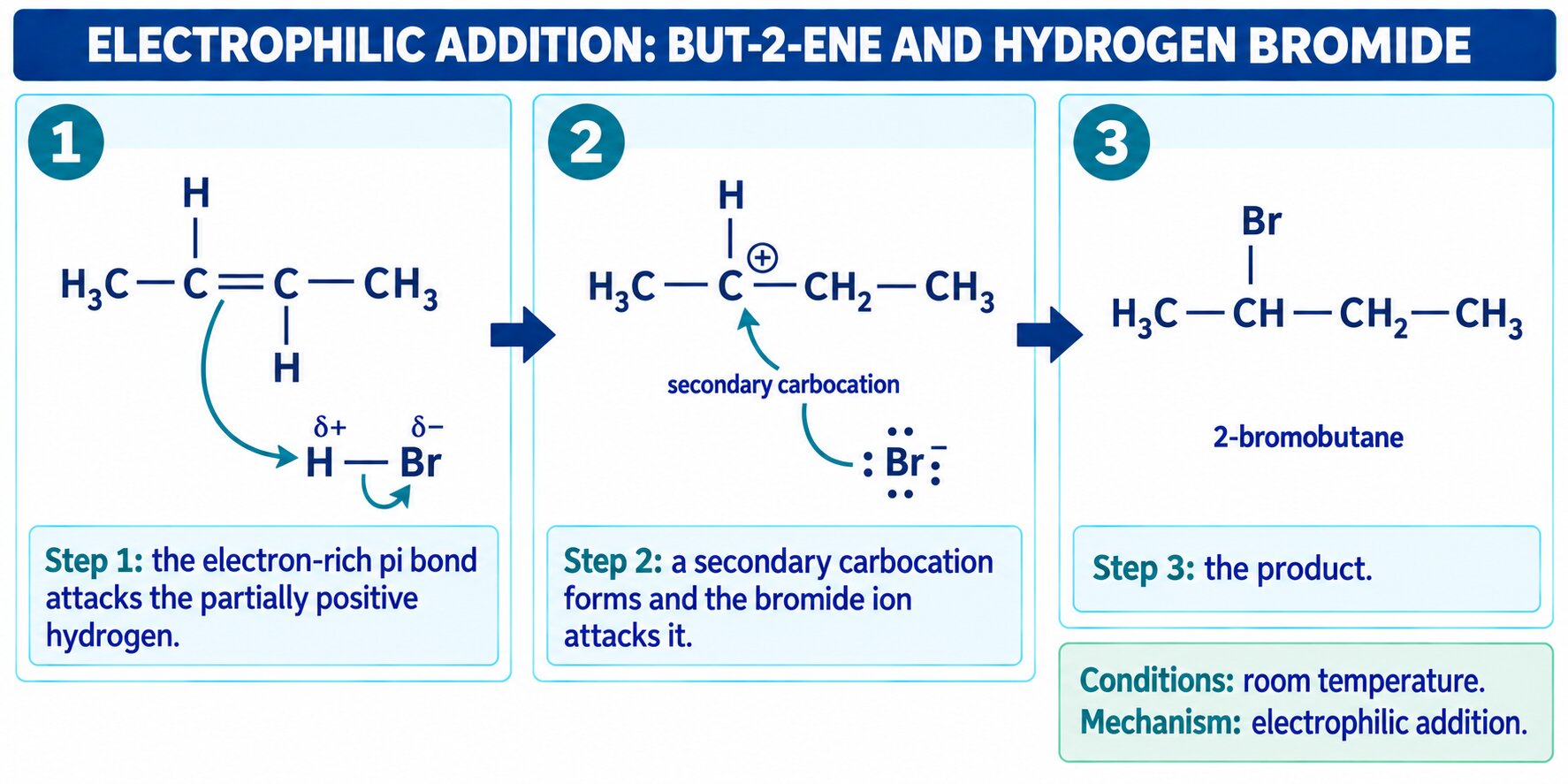
The π bond reacts with Hδ+ first, then Br- attacks the carbocation intermediate to form the haloalkane.
Quick Check: Run the Mechanism
Follow hydrogen iodide and oct-4-ene through the mechanism, one step at a time.
Unsymmetrical Alkenes Can Form More Than One Product
When an alkene is unsymmetrical, HBr or HCl can add in two different ways. This is because H+ can add to either carbon atom of the C=C double bond.
Each possible route forms a different carbocation intermediate. These carbocations can have different stabilities, so the products are not always formed in equal amounts.
Route 1
H+ adds to one carbon atom of the C=C bond, forming one possible carbocation intermediate.
Route 2
H+ adds to the other carbon atom of the C=C bond, forming a different carbocation intermediate.
Key idea: The major product usually forms from the pathway that produces the more stable carbocation intermediate.
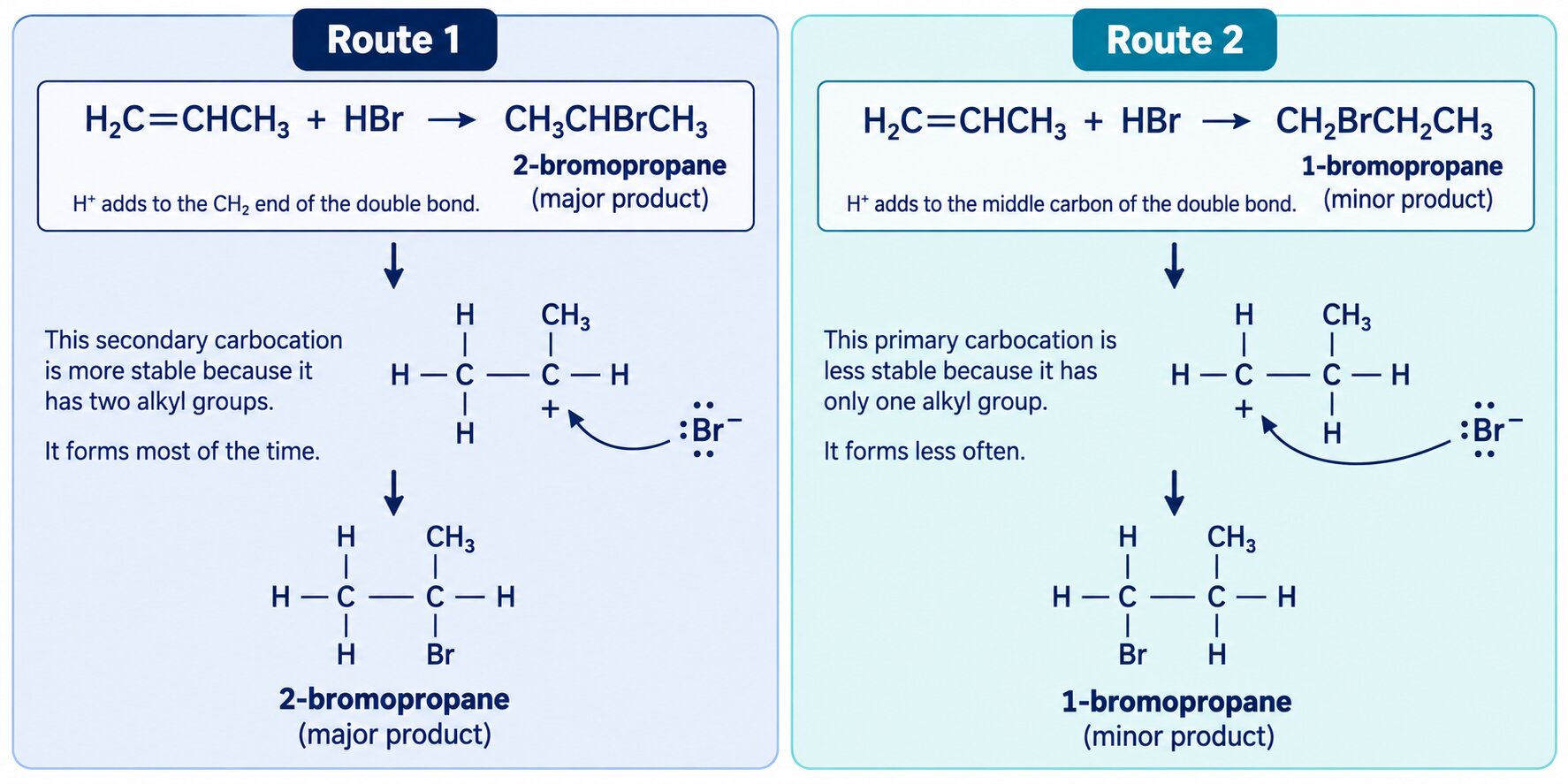
Different addition pathways can produce different carbocations, and the more stable carbocation pathway gives the major product.
Quick Check: Compare the Two Routes
Drag the words and numbers into place to compare the two carbocations.
Why One Product Forms in Greater Amount
A carbocation is an organic ion with a positively charged carbon atom. Carbocations are stabilised when alkyl groups are attached to the positively charged carbon.
Alkyl groups are electron-releasing. They help spread out and reduce the positive charge, making the carbocation less reactive and more stable.
Because the more stable carbocation is formed more readily, the reaction proceeds mainly through that pathway. This leads to a higher yield of the corresponding product.
| Carbocation type | Alkyl groups attached to C+ | Relative stability |
|---|---|---|
| Primary | One alkyl group | Less stable |
| Secondary | Two alkyl groups | More stable |
| Tertiary | Three alkyl groups | Most stable |
Exam focus: Explain the major product by comparing carbocation stability, not just by stating which product forms.
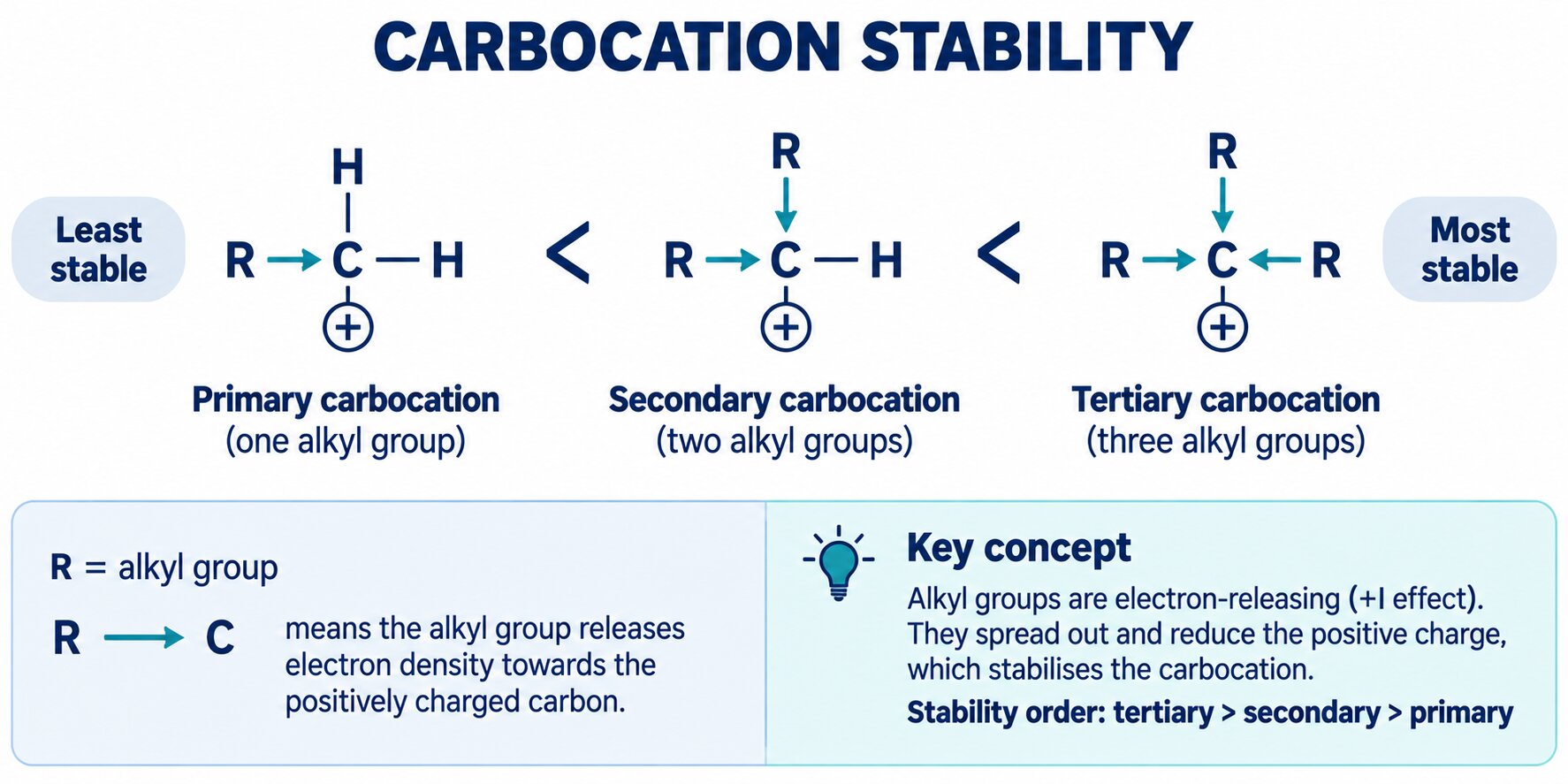
Alkyl groups stabilise carbocations by releasing electron density towards the positively charged carbon.
Quick Check: Explain the Major Product
Write a short explanation, then compare it with the mark points and the model answer.
Quick Check: Pick the Accurate Statement
In each round, choose the one statement that is accurate.
Markownikoff’s Rule
OCR names the pattern of addition to unsymmetrical alkenes as Markownikoff’s rule: when H–X adds to an unsymmetrical alkene, the hydrogen atom adds to the carbon that already has the more hydrogen atoms, and the halogen adds to the carbon with fewer hydrogen atoms.
For example, when HBr adds to propene, the major product is 2-bromopropane and the minor product is 1-bromopropane. The rule is a shortcut; the explanation the examiner wants is the relative stability of the carbocation intermediates.
How to answer a major product question
- Draw both possible carbocations and classify each as primary, secondary or tertiary.
- State which carbocation is more stable, for example secondary is more stable than primary.
- Explain that the alkyl groups attached to the positive carbon are electron-releasing and reduce the charge on the ion, stabilising it.
- Conclude that the major product forms through the more stable carbocation.
Exam focus: If both possible carbocations are of the same type, for example both secondary, the two products form in roughly equal amounts and there is no major product.
Quick Check: When the Rule Predicts Nothing
Find the alkene for which the rule gives no prediction at all.
Master Alkenes for OCR A Level Chemistry A
Continue from these free revision notes into the full 4.1.3 Alkenes course. The guided video lessons are ready now; the OCR A MCQ bank, teacher-marked short-answer questions and KASP spec-point report are being written, and the course opens for enrolment as soon as they are complete.
Guided video teaching
Learn the chemistry and exam technique through structured video lessons with worked examples and walkthroughs.
Instant MCQ feedback
Auto-marked MCQ quizzes provide immediate diagnostic feedback for every answer choice.
Teacher-marked SAQs
Submit written exam responses and receive chemistry specialist feedback with improvement guidance.
Progress tracking
Identify strengths and weaknesses across the full 4.1.3 specification with targeted reporting.
See how the course works
Click play to start the course preview animation.
Some ionic radii are shown.
| Ion | Ionic radius / nm |
|---|---|
| Na+ | 0.102 |
| K+ | 0.138 |
| F− | 0.133 |
| Cl− | 0.180 |
Which compound has the strongest ionic bonding?
Explain why the metallic bonding in magnesium is much stronger than that in sodium.
Copyright notice: This OLS revision content, including the explanations, layout, diagrams, tables and embedded learning structure, is authored for Online Learning System by Dr. Mohammed Al-Fatah. It may not be copied, reproduced, redistributed or adapted without written permission.
Keep this note — free
Save your progress across every OCR A topic. A free account remembers which topics you have covered, saves your question scores, and syncs across your phone and laptop.
- Track every topic you have finished
- Keep your practice-question scores
- No payment, no card, free forever
Already registered? Log in